Unlike today’s freighters where a crew can be aboard for several soul-crushing months at a time without seeing a port, freighters in the 1940s and 1950s made frequent port calls – either for replenishment of stores or cargo transfers. Port calls for a ship’s crew meant a jaunt around the port district or visits to places further afield. Sometimes, a merchant seaman might go to a seedy bookshop and purchase a racy postcard and magazine or two, or maybe see a show. Despite popular conceptions of them having libertine sensibilities, most seamen did not have a penchant for hard liquor and frequenting jiggle joints. For the most part, merchant seamen operated under the mores of their era and their appetites by today’s standards would be considered tame – yet context is important. And so, from time to time, when families sift through mementos of their merchant mariner relatives, strange risque photocards and the odd cheesecake snapshot may appear. These may be of friends or lovers of the moment. And other times, a photograph may appear and instantly becomes the site of trauma.
The photograph below was produced by an ex-Merchant Marine man by the name of David C. Tucker. He snapped photographs for local media in Baltimore, Maryland primarily of the waterfront; with his output being of ships and shipping. However, he apparently also traded in fetish images – a trio have surfaced of a semi-nude without context from 1947; this series, in particular, features a young woman holding the props of a majorette. During the mid-1940s through the 1950s, majorettes were a theme of pin-up artists with images gracing calendars and invariably a trope of burlesque performers. From a composition standpoint, Mr. Tucker has the majorette character not engaging the gaze of the viewer, which would imply licentiousness. As opposed to a demure look to the side which would convey that the majorette is a coquette, and thus inviting the male gaze, Mr. Tucker’s majorette is posed looking away from the viewer; this gives the image an almost voyeuristic quality. Albeit, the sheer fabric of the costume suggests the voyeur’s imagination has penetrated the layers of clothing and rambles freely over the almost naked form of the object of their gaze. This photograph could have been a promotional copy for a burlesque dancer, however, the envelope suggests it was sold for fetish purposes since it lacks the performer’s name.
This specific image was once in the collection of an ex-Merchant Mariner whose adult child discovered it while cleaning out her father’s belongings after his death. The other two images in the series were destroyed due to water damage. The destroyed images comprised one image of the majorette character with the baton pressed against her breasts, and another without a baton; both in the same pose as the one presented.
The discovery of the photographs was disturbing for the daughter as she was a majorette in junior and senior high school – the period when this photograph was procured by her father. Although I did not press the finder of the image, she stated that after finding it, many questions she had about her father fell into place and the unease she felt growing up – that she, in her youth banished as the markers of paranoid thought – came rushing back. Along with these photographs were others of her and her friends as majorettes. She mentioned how he looked at her when she was a young woman and made passes at her teenage friends.
She told me her father was a war veteran and he was quiet about what he experienced out at sea; he once and only once spoke of a buddy whose body was ripped apart by shrapnel and how others who were washed off deck and burned alive in flaming oil slicks while his convoy was attacked. He must have been traumatized, I said. “He took it out on ma and me.” She told me she could not tell me what he did, but it was all very wrong in retrospect, “A father does not do what he did to his daughter.”
The photograph and the narrative that accompany it affected me deeply for several years – especially since the daughter passed away and her surviving family knows nothing of their grandfather, his war service, or much of who he was. The story and the revelation brought to the fore the veritable code of silence that has pervaded the lives of those who lived through the trauma of the war and domestic abuse; the daughter linked what her mother said about how her father changed from an optimistic man to a sullen one when he returned. If he had treatment, if he talked, perhaps things that had happened would not have, I posited. The photograph, easily overlooked as a racy pin-up, when put in the context of the abuse it represented to the daughter, had me look at it as a perverse memento by a damaged man.
In no way do I wish to besmirch the good deeds and sacrifices done by the few for the many by presenting this story; I am, though, left asking how we have so quickly forgotten the horrors merchant seamen underwent and how some “cracked” by the weight of their pain. Some lost themselves in drink, others by womanizing, and others to abusing those who loved and trusted them. If this fellow had access to psychiatric care as offered to service members who returned from the war, would his pain have manifested itself in abuse? This is a question that may never have an answer.
At its outset, the United States Merchant Marine Academy’s predecessor, the United States Maritime Commission Cadet Corps bucked the prevalent sartorial trend and uniformed its members in the garb of a ship’s officer, eschewing the popular eight-button coat of the maritime cadet or midshipman. This ethos of non-conformity continued through the Second World War – culminating in the Kings Point cadet-midshipman jazz band taking the round coat of their Annapolis peers and eventually extending its wear to the Regiment. Headwear was no exception.
Garrison caps were first called “aviation caps” in Cadet Corps regulations; for good reason, they were the primary headgear worn by aviators; for some reason, Naval aviators did not have the tradition of wearing “crushers” like their Army Air Corps contemporaries (although sub sailors did). These caps first appeared in Cadet Corps sea bags in Summer 1941 and came in khaki with blue piping – piping was a notably a U.S. Army innovation; the color of the cord translated to the Corps a soldier belonged. Thus in a maritime setting, the Cadet Corps adopted this novel headgear before midshipmen at Annapolis or New London, or cadets at Fort Schuyler.
In terms of insignia on Cadet Corps garrison caps, the United States Maritime Commission (USMC) pin was worn on the left side from 1939 to 1942 with a blank blouse; at some point in 1942 it was replaced with Cadet Corps Shield and the piping was deleted from the cap. The anchor appeared on the blank curtain (triangle of folded cloth at the front) in June 1943. The shield remained until November 1943; after this date, the Merchant Marine service emblem replaced both the anchor and shield. It should be noted that the reason why there was no anchor device on the blouse between some point in 1942 and mid-1943, was because no anchor device existed at the time – only in 1943 did U.S. Navy officers begin wearing miniature devices on garrison caps.
White garrison caps first appeared in January 1941 in U.S. Navy sea bags; at the time, they were only worn with tropical uniforms (short sleeve shirts and shorts). As the Navy began building up shore installations in the Pacific, officers found their usual visor cap and sometimes pith helmets impractical (if not visually silly). The Navy looked to the U.S. Army for inspiration where garrison caps were the rule for “informal formal” wear. Clotheshorses that they were, since Naval officers needed something to wear with their tropical uniforms as they did with their service uniforms Stateside, voila: white garrison cap.
Maritime Commission Cadets on parade, Summer 1943
In Summer 1943, the recently-formed Merchant Marine Academy and its Basic Schools issued white service uniforms to its cadet-midshipmen along with a white garrison cap. The cap appears to have been first issued to members of the Cadet Corps at Cadet Basic School in Pass Christian, Mississippi; and curiously, it was seen on the parade ground in combination with the white service uniform – the military discipline of day (to which the Cadet Corps subscribed) forebade the public to ever see a service member in a garrison cap since it was considered undress; it was a gaffe on the order of a gentleman being seen in shirt sleeves in public. By Spring 1944, the white garrison cap was a memory.
In 1974, the United States Merchant Marine Academy removed a unique piece of headwear from midshipman seabags after twenty-eight years of use: a denim garrison cap. This cap was a unique uniform item only used at Kings Point and not at anywhere else among the sea services; the other state maritime or federal academies issued their inmates in white hats (Plebes wore a blue-rimmed hat at USNA) and eventually command ball caps.
November 1945 vs. December 1946
This garrison hat was issued from November 1946 through at most Spring 1974. The denim garrison cap supplanted khaki garrison caps that were previously worn with dungarees and chambray work shirts; its first appearance is noted in a photograph of a new thermodynamics laboratory. The change from khaki to denim makes sense as grease strains are extremely difficult to clean from khaki; and khaki garrison caps were worn for inspection and for “official, unofficial functions” and as such stains would reflect poorly on the wearer. Luckily, dungarees were work clothes and not subject to the rigors of inspection, except shirts were expected to be bloused. It was worn by Engineer midshipmen in shop and laboratory spaces, and by midshipmen assigned to maintenance activities in the dormitories (e.g. swabbing the deck). As for insignia, extant photographs show it featured both the midshipman anchor and Merchant Marine Service emblem, and without the anchor (like this example); this is due to the fact that cadets in their preliminary phase of training – their first couple of weeks at the Basic Schools – were not full members of Cadet Corps, and were in a preliminary state. Once they survived the first two weeks, they rated an anchor pin on their caps and hats. The disappearance of the Service Emblem occurred in the late 1950s, with the anchor remaining its only adornment.
In later years, the dungaree uniform, which came in both long and short-sleeve versions, was supplanted by the boiler suit. This uniform was an integral pair of trousers and a shirt in dark blue. It was a popular article of wear in civilian machine shops and was de rigueur in U.S. Navy hull repair and engineering spaces. From 1973-1975, there were two years of un-uniformity in Kings Point’s working uniforms and allied headwear.
Last sighting of denim garrison cap, Midships 1973 & 1975
In Fall 1974, the denim cap was removed as an item of wear for the class of ’76 and replaced with a command ball cap after nearly thirty years of official wear. Kings Pointers afterward wore caps like those worn at Annapolis – and no longer was a distinctive visual emblem of the Cadet Corps. Prior to full abolishment of the denim cap, degrading Kings Point’s distinctive look was the retirement of dungarees; apparently, the Superintendent’s wife thought midshipmen wearing the dungaree uniform made them look like “hippies” (it must have been the flared pant legs of their Seafarer dungaree trousers). Their uniforms were summarily replaced with polyester boiler suits in 1973. The switch over was not complete across all classes as upperclassmen still wore their dungarees (see the image above). By the end of the 1970s, Kings Point willfully shed most of its idiosyncratic uniform components and adopted a marked Naval Reserve Officer Training Corps appearance – the denim garrison cap was the third uniform item, after the Zombo shoulder boards and hippie dungarees in a long line of abandonments.
Command ball caps at Annapolis and Kings Point, Fall 974
Special thanks are due to Thomas F. McCaffery, USMMA ’76.
The following collection of insignia details an interesting career arc of a licensed engineer in the American Merchant Marine. It also illustrates a transformative period of the American Merchant Marine from its zenith in the 1940s through its struggle for relevance in the Cold War.
[T]he person that owned this collection graduated from the U.S. Merchant Marine Academy at Kings Point as an engineering officer. Then worked for United Fruit Company and the American Export Lines. Both companies used the B.M.O. (Brotherhood of Marine Officers) – this union represented both Deck and Engine Officers and it was easy for officers of United Fruit to change to American Export Lines.
Mr. Chet Robbins of N.S. Savannah Association, personal communication.
As an officer in the employ of latter, the owner ended up on the NS Savannah as a nuclear engineer with American Export-Isbrandtsen Lines, F.A.S.T. (First Atomic Ship Transport); after a sea-going career that began during the Second World War, there is evidence of work with General Dynamics and support for the creation of the American Merchant Marine Museum. Unfortunately, I do not know the full provenance – perhaps someone may know the contours of the career and individual.
NS Savannah significance
As part of the “Atoms for Peace” program as promoted by the Eisenhower Administration at the height of the Cold War, NS Savannah was a demonstration vessel to illustrate the technical feasibility of nuclear propulsion for merchant ships. She was not expected to be commercially competitive, rather was designed to be a set-piece: she was to be visually impressive with a look more akin to a luxury yacht than a bulk cargo vessel. Her design called for thirty air-conditioned staterooms (each with an individual bathroom), a dining facility for one hundred passengers, a lounge that could double as a movie theater, a veranda, a swimming pool, and a library. Even the often utilitarian cargo handling equipment was designed along the lines of the era’s Atomic Age aesthetics. As a demonstration vessel, by many accounts, the ship was a success. She performed well at sea, her safety record was impressive, and since a nuclear reactor powered her, her gleaming white paint was never smudged by oil or diesel exhaust smoke.
Yet, no amount of positive design could paper-over NS Savannah‘s impracticalities. Her cargo space was limited to 8,500 tons of freight in 652,000 cubic feet – which was a fraction of the space her competitors could accommodate. And, despite her modern appearance, she was still a creature of her times – cargo-handling was done by longshoremen. Her streamlined hull made loading the forward holds laborious, which became a significant disadvantage as ports embraced automation. Her crew was a third larger than comparable oil-fired ships and received special training in addition to that required for conventional maritime licenses. Although she was initially chartered by States Marine in 1963, from 1965 to 1971, the Maritime Administration leased NS Savannah to American Export Isbrandtsen Lines for revenue cargo service. This change was due to a labor dispute which erupted over pay scales. NS Savannah‘s engineering officers had been allotted extra pay in compensation for their extensive additional nuclear training. The deck officers, however, cited the tradition where they received higher pay than engineering officers. A labor arbitrator ruled in favor of the higher pay for the deck officers, in keeping with the traditional pay scale, despite the lower training requirements of the deck officers. The pay issue continued plagued States Maritime’s crew, resulting in it dismissal and the Maritime Administration canceling its contract with States Marine Lines and selecting American Export-Isbrandtsen Lines as the new ship operator. The resulting need to train a new crew interrupted NS Savannah‘s demonstration schedule for nearly a year.
Although the change in operators alleviated the immediate labor problem, the failure to resolve this dispute would forever cloud the feasibility of nuclear merchant ships. Many feared that abandoning the
Masters, Mates, and pilots (M.M.& P.) and the Marine Engineers Beneficial Association (MEBA) trade unions merely deferred the necessary resolution of this conflict. After all, these two unions represented deck and engineering officers on a majority of all other U.S.-flag operated ships.
As a result of her design handicaps, training requirements, and additional crew members, NS Savannah cost approximately US$2 million a year more in operating subsidies than a similarly sized Mariner-class ship with a conventional oil-fired steam plant. The Maritime Administration decommissioned her in 1971 to save costs, a decision that made sense when fuel oil cost US$20 per ton. In a note of historical parallel, the ship’s ill-augered namesake, the SS Savannah, which in 1819 became the first steam-powered ship to cross the Atlantic Ocean, was also a commercial failure despite it being an innovation in marine propulsion technology.
Note: above text is spindled from a Chatham County Georgia Historical handout on NS Savannah.
Below are the items in chronological order. All may be seen viewed together on the Collection page: NS Savannah ex-crew.
Nuclear Reactor Control Room mock-up at Kings Point. Note the flag.
1940s Kings Point
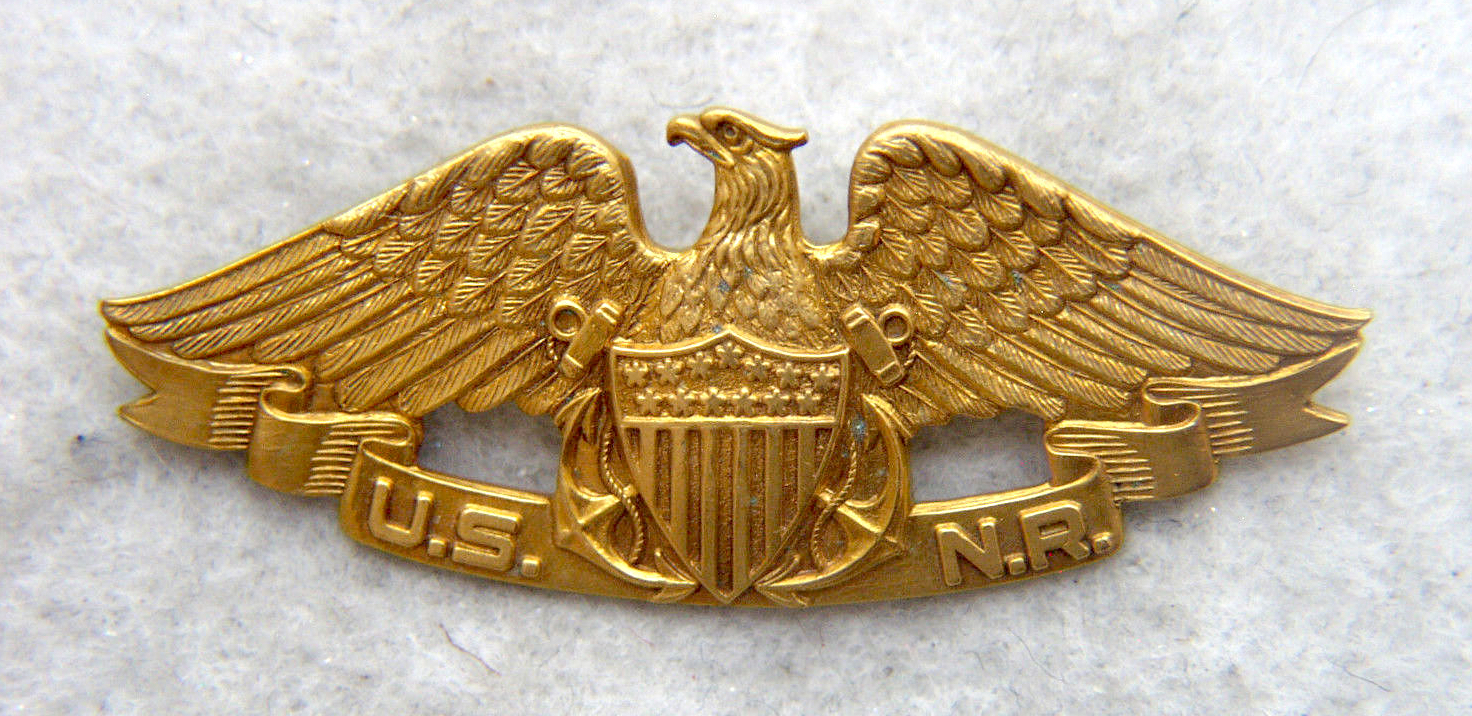
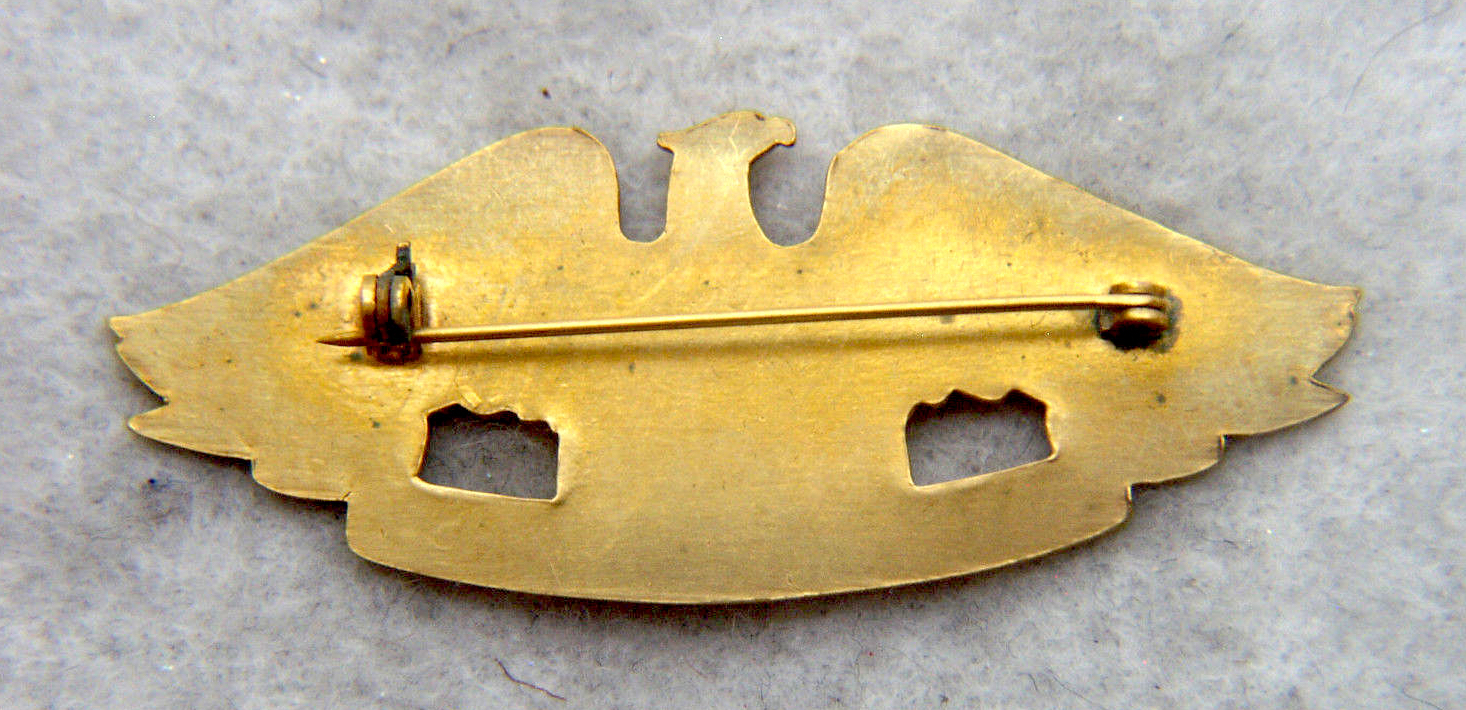
The collection begins with a Kings Point “4.” These items were worn on athletic uniforms; the USNR badge is circa 1942-1945; finely woven and pin cushion style badges replaced these generally flat woven examples immediately following the close of the Second World War.
Kings Point “4”
USNR badge
1940s United Fruit
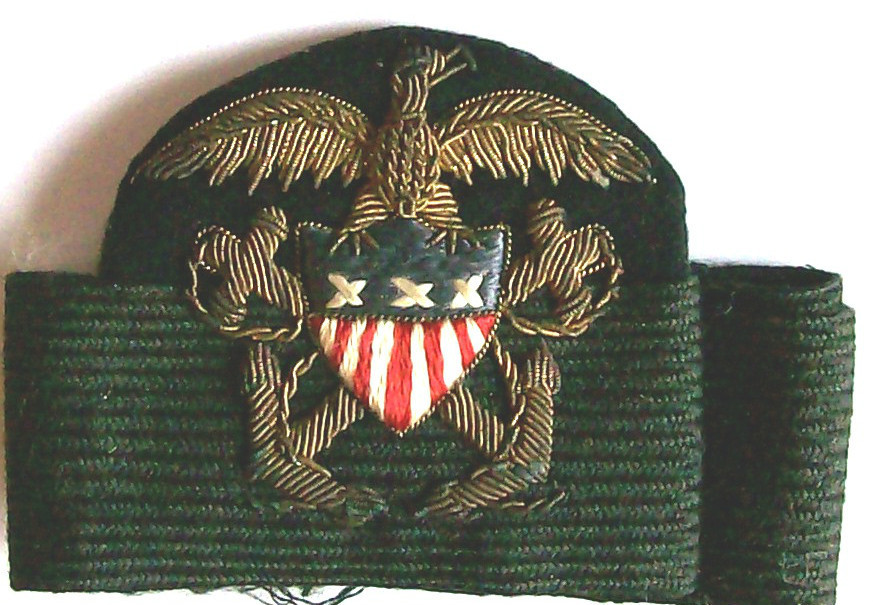
The two following cap badges show a progression of responsibility within the United Fruit fleet. Senior officer wore cap badges with anchors and small flags above; this innovation was an innovation begun in the United States Merchant fleet by United States Lines under the management of Internation Merchantile Marine; hierarchical badges were largely abandoned by the end of the 1940s in favor of command positions being denoted by felt-covered visors with embroidered oak leaf clusters.
United Fruit, Officer
United Fruit, Senior Officer
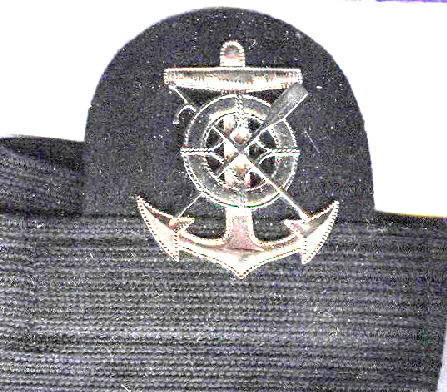
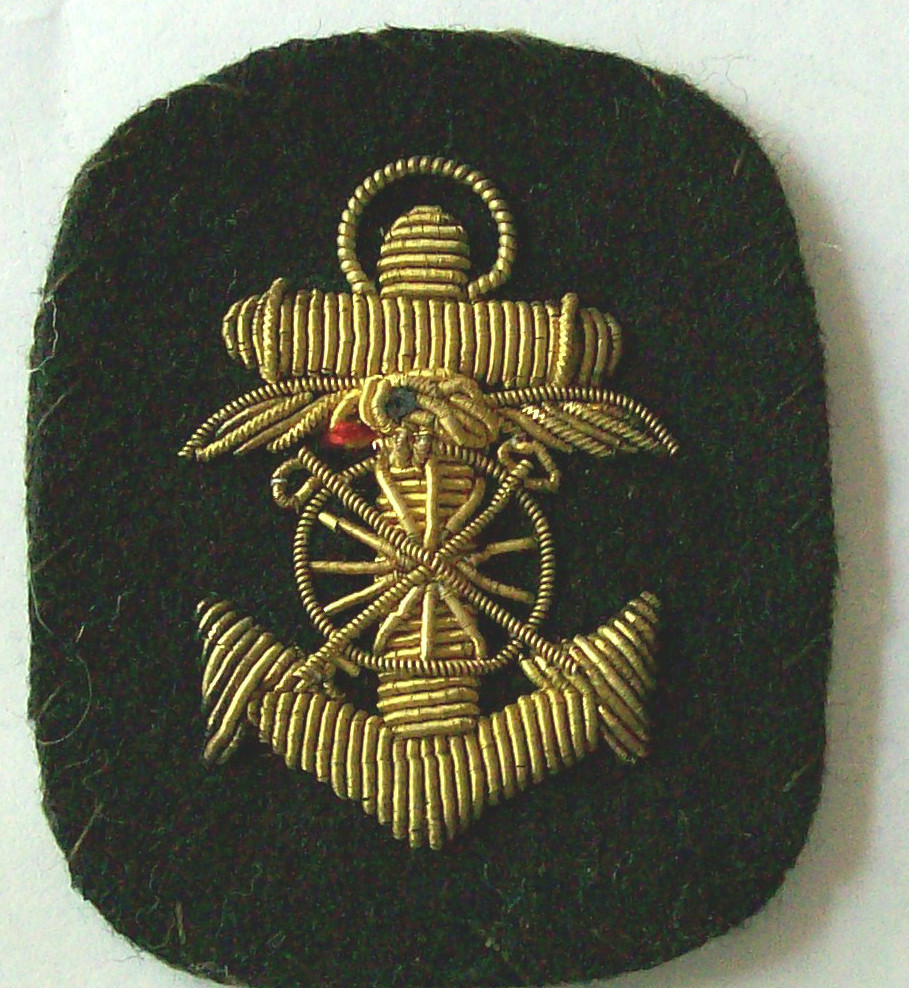
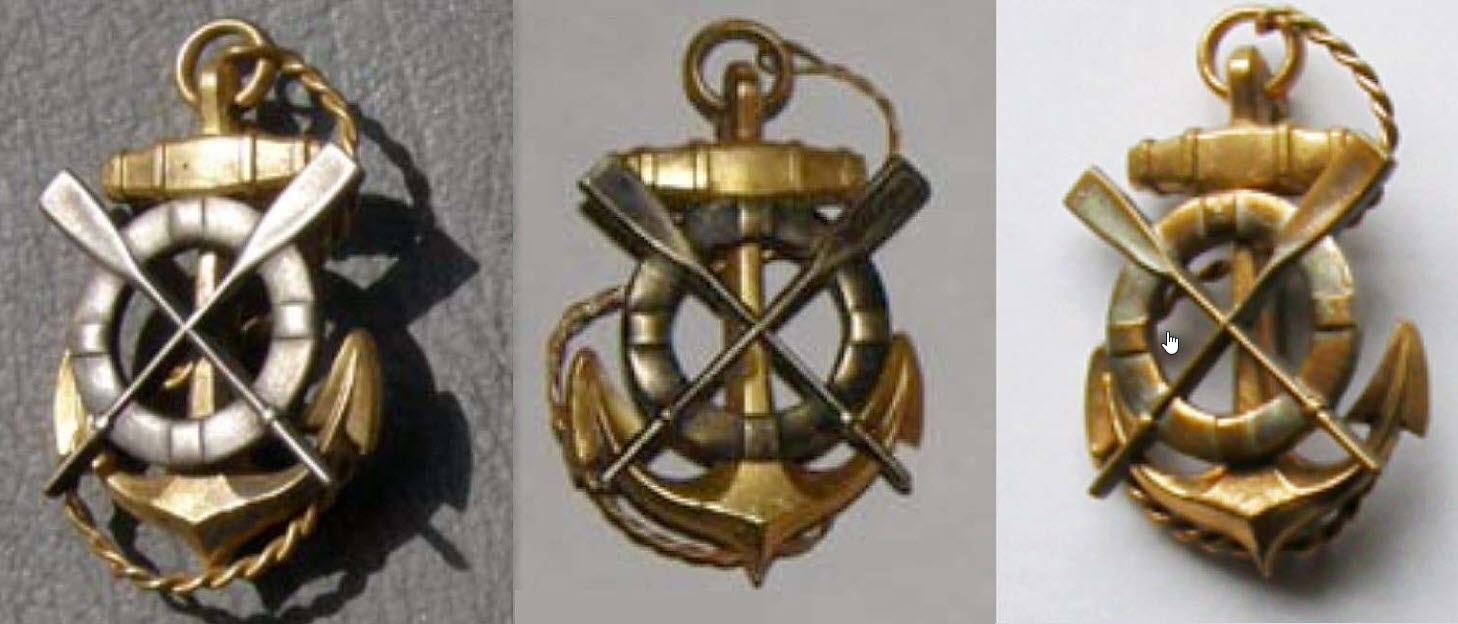
The insignia from United Fruit also shows a steady progression of responsibility. The shoulder boards illustrate promotion from 3rd to 2nd Engineer, and the insigne (for further details please see the collection page) shows the wearer as belonging to the Engineering department. United Fruit insignia is a bit confusing as at first glance it appears to look like United States Merchant Marine cadet-midshipman insignia as USMMA insignia has program identifiers ringed in bullion rope; this insignia lasted at least through the 1950s as it was current during the Korean War.
United Fruit Co. engineer insigne
United Fruit Co. 2rd Engineer
United Fruit Co. 1st Engineer
1960s American Export Lines
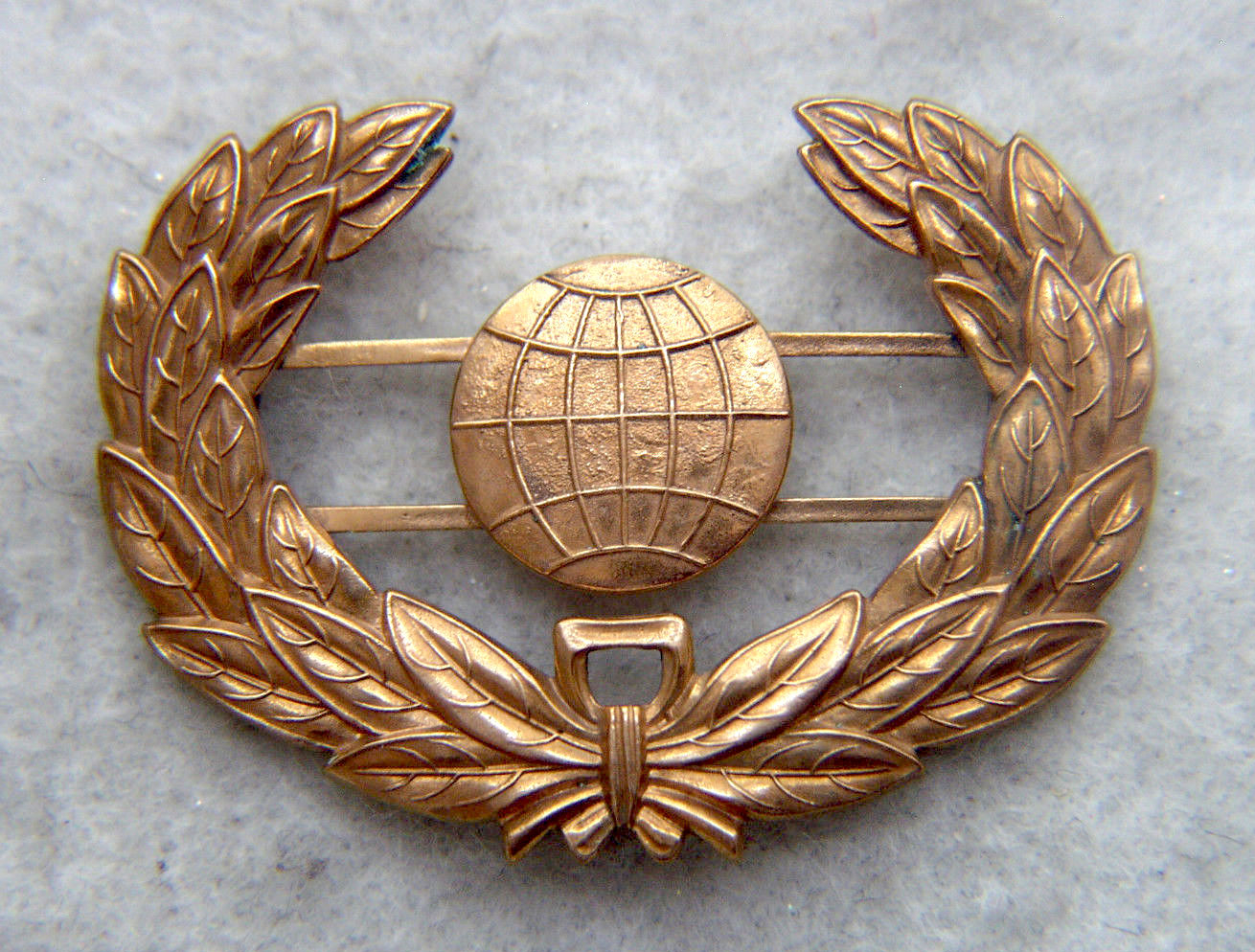
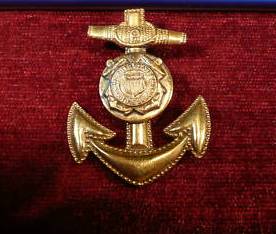
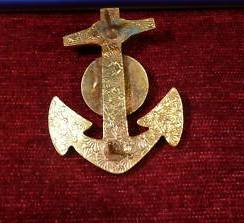
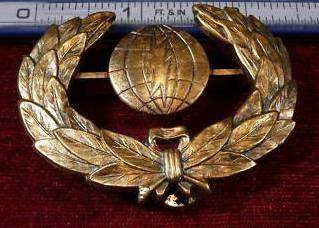
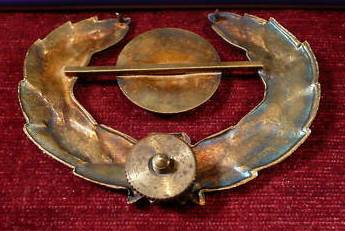
American Export Lines cap badge features the outline of the globe. This cap badge was worn for a short duration since American Export Lines did a corporate livery change in 1962 and was later absorbed by Isbrantsen Lines in 1964. It was in this last year when it was probably briefly worn while the NSS Savannah was under Isbrantsen’s ownership of the ship and F.A.S.T. lacked shipboard insignia of its own.
American Export Lines cap badge
1960s First Atomic Ship Transport
Rounding out the collection are items from when the original owner worked aboard the NS Savannah as a junior engineer. These would have come with American Export-Isbrantsen award of the contract to operate the NS Savannah in May 1963 through the subsidiary First Atomic Ship Transport (F.A.S.T.); this contract lasted until 1971, at the end of which the ship was taken out of service. By 1972, the ship was mothballed.
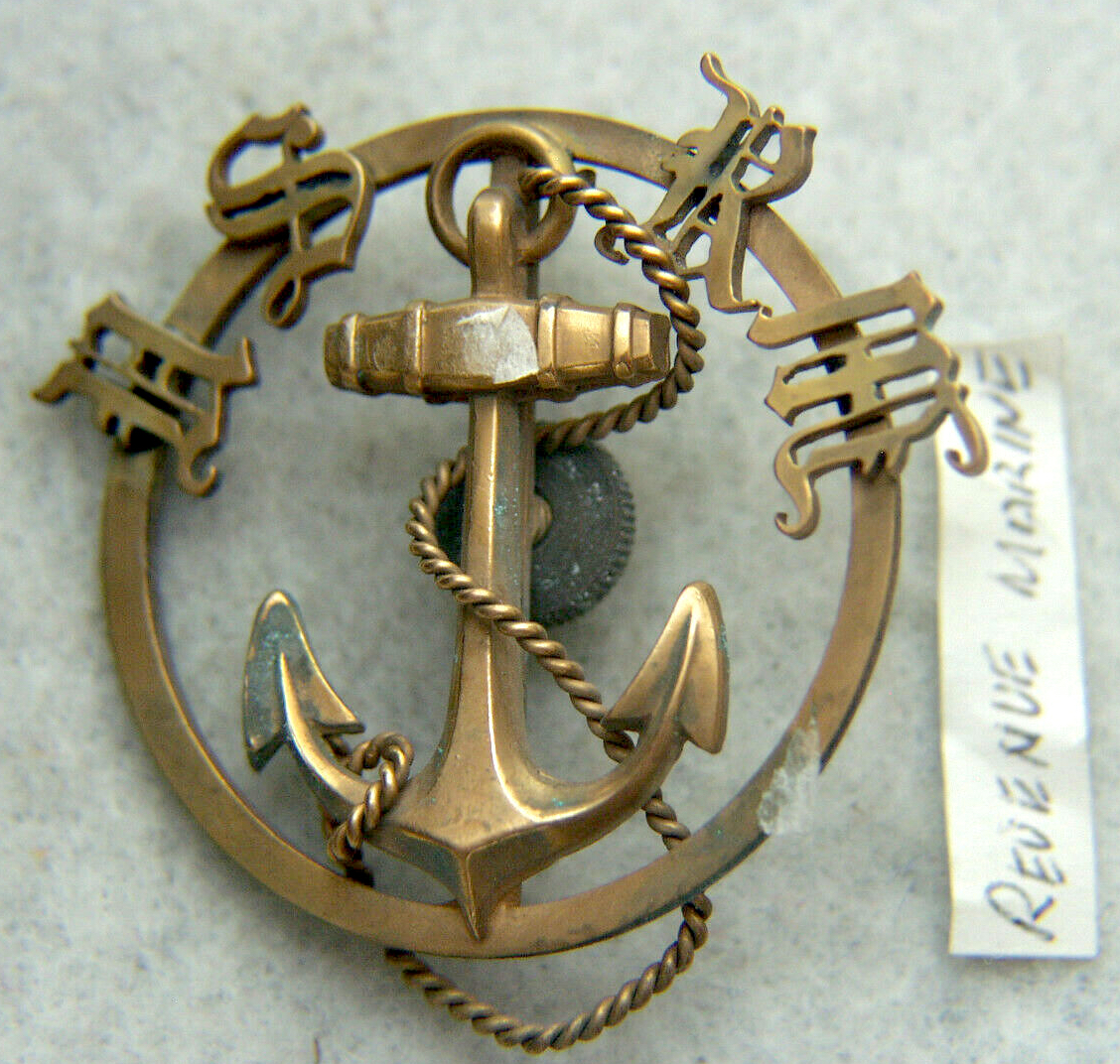
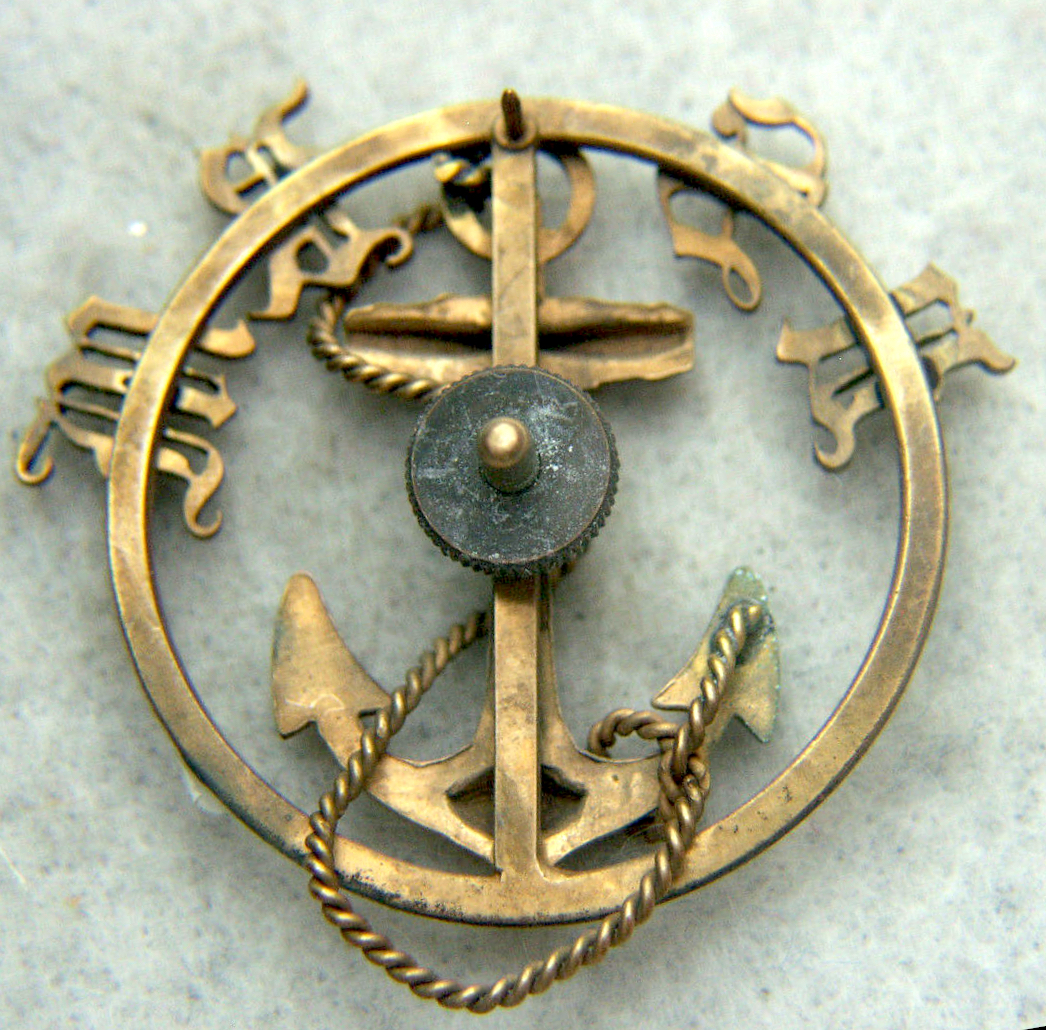
Of particular note are the cap badge and the shoulder boards. The construction of the cap badge points to manufacture or fitting in the United Kingdom or an English-influenced tailor since the stitching pattern of the band has band seams fore as opposed to American aft. This cap badge is that of F.A.S.T. and was worn from at least 1964 onward (see images below). Although the American Merchant Marine industry closely followed United States Navy insignia patterns after the Second World War, the US Navy had no specialized identification for nuclear engineers despite a great many reactor operators in the fleet; thus the shoulder boards are unique to the NS Savannah. There is evidence that the deck officers first wore shoulder boards with an atomic orbital model superimposed over anchors beginning with the maiden voyage of the NS Savannah in January 1962 while she was under contract with States Marine Lines.
NS Savannah ship organization, 1962-1965
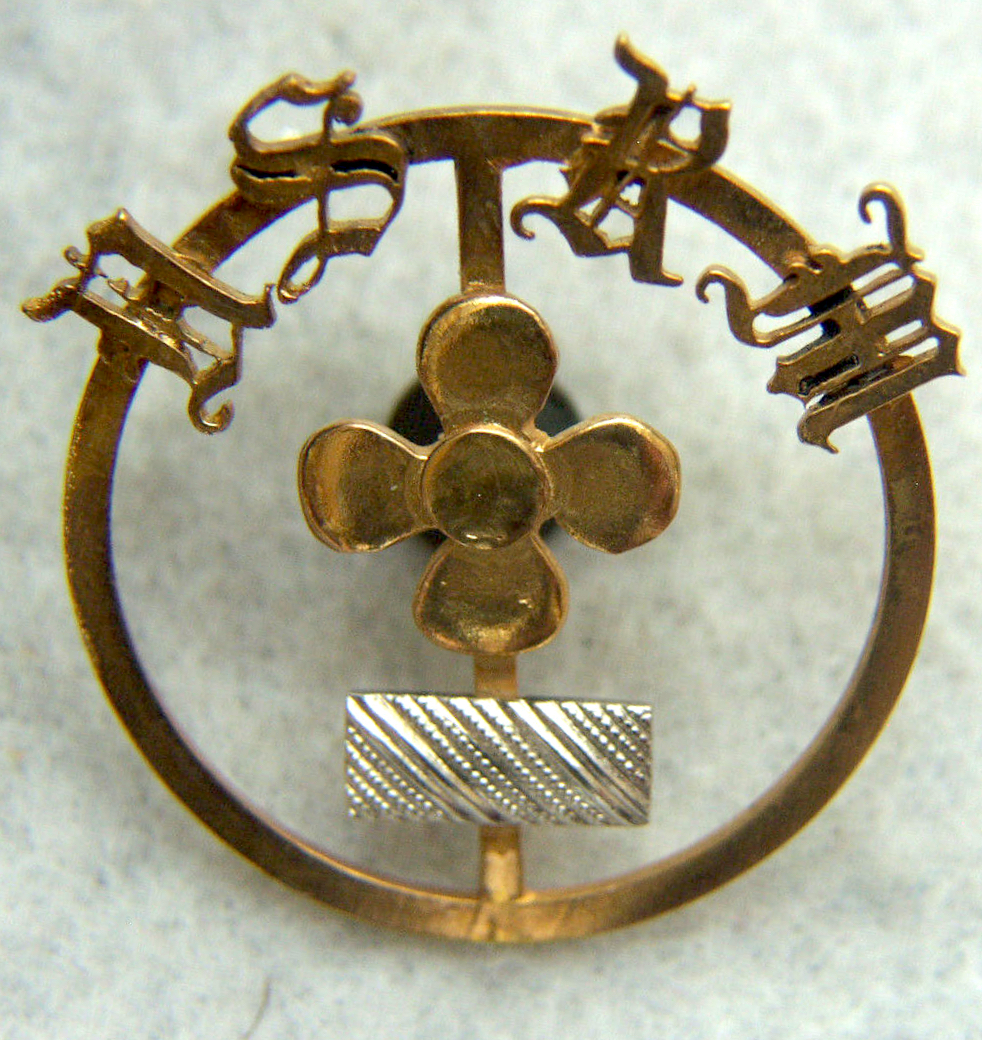
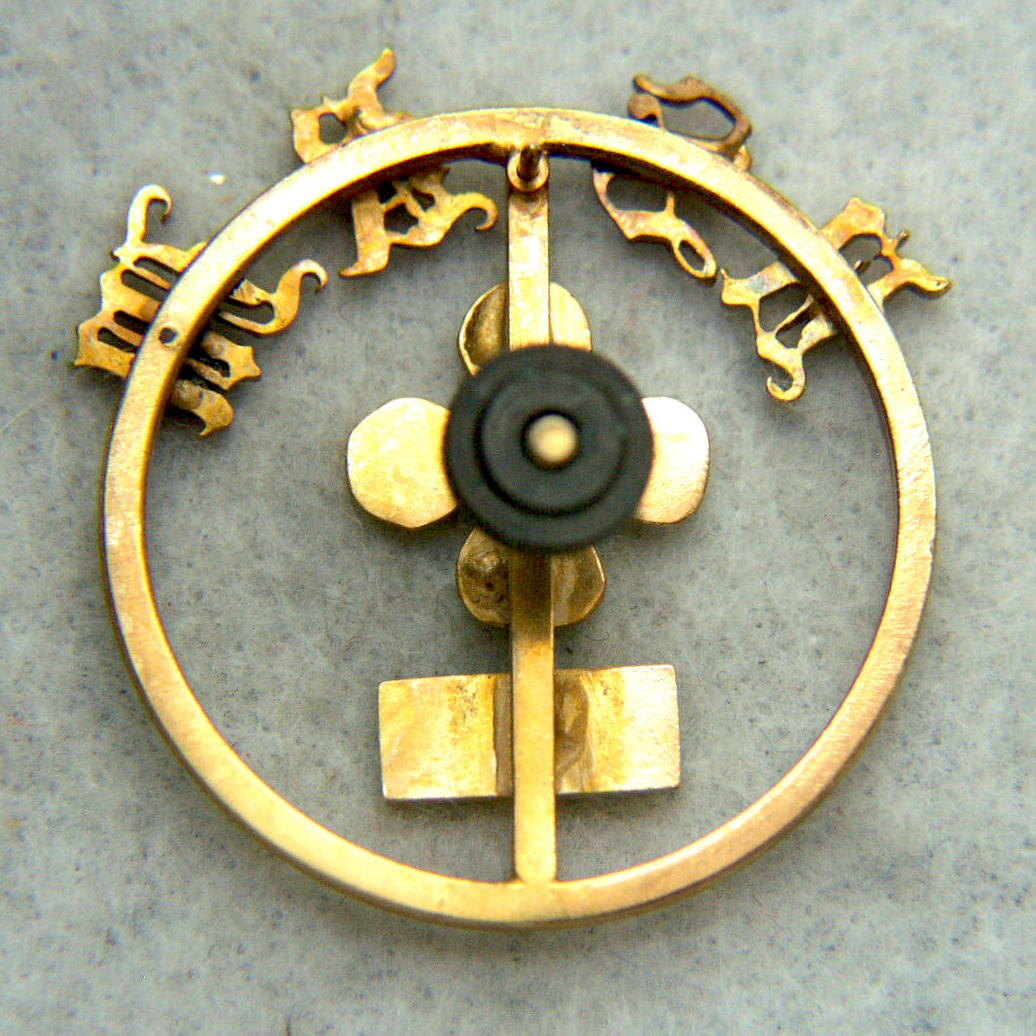
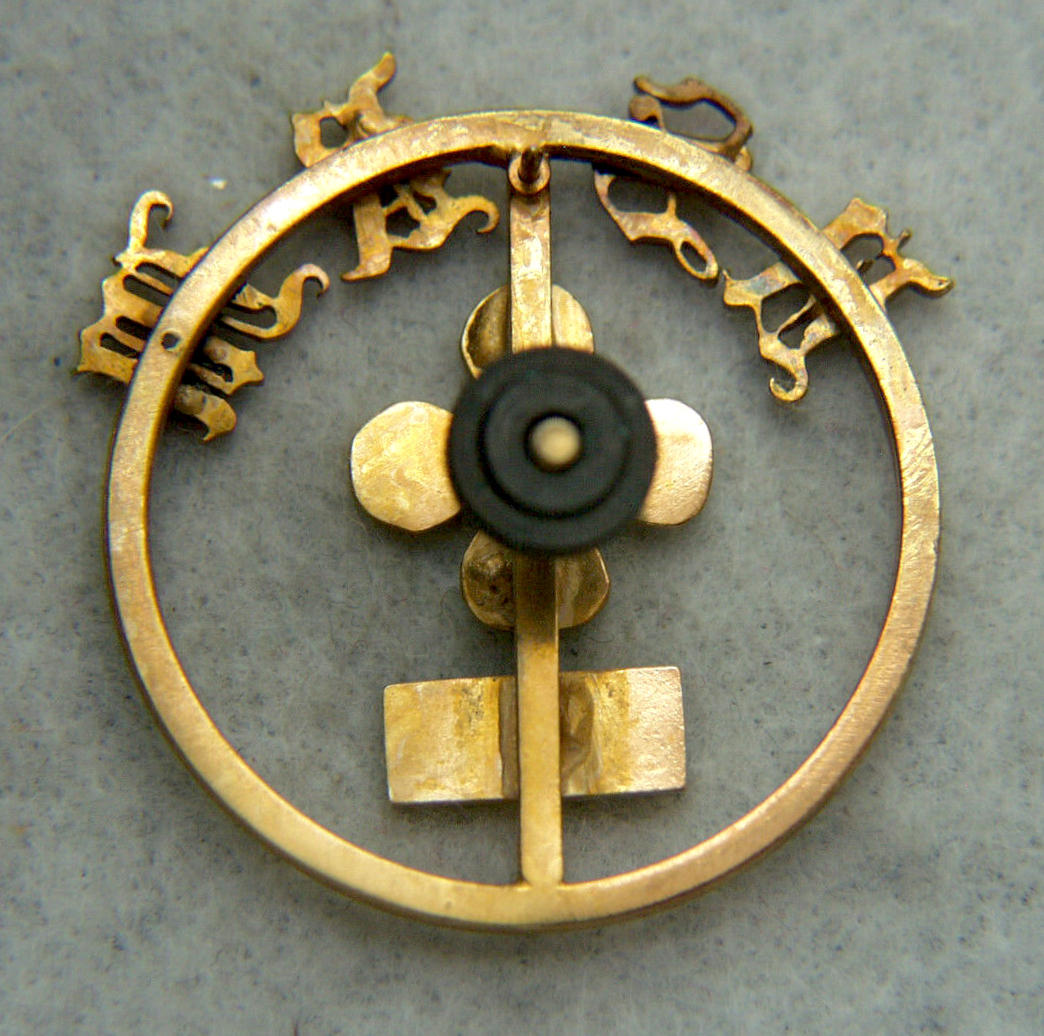
As of this writing, I do not know the significance of the blazer badge’s Latin motto nor what the tie tack represents. “Arduus Ad Altatus” (lit.: “Striving to Dance”) could be an allusion to getting atoms to dance in the reactor; and the tie tack could be styling representation of the ship’s reactor.
F.A.S.T. cap badge
F.A.S.T. Junior Engineer
F.A.S.T. blazer badge
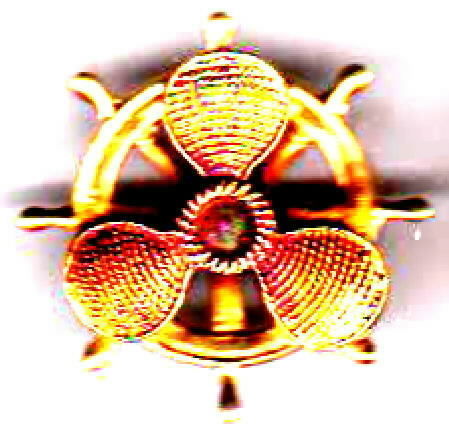
F.A.S.T tie-tack
Captain Gaston H. DeGroote, January 1962.
Captain David B. McMichael, port demonstration in Dublin, Ireland, July 1964.
Captain David B. McMichael, port demonstration in Dublin, Ireland, July 1964.
Note above the shoulder boards worn by Captain DeGroote with his States Marine Lines cap badge, and the F.A.S.T cap badge worn by Captain McMichael along with the specialized deck shoulder boards. Images of Captain McMichael are from the Port Agent of Dublin, Irish Shipping Ltd. newsletter Signal; the article on the port demonstration is here.
Many thanks are due to Mr. Chet Robbins of N.S. Savannah Association for offering a synopsis of the original owner’s possible career and identification of the F.A.S.T. items.
In 1972 the Soviet Union and Europe suffered a drought that resulted in catastrophic crop failures. Although the Soviet Union was perenially plagued with periodic droughts and crop failure, 1972 was significant since the main crop affected was wheat – a dietary mainstay for both people and livestock. This failure brought about talks between the United States and the Soviet Union that culminated in the grain agreement of 1975 between the two countries; the United States pledged to send 8 million tons of wheat a year to the Soviet Union. This agreement was significant for the Unites States shipping industry as it came on the heels of the United States-Soviet Maritime Agreement of 1972. The earlier deal called for one-third of the U.S.-Soviet trade to be carried in U.S.-flag vessels, one-third in Soviet-flag vessels, and one-third in third flag vessels – the latter enabled United States’ allies to benefit from the trade agreement. In addition, part of the 1972 agreement was the opening of 40 United States and the reciprocal opening of 40 Soviet ports to trade. As a result, the Soviet grain trade offered a steep increase in American ships visiting Soviet ports.
“The [1972] accord, described by the Administration as “an indispensable first step” toward a contemplated vast increase in Soviet-American commercial relations, also provides for the unloading and loading of Soviet merchant vessels in East Coast and Gulf Coast ports for the first time since 1963. New York, Philadelphia, and Baltimore are among the United States ports in which American union leaders have agreed to handle Soviet vessels under the over-all accord.”
Of those ports opened to the West was Petrograd, today’s St. Petersburg. Due to both accords, Petrograd saw both the import of grain and a collateral clandestine trade in foreign media grow. Soviet merchant sailor sea bags increasingly contained magazines, newspapers, records, and pornography; they imported these materials at their peril: the Soviet state followed a stringent policy of censorship and ban on materials deemed subversive to the Communist Party, the State, and society. In spite (or despite) the threat of imprisonment or worse, the trade of forbidden items flourished in Petrograd and other large urban areas. Media was often translated and copied via various means and entered the underground economy in forbidden texts; these materials had the blanket term samizdat (самиздат). This was a coy play on the word Gosizdat (Госиздат):
“[Which] is a telescoping of Gosudarstvennoye Izdatelstvo, the name of the monopoly‐wielding State Publishing House. The same part of the new word means “self.” The whole samizdat—translates as: “We publish ourselves”—that is, not the state, but we, the people.”
The means of samizdat production could be by the author of the media or by a reader – and thus not sanctioned, and being forbidden, it circulated outside of official distribution channels. All media in the Soviet Union was censored and sold under license by the State; samizdat, not so – it circulated under the noses of the authorities. In early periods, samizdat came in typewritten, photographic, or longhand forms; by the end of the Soviet era, some were produced via primitive computer word processing applications. Examples of samizdat comprise of smuggled books may be found where their pages were photographed and cut to size and stapled or sewn together and glued into a cover of another book; still, others were created with photostats placed between plain cardboard wrappers, or simply stapled-together manuscripts. An underlying ethos of samizdat was that the production of these materials meant resistance to state repression, and to resist was a means to live.
In the late-1970s, when the Soviet Union opened itself ever so carefully to the West in a time of need, did an American merchant seaman acquire the small collection of photographs below for a carton of cigarettes and smuggle them out of Petrograd to the United States. The collection features a series of four photographs and a single photograph. I am unsure if the four and the one are connected; the latter is a single photograph of a woman posing like a Greek statue; the remaining four photographs offer some sort of erotic social satire – as explained to me, they employ universal characters of the Soviet period used in dirty or satirical stories: a militiaman, a market trader from the Caucasus, a street tough, and a bodybuilder. Each hunts for a woman’s body and attempts to possess her; in the end, she chooses the bodybuilder, to the chagrin of all.
Samizdat often seen by Westerners involves forbidden literature such as the political tract “Memoirs of a Bolshevik-Leninist” or hand-made books; photographs such as this collection are rarely commented upon. Nevertheless, despite the harsh cultural repression at play in the Soviet Union, the images represent resistance and the need to poke fun at authority.
This was quite the trade for a carton of cigarettes. My lingering question is what was the context that led to the trade.
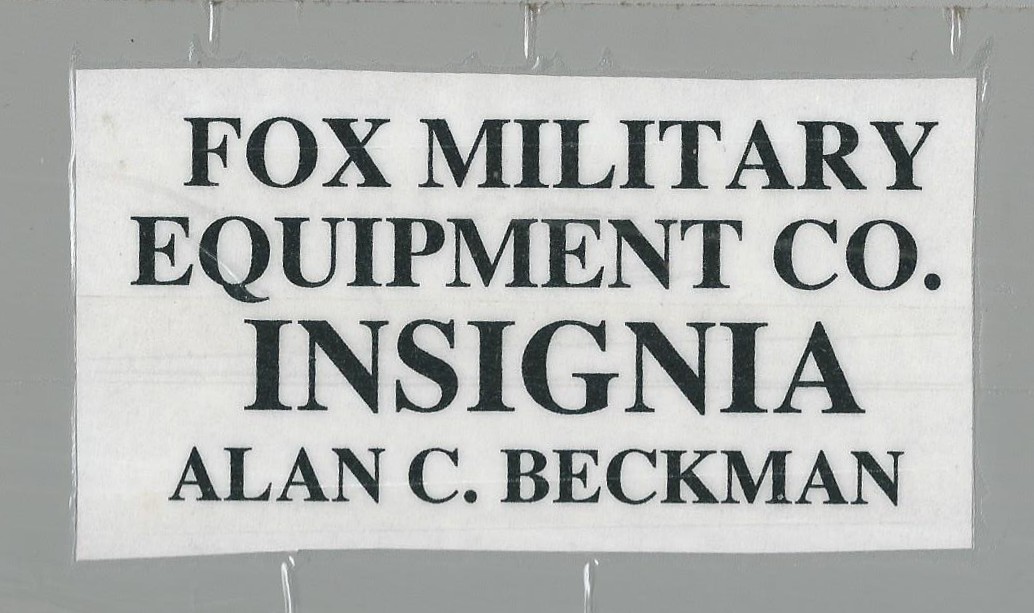
For a collector of period items, there is nothing more vexing than a fake offered as an original, vintage item. The higher the rarity, the greater the amount of “fakes” circulate. Although the field of collecting merchant marine insignia is small and insignia is relatively undocumented, spurious items often appear with incorrect attribution. Exploiting this lacuna, from the 1980s through the early 2000s, a single individual muddled the field and thoroughly confused collectors: Alan C. Beckman of Fox Militaria. Mr. Beckman never purported his creations to be “Official Issue” – those reselling them do now. Since education for the collector is critical, hopefully, this post will help set the record straight.
Particularly frustrating in researching and collecting Second World War Merchant Marine items is the lack of documentation. An early researcher in the field Rudy Basurto quipped in personal communication, “manufacturers be damned.” It is no wonder – the American Merchant Marine at the time was marshaled under the guidance of the War Shipping Administration to transport people and materiel in support of the war; and, with each re-alignment in Federal organization, insignia changes followed suit. Managing steamship operators did not issue handbooks or pamphlets detailing their uniforms, and government agencies – such as the United States Maritime Service – did not leave behind uniform circulars like the United States Navy. Compounding the issue, insignia houses have come and gone with their archives going the way of the wastebasket. With scant clues as to who made what insignia when and for whom, the overall lack of information has lead to speculation and guesswork.
NB.: If you wish to skip my editorial, below the text are a series of galleries of some of the items from Mr. Beckman’s stock.
Enter Alan C. Beckman
Such an unresearched and poorly documented field as Merchant Marine insignia is ripe for unscrupulous insignia dealers. No one dealer seems to be more reviled than Alan C. Beckman, the ex-proprietor of Fox Military Equipment|Fox Militaria|eBay seller usnusa. When Manion’s had a public marketplace, he set up shop there as well. Through these various channels, Mr. Beckman was a distributor and manufacturer of many restrikes, fantasies, and cinderellas. Once collectors found him peddling bad wares, they branded him as a persona non grata. Since he never gave full provenance or a complete description of the stock he sold, it enabled him to feign innocence when an angry customer confronted him.
Before he passed away, I occasionally corresponded with Mr. Beckman and learned of how he was able to offer such a broad array of items. He began manufacturing items in earnest in the early 1990s through the mid-aughts. Through a fluke of luck, I discovered he placed a large order for NOAA wings with International Insignia in Rhode Island. After a conversation with International Insignia, I learned most of Mr. Beckman’s items were not period, but restrikes. It is worth mentioning International Insignia is a supplier to Vanguard Industries and holds the archive of N.S. Meyer dies; the proprietor of International Insignia is the son of the last president of N.S. Meyer, Robert Raeburn. Through his contract with International Insignia, Mr. Beckman was able to offer many high-quality items and cinderellas (which may be collectible in their own right if one is into fantasies). Mr. Beckman’s spray-painted casts were his own experiments and came as a result of him trying to mass-produce items for market.
It is useful to offer some definitions; a leader in the field of Phaleristics – Alexander J. Laslo – provided an important terminology in his Interallied Medals of World War I. Coming from the world of numismatics, I find they offer a useful framework when considering merchant marine insignia and cap badges in particular:
Official Issue: produced for general distribution by a government or commercial firm under contract, license, or sanction of the issuing authority. Collectors will most often want to acquire these items. These may be found either unissued or used. Depending upon one’s collecting interests, one or the other is valued. For the latter, provenance is often a key determiner of value.
Reissue: A later strike of an official issue. This may involve die or finish variations. I would also include far later official issues of items; items such as the Merchant Marine discharge button currently issued by Vanguard fall into this category – same die, different bronze alloy, but given to veterans by MARAD.
Unofficial Issue: An item produced by a commercial firm and available from the firm or a vendor for the purpose of providing seamen a replacement of the official issue or an interim item to wear until the distribution of the official issue. These are “theatre manufactured” items and include sand casts of cap badges as found in collections as picked up by seamen in foreign ports as far afield as Alexandria or Sydney. I would also include items manufactured under license for general distribution, but not released (see Russell Uniform Co. below).
Reproduction: An item produced by a commercial firm for the purpose of satisfying the needs of collectors. These are sometimes referred to as “fakes.” These are only fakes if they purport to be official, vintage issues. And like reissues, they will have die and finish variations; such as lack of hallmarks or stoning of enamels. They fill gaps in a collection.
Fantasy: An item produced by a commercial firm that has no official status. These may be created to create the idea of an official issue. These may also be called “cinderellas”; cinderellas are collectible in their own right.
When it comes to Merchant Marine insignia, it is often difficult for the untrained to determine what is truly an “Official Issue” or “Fantasy” given the paucity of information and the relative sophistication of the modern manufacturing process. Coupled with the aforementioned, insignia were often altered, defaced or invented by bored mariners. Provenance and determination of “genuineness” are at times problematic. Fortunately, a small number of references devoted to the subject do exist: a self-published book by Rudy Basurto acts as a general catalog and starting point for anyone interested in the subject – it is not an academic treatment of insignia, rather is more a collection of images and pithy descriptions with some of the depicted insignia existing only in long-lost regulations; a smattering of articles published in the American Society of Military Insignia Collectors Trading Post by Dave Collar and Bill Emerson have depth to their descriptions and illustrate insignia quite well; a more specialized treatment of U.S. Maritime Service and Army Transport Service (in its various guises) is found in a self-published work by Steve Soto and Cynthia Soto; ATS-only topics are treated by Bill Emerson in his encyclopedia survey of U.S. Army Insignia; perusing Herbert Hillary “Sarge” Booker’s newsletter “Crow’s Nest” details some of Basurto’s material and offers variations of maritime insignia; Joseph Tonelli, in his Visor hats of the United States Armed Forces presents some handsome examples of many common and not-so-common head wear of the sea services, with the Maritime Service and Merchant Marine included. Readily accessible, Collar and Emerson are indispensable; and take care in consulting Basurto’s book – although it is a good starting point. I have a running list of references here.
There is always the question of what is or is not genuine. Considering Alexander J. Laslo’s and my definitions, the terms fake and reproduction are subjective; as are fantasies and test patterns. The coin-collecting world is less kind, terms used are “forgeries” and “replicas”; the former is meant to deceive and the later to collect. Objectively, Alan C. Beckman was a businessman, and he sold insignia; the onus of knowing what one purchased from him lies solely with the purchaser. The purchaser was always free to ask questions of him, and more often than not, Mr. Beckman would respond; if the purchaser was unhappy with the product he offered, they could always return it to him, no questions asked. Collectors, though, often have an acquisitiveness about them and will purchase items no questions asked. This is dangerous and where collectors in search of first-strike, original period oftentimes get “burnt.”
There are two schools of thought when it comes to cap badges. One school will not entertain re-strikes or copies. […] Under normal circumstances not only are original badges difficult to come by but they will be very expensive.
When an original metal cap badge is made the manufacturer is supplied with the metal die from which to produce them. Sometimes the manufacturer produces more than requested so that he has a few spares left over in case of any rejects and if there are no rejects then the spares are no good to him.
When the contract is finished the die should be returned to the customer and it has been known for these to end up on rubbish skips. So a restrike is one that is made to the original customer and manufacturer’s specifications using an old die but was never actually authorized.
Mr. Beckman got his start in buying and selling militaria during his time in the U.S. Army while stationed in Europe. Using West Germany as his base, he went on collecting trips where he bought up stock and sent it back home to the United States. Since he was active in the 1960s, militaria was relatively plentiful and inexpensive in Europe; this formed the core for his business – Fox Militaria operating out of Clarendon Hills, Illinois. Over the years, he was fortunate in his ability to cultivate relationships with individuals in the insignia manufacturing business; he had contacts in Rhode Island – which was a major insignia manufacturing center – and was able to purchase unsold or incomplete stock as well as old dies and tools. From these old, worn-out dies, he made his earliest items, but they were of the poor pot-metal type of reproductions. A friend taught him the art of casting, but his efforts often ended up with all the tell-tale signs of a poor cast: bubbles, wavy lines, parting lines (and file marks), &c. In time, he was able to acquire some bits and bobs from places going under such as Pasquale and Wolf-Brown, but his most valuable connection was that with International Insignia.
Mr. Beckman fabricated an amazing story to capture the imagination of his customers and to appear he had struck a collector’s dream: the coup of a personal invitation to purchase N.S. Meyer’s unsold stock at the company’s liquidation. He asserted from that sale in Manhattan he acquired many of their submarine and aviator “wings” as well as a significant amount of their old dies and unsold stock. There is a ring of truth to his story; N.S. Meyer was acquired by Vanguard in 2000, and some assets were sold – but not dies and not insignia lying in boxes on warehouse shelves. The truth is far more interesting. Mr. Beckman had a close relationship with N.S. Meyer and did buy much of their unsold stock – but not wings, rather the small notions soldered on other pieces of insignia to make up MSTS rank pins. It was through this contact that in the late 1990s – right after N.S. Meyer suffered a flood in one of their die-sheds in Rhode Island at their International Insignia subsidiary – that he was brought in to re-catalog their dies and tools. The flood completely decimated the cardboard wrappers around the dies, and the company was left wondering what they had. Since he was an avid collector of insignia and a veteran of militaria shows, he offered his services to identify their assets. In that die-shed, he discovered a trove of tools and dies used from the outset of N.S. Meyer’s creation. Armed with expert knowledge and a dash of educated guesses, he labeled and inventoried the dies and tools.
Knowing what International Insignia had on hand enabled Mr. Beckman to order rare items from them to sell to the militaria collecting community. He often jobbed out lots of one hundred pieces at a time and sold them at a trickle careful not to saturate the market. Early on, he placed his orders with International Insignia using what he surmised were original materials: a base metal plated in silver or gold; however, when precious metal prices made their use cost-prohibitive, he began placing orders for pieces in bronze, brass, and gunmetal. The later pieces of insignia, Mr. Beckman described as the rarest of rare items. Using International Insignia as a manufacturer gave him the sort of quality control over high-demand items he did not have in his own workshop. The light-chocolate bronze N.S. Meyer wings as produced by Internation Insignia were “works of art” and truly well-crafted and as the manufacturer claimed – they were complete down to the 45-degree angle catches.
Alan C. Beckman claimed many of the cinderella designs that came out of his N.S. Meyer stock were trials or leavings from small batch jobs. He explained that often a client would approach N.S. Meyer and ask if they could produce something. N.S. Meyer would make trial strikes and either make a sale or not. In fact, in the insignia business, tools are considered assets and if they were kept around, they were taxed; most, if not all of these hubs for trials went the way of the scrapyard. Mr. Beckman never owned an N.S. Meyer die, despite what he intimated to me. In regard to the dies themselves, he speculated correctly on some – and others not so. Since Mr. Beckman was a United States Navy veteran, he had a particular fondness for offering submarine badges and maritime-related insignia badges. And, being a friend of Rudy Basurto, Mr. Basurto’s work informed Mr. Beckman, and Mr. Beckman offered Mr. Basurto examples of his work and Herbert Hillary “Sarge” Booker drafted line drawings for Mr. Basurto’s monographs lending legitimacy to the fakes; it was a self-feeding circle. The cinderella pieces were Mr. Beckman’s own imaginative creations. In propping up his legend, he wrote me when I asked where does one find all of his merchant marine insignia:
As far as other information the only thing I can offer is “keep your eyes peeled”! You will learn information about the Merchant Marine from the most unlikely sources. Before Russell Uniform Co. closed their doors I was able to buy a lot of Merchant Marine insignia from them-a most unexpected source! If you can make a trip to the Merchant Marine Academy at King’s Point it might be well for you to do so.
Private correspondence with Alan C. Beckman, July 10, 2009.
Mr. Beckman encouraged me to seek out insignia at estate sales. He told me trips to Florida netted him a trove of Pennsylvania Nautical School cap badges he was about to sell (N.B. P.N.S. never used stamped metal cap badges – a belt buckle, yes). I followed his advice and started to look around and was confused about what I saw and what he offered. At one point, I asked Mr. Beckman about the incongruity I noticed between the insignia I found in estate sales versus his offerings – all the old salts were selling sterling or gold. He slipped up told me the reason why the insignia he offered were in strategic materials – and not in silver plate – was due to collectors not wanting silver items. In a later sale, I mentioned to him I had done a scratch-test on one of his items; he told me gold substitute (e.g., Rust-oleum) is easier to procure than real gold. He then did a quick followup, writing, “Good eye.” He refunded my money, and told me the cap badge was mine for free.
It is interesting how Alan C. Beckman both challenged and in a sense educated me to learn more about merchant marine insignia and their production. It is almost as though he wanted me to unravel his business model.
Galleries
Fox Militaria | eBay Seller: usnusa
These images were gathered between September 2010 and August 2012. Alan C. Beckman as the eBay seller usnusa would sell stock often in batches of 15-20 items every few weeks among them would be Merchant Marine or Maritime insignia. After 2012, I left eBay and no longer watched his auctions. Each piece of insignia had an average sale price of $40-50.
Fox Militaria II
After a couple of years of inactivity, I learned Mr. Beckman’s stock was appearing once again on eBay. I was astounded, and then learned Mr. Beckman was not well. Images of his stock as sent me are below; most I already knew from the fliers he sent me years prior. One thing that always stands out about Mr. Beckman’s cap badges is how he consistently re-used the anchor from the N.S. Meyer U.S. Marine Corps Eagle/Globe/Anchor cap badge construction.
Some collectors through the years have come to recognize their purchases as items having a provenance leading to Mr. Beckman. Below find a gallery of some of those pieces.
Fox Militaria | Russell Uniform Co.
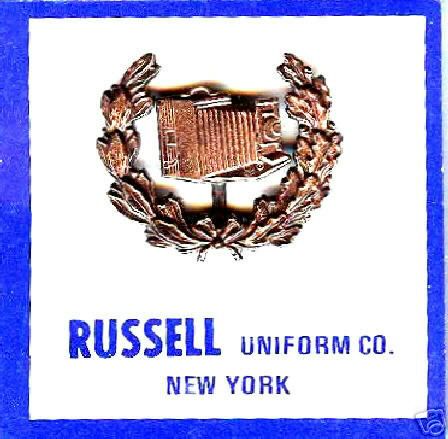
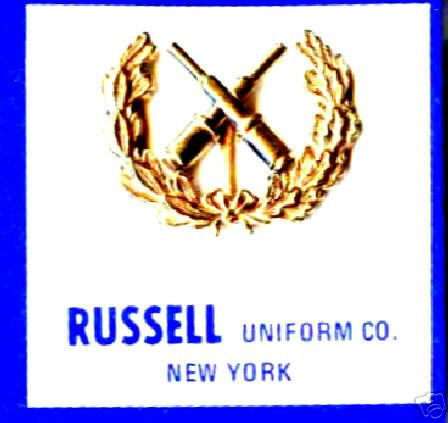
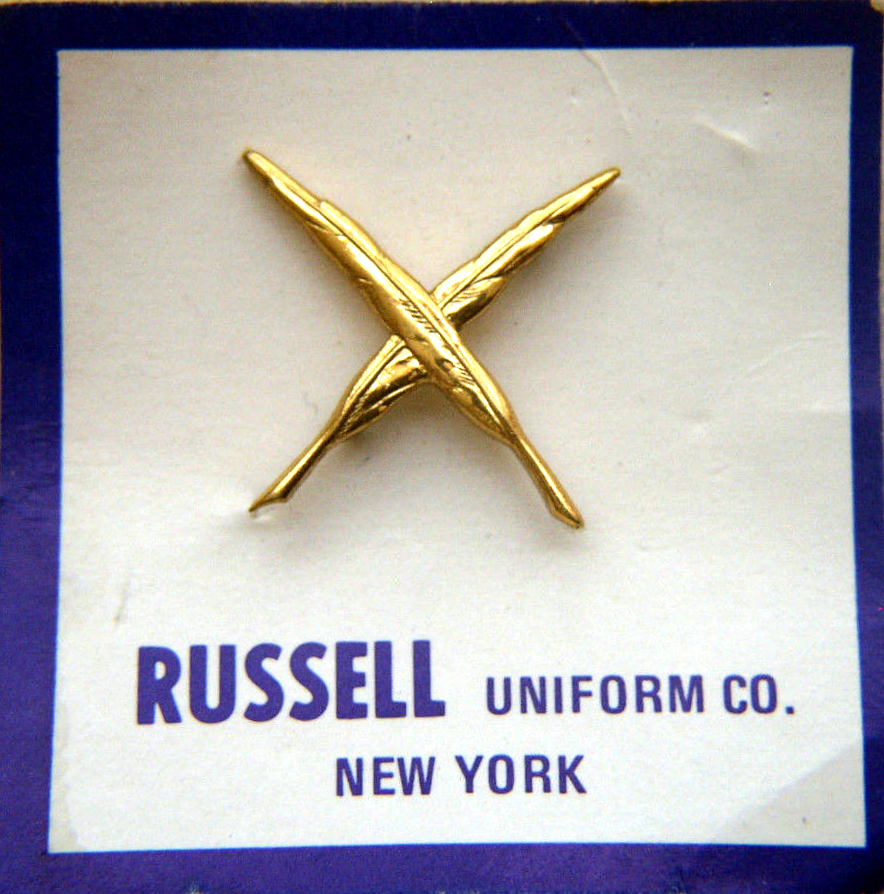
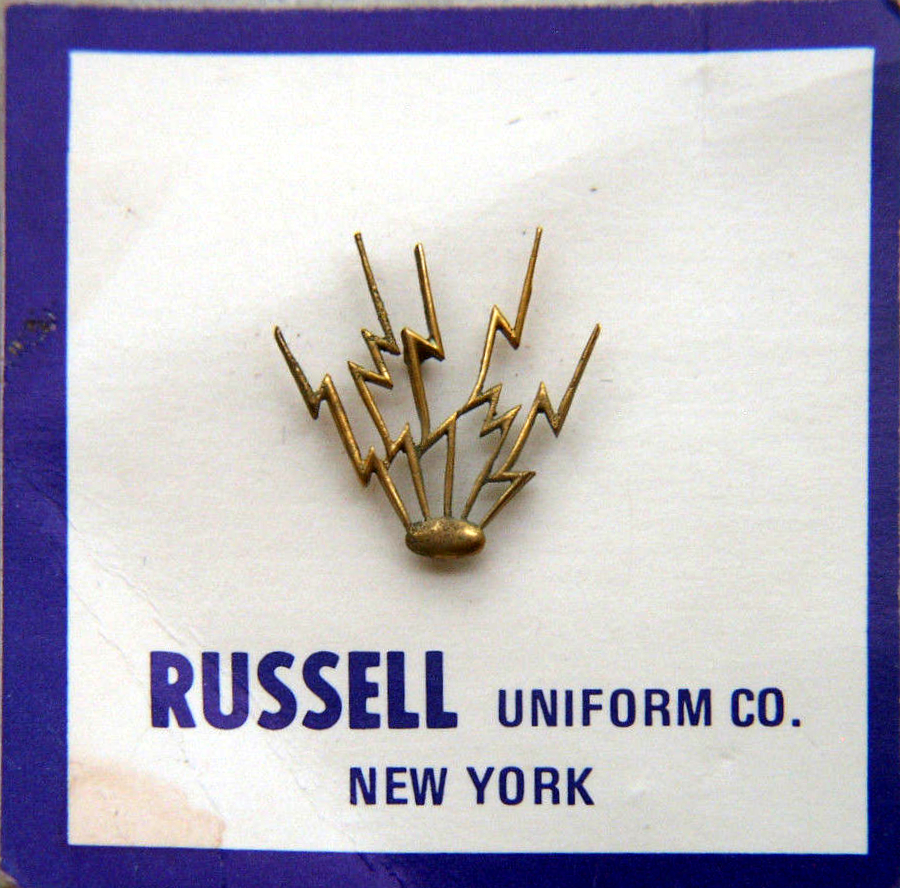
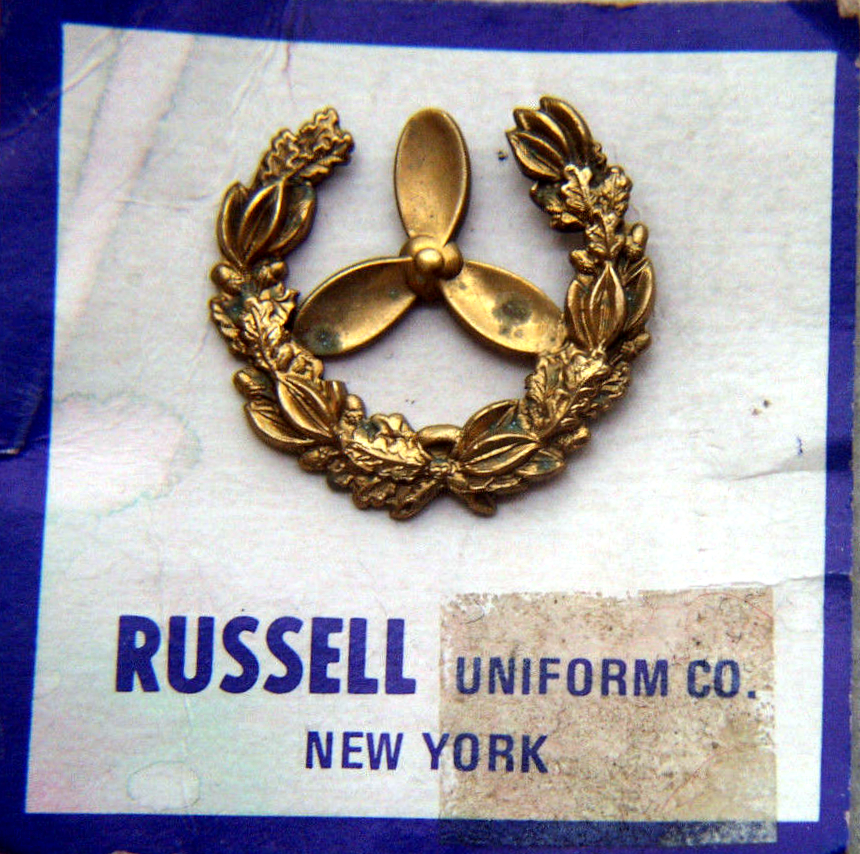
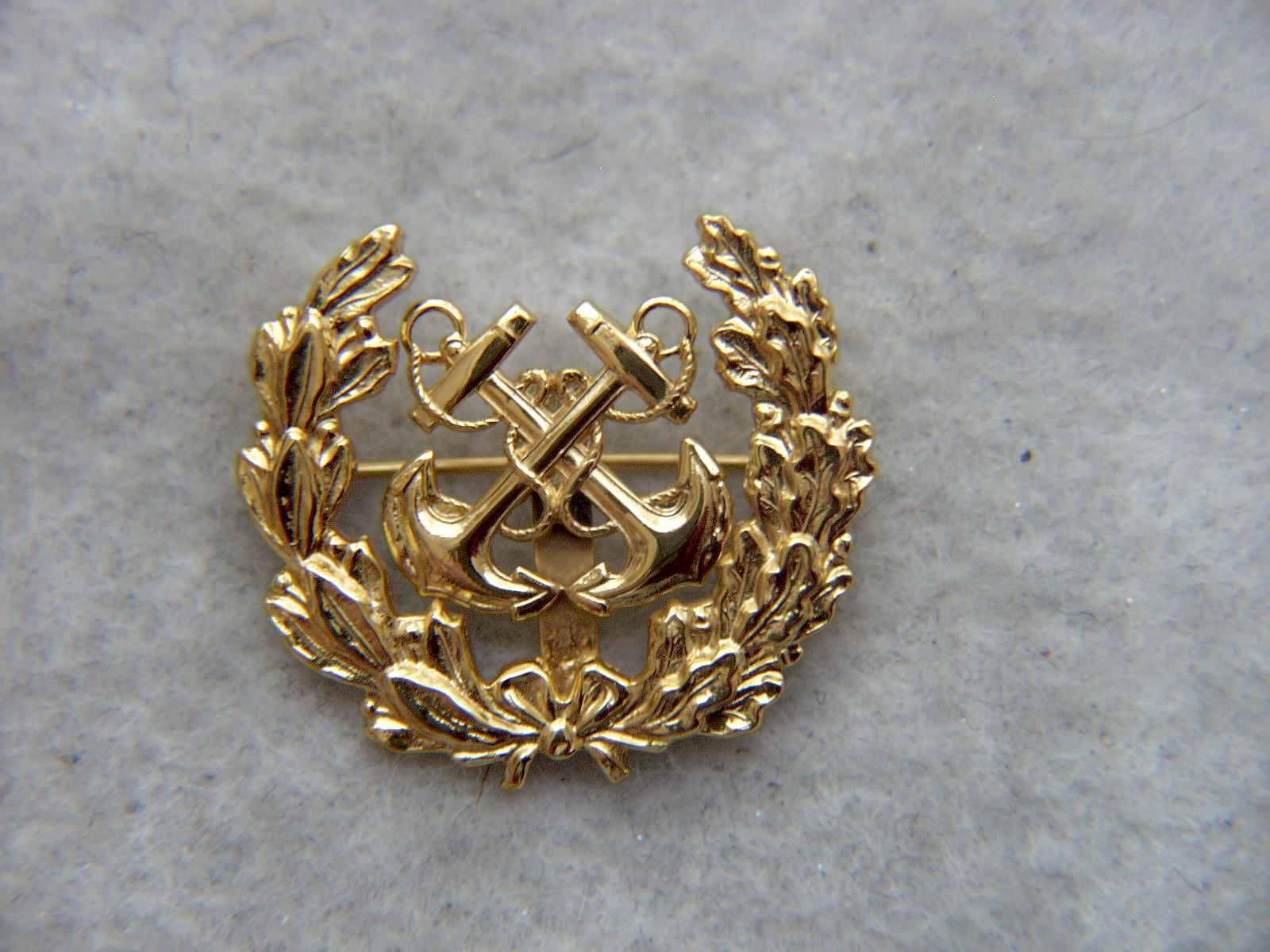
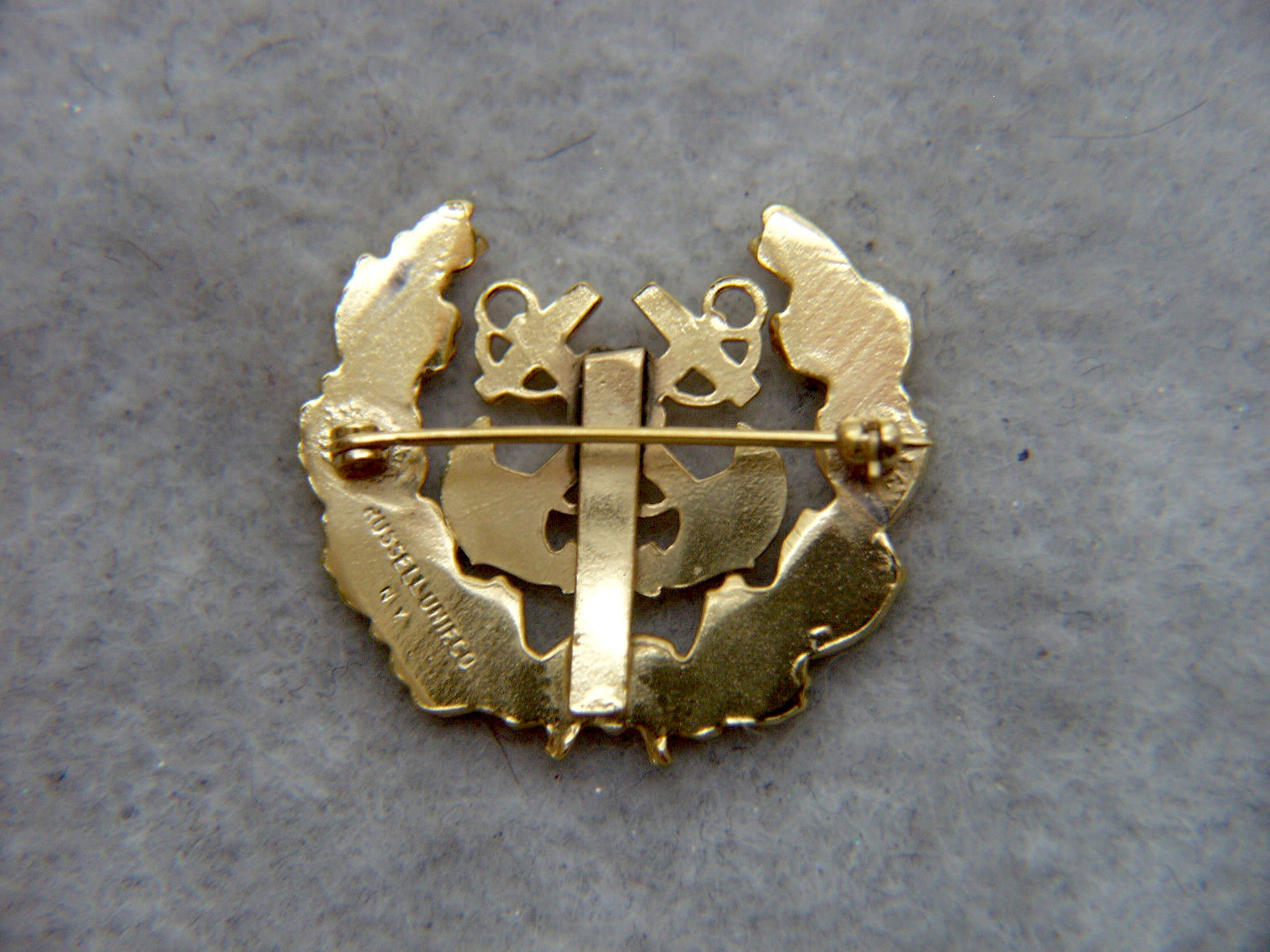
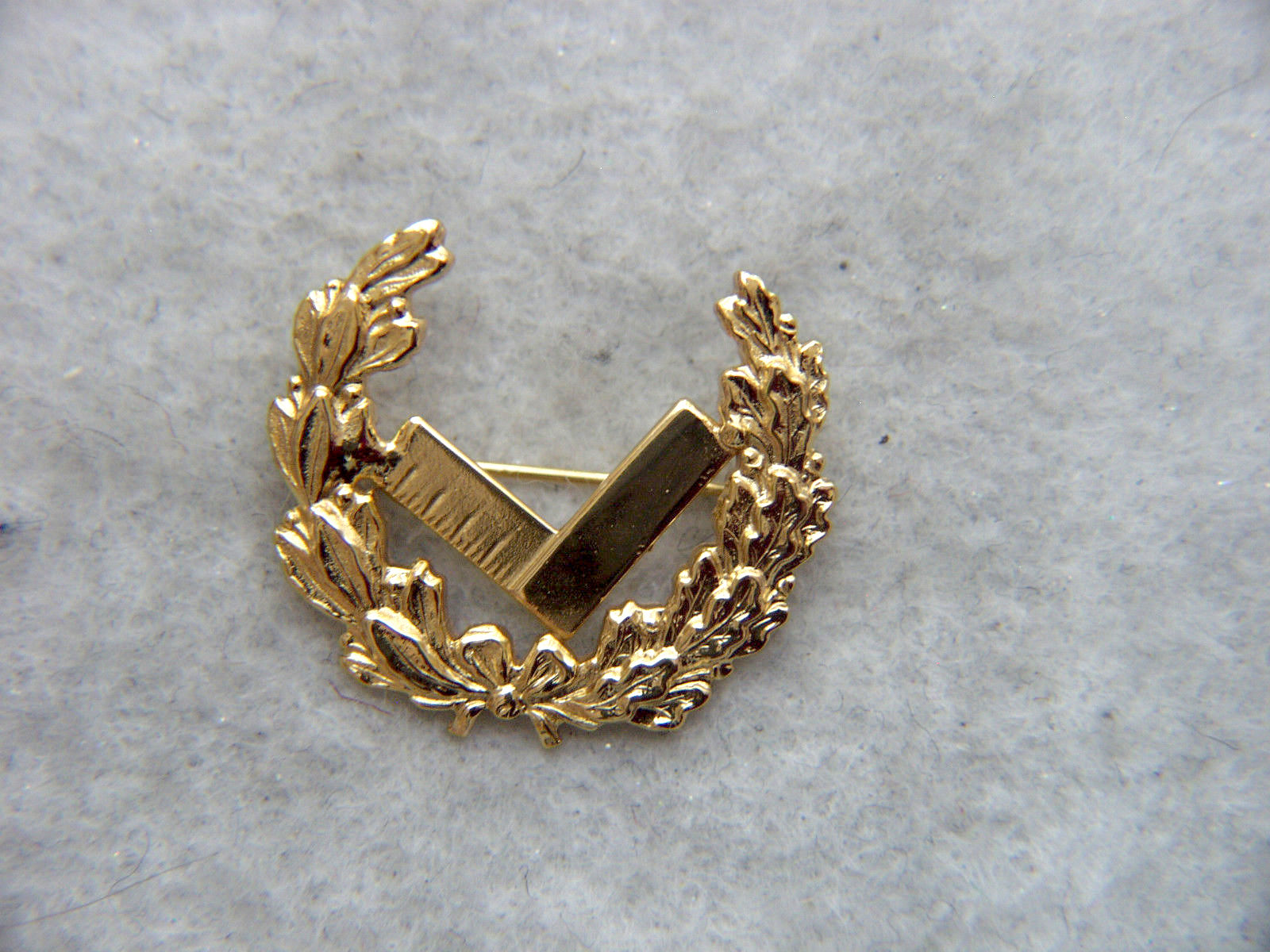
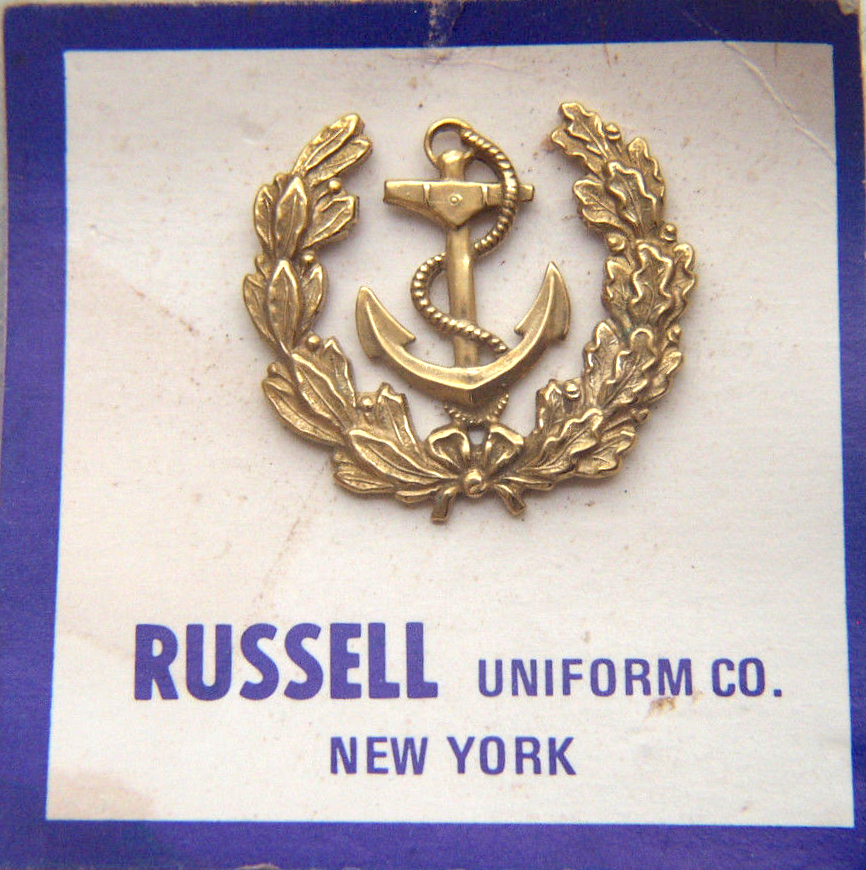
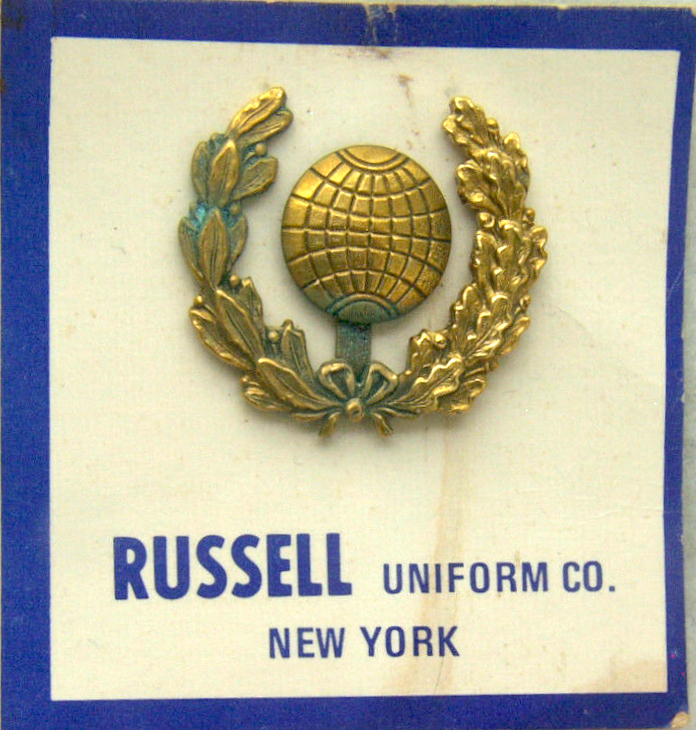
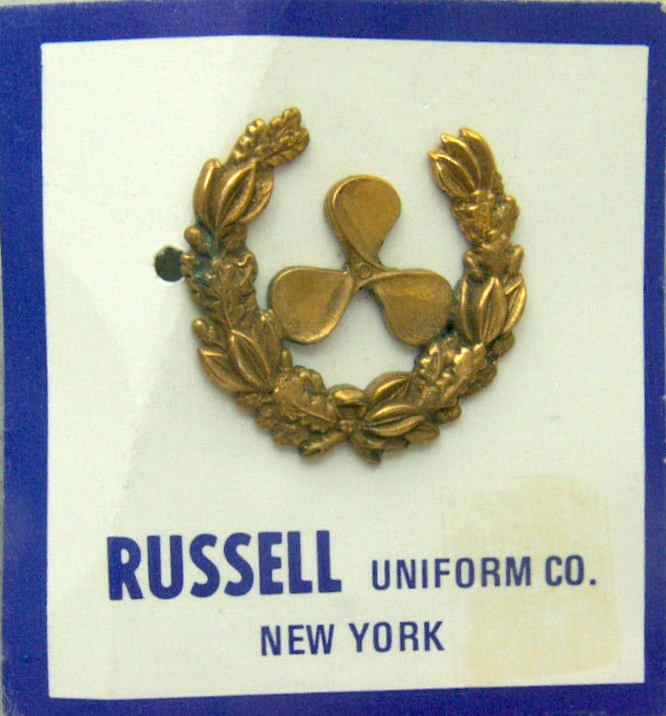
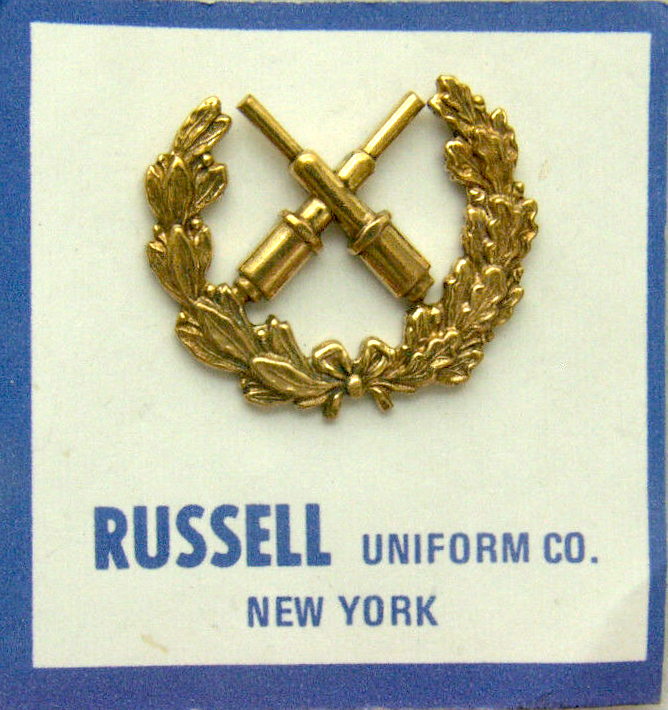
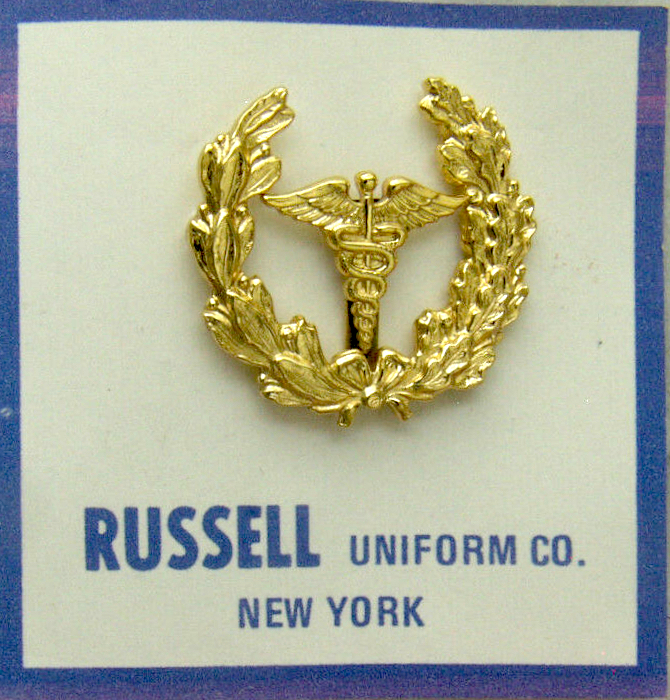
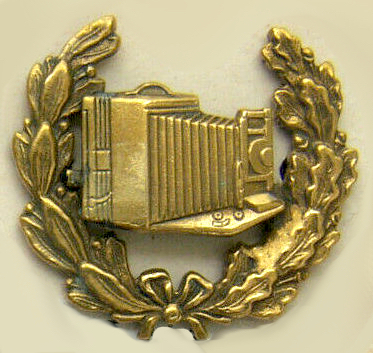
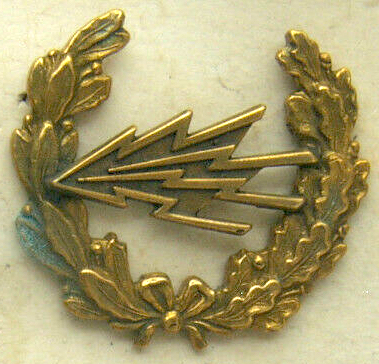
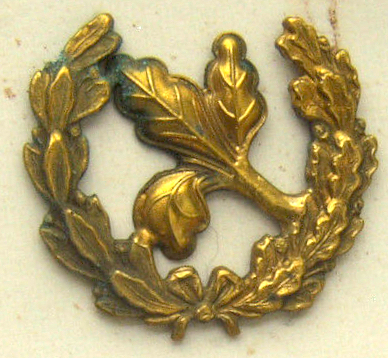
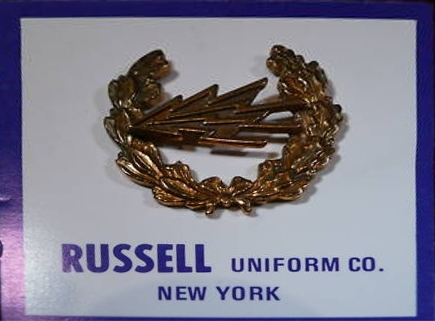
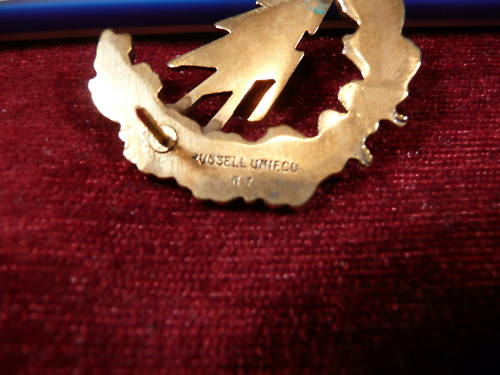
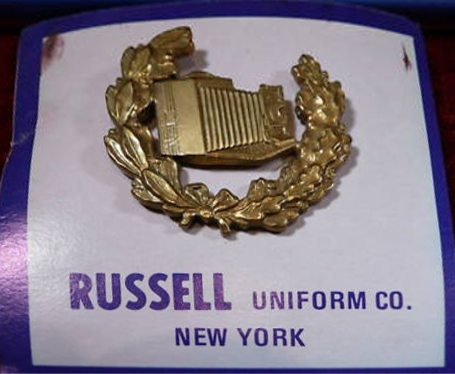
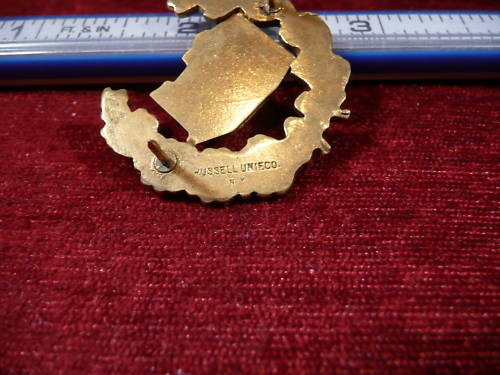
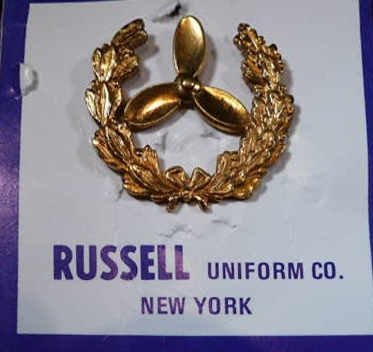
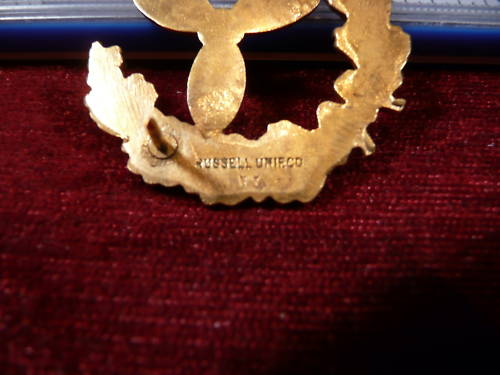
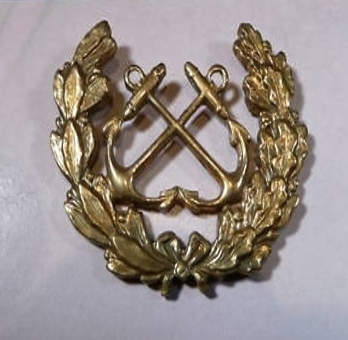
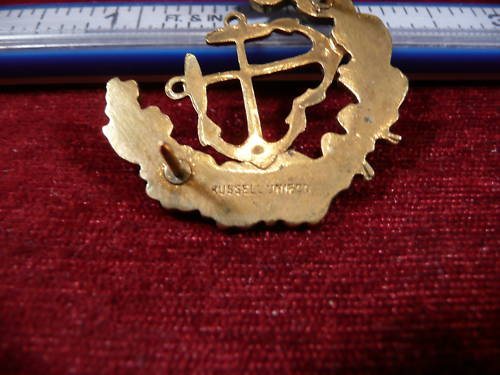
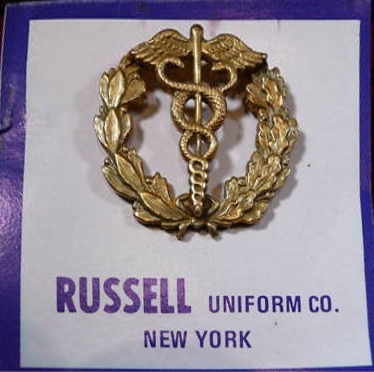
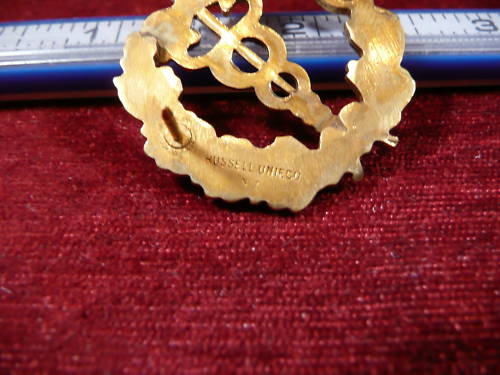
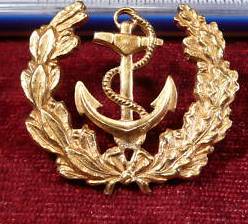
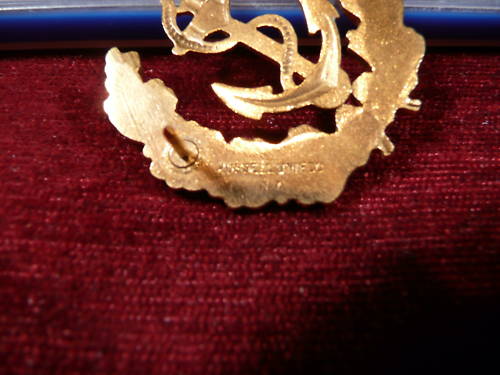
In late November 2018, I was approached and asked if I knew anything about insignia marked as coming from Russell Uniform Company. I spoke with Alan C. Beckman about his offerings a decade prior and he told me he was invited to the company’s offices in New York to take their existing stock when they were going out of business. With this amazing piece of information, I had purchased (and later returned a piece of Russell Uniform Co. insignia) from Mr. Beckman. Upon closer inspection, I found the insignia was a spray-painted cast. He congratulated me for my good eye and later told me that he had the cardboard privately printed (Tektronix printer) and he based the insignia on “unpublished” warrant officer regulations – he later told me he did not have the regulations:
Rudy has them in his book.
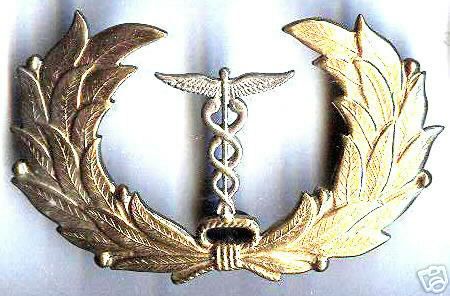
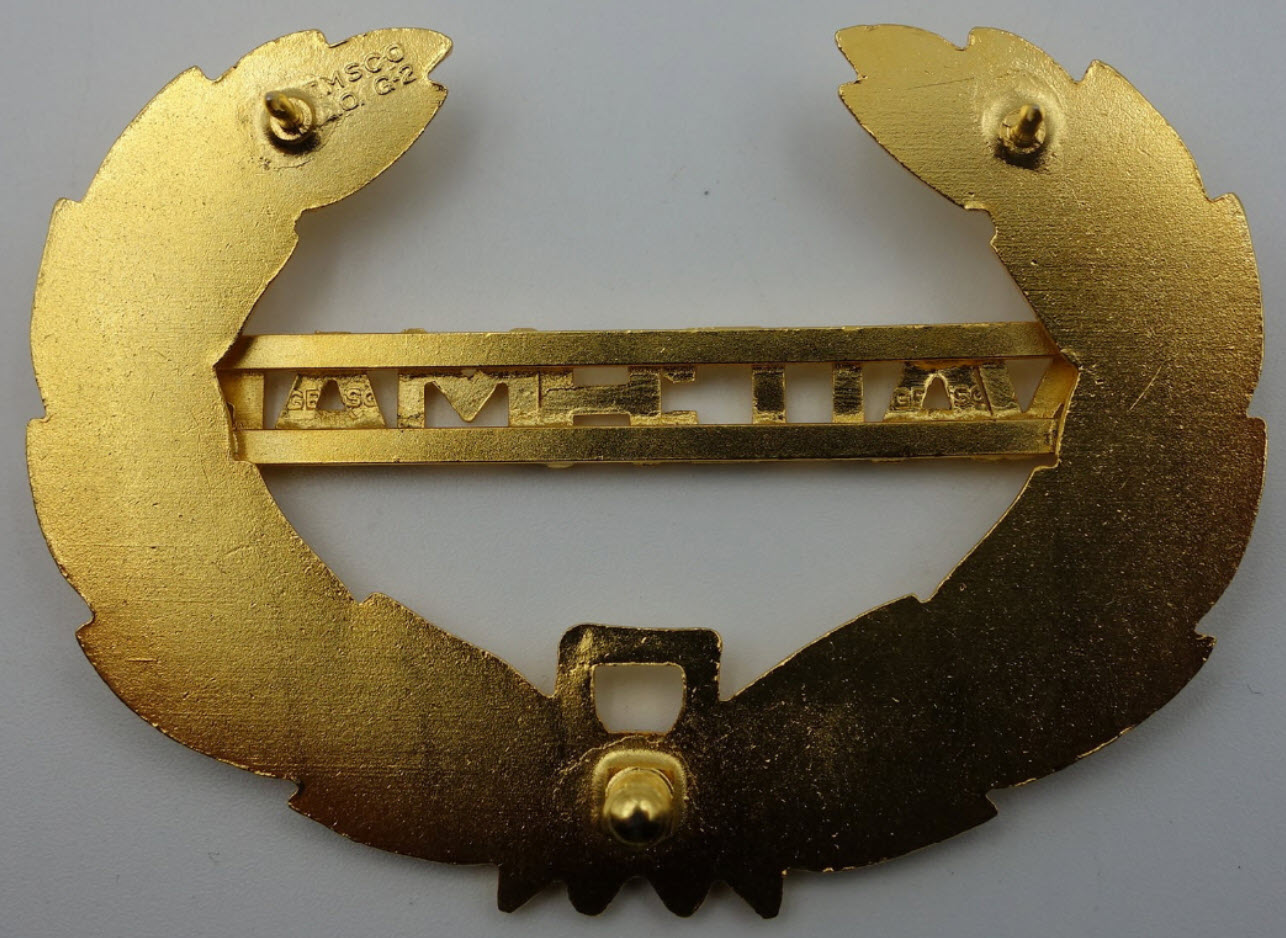
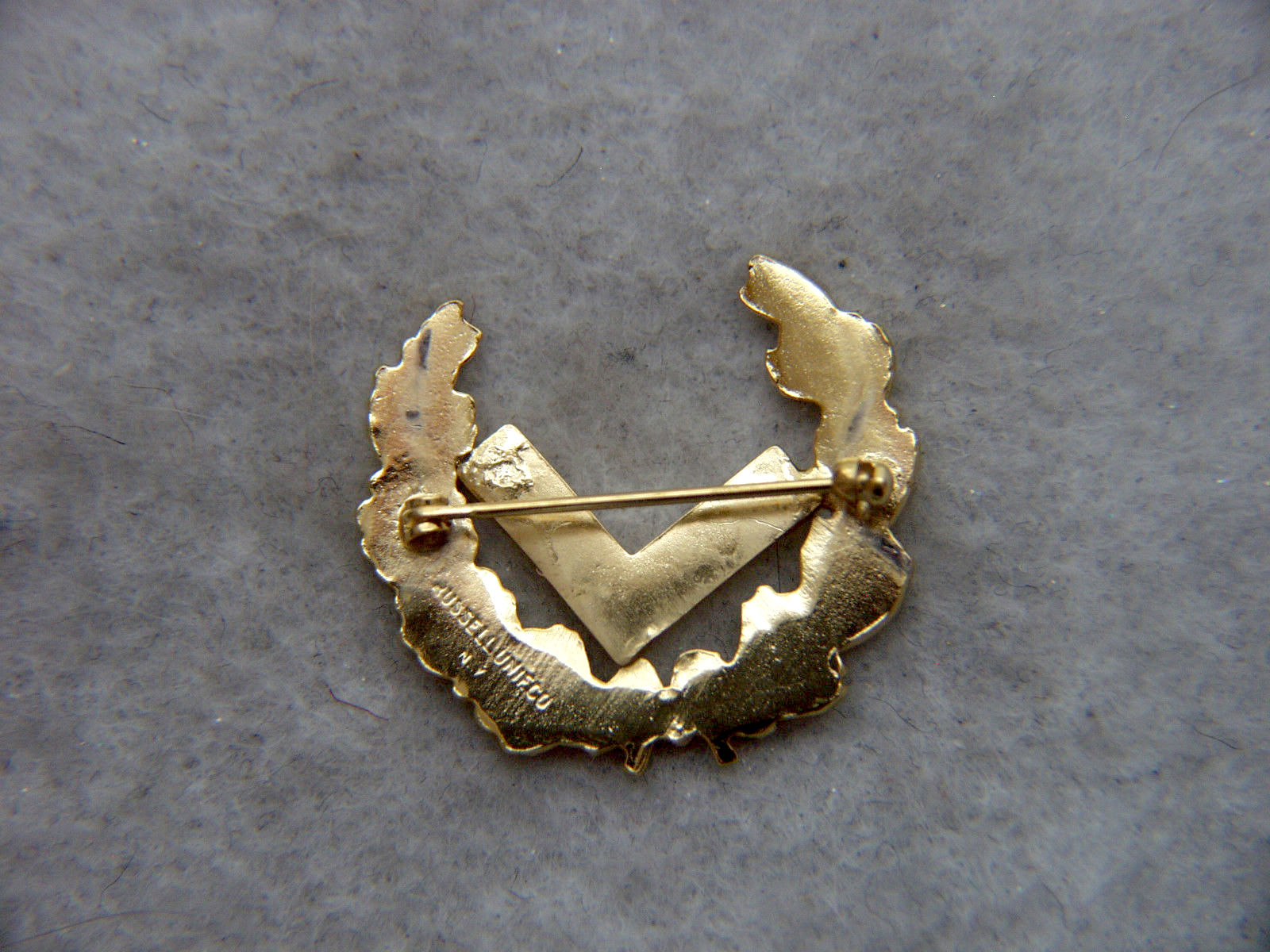
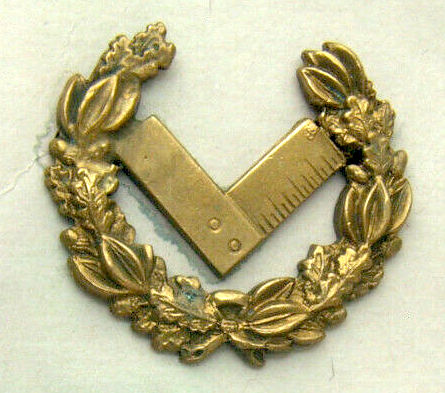
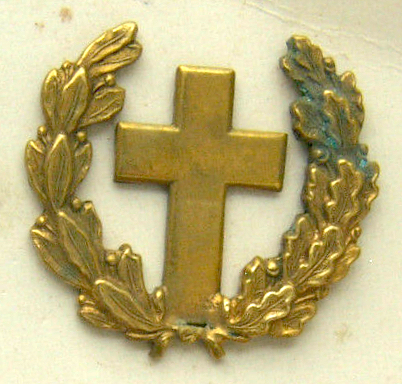
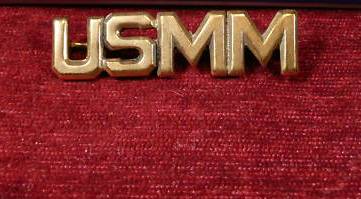
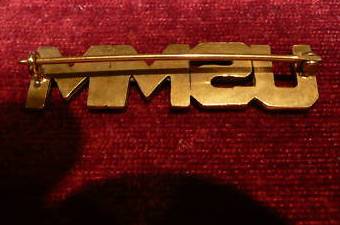
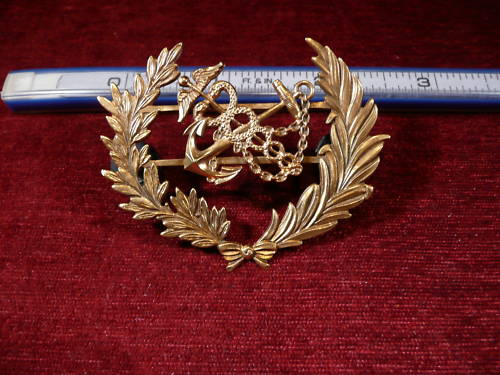
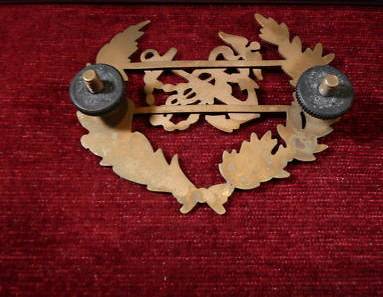
There was no going-out-of-business sale, and the unpublished regulations were made up. The United States Maritime Service used U.S. Navy warrant officer devices on collars and garrison hats; the only wreathed insignia were found on cuffs devices and shoulder boards. Russell Uniform Company did exist, it was a seller of police insignia and once the official uniform providers to the New York Police Department and New York State Police. Particularly problematic regarding much of the insignia is its corrosion – wartime insignia was not made of brass; especially when these items were purported to have come out: 1944-1945.
Fake MSTS Clerk
Fake MSTS Radio Officer
Fake USMS Warrant Engineer
Fake USMS Warrant Fantasy rate
Fake USMS Warrant Fantasy rate (reverse)
Fake USMS Warrant Carpenter
Fake USMS Warrant Carpenter (reverse)
Fake USMS Officer device
Fake USMS Warrant Carpenter
Fake USMS Warrant Chaplain
Fake USMS Warrant Clerk
Fake USMS Warrant Electrician
Fake USMS Warrant Engineer
Fake USMS Warrant Gunner
Fake USMS Warrant Pharmacist
Fake USMS Warrant Photographer
Fake USMS Warrant Radio Officer
Fake USMS Warrant Supply Officer
“Rudy Basurto” Collection
When I first posted this page, I received an anonymous comment with the images created below. Apparently, between August 2010 and February 2011, a number of merchant marine insignia flooded eBay. I dubb these “Rudy Basurto” Collection since they all looked very similar to items depicted in Rudy Basurto’s privately-printed book, Insignia of America’s Little Known Seafarers. To an item, each appeared at one time or another in usnusa eBay auctions. These images are important as they depict the reverses of many of the pieces of insignia, and they show detail otherwise absent from the scans above.
Fox Militaria Mailer | Sarge Booker
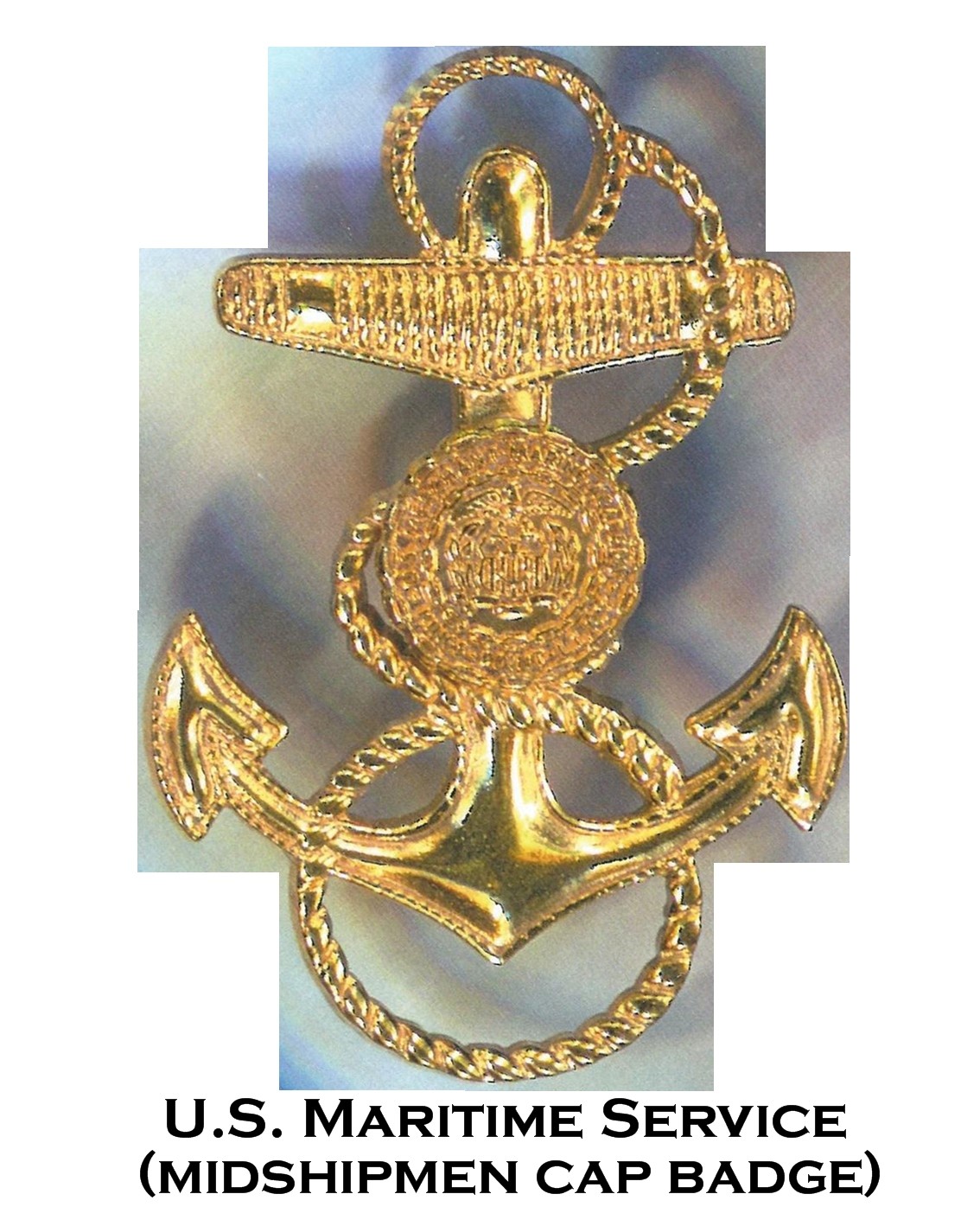
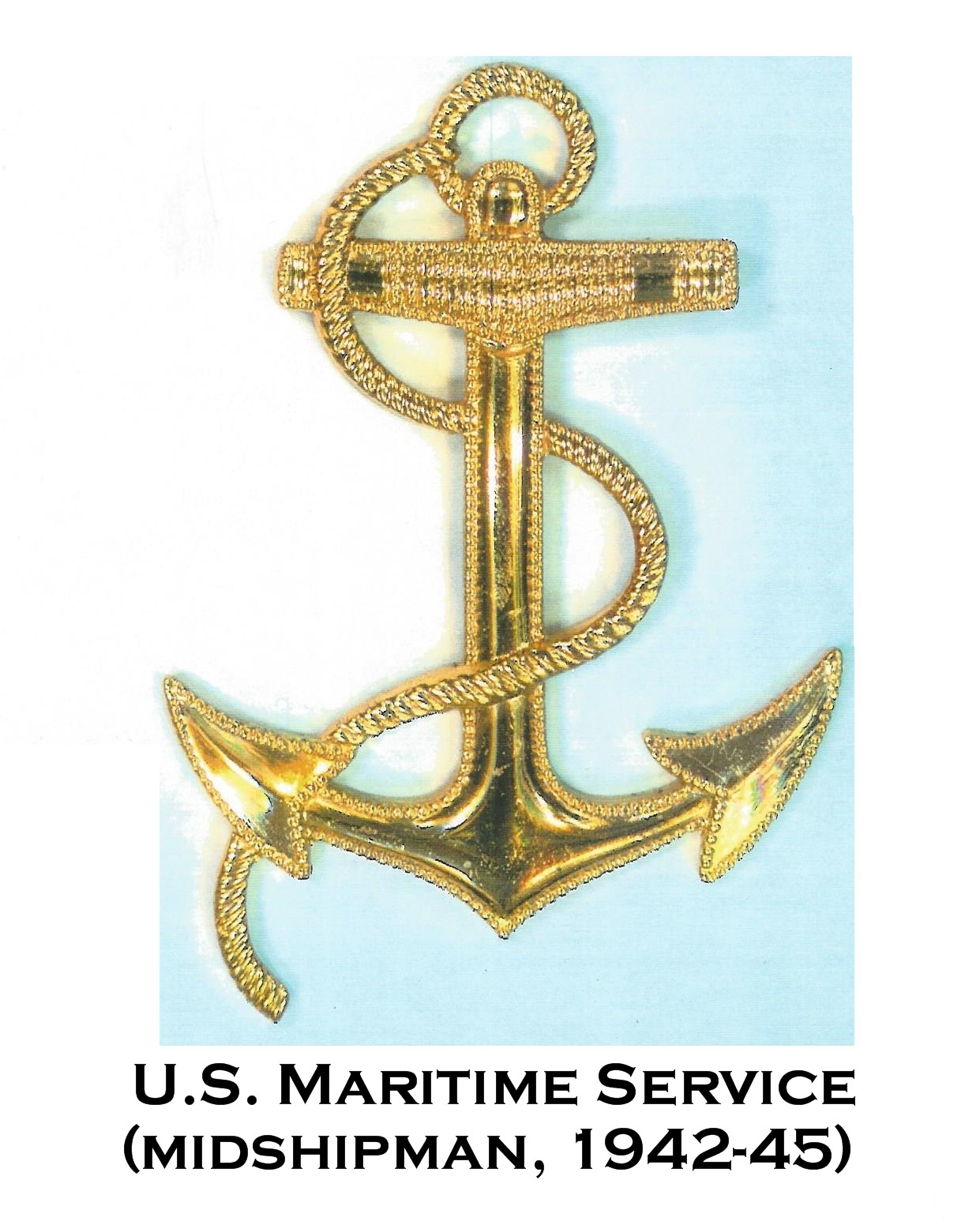
In the early aughts, Mr. Beckman contacted all of his previous customers and sent them direct mailers with items that may interest them given past purchases. These images were scanned and provided to me by Sarge Booker. Although not in this flier, Sarge intimated that Mr. Beckman has woven badges jobbed out all his woven badges to a firm in Pakistan. All of the items, with the exception of the “Maritime Service Midshipman 1942-1945,” “MSTS,” and “MSC” items are not official issues. Apparently, the USMS Midshipman badge was an actual trial struck for use at Kings Point; the Administration declined.
One day, I asked Sarge how Mr. Basurto and Mr. Beckman got in contact – they were both subscribers to a zine Sarge put out called “Crow’s Nest.” Mr. Basurto was had the idea of writing a monograph called “Insignia of America’s Little Known Seafarers” and the three collaborated to add content; some pieces actual and some speculative.
Commentary
This post has seen many revisions since it was first drafted; in its first iteration, it was merely a commentary on my opinion regarding what is problematic about a particular insignia item. That commentary is as follows.
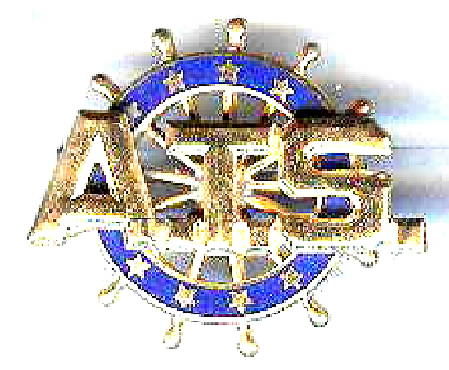
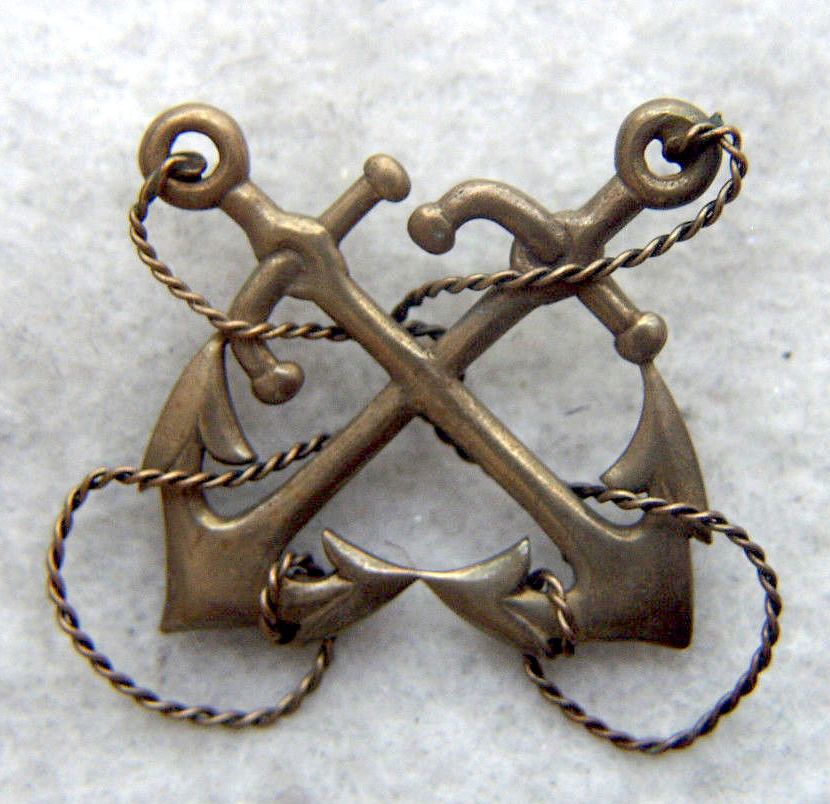
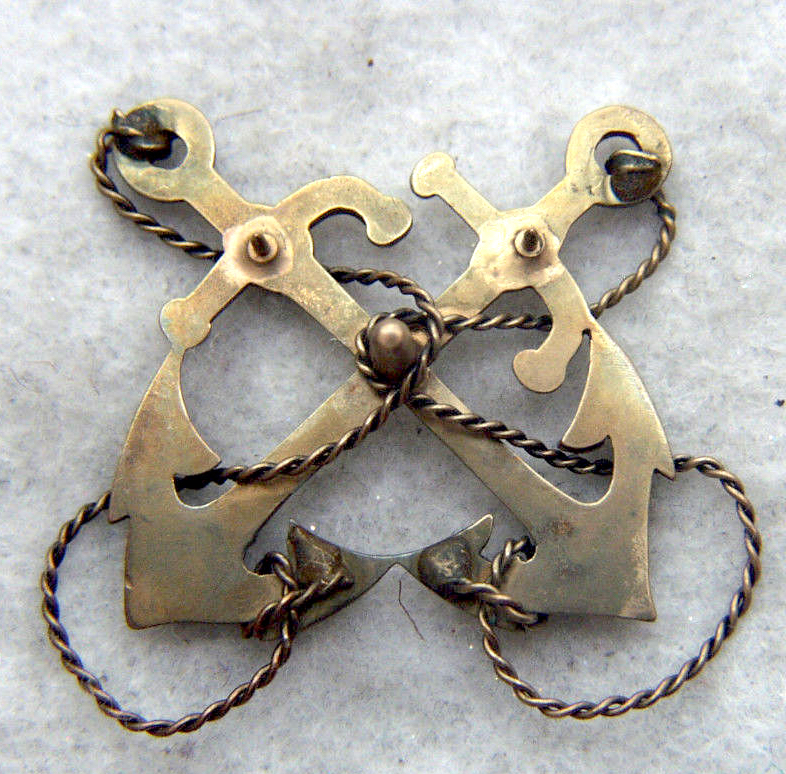
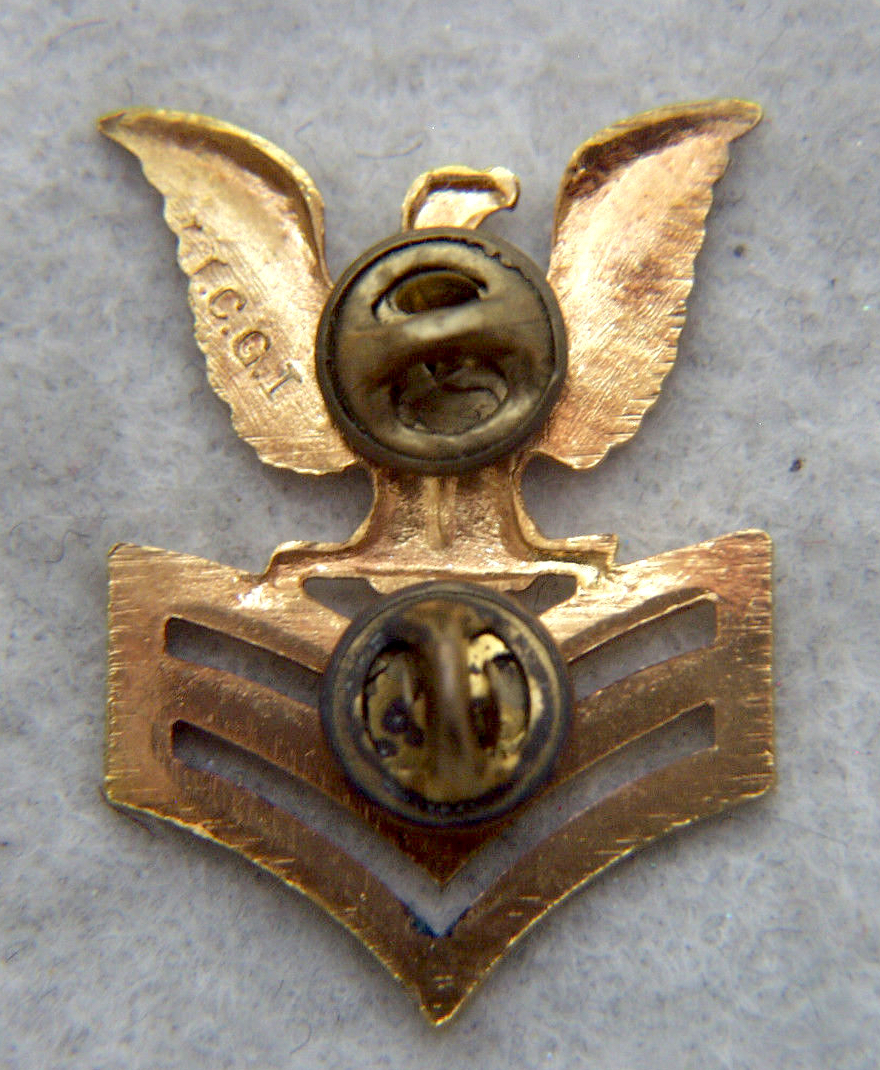
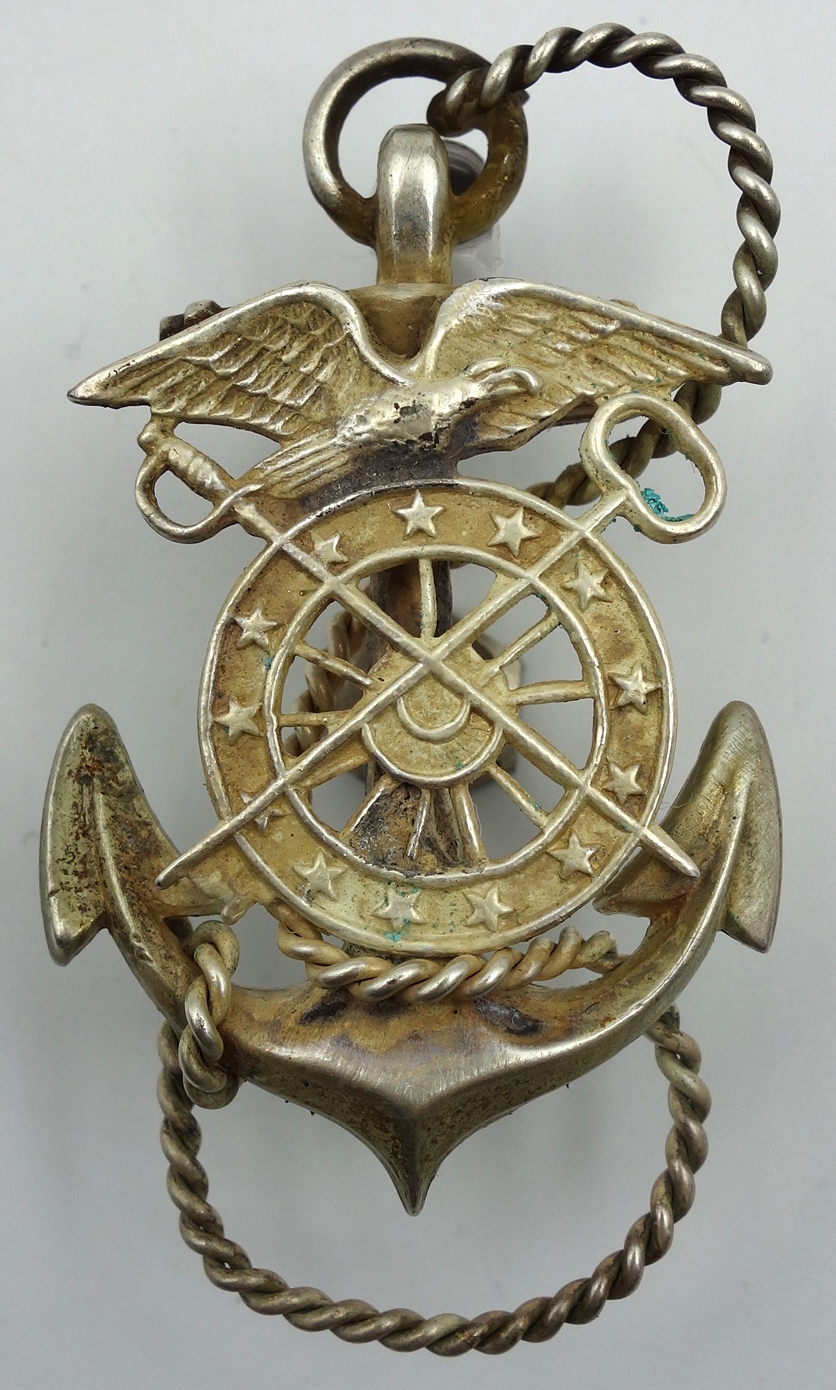
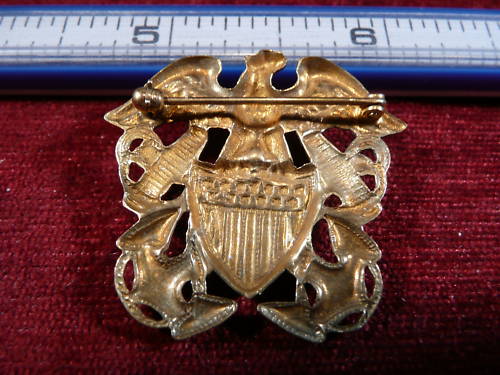
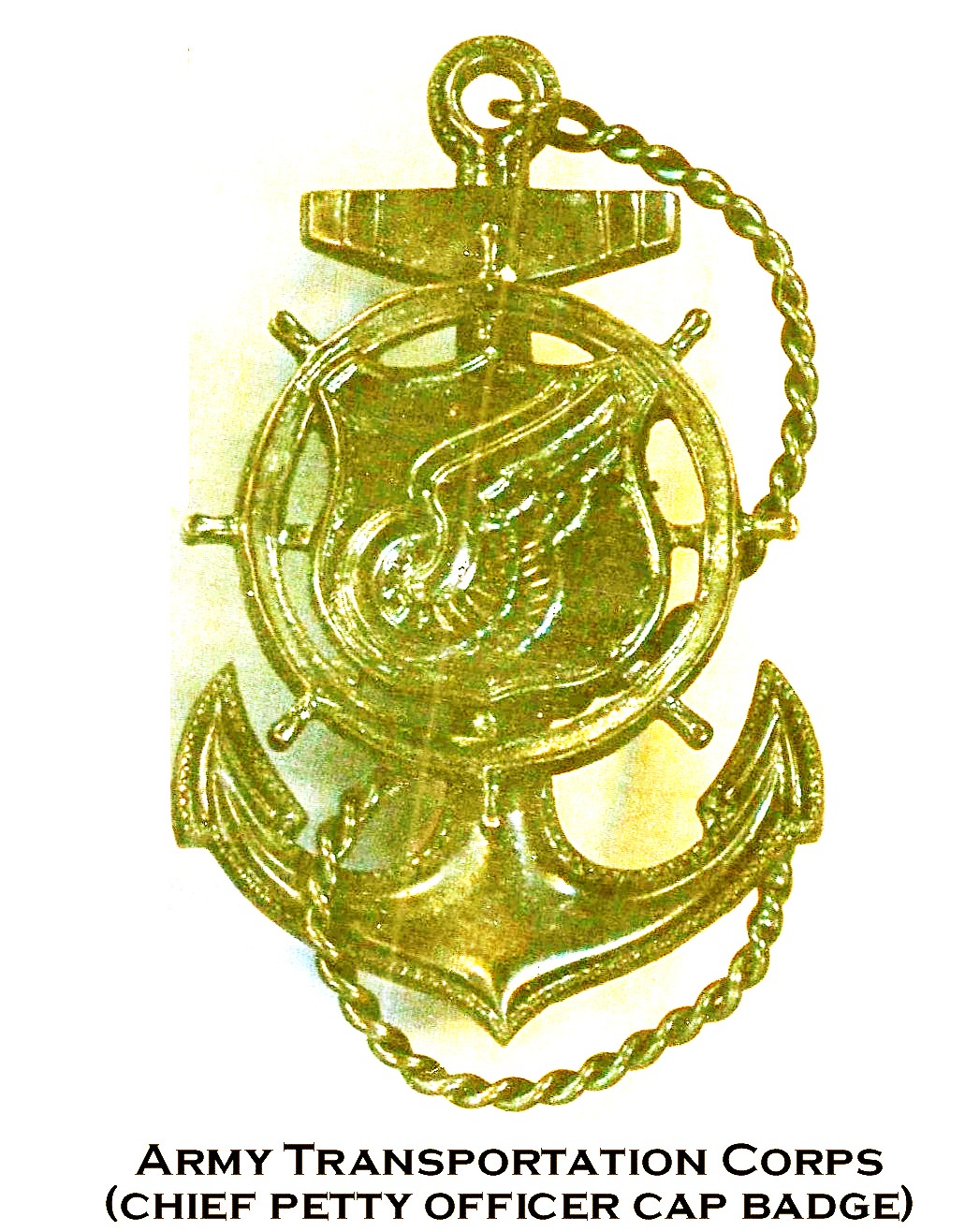
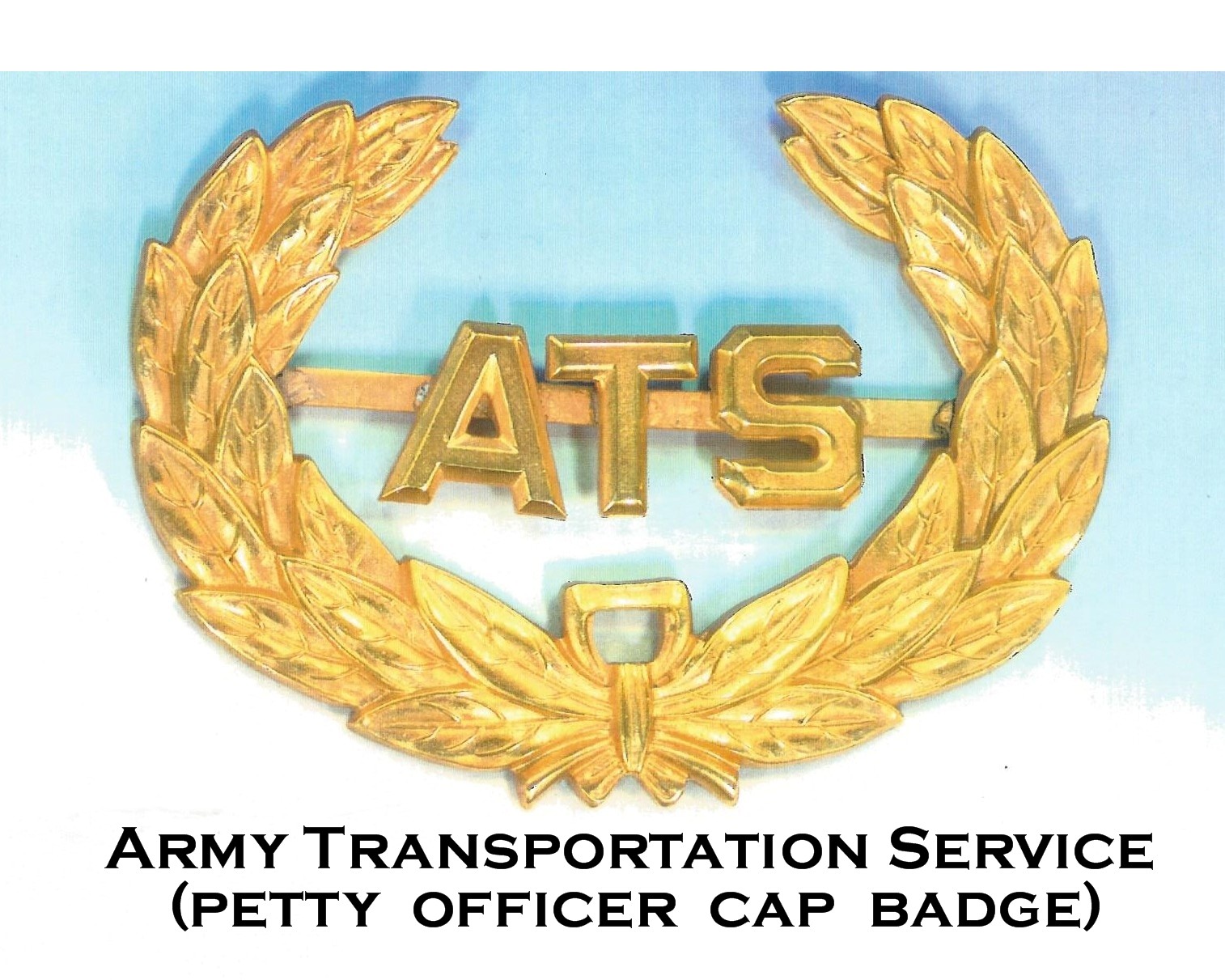
ATS Chief Petty Officer This device comes up in online auctions from time-to-time with examples in bronze. Alan’s signature is the hand-applied and soldered “rope.” The wire is loose, and the reverse solder is sometimes blotchy. His pieces have N.S. Meyer hallmarks – this is due to the fact he purchased many unfinished pieces and dies were sold at auction in the 1990s when the N.S. Meyer plant closed – every year about 3-4 of these badges find their way to sale.
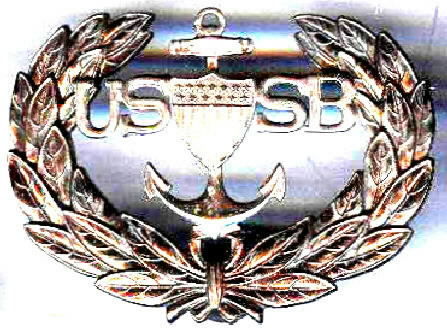
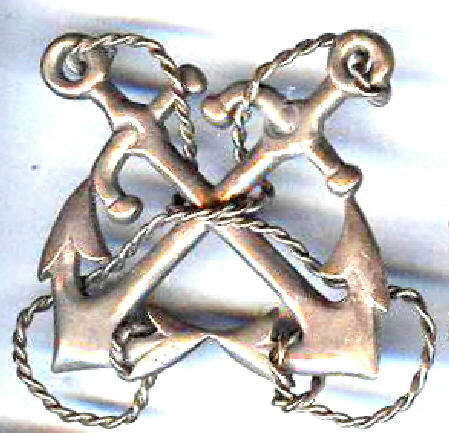
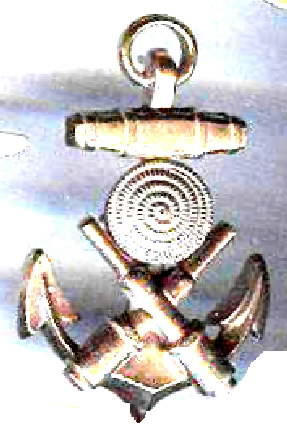
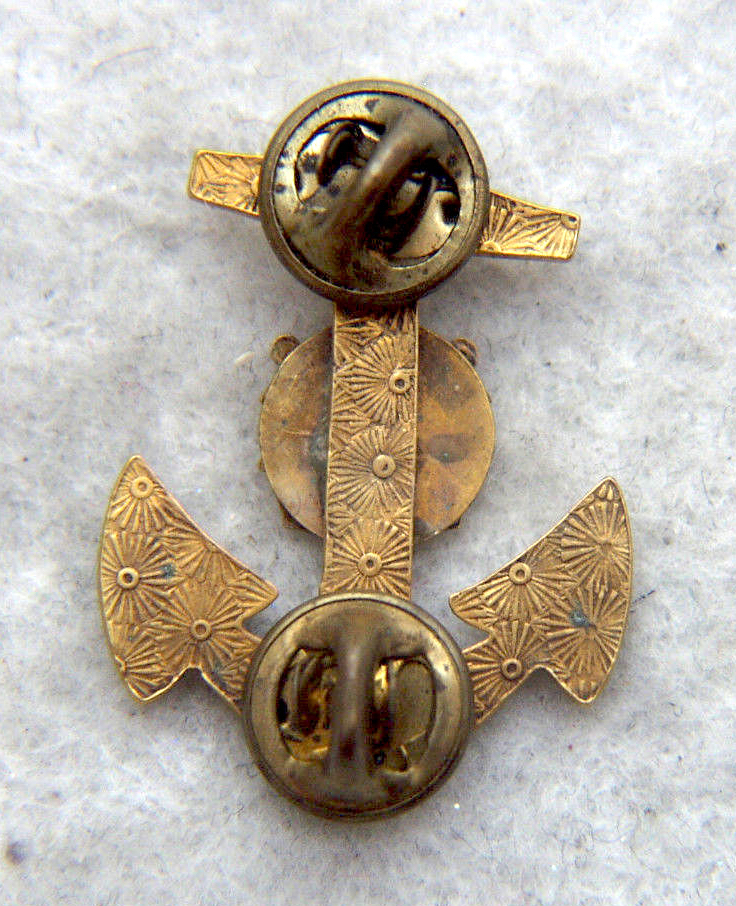
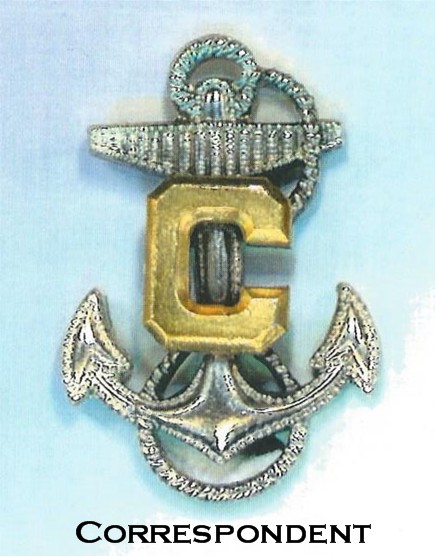
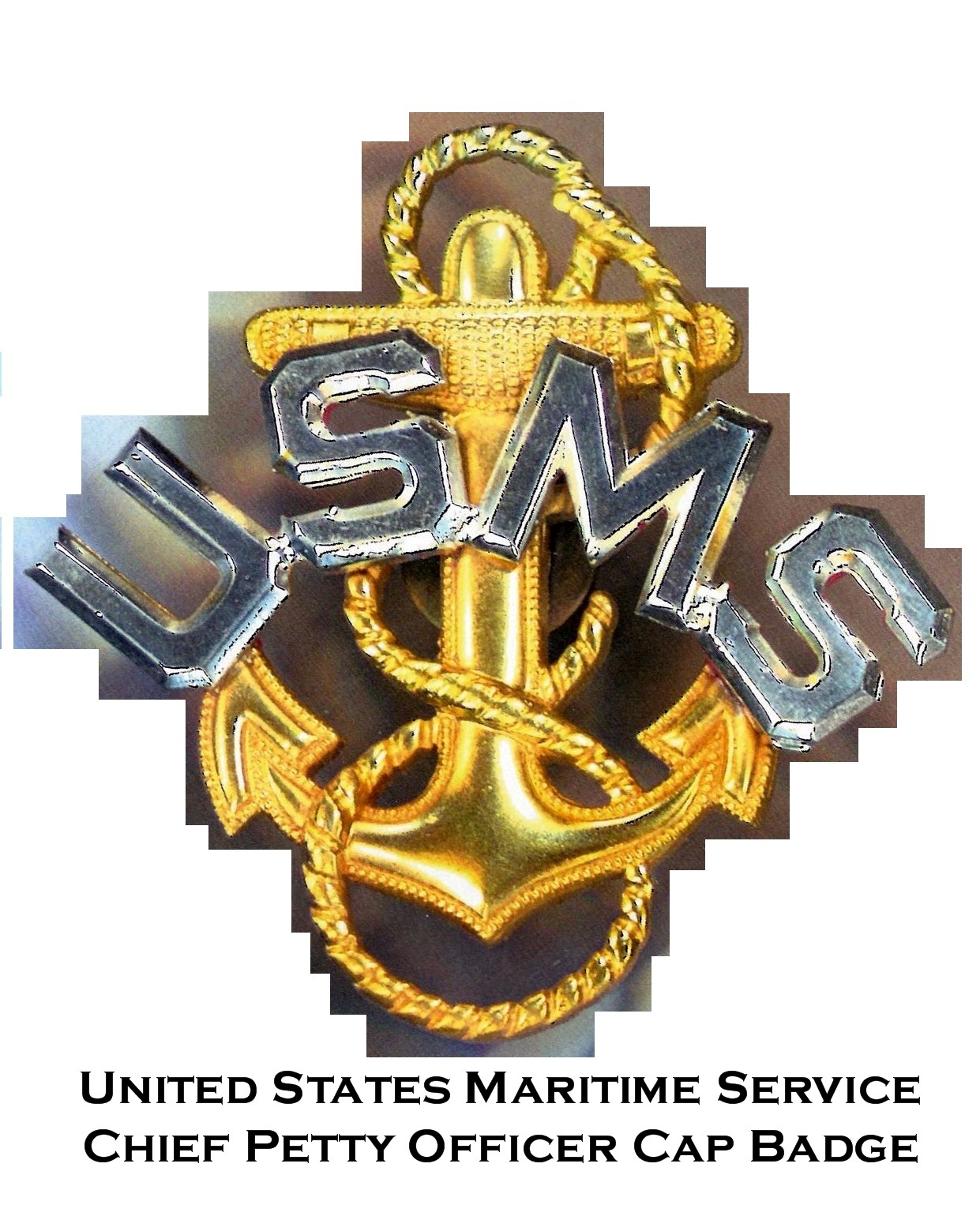
USMS Chief Petty Officer The applied anchor is a dead giveaway. No USMS CPO devices were ever manufactured that have said application. Alan offered the same device with silver applied anchors. In regard to the anchors themselves, these are actually old N.S. Meyer appurtenances struck in the late 1930s for use with U.S. Maritime Commission Cadet Corps Scholastic Award Ribbon.
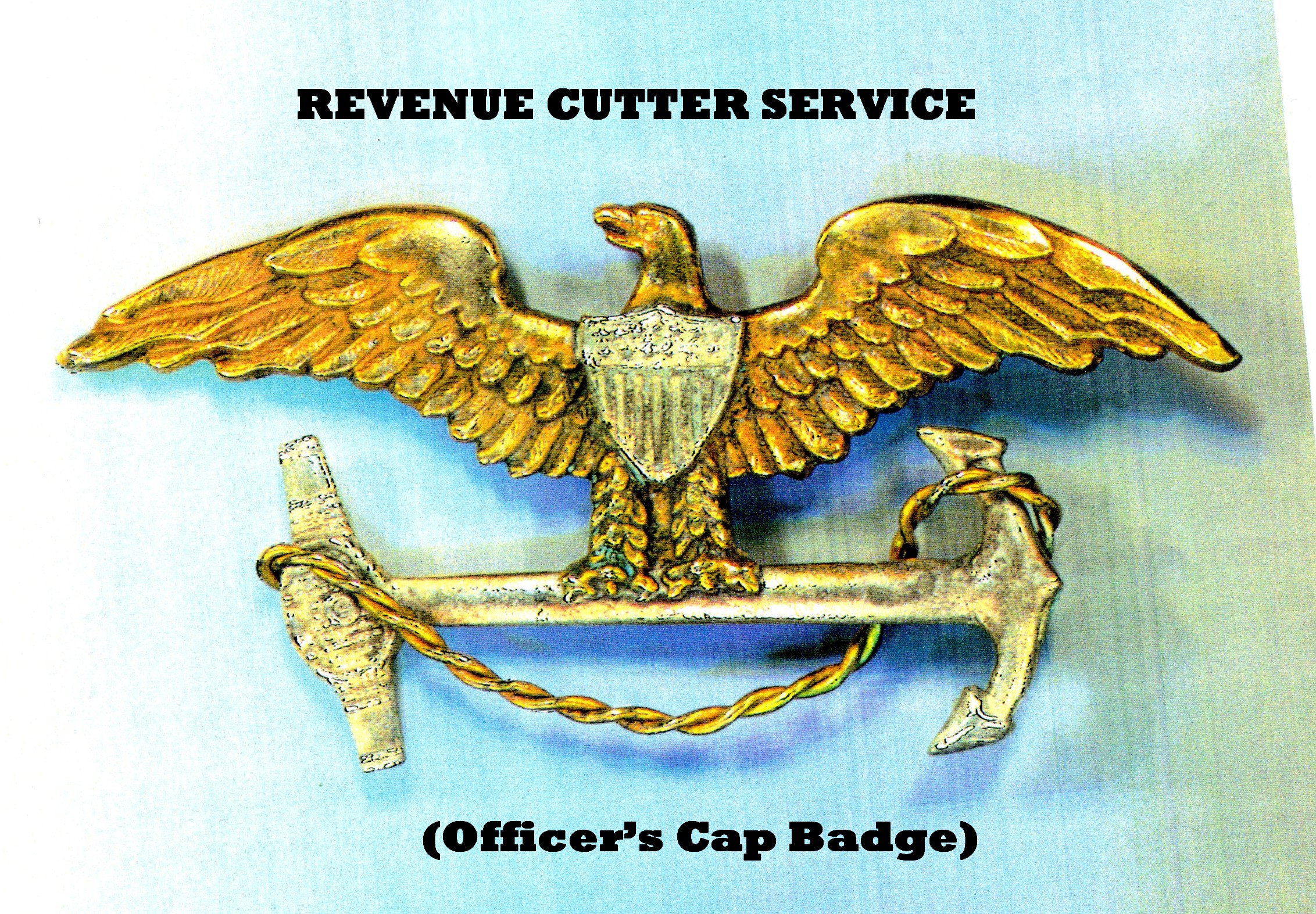
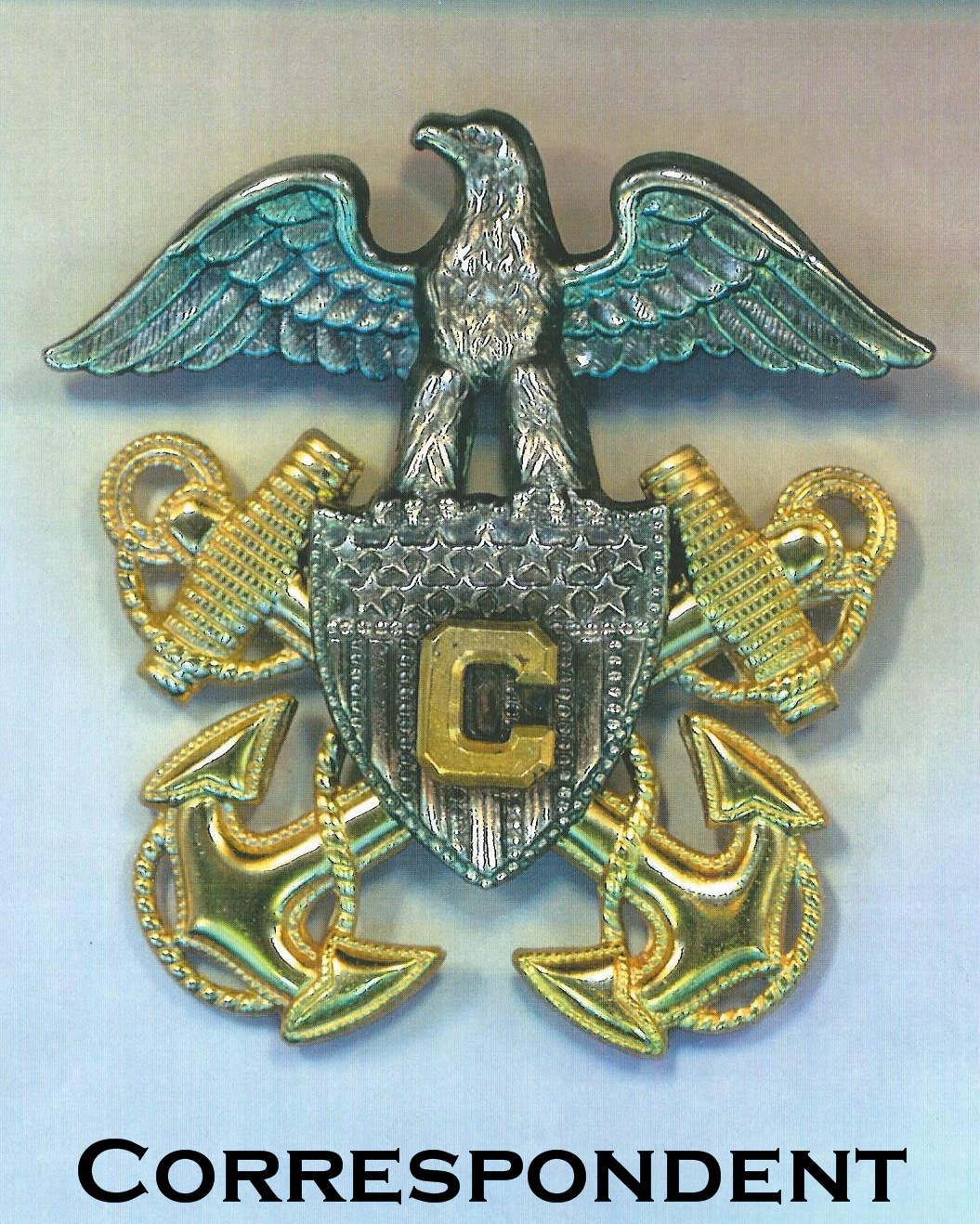
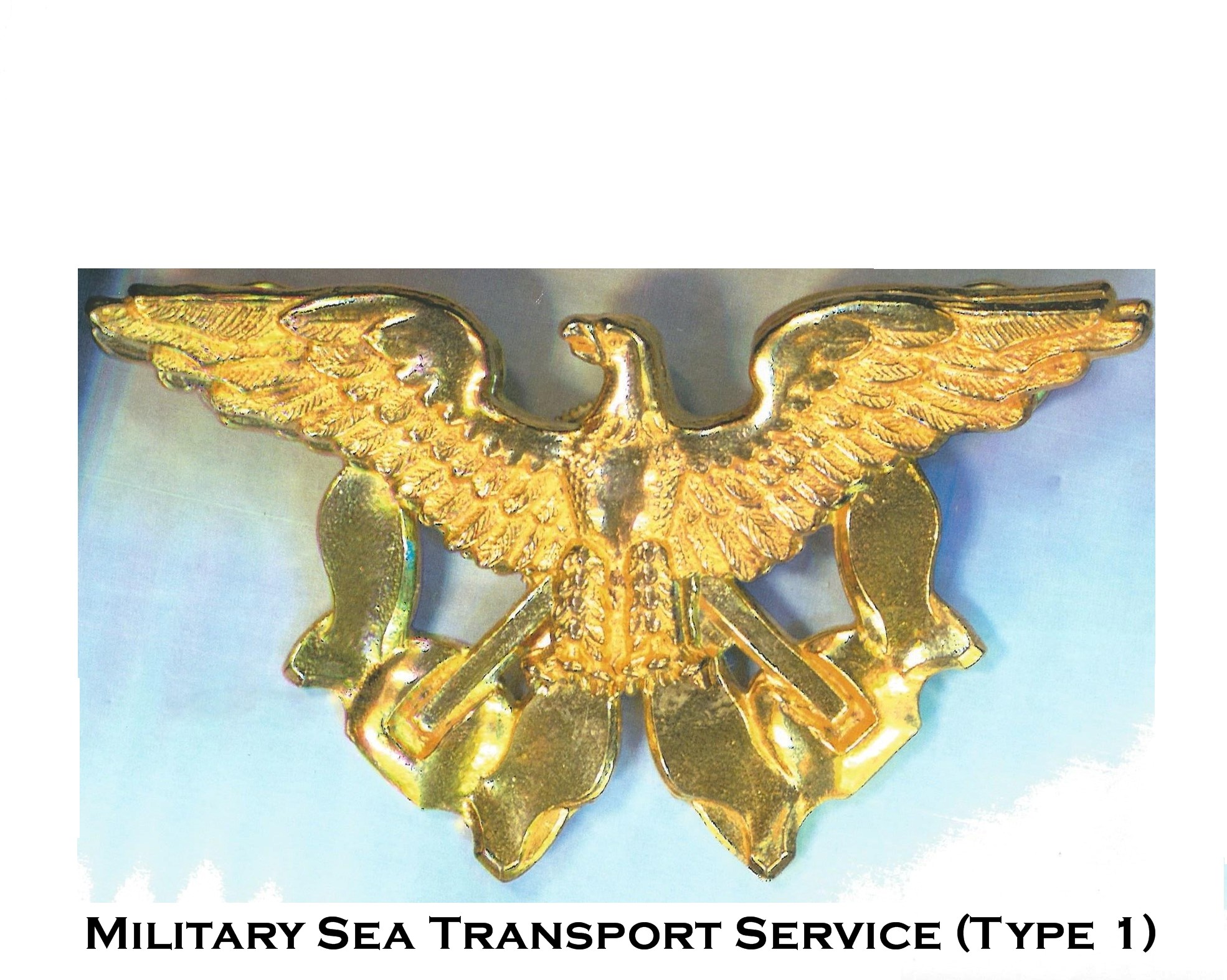
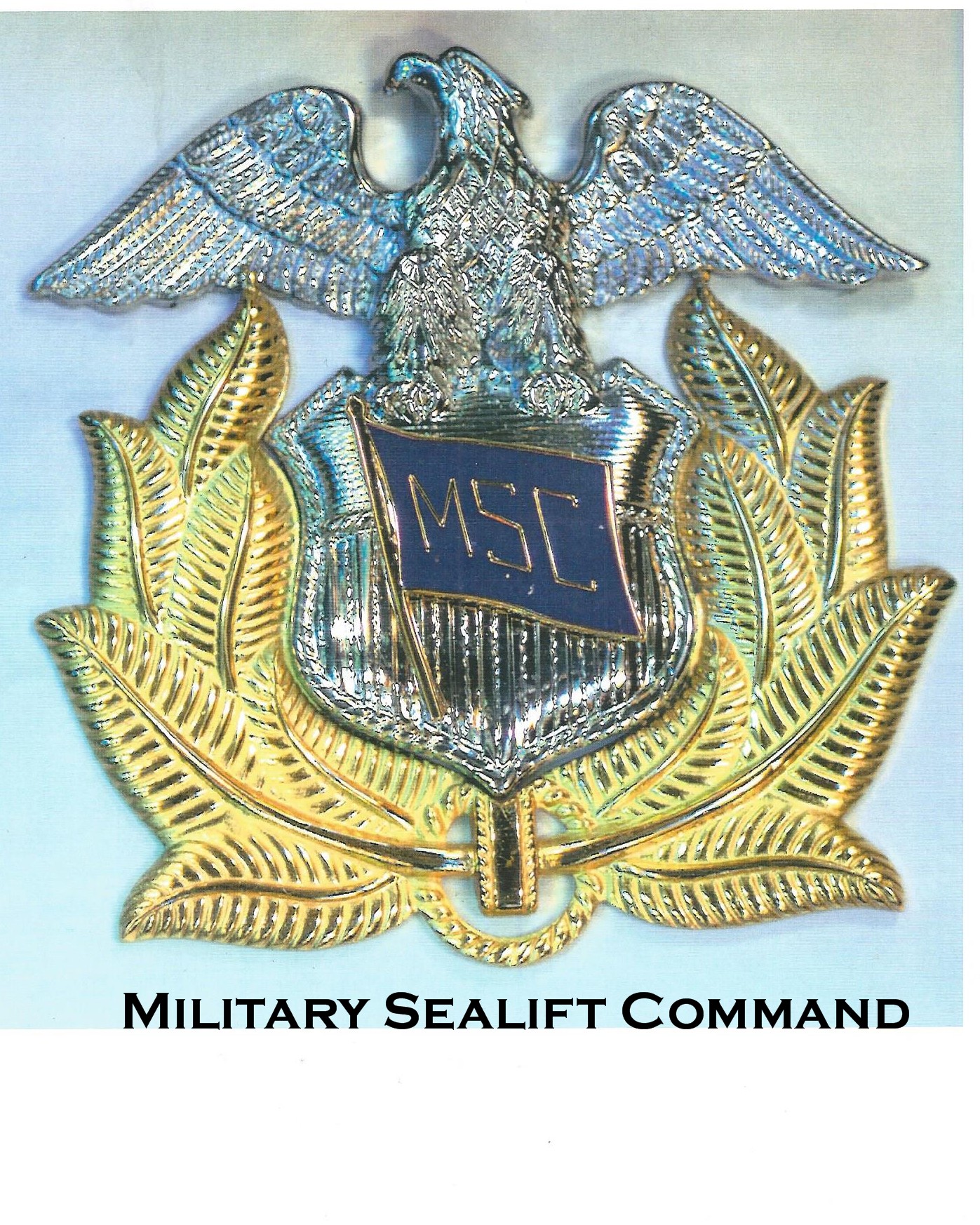
This is a fun badge. The eagle is actually a MSTS eagle with a USCG shield and USN anchors. US C&GS hat badges from the time of the Second World War are exclusively woven. Only postwar did metal hat badges come to be manufactured; with those matching NOAA examples from the present day.
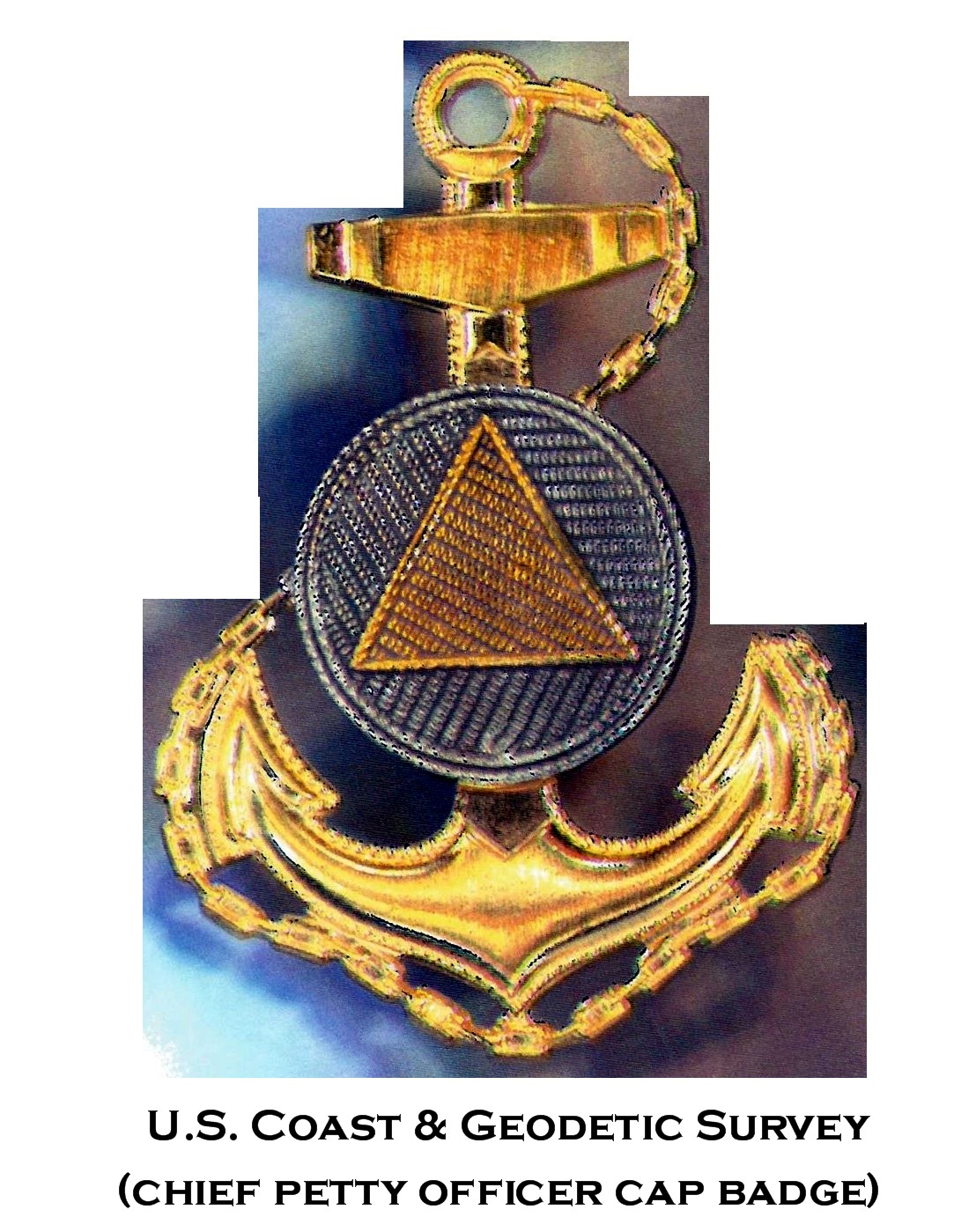
US Coast & Geodetic Survey Senior Chief Petty Officer
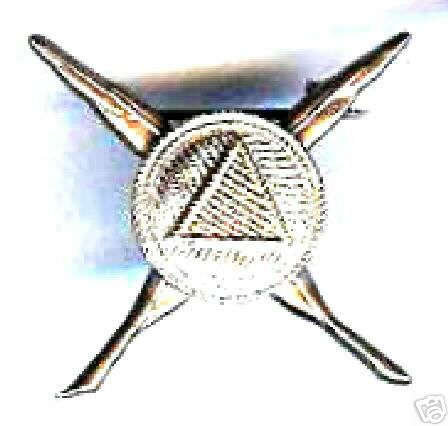
This badge is a mash-up of ideas. It was not until 1968 that the US Navy Uniform Board approved a Master and Senior Chief Petty Officer cap insignia – similar to their collar devices, with one or two silver stars superimposed on the anchor, inverted and centered on the stock. The US Coast Guard soon followed the US Navy’s lead in 1970, as did the regulations for US C&GS/NOAA. The US C&GS had a small core of Chief Petty Officers up until the 1950s, afterward they converted to unlicensed, un-uniformed Federal, civil-service employees. Proposed insignia tables were published in 1965 without examples being produced. With the transfer of the agency to the Environmental Science Services Administration, all non-commissioned officer positions were removed and finally ceased to be with the 1970 reorganization into the National Oceanic and Atmospheric Administration.
Students of naval insignia will note that on this particular hat badge is the fact that the star is not of the type used by any of the licensed manufacturers of US Military establishment insignia, and and the anchor itself is that of a US Navy ROTC/Annapolis midshipman. The only US CG&S true device is the triangle within the circle.
USMS Supply Officer
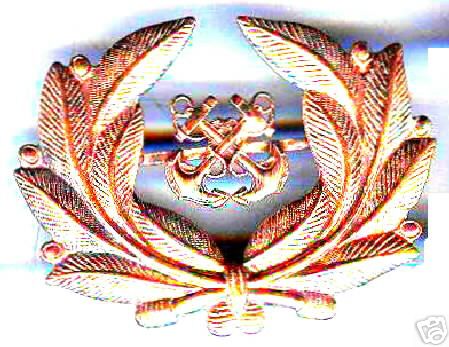
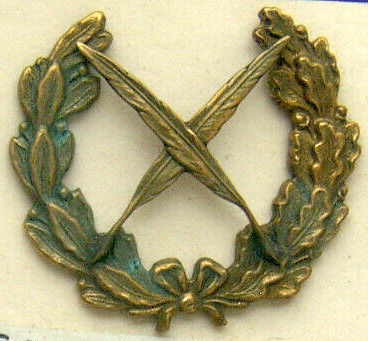
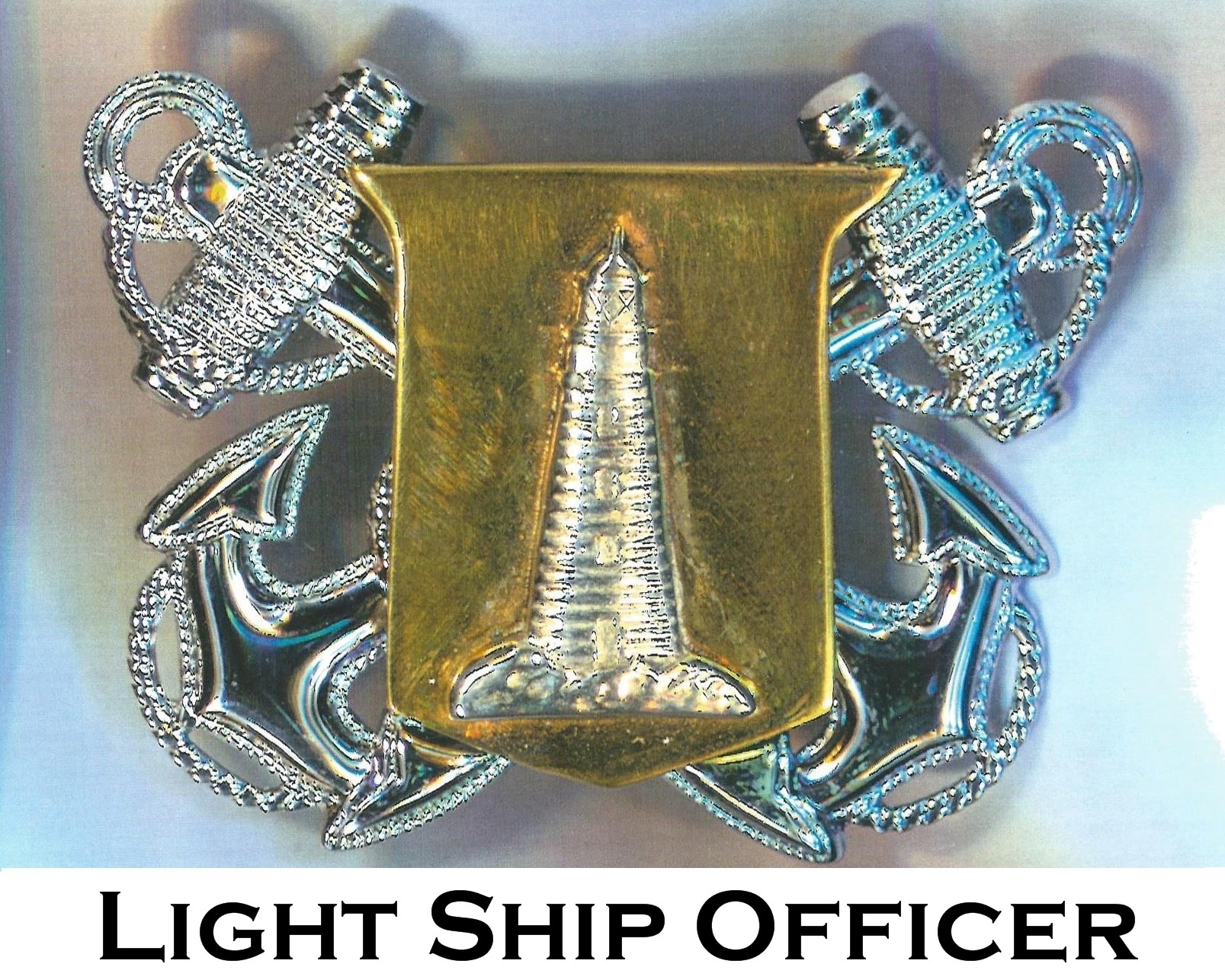
Russell Uniform Company had a cache of badges they created as patterns for the United States Maritime Service, but they were never is sued. These badges were simply too large to be worn on the collar; what the USMS did instead was to wear USN warrant officer badges. When Russell Uniform Company closed shop (formerly of 1600 Broadway & 192 Lexington Ave., New York City and the original uniform shop for NY State Troopers), Alan purchased their stock; thus these badges fall in the gray area of Official and Unofficial issues.
After I wrote the above, I contacted Alan, and he mentioned the cards he provided with the insignia were sometimes privately printed. He did admit to combining some USN warrant officer pins with Russell Uniform Company wreaths – just look for the sheared-off posts. If there is pitting, the wreaths were cast by him.
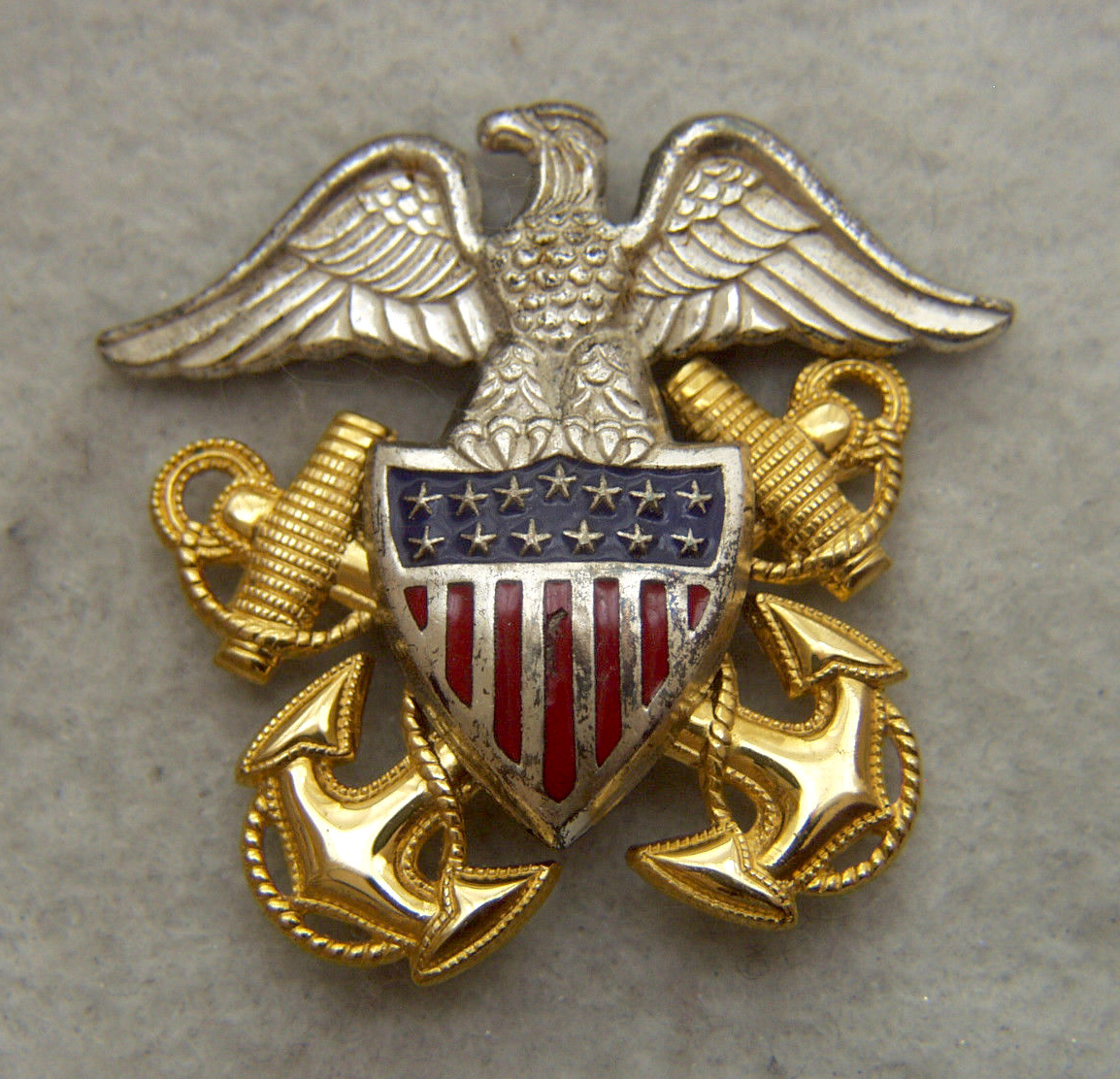
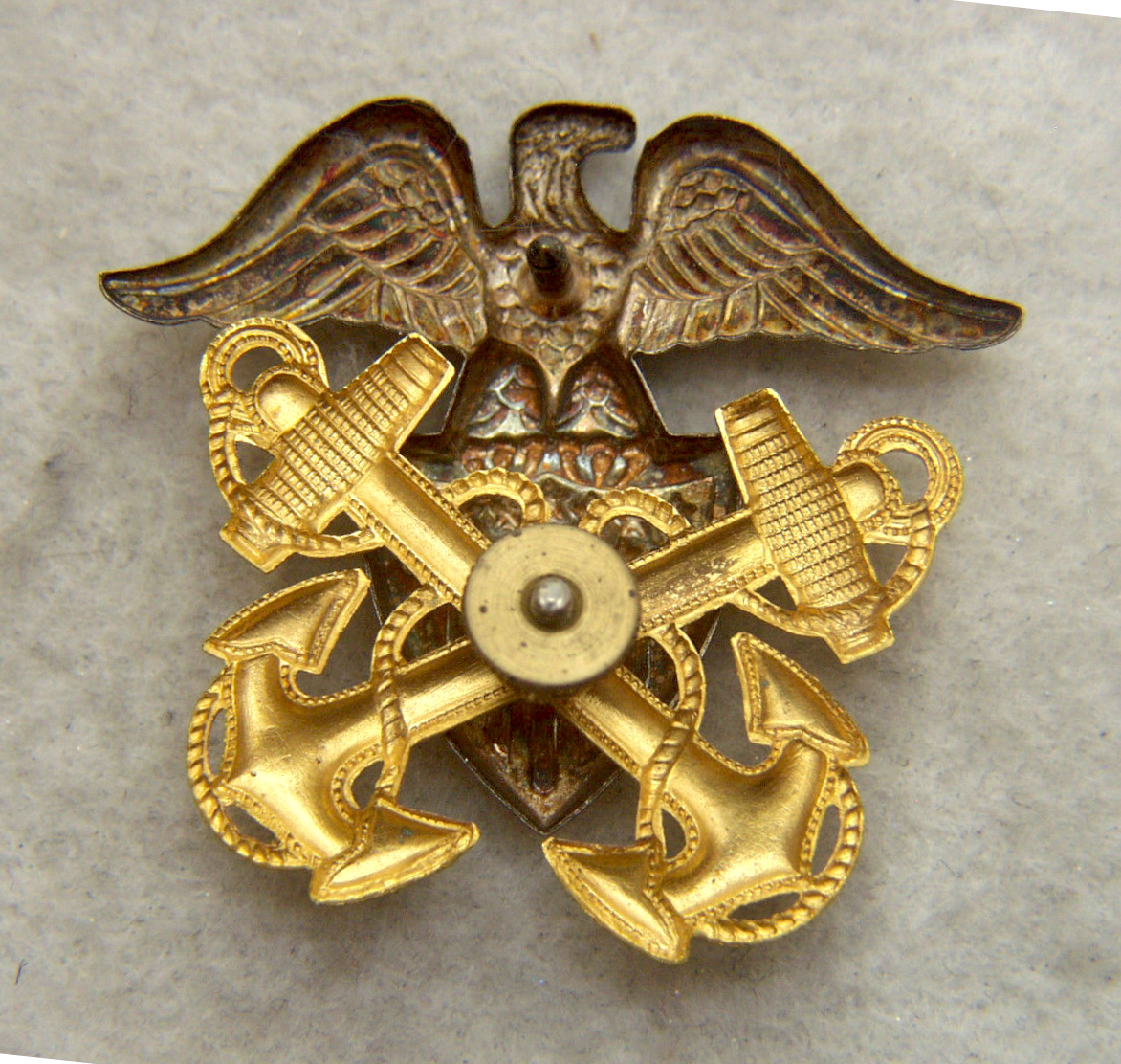
US Navy Commissioned Officer
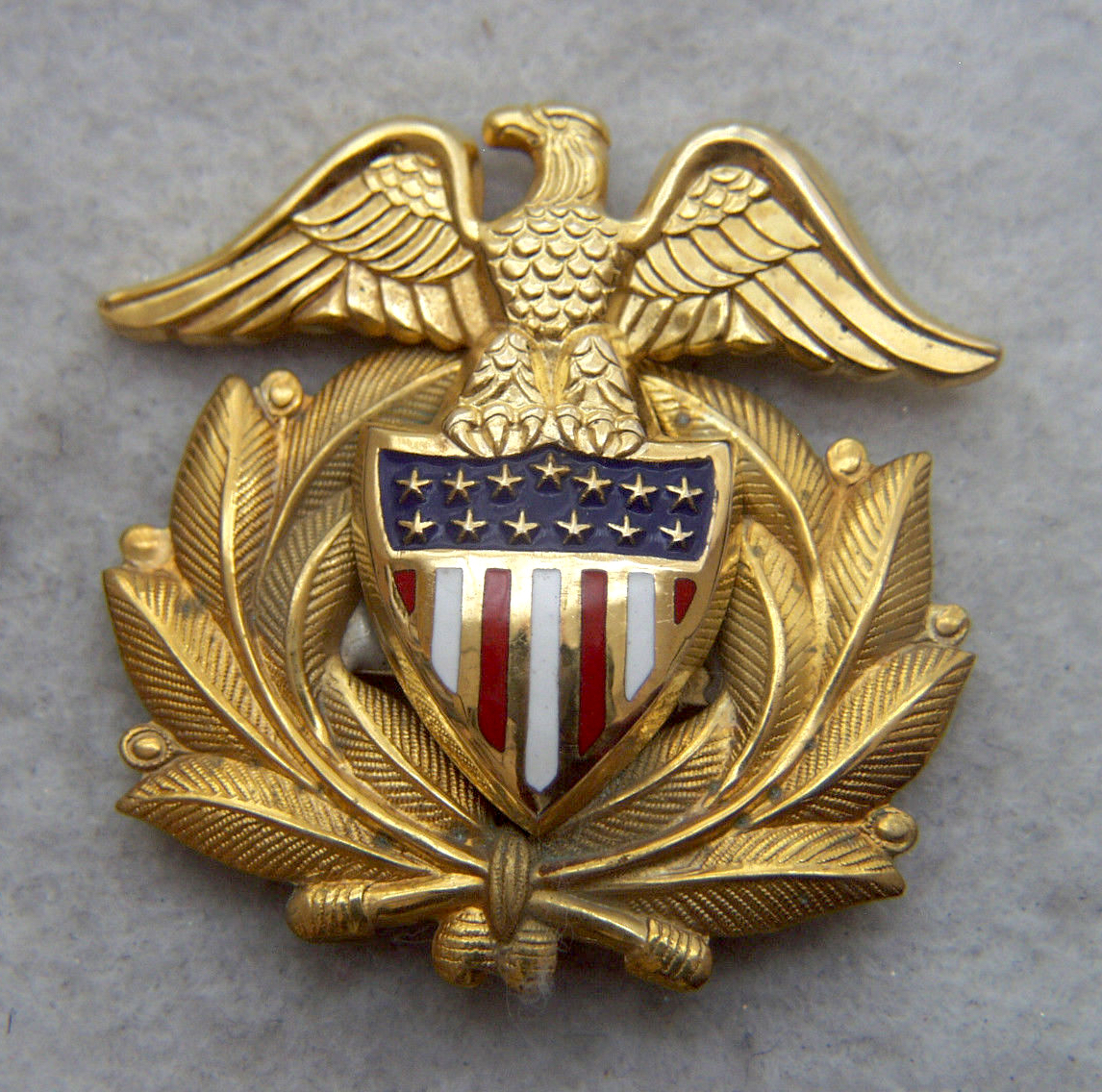
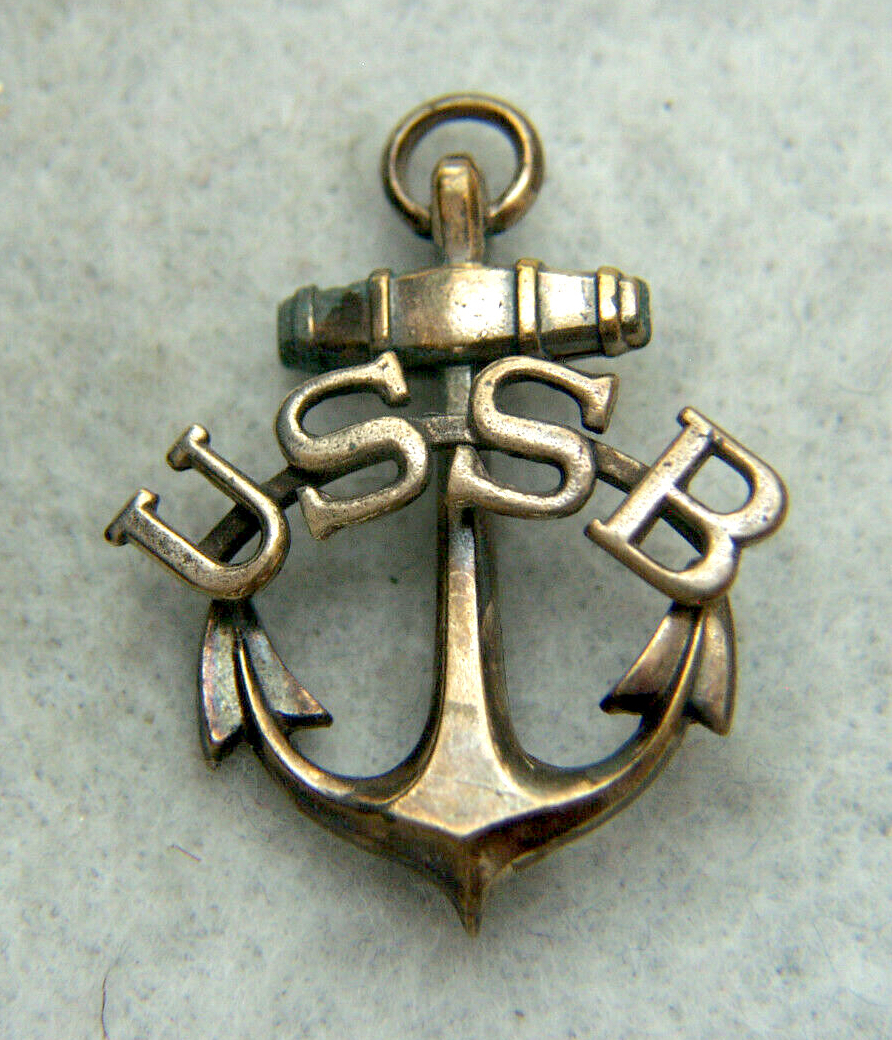
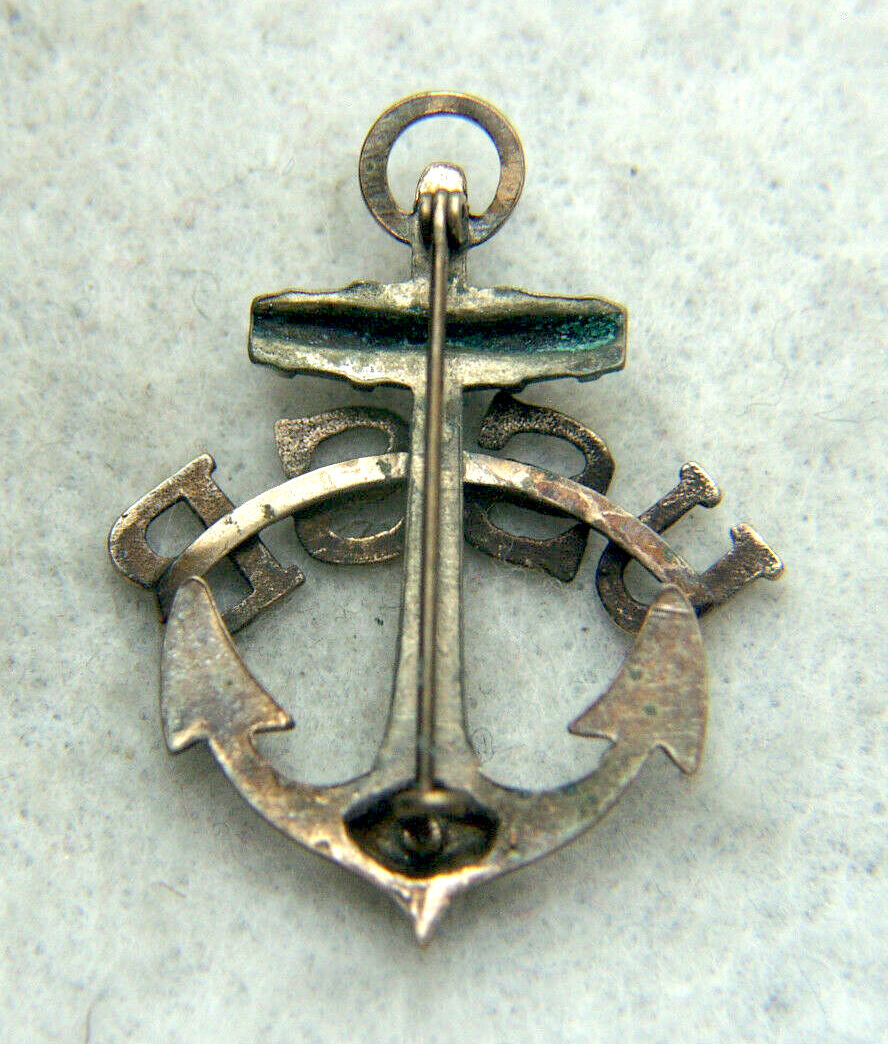
This is not quite a restrike. The die was designed, yet the badges never went into production. I have an actual, issued US Navy Commissioned Officer hat badge of the “pre-1940s” type in another post. Alan also had this badge as what he called a WSA cap badge. The WSA badge had bronze anchors and three stars on the shield; this would have been a fantasy issue since the WSA never issued such a badge; the three stars were a misunderstanding/attribution of MMP cap badges with the thought of what a USSB cap badge would have looked like.
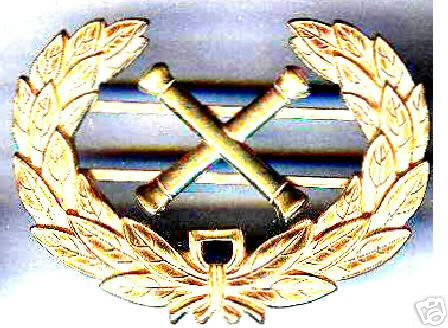
USMS Gunner Although the USMS had a gunner rate, these gunners only served at training stations. It is a nice thought, though. Thoroughly unofficial ATS examples use the same central device within a wreath and are woven and not struck.
ATS Radioman
This is sometimes advertised as either an ATS Electrician or Radioman. See above.
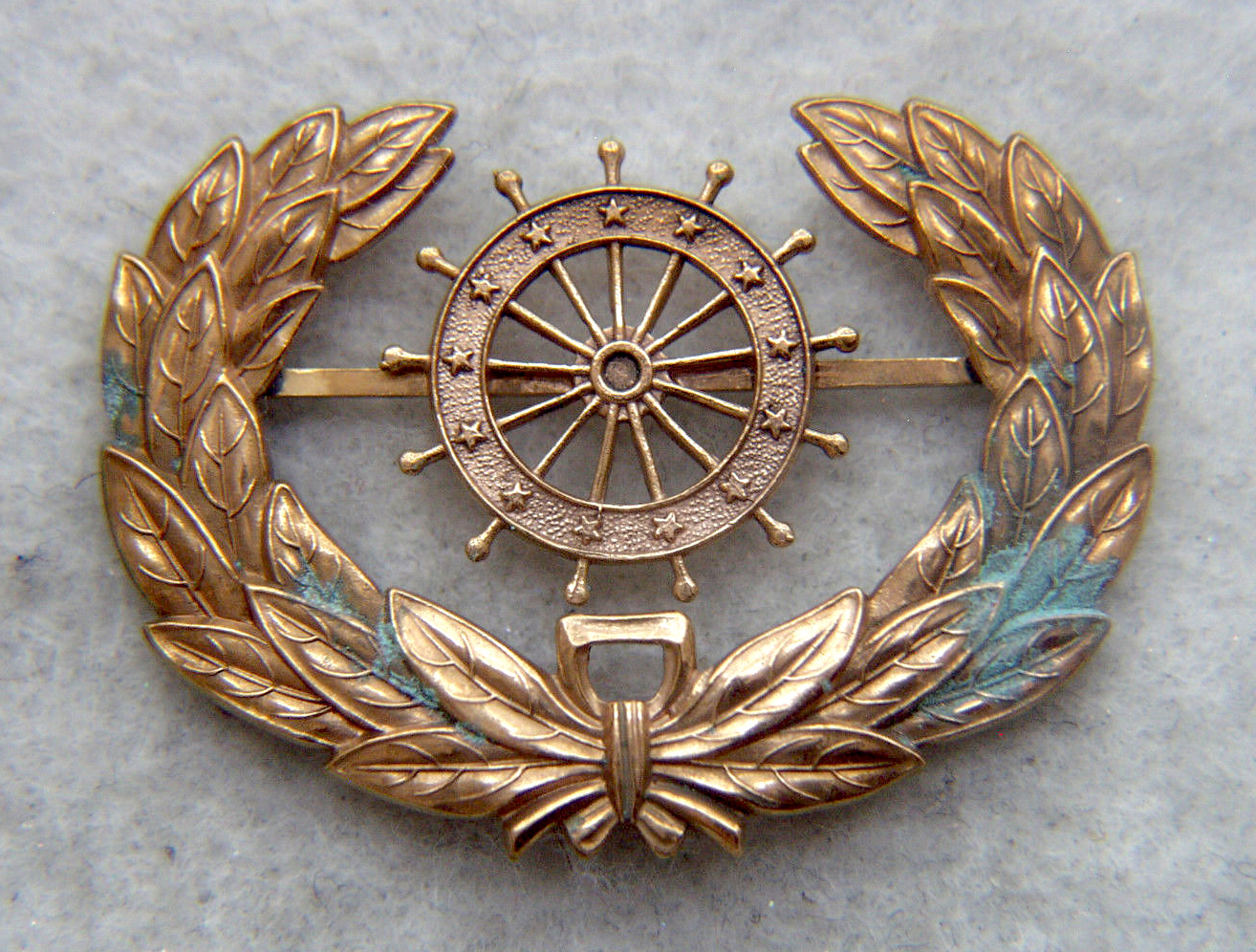
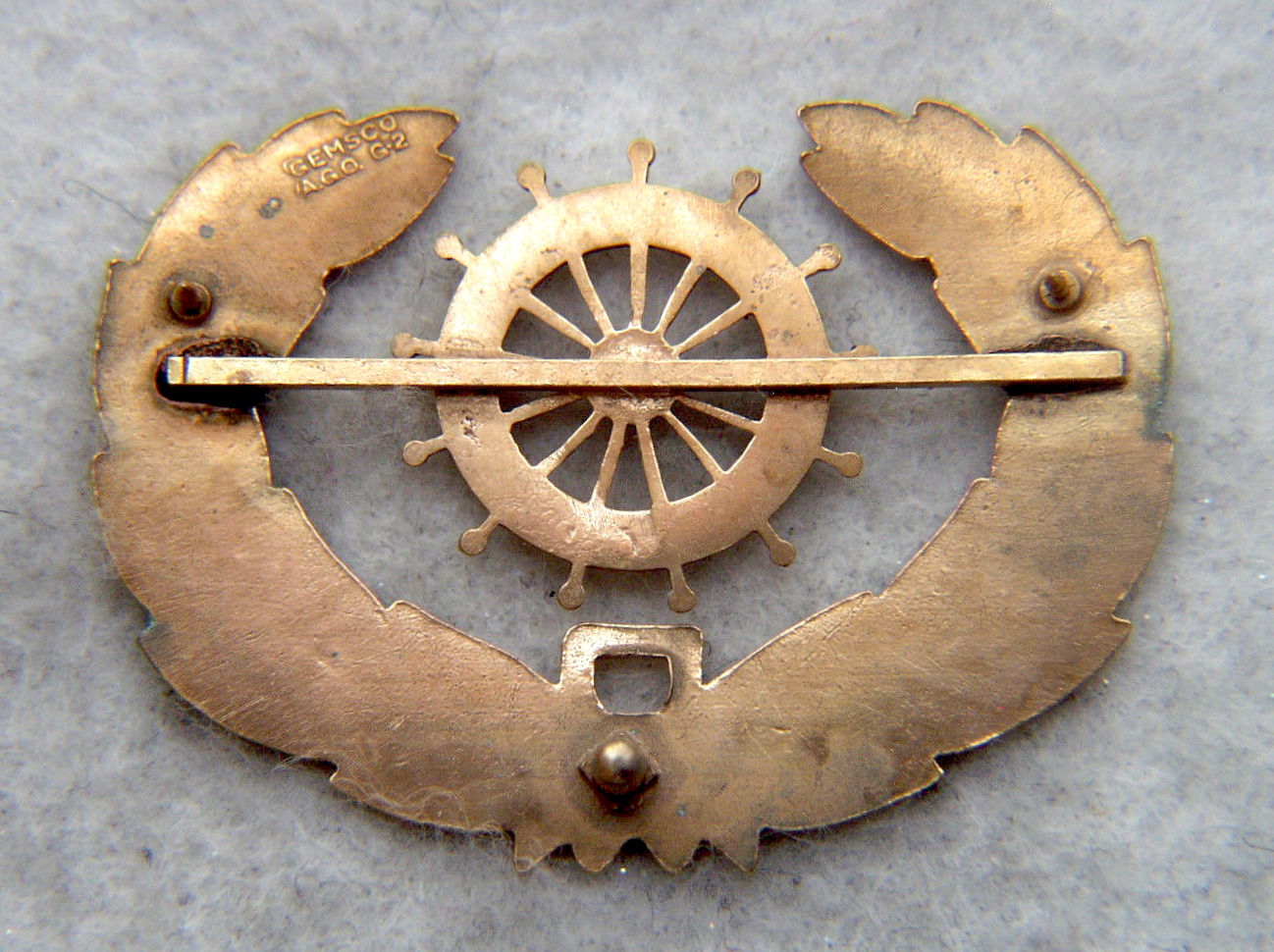
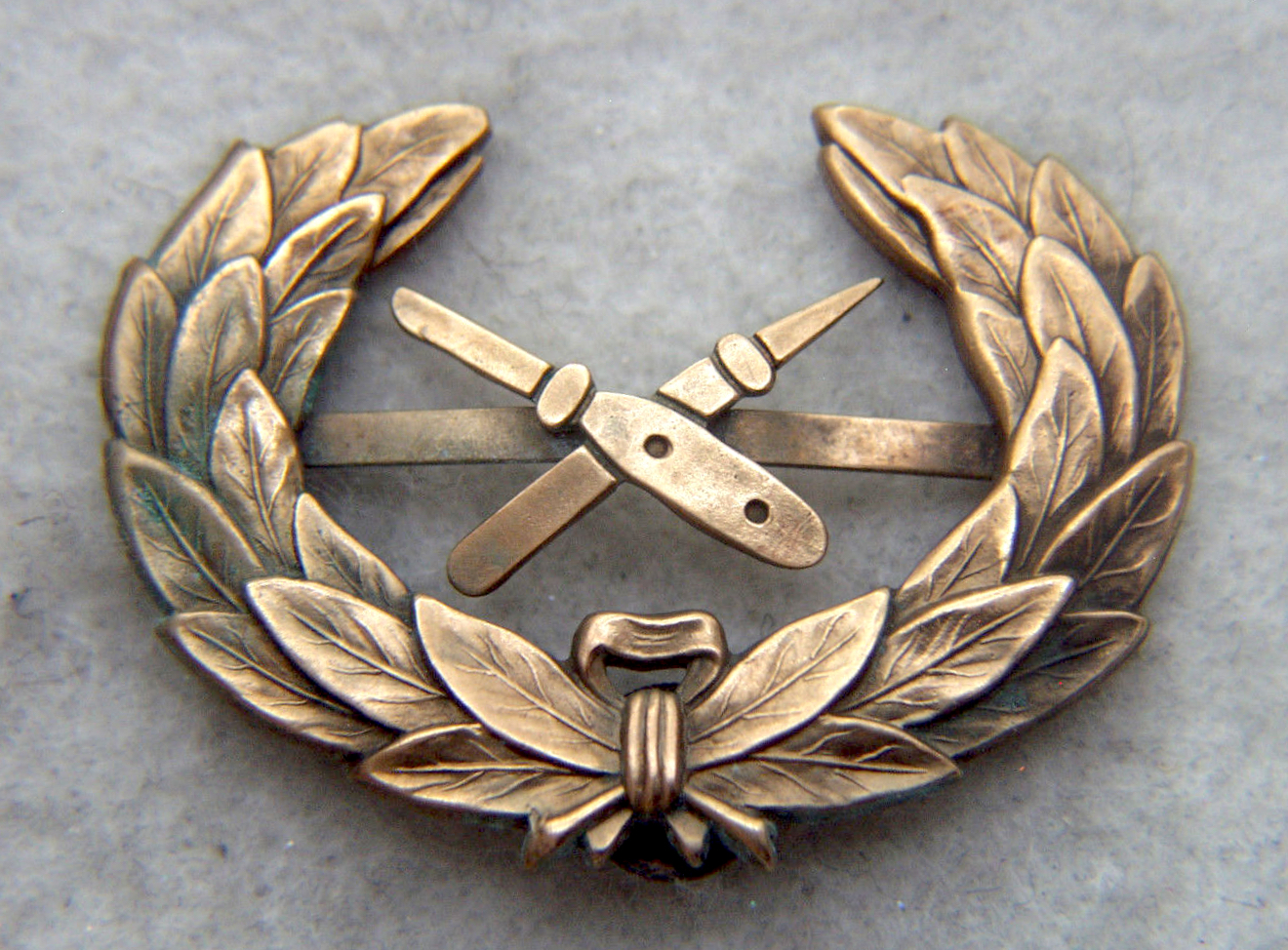
ATS Craftsman See above.
ATS Clerk
See above.
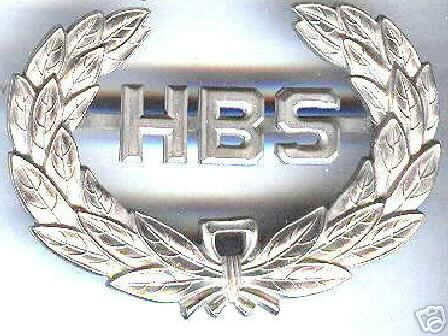
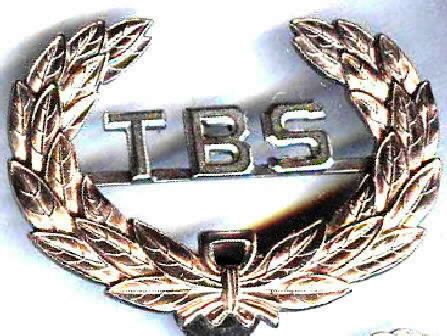
US Army Harbor Boat Service – Tug Boat Service
The US Army Quartermaster Corps operated the Harbor Boat Service; the individuals would wear an anchor with a Quartermaster Corps device soldered on the anchor. The HBS included launches, tugboats, and other utility boats in support of ATS vessels and US Army waterfront bases. Thus, TBS never existed; once again this a fantasy filling in a perceived gap in Army insignia.
Harbor Boat Service Officer
This is a fantasy, and a fun one, at that. Following the interwar US Army penchant for identifying units by placing small devices on other pieces of insignia – numbers and Corps devices (for example), this places a miniature Quartermaster Corps device on the shield of a US Navy Commissioned Officer’s hat badge.
War Shipping Administration, U.S. Maritime Service training cadre CPO/trainee. 1942.
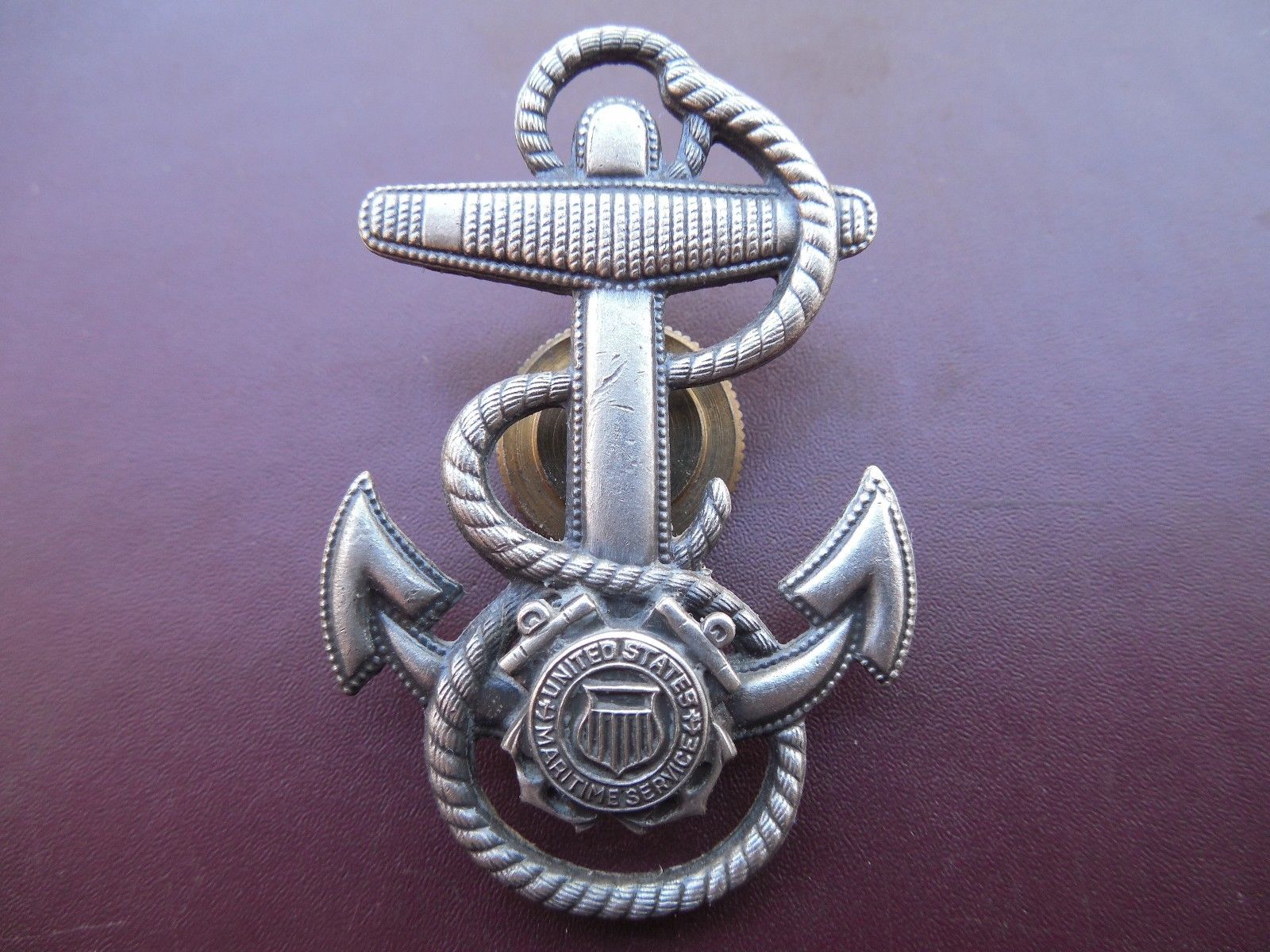
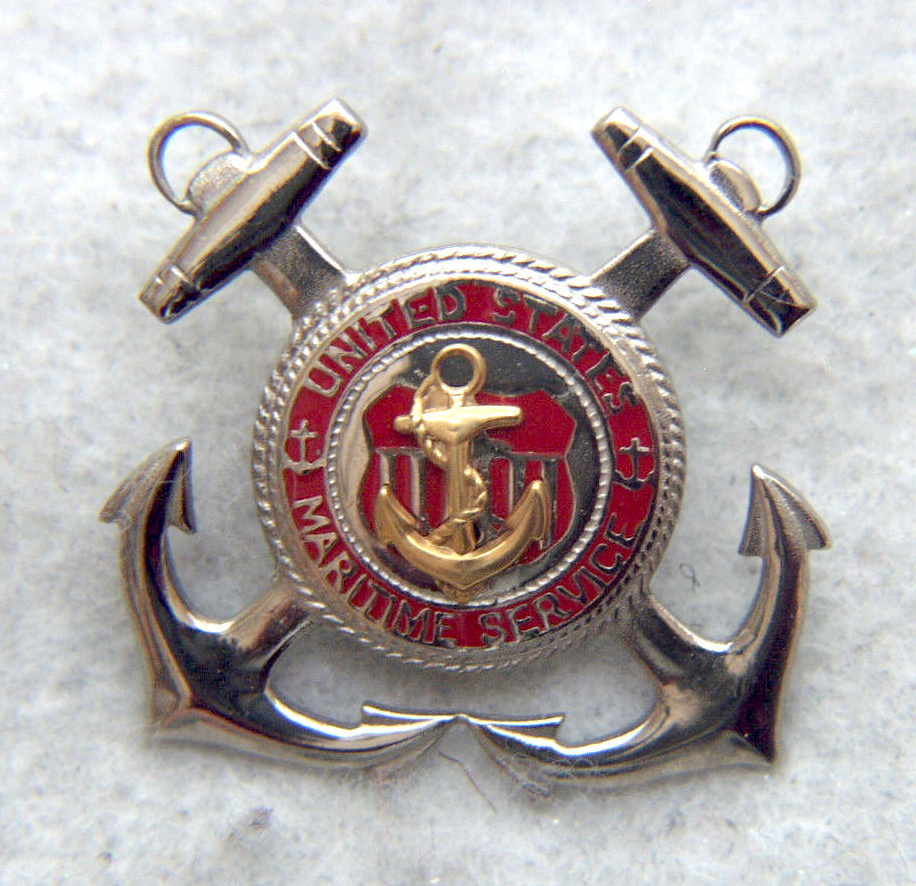
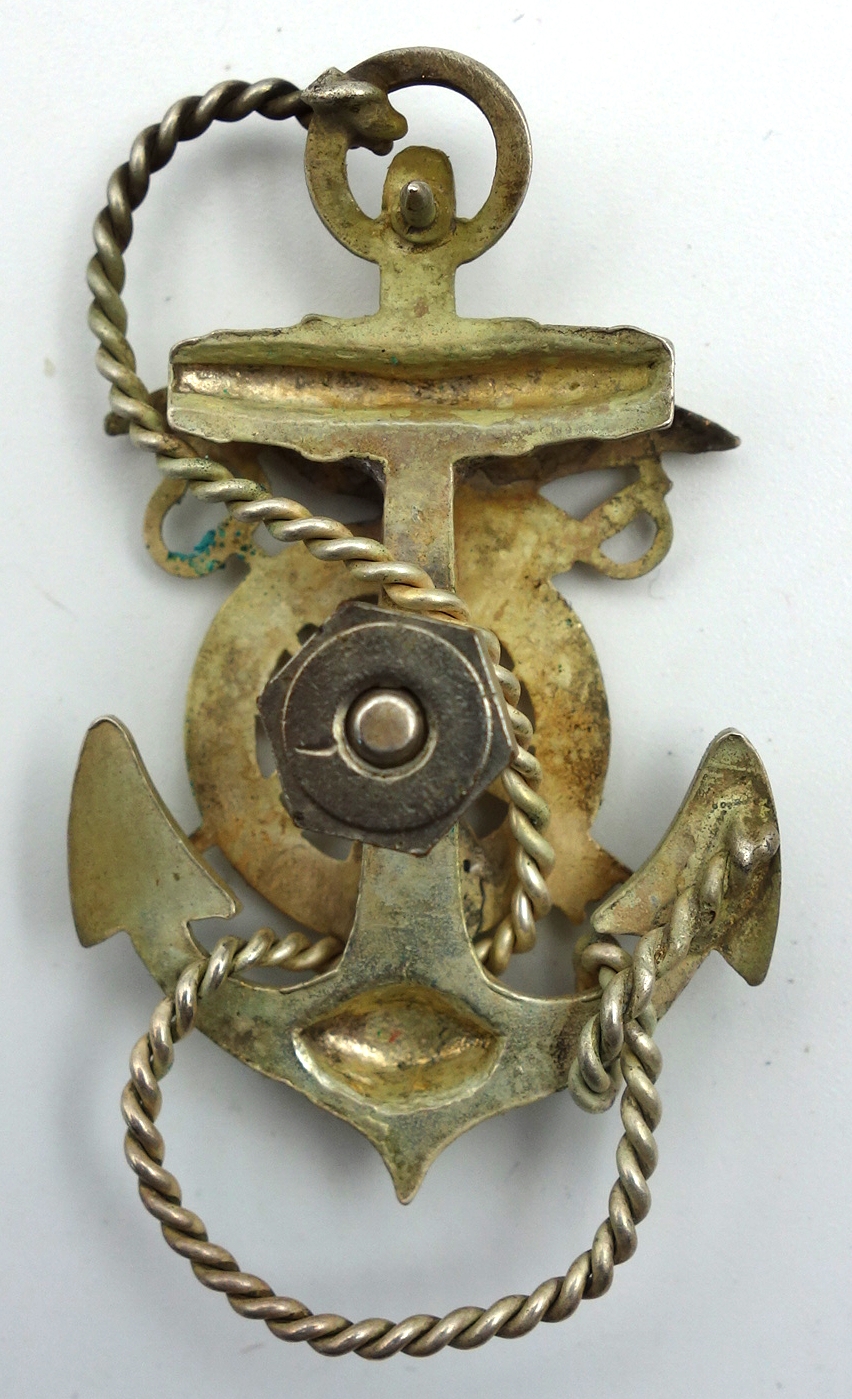
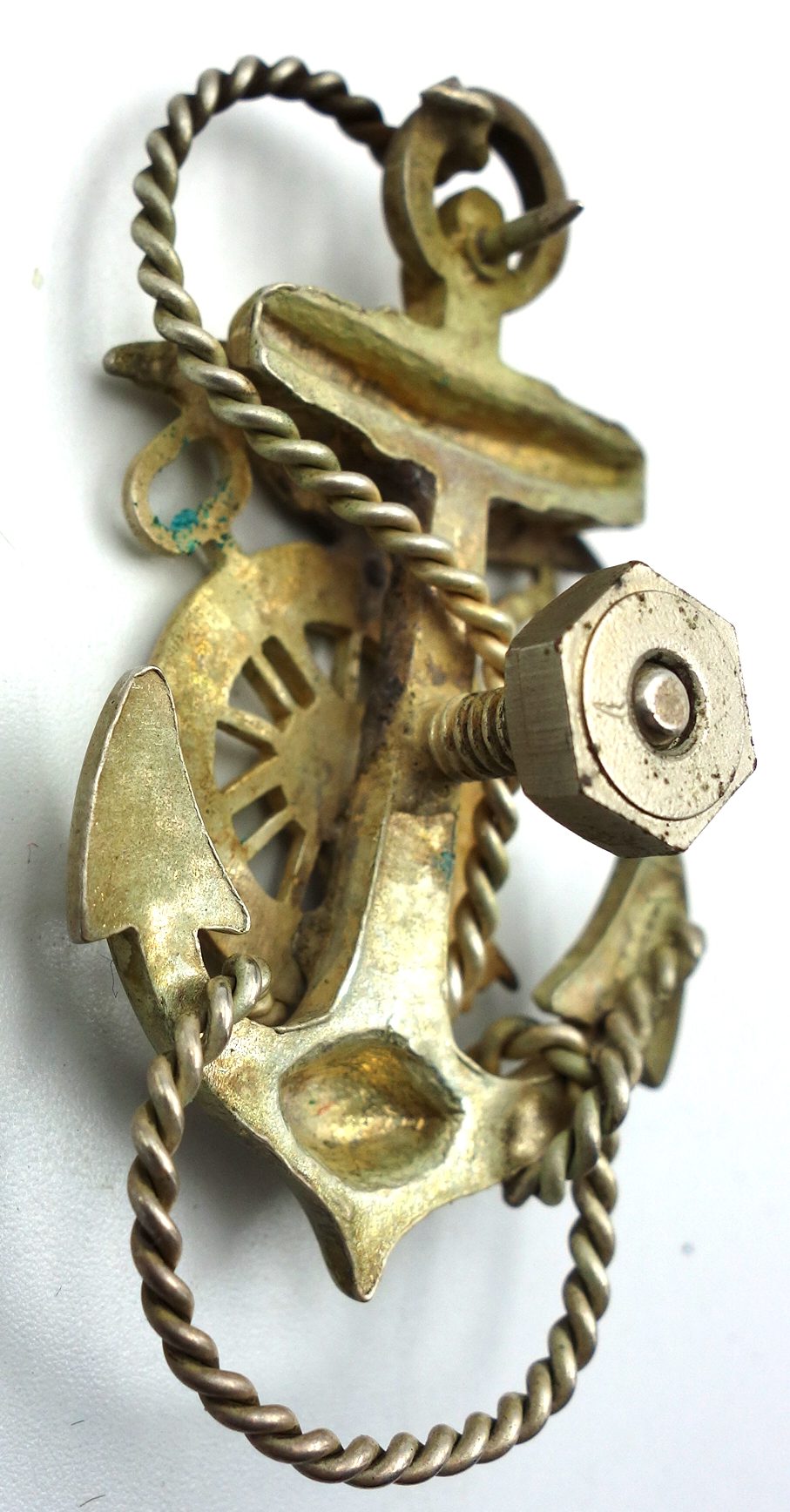
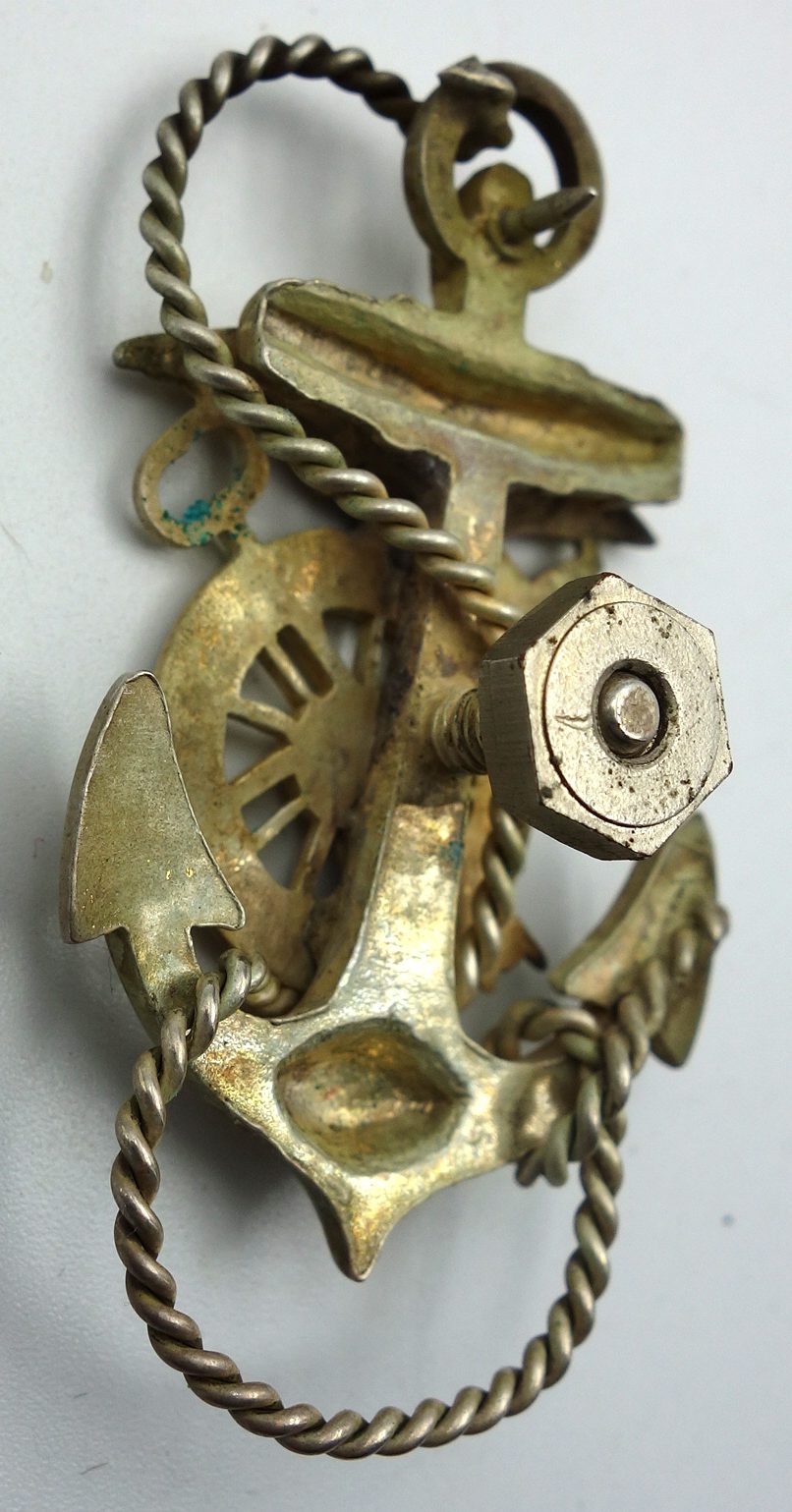
U.S. Maritime Service Chief Petty Office cap badge (Type 2a – Variant 1) One-piece construction. Seal, 25mm diameter; Anchor, 50mm length. A. E. Co. (American Emblem Company, Utica, New York) hallmark. Anchor and device stamped nickel; red enamel band and shield. Circa 1942.
This is the first example of the second design of the USMS CPO hat badge; the first design was worn briefly from 1941, up until WSA control of the USMS in July 1942 with the illustrated badge appearing in August 1942. The former badge may be found in plain brass as well as in nickel – as is the case of this badge. This badge, appearing in nickel is a bridge between the more common second design manufactured by Coro in silver plate.
It is unknown at this time whether or not American Emblem Company manufactured a miniature of this device. It is also unknown if there are collar dogs made by American Emblem Company; thus far, only Coro hallmarked examples are known.
USMS CPO Hat badge, obverse.
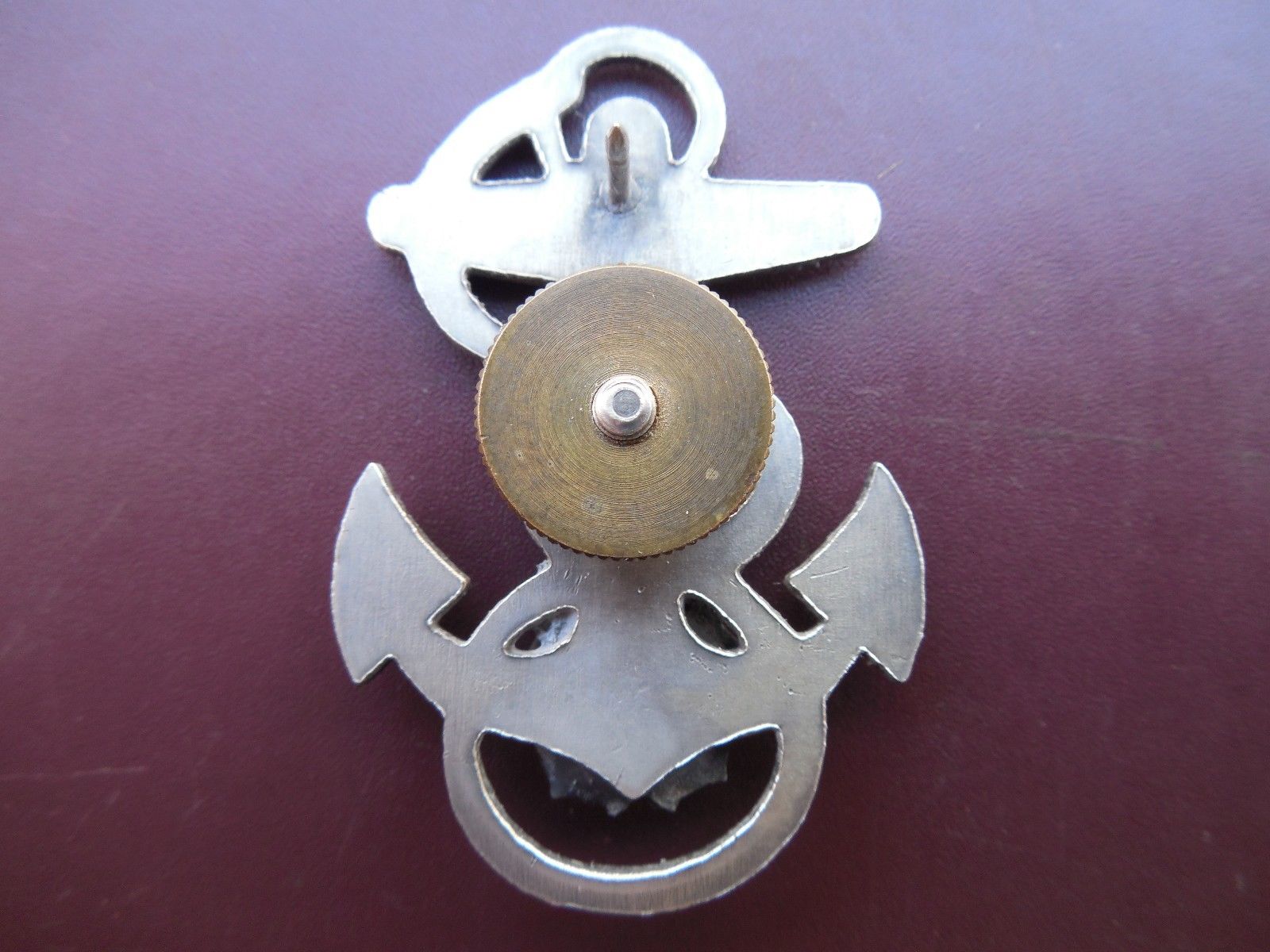
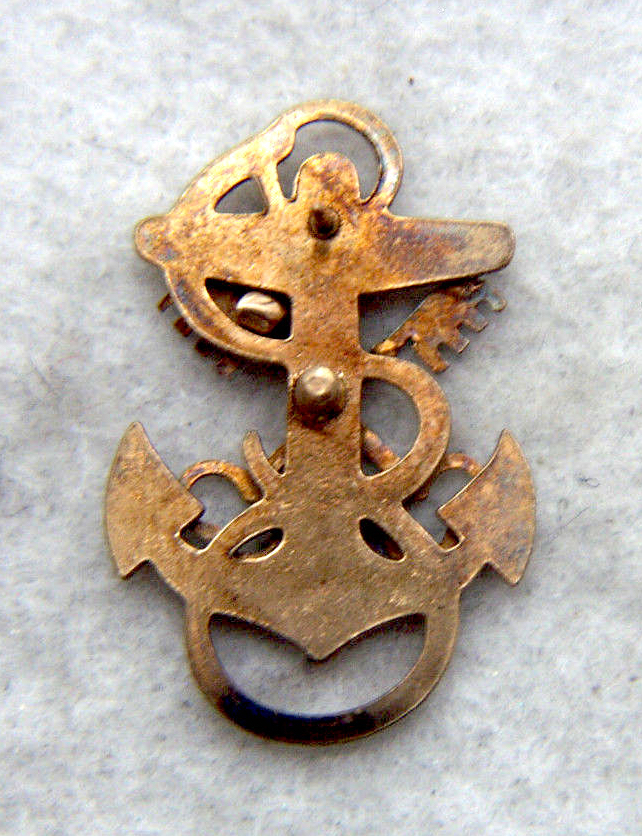
USMS CPO Hat badge, reverse. A close-up of the reverse details the A. E. Co (American Emblem Company) hallmark as well as the relative thinness of the badge. This variant, most likely due to the preponderance of Coro badges may be of a short, limited run. Coro, it is noted, did not produce the first variant of the CPO badge. Either A. E. Co. nor Coro produced the USMS commissioned officer cap badge patterns from 1942 onward.
U.S. Maritime Service Chief Petty Office hat badge (1st design, 2nd pattern)
One piece construction. Seal, 25mm diameter; Anchor, 50mm length.
Obscured AE CO N.Y. hallmark (American Emblem Company).
Anchor and device stamped nickel; blue enamel band and red, white & blue shield.
This is the second pattern of the first design of the USMS CPO hat badge; it was worn from 1942 until the dissolution of formal Coast Guard management of training program and its transfer to the War Shipping Administration in July 1942. The summer of 1942 saw a re-design of U.S. Maritime service insignia, and with it, the USMS CPO hat badge. Both the first pattern of the first design and second design have been respectively treated before, here and here.
This specific badge is often misidentified as a USMS Warrant Officer device; this is an understandable error, as mid-war, individuals who trained at USMS Radio Officer schools were issued USMS CPO hat badges and collar disks, and upon graduation held the appointed rank of Warrant Officer within the U.S. Maritime Service. Compounding some of confusion is that by war’s end, USMS Regulations published in 1944 stated that officers in the Radio Department, depending upon vessel tonnage and class, and certificate status could rank anywhere from Lieutenant to Ensign, vid.: U.S. Maritime Service Officers’ Handbook, 1944 p5.
USMS CPO Hat badge, obverse.
USMS CPO Hat badge, obverse detail.
USMS CPO Hat badge, reverse.
Note that the screw post and pins have been sheared off and replaced by a flat pin.
U.S. Maritime Service Chief Petty Office cap badge (Type 2 – Variant 2)
One piece construction. Seal, 25mm diameter; Anchor, 50mm length.
Coro (Cohn & Rosenberger) hallmark.
Anchor and device stamped brass, sterling plated (marked); red enamel band and shield.
Mid-to-post Second World War era; 1942-1947.
This is the second design of the USMS CPO hat badge; the first was worn briefly from 1941, up until WSA control of the USMS in July 1942 with the illustrated badge appearing in August 1942. The former badge may be found in plain brass as well as in plated silver – as is the case of this badge. The second design is almost always found in silver plate or less common brass; any others are patterns or reproductions. Enterprising merchant seaman have been known to buff the plate off, showing yellow medal underneath. The illustrated badge is of the second type and variant two – it differs from the first with a few stylistic differences – a difference in shield configuration and the inclusion of a motto, and punctured anchor ring. The first employs blue enamel as opposed to red. Interestingly enough, the changed design did not stylistically match that of the contemporary uniform coat, cap and shoulder board buttons and snaps which were altered at the same time as the hat badge.
A miniature of this device was authorized and manufactured for wear on overseas caps.
USMS CPO Hat badge, obverse.
USMS CPO Hat badge, reverse.
A close-up of the reverse details the Coro (Cohn & Rosenberger) hallmark as well as the Sterling denotation. Coro, as a corporate name came to be in 1943; however, the incuse hallmark “Coro” with a distinct curly-queue C in serif font dates to 1940 and underwent minor variations until 1945. Moreover, due to wartime metal shortages, Coro produced Sterling insignia items under Government contract from 1942-1947. With the aforementioned in mind, this hallmark adequately dates the device to the early-to-mid 1940s, contemporaneous with USMS insignia change.
USMS CPO Hat badge, production hub.
This hub is composed of hardened steel; of interest are the alignment pins used in the creation of dies. I have already written about production methods specifically outlining the purpose of a hub, here. If you visit the image’s page on Flickr, and select “All Sizes”, the original size can give you a better idea of the intricacy of design and even the parts of the hub that have been buffed and chiseled.
One reason that dies do not show up often in collections is that as dies wear out, they are taken out of production, defaced and melted down; hubs survive due to the fact that more than one master is required for die production. In terms of USMS hat insignia, hubs are few and far between as there were not a whole lot of insignia houses producing USMS devices.
This specific die was sourced from an estate in Rhode Island; which corresponds to the fact that this is perhaps indeed a Coro hub (see above). Prior to, during and following the Second World War, Coro had a large jewelry factory in Providence, Rhode Island. Thus far, I have only seen period USMS CPO (Type 2 – Variant 1 & Variant 2) badges with Coro hallmarks.
Sometimes the U.S. Navy doesn’t quite get it right. Back in the 1970s CNO Admiral Zumwalt embarked on a noble experiment: for men beards and sideburns were allowed and crackerjacks were removed from an enlisted sailor’s sea chest. A bluejacket could sport sideburns reaching the end of his earlobes, and everyone got to wear a reefer and a combination cap! Regarding the latter, career Petty Officers clamored for their traditional uniforms back despite the professional appearance the new uniforms promoted. In the early eighties, the CNO had enough of weird beards and mandated them shaved off because they didn’t work with the Navy-issue Mark V gasmasks.
When the CNO announced the retirement of the USNR badge in 2011 and further singling out (Kings Point) midshipmen as not able to wear its replacement, the Academy authorized its return, albeit in a different form. No one complained – then again who would listen? For an organization bent on tradition and group cohesion, the U.S. Navy got it wrong with the SSWO badge (and the anacronym is terrible).
Current ship wardroom plaques, otherwise known as ship’s plaques or ship’s emblems, or formally as ship’s badges came from an old tradition that reaches back to the age of sail. As a means of identification, sailing ships used carved figureheads as a distinguishing feature; however, with the move from sail to steam, there was no place on the prow or the bow to place ornate carvings. Utilitarianism eventually won out over embellishment and on haze-gray hulls became painted dull numbers and names. Yet, sailors wished to hold on to tradition and over time developed a system of naval heraldry; similar to, but distinct from that of landsmen.
Ships’ badges first appeared on United Kingdom Royal Navy vessels in the 1850s. Originally, they were found on ship’s stationery, and this innovation came to mark the small boats assigned to a ship and also the ship itself, on the bridge. The Admiralty decided to reign in the rather haphazard means of creating badges and appointed its first advisor on naval heraldry in the person of Charles ffoulkes, then curator of the Imperial War Museum, in 1918. He picked up the mantle of the Ships’ Badge Committee. Their main innovation was the use of a visual means to determine the class of ship or establishment by shape of badge: circular (battleships and battle cruisers), pentagonal (cruisers), U-shaped shield (destroyers), and diamond (shore establishments, depot ships, small war vessels, and aircraft carriers).
By 1940, the designs for all ships were standardized to a circular design. This was due to the bureaucratic nightmare of re-use of names on newly commissioned ships requiring re-configuration of badges to match ship type. Post-war, After the war, the pentagonal badge shape was assigned to Royal Fleet Auxiliary vessels and the diamond to commissioned shore establishments. RRS ship also used a circular configuration badge was noted in the example of the RRS Shackleton.
The RRS Shackleton was in service with the Falkland Islands Dependencies Survey (FIDS)/British Antarctic Survey (BAS) from 1955/56 until 1968/69. Her role was primarily that of a survey and science vessel, supporting marine geophysics programs. Originally named the Arendal, she was built in 1954 at Sölvesborg in Sweden for Arendals Dampskibsselskab, Norway. In August 1955, she was bought by FIDS for £230,000, and further strengthened for work in sea ice. She was renamed RRS Shackleton by Mrs. Arthur, wife of the then Governor of the Falkland Islands and Dependencies, in a ceremony at Southampton on 19 December 1955.
Her namesake is Sir Ernest Shackleton, 1874-1922, one of the most famous figures from the Heroic Age of Antarctic Exploration. Sir Shackleton served on Scott’s Discovery Expedition (British National Antarctic Expedition) 1901-04, he led the Nimrod Expedition (British Antarctic Expedition) 1907-09 but is most well-known for the Endurance Expedition (Imperial Trans-Antarctic Expedition) 1914–17 – a remarkable story of survival against the odds. Sir Shackleton died during the Quest Expedition (Shackleton-Rowett Antarctic Expedition) 1921-1922, and is buried in the whalers’ graveyard at Grytviken, South Georgia.
From 1969, the RRS Shackleton was operated by BAS’s parent body, NERC (Natural Environment Research Council) as an oceanographic research vessel. Under NERC ownership she carried out geophysical and marine geology cruises in Antarctic waters until being withdrawn from service in May 1983 and sold.
Technical specification Lloyds classification: 2-3 for ice Dimensions: length 200 ft 6 ins; breadth 36 ft 1 ins Loaded displacement: 1658 tons Gross tonnage: 1102 tons Propulsion: diesel engine, 785 SHP Speed: service speed 12 knots Port of registry Stanley, Falkland Islands
A second ship was also named after Ernest Shackleton in 1999 – the current RRS Ernest Shackleton.



 .
. 


