Training Organization
U.S. Merchant Marine Cadet Corps
39 Broadway, New York, N.Y.
Confidential
From: Cadet-Midshipman Willard F. FAHRNER, Third Class, (E-2), USMMCC
To: Supervisor, U.S. Merchant Marine Cadet Corps
Via: District Cadet Supervisor, New York.
Subject: Loss of vessel SS STANVAC MANILA; Report on
The tanker STANVAC MANILA left pier 60, New York on of Squadron 12, 1948 carrying a deck load which consisted of seven P.T. boats of Squadron Tweleve, Several thousand tons of dry cargo consisting of P.T. engines, aircraft engines, radar equipment, carried in the dry cargo hold forward. There was no liquid cargo except 1200 tons of fresh water to be discharged in Aruba, our loading port. We proceeded from New York without escort and headed south via Crocked Island Passage, picking up a thirty two ship convoy off Guantanamo, Cuba. Three P.C. boats and a small destroyer served as escorts. We proceeded in convoy to San Nicholas, Curacao where our ship was detached from the main body and proceeded to Aruba. We ddischarged the fresh water ballast and loaded 100,000 bbls of Navy fuel oil after which we proceeded to Balboa, unescorted. We then proceeded through the Canal and into the Pacific. The Weather from Balboa and across the Pacific consisted for the most part of cool weather with clear skies and medium seas and swells. A gale was encountered about fourteen days out of Balboa, but this blew itself out after the second day.
2. The ship was hit by a torpedo at 0409 the morning of May 24th. The sky was hazy, emitting enough of the half moon to silhouette our ship. The sea was heavy and choppy. The writer had come off wath at 0400 and was in his quarters at the time the torpedo struck. Members of the fun crew on watch claim seeing one torpedo miss the stern a moment before the ship was hit by the second torpedo. The vessel was on course 317 deg. True, zigzagging, and 72 miles from Noumea, L.H. bearing 323 deg. True. The torpedo struck dead astern, below the fire room, engine, electricity and steerage were cut off immediately. Gun and fire stations were manned and the crew stood by for action.
3. The ship began going down by the stern, and in an hour the after gun was under water. Life boats aft were manned and launched almost immediately, the Chief Mate and the writer took the port forward boat off about two hours later, and stood by for survivors. A half hour later, the Chief Mate was put aboard again as he wished to try to get some of the P.T. boats off the deck. The writer was left in charge of the life boat and layed off to starboard of the ship to await orders.
4. No enemy craft sighted at any time.
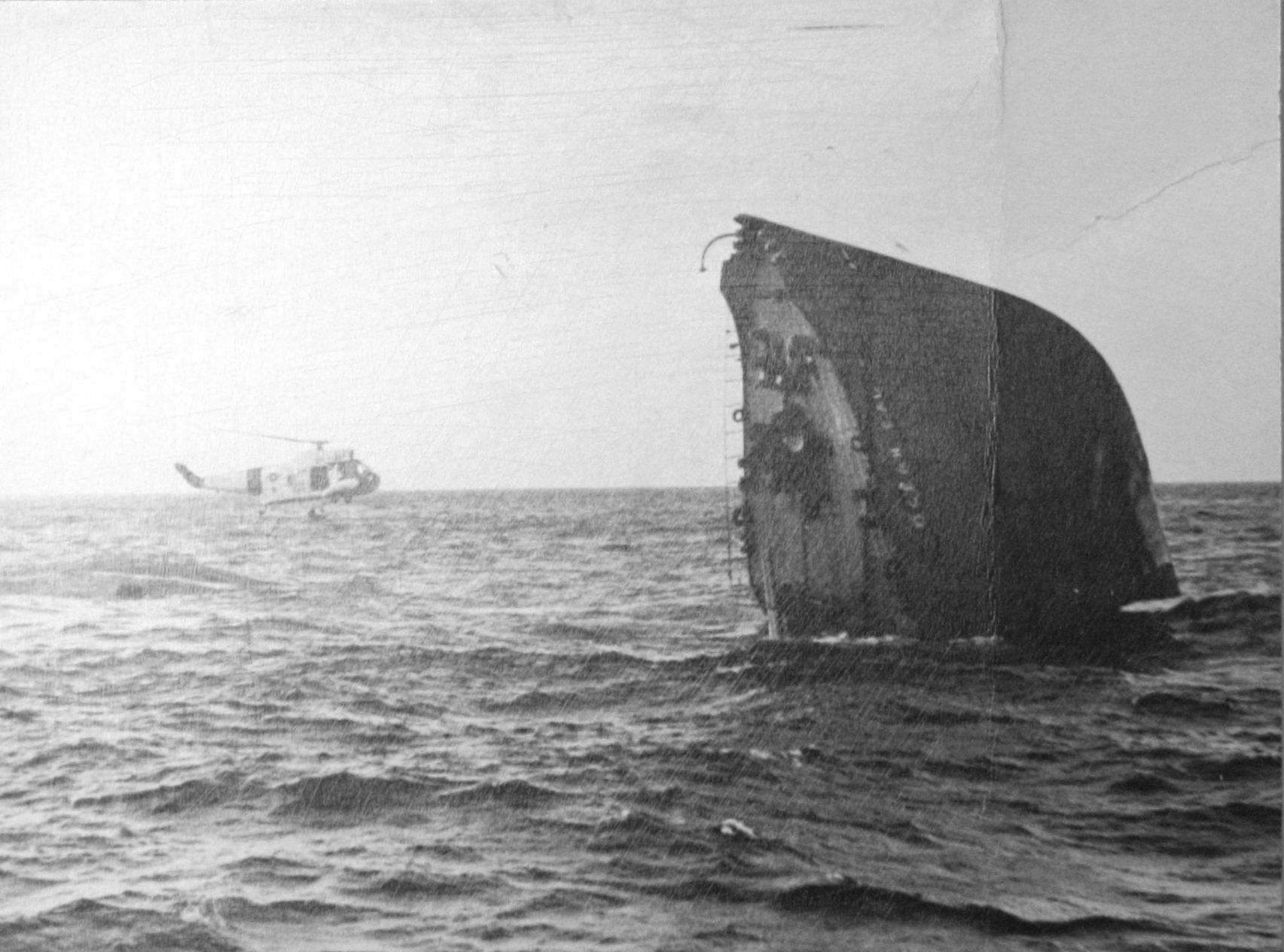
5. About 0800 the first P.T. boat was taken off the sinking ship and was used to relieve the life boats of excess passengers. As the ship sank lower by the stern, another P.T. boat was floated off. This boat was alsol used to pick up men who had abandoned the rapidly sinking stern. As the ship began to collapse amidships, the writer went alongside and took the second and third mates aboard along with members of the gun crew who were nearly swamped by the suction of the sinking ship. At 1210 the ship disappeared and at 1300 all the survivors were picked up by the life boats or the P. T. boats. About 1400 we were sighted by the USS Prebele which took the P.T. boats in tow and landed in Noumea at 1400 the following day. The injured were taken to the hospital ship at Noumea at 1400 the following day. The injured were taken to a hospital ship at Noumea and all the rest of the survivors were taken to a Navy Receiving Station from where we were given passage back to San Francisco.
6. The P.T. boats used their radar very successfully until their generator went dead, and shortly thereafter we were hit by the torpedo.