
Button Identification | USL Buttons | Kings Point Button
The object
I first heard the uniform button on Kings Point uniforms called a “yacht club button” by a long-graduated midshipman. That, and his mention of Zombos, piqued my interest for almost a decade.


The button is small enough to disappear into a coat pocket, and during the Second World War it was often not even completely brass. Wartime examples of the United States Merchant Marine Academy pattern, the design cataloged by Alphaeus Albert as GO-26B, were struck in gilt with plastic backs to conserve metal for the shooting war, which also had the side benefit of not staining dress whites. Hold one up to the light and the composition resolves quickly: a fouled anchor on an engine-turned field, a five-pointed star at either end of the stock, the whole enclosed by a raised ring and a rope-twist rim. It is the button of the federal service academy at Kings Point, and of the American merchant officer’s dress uniform to this day.

It is also, in nearly every particular, the button of the New York Yacht Club.
Set a nineteenth-century NYYC coat button beside a wartime cadet-midshipman button, and the family resemblance is unmistakable. Surviving examples from the 1860s and 1870s show the whole grammar already in place: rope border, fouled anchor, flanking stars, precision guilloché lined field, and the club’s name running around the circumference. By 1904 the club had written the device into law. Its yearbook prescribed gilt and black buttons in three sizes, 34 ligne for service dress down to a 22 ligne black button worn only on the cap, each bearing a foul anchor with a star on each side within the circular inscription of the club’s name. Strip the legend from that prescription and what remains is, letter for letter of the visual language, the merchant marine button of 1942.
The obvious question someone may ask when they first notice the correspondence is why a federal academy charged with producing licensed officers for the nation’s merchant fleet would dress its midshipmen in the insignia of a private club on Manhattan’s West 44th Street. The answer is that it did not, or at least not in the way the question assumes. The Academy did not recycle a yacht club’s trademark. It inherited a visual language that had left the club decades earlier, and the vehicle that carried it was not an institution at all. It was a shop: a low red building with a steeply sloping roof at 18 Fulton Street, one block from the Fulton Ferry, in a neighborhood that smelled permanently of fish.
A club with quasi-official standing
First, the design’s pedigree, because it matters that the New York Yacht Club was never merely a private club in the heraldic life of the nation. When Congress created the licensed yacht signal in 1848, the design work was not done in Washington. The Act of August 7, 1848 required licensed yachts to use a signal of the form, size, and colors prescribed by the Secretary of the Navy, and the Secretary turned to the New York Yacht Club for the pattern. The club’s secretary solicited members’ ideas in late 1848, and in January 1849 the club resolved to recommend the American ensign with the addition of a fouled anchor in the union. The Secretary adopted it. The result, thirteen stars ringing a canted fouled anchor in the canton, was prescribed by the Navy, its display enforced on licensed yachts by Treasury decision, and, though the statutory requirement is long repealed, the flag remains in customary use on American pleasure craft today.[1] The government had, in effect, invited the club to design a national maritime emblem, nearly a century before Kings Point existed. The anchor-with-stars vocabulary thus entered American waters as something closer to shared civic iconography than club property.
Nor was the club’s uniform culture an isolated affectation. By 1868, Charles Peverelly’s Book of American Pastimes could record the Brooklyn Yacht Club prescribing double fouled anchors in gold on the collar for honorary members, a single gold anchor for members, and fouled anchors on collar and cap for captains of yachts.[2] American yacht clubs from Jersey City to Brooklyn had built themselves miniature naval establishments, complete with insignia regulations, officer flags, and corporate seals. The NYYC’s cap ornaments of the 1904 yearbook show the mature system: the commodore’s device wreathed in crossed fouled anchors beneath three stars, the vice and rear commodores differenced by two, the plain member’s badge a single anchor behind the burgee.[3] This was a world that took its buttons seriously, and a world of that size and punctiliousness required a supplier.
The house of Appel
The supplier had a name, and when he died in 1910 the trade press knew exactly what he had been. The first volume, first number of The Master, Mate and Pilot, the journal of the organized licensed officers of the American merchant marine, carried his obituary with a photograph: a formally dressed man with a white tie and a steady expression, remembered as “the pioneer yacht outfitter of this country.” Mr. S. Appel was born in Germany in 1836 and came to the United States as a boy. In 1858 he opened a clothing store in New York, and within a few years he had turned it into a uniform business catering to the seafaring trade. He counted friends among the old-time skippers and the working captains of the day, belonged to numerous charitable organizations, and gave, the obituary noted, without regard to creed.[4]
House tradition would later push the founding back slightly. When The New Yorker profiled the firm in 1935, it reported that the Appels had been outfitting yacht crews since 1856.[5] The two-year discrepancy between the magazine’s date and the obituary’s is the familiar signature of a firm’s own legend outrunning the paper record, and it hardly matters. What matters is that by the 1860s, precisely when the earliest surviving lettered NYYC buttons were being struck, a German-born clothier a block from the Fulton Ferry had made the outfitting of yachtsmen and seamen his specialty, and that the two facts are connected. Antique NYYC buttons survive today carrying Appel backmarks alongside those of other makers such as Raymold & Whitlock.[6] The club’s button was, in a literal manufacturing sense, an Appel product.
Geography is the underappreciated actor in this story. 18 Fulton Street sat at the exact seam where the two American maritime worlds met. A few steps away ran South Street, the working waterfront of sail and steam; one block away the Fulton Ferry landed; around the corner sprawled the fish market. Uptown, in the clubhouses, lived the men who owned the yachts. Downtown, at Appel’s counter, the two populations converged, because a yacht is a vessel that requires both a commodore and a crew.

A 1906 advertisement makes the firm’s proposition explicit. With the motto “like master, like man,” it argued that an owner in fine toggery aboard a slovenly crewed boat was not ship-shape, and offered complete satisfaction in sailormen’s outfittings, uniforms in good form all the way from cabinboy to commodore.[7] That advertising copy is the entire mechanism of this essay in four words. The same house, working from the same pattern books and the same button dies, dressed the whole vertical hierarchy of American yachting, from the boy who polished the brass to the man whose flag flew three stars.
By the interwar years the firm’s scope was remarkable. The 1935 New Yorker profile found the Appels in their ancient red building equipping owners, officers, engine-room staff, steward’s department, and seamen alike, in everything from dress uniforms to oilskins and sou’westers, and claiming the ability to outfit every man on a ship within forty-eight hours. More striking still, the firm could supply the men as well as the clothes: through the season its lobby filled daily with seamen waiting to be signed onto yachts.[8] The outfitter had become a labor exchange. This detail matters for the history of insignia more than it first appears, because it means the firm sat at the choke point through which both the symbols and the wearers of American maritime service passed.
The clientele ran to the very top of the register. The Morgans, Astors, and Vanderbilts patronized the house; in 1930 it dressed the crews of every candidate boat in the America’s Cup defense trials, and in 1934 it outfitted the new defender Rainbow. Its 1929 catalog, Correct Uniforms for Yachting, ran to forty-six pages and closed with a four-page list of the yachts the firm represented, a document that reads today like a census of the East Coast pleasure fleet.[9] By the mid-1930s there was a branch in Miami. And crucially, the Appels were not merely vendors of the New York Yacht Club’s kit but its interpreters. The club functioned as the local arbiter of uniform correctness, its cap pattern distinct enough that Brooks Brothers stocked it alongside the English style, and the Appels were regarded as authorities on the correct insignia for every rating, down to the fine distinction between the four gold stripes of a large vessel’s master and the crossed anchors and silver chevrons worn above the elbow by the master of a small yacht.[10] When a firm holds that position for two generations, the difference between supplying a design and owning it quietly disappears.
The founder’s death in 1910 did not end the house. It passed to a corporate successor, S. Appel & Company, Inc., and the litigation records of the New York Supreme Court preserve, with an accountant’s unsentimental precision, the anatomy of the firm in its later decades. In December 1927, three men, Benjamin Abert, Isaac Alkus, and George I. Appel, organized a realty vehicle called Eighteen Fulton Street Corp., which promptly purchased the premises at 14-16-18 Fulton Street and 195 Front Street for $82,000 and leased them back to S. Appel & Company, Inc. at $12,000 a year. The pleadings describe the tenant’s business plainly: manufacturing, selling, and dealing in uniforms, uniform equipment, and kindred articles, occupying the entire premises as a single unit.[11]
The arrangement ended in a family-scale corporate war. After the deaths of Abert and Alkus, George I. Appel and Emanuel M. Bernstein ran both the operating company and the realty company, and from 1938 to 1946 the rent charged to the uniform house never exceeded $6,600 a year. When new shareholders took control of the realty corporation in 1946, they sued, alleging the insiders had mulcted the landlord of more than $35,000 in below-market rent; the defense answered, through three rounds of appellate briefs in 1947, that the complaint pleaded conclusions rather than facts and fell within the business judgment rule. For the button historian, the merits are beside the point; what the case establishes is that S. Appel & Company, Inc. sat at 14-18 Fulton Street, manufacturing and dealing in uniforms and uniform equipment, through precisely the years 1938 to 1946: the years of the Merchant Marine Cadet Corps, the wartime Maritime Service, and the founding of Kings Point. When the government needed the trade’s button, the trade’s button house was open for business at the same address it had occupied since the Civil War era.
The transmission
Designs do not migrate on their own. They travel through the workshops of the die-sinkers and the counters of the outfitters, and from a die-sinker’s perspective, the NYYC pattern was close to ideal stock: visually elegant, instantly legible as maritime, already accepted on the coats of men of standing, and easy to modify. Retain the anchor and stars, alter or omit the legend, and the same essential tooling served a new customer. This is precisely how the pattern shows up in the trade as a generic article. Leopold Morse & Co. of Boston, an upscale clothier that had uniformed Union officers during the Civil War, sold a generic merchant marine button of this type, and thus even the button design of the National Organization of Masters, Mates and Pilots is itself a derivation of the NYYC original.[12]


Here the 1910 obituary acquires its full weight. It appeared in the first number of the licensed officers’ own journal: the union whose button descended from the New York Yacht Club’s pattern used the opening issue of its magazine to mourn the yacht outfitter of Fulton Street. That is the social fact the buttons record. It is not that American merchant officers lacked a prescribed uniform. One existed on paper; in April 1930 the American Marine Standards Committee promulgated American Marine Standard O No. 27-1930, “Uniforms for Merchant Marine Officers,” specifying the dress and its buttons.[13] But the standard carried no enforcement, and a voluntary specification is a suggestion; in practice the steamship lines dressed their officers in their own house uniforms and their own company-marked buttons, and those officers who also held reserve commissions wore a separate set of United States Navy buttons for that purpose. What filled the space between the ignored standard and the patchwork of company patterns was the market, and the market’s principal house served commodores and shipmasters from the same counter. By the early twentieth century the anchor and two stars composition had ceased to be a citation of the yacht club and had become the default answer to a practical question the toothless standard had failed to settle: what does an American maritime officer’s button look like?


The institutional descent
The pattern’s passage into the training institutions followed the same logic, one school at a time. The nautical schoolships led the way. The New York Nautical School, the schoolship institution that became the state’s merchant marine academy, took up the composition and substituted its own name where the club’s had been. Here a diagnostic detail deserves emphasis. Most schools that struck a button put their own seal, or a derivation of it, at the center: the institution named and pictured itself. The New York Nautical School did not. It reached instead for the New York Yacht Club’s anchor and stars, choosing the trade’s generic maritime device over its own available heraldry. That choice is the whole argument in miniature. By the time the school needed a button, the NYYC composition was no longer read as a club crest at all; it was simply what a maritime officer’s button looked like, current enough to be preferred over a school’s own seal. A nautical school asking parents to entrust their sons to a training ship wanted to communicate seamanship, officer status, and social respectability in a single glance, and the fastest way to do that was to adopt a device the maritime public already associated with all three. The device these schools reached for was, again, the one already sitting in the outfitters’ dies.


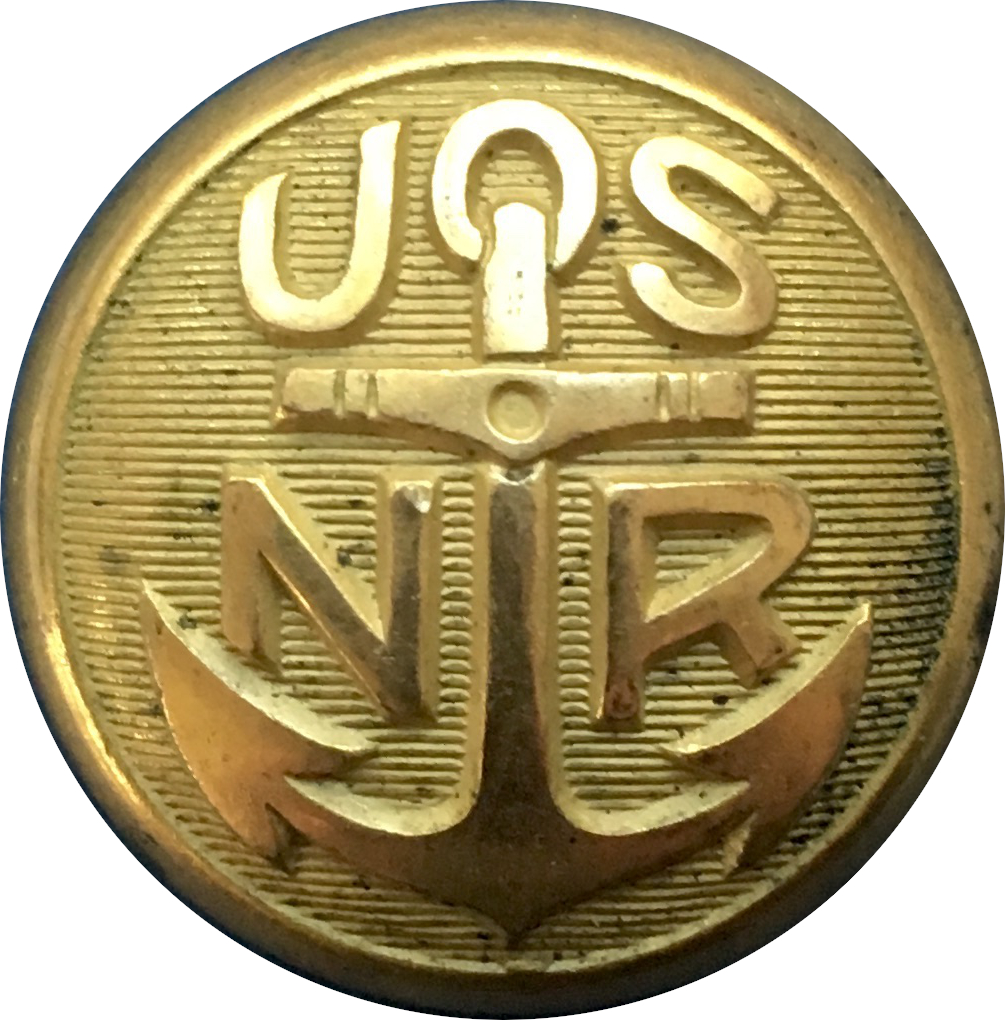
When the federal government entered the picture, it did so along two tracks that must not be confused, because they wore different buttons. One was in-service training for men already in the trade. In 1938 the Maritime Commission took custody of Hoffman and Swinburne Islands in New York’s Lower Bay and built a training station there, an upgrade school where working mariners refined their skills; it improved the artificial islands to the tune of more than $800,000 before the station closed in 1947, and visitors to the abandoned site a few years later found the dormitory doors still labeled with painters’ and lieutenants’ name cards and the mess hall still papered with wartime exhortations against wasting food.[14] The Hoffman Island station had its own distinct button modeled after its cap badge, which was an interpolation of its controlling-Agency’s seal: the Coast Guard.
The other track was cadet training for young men out of high school, and it is the one that carried the anchor and two stars device forward. These were the cadets of the United States Maritime Commission Corps of Cadets, and before the Corps found a permanent home, it was hosted at the New York State Merchant Marine Academy at Fort Schuyler. Fort Schuyler was a billet, not a parent: the state academy lent the federal Corps its facilities, and the Corps carried its own button in and out again. That button was already the anchor and two stars – a design similar to that of its erstwhile host absent a ring of text. The pattern appears on a cadet uniform as early as 1939, and the Corps’s first uniform regulations, dated 9 January 1942, prescribed the button of the “Merchant Marine design.”[15]
The Corps had a lineage of its own that ran through the same harbor. Its predecessors, the Department of Commerce mail-subsidy cadets, had trained aboard ships sailing out of New York, and the federal Corps sailed from the same port. But the Corps differed from those predecessors in one decisive respect: its cadets were furnished their uniforms and insignia by the federal government rather than assembling a kit at their own expense. And when the government needed a place to furnish that uniform, it went where the trade had always gone. It went to Appel. The house that had dressed commodores and cabinboys from the same counter on Fulton Street now dressed the government’s cadets, and the button it supplied was the one already in its dies, one which a cadet could ask for at the counter: “Merchant Marine design” produced just for them.


Here the blank ring finds its most concrete explanation. The button carries no legend around its edge, and the plainest reason is the least heraldic: the name would not fit. “United States Maritime Commission Corps of Cadets” is not a circular inscription; it is a paragraph. Faced with a body whose title could not be spelled around a 36-ligne button, the outfitter did what the trade had done for decades and supplied the generic device, the anchor and two stars without words. The larger forces still hold that a national service does not letter its buttons the way a club or company does, and that the unlettered die already existed. But the immediate, practical cause was a name too long to engrave, resolved by a button that had never needed a name in the first place.
When the Corps moved to its permanent site at Kings Point in March 1942, the button went with it, and Kings Point became the United States Merchant Marine Academy, dedicated in 1943, wearing the device it had brought from Fort Schuyler and the West Side Piers. This is the crucial junction: the button descends from the New York Yacht Club pattern through the trade, through Appel’s counter, to the federal Corps of Cadets, and thence to Kings Point, not through the Hoffman Island upgrade school with which it shared a harbor and a chaotic founding moment, and not from the state academy that merely housed the cadets along the way.
That moment was frantic in every direction. Services were being created, transferred, and renamed; the Maritime Service passed from Coast Guard administration to the War Shipping Administration; hundreds of thousands of men needed to be dressed quickly. An establishment in that position does not commission novel heraldry. It codifies what the trade already makes, and the trade’s dies, at Appel and the other established naval outfitters, had carried the anchor and two stars for eighty years. Albert’s Record of American Uniform and Historical Buttons accordingly lists the design in its Governmental Organizations section as GO-26, noting its first use on cadet coats, and there it has remained, still issued in 36 and 25 ligne for merchant marine dress uniforms today.[16]
The recycled coat
There is one more mechanism to account for, and it is the one that explains not how the pattern arrived but why it stayed. The wartime graduate of Kings Point or the state schools walked ashore with a license, a reserve commission, and one good blue uniform. Officers in the merchant service bought their own kit, cloth was rationed, and a new third mate’s pay had better uses than a replacement coat. So the coat was converted, not retired. The cadet rank stripes came off the sleeves, and regular officer’s braid went on, a few dollars’ work at any port tailor, and the buttons stayed exactly where they were. They could stay because, unlike the lettered button of New York State Merchant Marine Academy, which names an institution the graduate is leaving, the cadet button was close enough to the unlettered generic device of the whole service. It said nothing that stopped being true at graduation.
Surviving uniforms bear this out materially. Kings Point coats exist, examined by the author, with the original buttons in place and the sleeve braid visibly replaced, and wartime caps survive that retained their bodkin screw-post buttons after graduation.[17] The cap detail is the more telling of the two. A screw-post button can be swapped in seconds without a tailor, so its retention was not thrift or inertia but a judgment that the device remained correct. The coat argues economy; the cap argues legitimacy.
The consequence played out at fleet scale. The field of merchant marine button wear had been confused through the late 1930s, with companies, schools, and the Maritime Service each improvising. Then the war graduated the academies’ classes by the thousands, every man carrying the same button to sea on the same converted coat, and the demographic weight of that cohort settled the question. The Academy never imposed its button on the merchant marine. Its graduates simply outnumbered every alternative into extinction, and the pattern they carried became, by attrition and seniority, the button of the service.
It would be a mistake, though, to leave the story at the level of tooling economics. The pattern persisted because it said something the merchant service wanted said. The American merchant officer corps and the northeastern yachting world were never separate societies. The men who commanded liners, sat on steamship boards, staffed the Maritime Commission, endowed the nautical schools, and raced at Newport moved in overlapping circles, and the aesthetic of American merchant officer dress had always taken its cues from yachting rather than from the Navy. The choice carried meaning. The naval eagle announced armed federal authority. The fouled anchor between two stars announced professionalism, command, gentlemanly seamanship: the merchant officer as a professional gentleman of the sea rather than a junior naval imitation, his authority resting on license and competence rather than commission.
Kings Point, of all institutions, needed exactly that dual register. The Academy was built to produce merchant officers who were simultaneously naval reserve officers, men expected to move between the conference of a convoy and the bridge of a freighter. Its button was not claiming membership in the New York Yacht Club. It was claiming membership in the same American maritime officer tradition the club had helped furnish with symbols since 1849, and that a German immigrant’s shop on Fulton Street had spent three generations selling to everyone from cabinboy to commodore.
Coda: the plastic button
Which returns us to the wartime example, the gilt and plastic-backed GO-26. There is a quiet irony in it. A design born in the most rarefied precinct of American yachting, cut in fine gilt brass by the house that dressed the Rainbow’s crew, ends up molded in plastic because the brass was needed for cartridge cases, and sewn onto the coat of an eighteen-year-old cadet-midshipman training in New York harbor, within sight of the fish market streets where the pattern’s maker had kept shop since before the Civil War. The composition is unchanged: rope border, fouled anchor, star at either end of the stock. But the symbolic capital has completed its transfer. What began as the mark of men who sailed for pleasure had become, by 1943, the mark of men who sailed because the convoys had to be manned.
The button did not change hands so much as change meaning, one die at a time. That is how insignia usually work. Nobody recycled anything. A visual language was learned, borrowed, worn smooth by use, and passed down through a single low doorway on Fulton Street to the people who needed it most.
Notes
- Act of August 7, 1848, ch. 141, 9 Stat. 274; New York Yacht Club resolution of January 1849 recommending “the American Ensign with the addition of a foul anchor in the union,” as recorded in the club minutes; Treasury Decision No. 2727 (March 24, 1876), reiterated in Treasury Decision No. 9426 (June 11, 1889); statutory requirement repealed by the Vessel Documentation Act of 1980, Pub. L. No. 96-594. Two qualifications. The 1848 flag was conceived as a masthead signal, not an ensign: the club secretary described the proposed design as a distinguishing flag to be worn at the masthead, and Rogers’ American Code of Marine Signals (1856) treated it as a signal displayed above a yacht’s telegraphic numbers. Its elevation to de facto ensign came through yachtsmen’s custom over subsequent decades, over intermittent Navy and Treasury objection (see the February 1916 correspondence of Secretaries Josephus Daniels and William G. McAdoo), and was recognized by the Navy only in a 1939 Judge Advocate General opinion. The characterization of the episode as a quasi-official commission is the author’s inference from these documents rather than a claim made in any of them. For a modern synthesis, see Joseph McMillan, “Yachting Flags,” Sea Flags, accessed 2026, https://seaflags.us/yachting/Yachting.html.
- Charles A. Peverelly, The Book of American Pastimes (New York: published by the author, 1866), 89.
- New York Yacht Club, Constitution, By-Laws, Rules and Regulations, and Lists of Officers, Members, and Yachts (New York: The Club, 1904), “Cap Ornaments” plate and “Uniform for Members.”
- “Mr. S. Appel,” The Master, Mate and Pilot 1, no. 1 (1910).
- “As to Men: For Sea or Mountain,” The New Yorker, July 20, 1935, 40–41.
- New York Yacht Club coat buttons of the 1860s–1870s bearing the backmarks of S. Appel and of Raymold & Whitlock, examples in the author’s collection.
- S. Appel & Co. advertisement, 1906.
- “As to Men: For Sea or Mountain,” 40–41.
- S. Appel & Co., Correct Uniforms for Yachting (New York: S. Appel & Co., 1929).
- “As to Men: For Sea or Mountain,” 40–41.
- Eighteen Fulton Street Corp. v. Appel, N.Y. Sup. Ct., App. Div., 1st Dep’t (1947), record on appeal and briefs of the parties, New York County Clerk’s Index No. 10535 (1947).
- On the generic trade button and its descent from the New York Yacht Club pattern, see Don VanCourt, Transportation Uniform Buttons, vol. 3, Maritime and Aviation (1998); and William G. McGuinn and Bruce S. Bazelow, American Military Button Makers and Dealers: Their Backmarks and Dates, rev. ed. (2006).
- American Marine Standards Committee, Uniforms for Merchant Marine Officers, Specifications, American Marine Standard O No. 27-1930, approved April 18, 1930 (Washington, DC: U.S. Department of Commerce). The specification was advisory; it carried no mechanism of enforcement, and steamship lines continued to prescribe their own house uniforms and company-marked buttons. Officers holding U.S. Naval Reserve commissions wore Navy buttons in that capacity.
- “Deserted Island,” The New Yorker, August 25, 1951.
- Alphaeus H. Albert, Record of American Uniform and Historical Buttons, Bicentennial ed. (Boyertown, PA: Boyertown Publishing, 1977), GO-26 and GO-26B.
- United States Merchant Marine Academy uniform coats and caps showing cadet-era buttons retained after graduation, with sleeve braid replaced, examples in the author’s collection.
- United States Merchant Marine Academy uniform coats and caps showing cadet-era buttons retained after graduation, with sleeve braid replaced, examples in the author’s collection.