Establishing Certain Awards for the Merchant Marine [Federal Register Doc. 44 13133; Filed, August 29, 1944; 2:38 p.m.]
By virtue of the authority vested in me as President and as Commander in Chief of the Army and Navy of the United States, it is hereby ordered as follows:
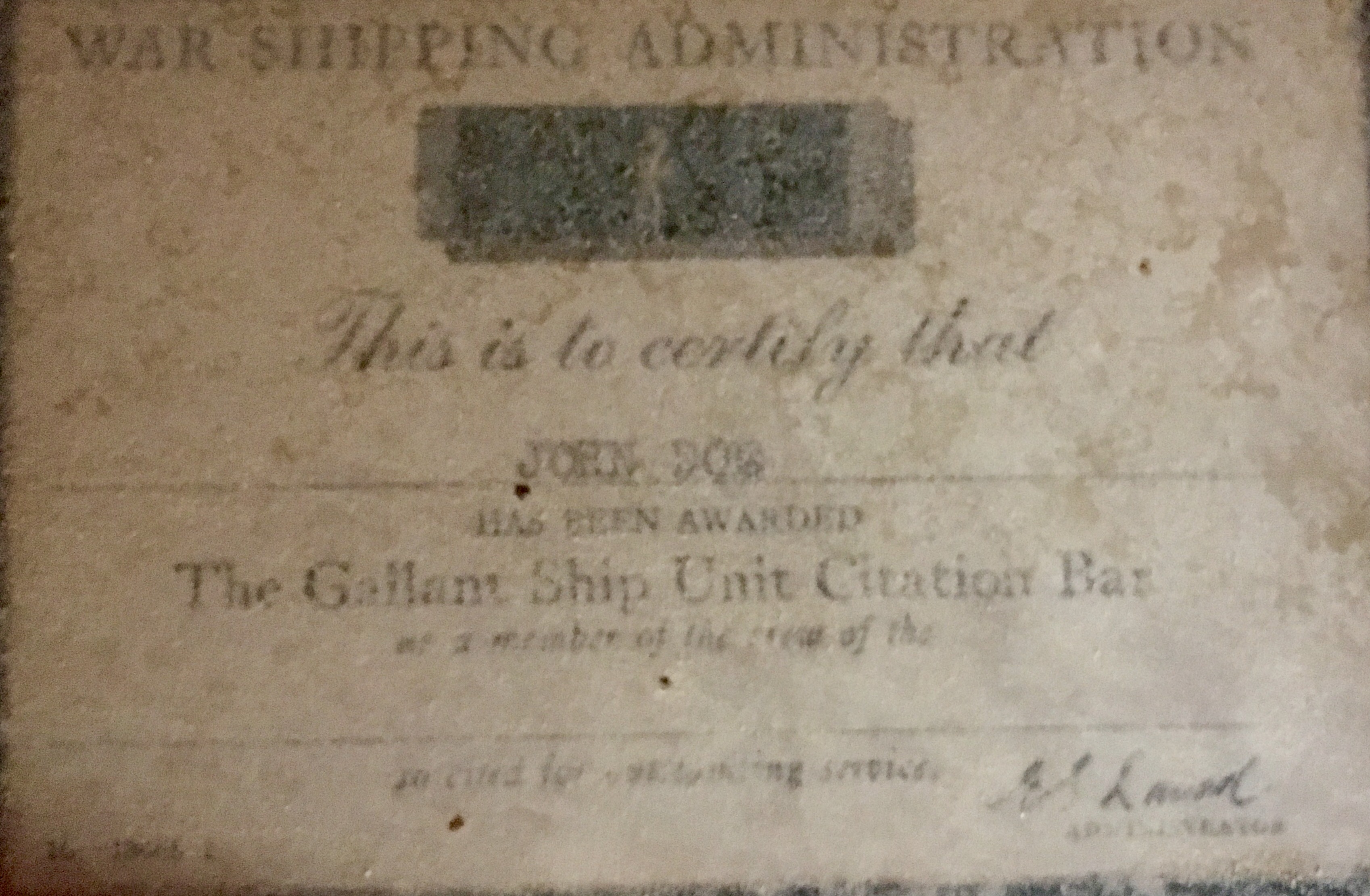
1. (a) The Administrator of the War Shipping Administration, hereinafter referred to as the Administrator, is hereby authorized to issue a citation as public evidence of deserved honor and distinction to any United States ship or to any foreign ship operated by or for the account of the United States Maritime Commission or the War Shipping Administration which, subsequent to September 8, 1939, or during the present war has served or shall serve in outstanding action against attack or in gallant action in marine disasters or other emergencies at sea.
(b) The Administrator shall award a plaque to any ship so cited; and a replica of such plaque shall be preserved, under such regulations as the Administrator may prescribe, as a permanent historical record.
(c) The Administrator shall also award an appropriate citation ribbon bar to the master and each person serving on board such ship at the time of the action for which citation is made, as public evidence of such honor and distinction: Provided, That whenever such master or person would be entitled hereunder to the award of an additional citation ribbon, a suitable device shall be awarded, in lieu thereof, to be attached to the ribbon originally awarded.
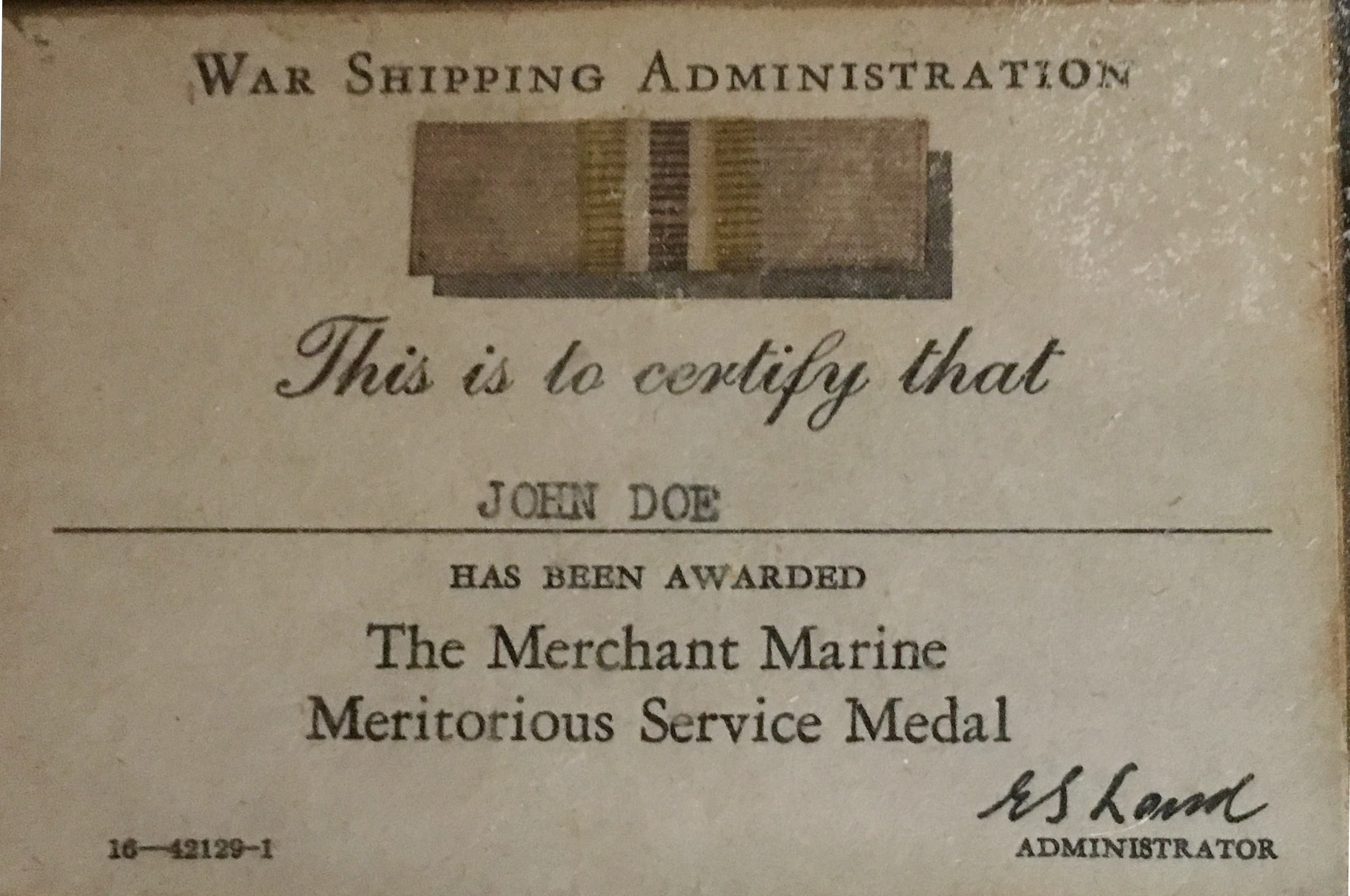
2. (a) There is hereby established the Merchant Marine Meritorious Service Medal, with accompanying ribbon and appurtenances, for award by the Admin-istrator, under such regulations as he shall prescribe, to any master, officer, or member of the crew of any United States ship, or any foreign ship operated by or for the account of the United States Maritime Commission or the War Shipping Administration who, subsequent to September 8, 1939, or during the present war has been or shall be officially commended by the Administrator for conduct or service of a meritorious character but not of such an outstanding character as would warrant an award of the Merchant Marine Distinguished Service Medal established pursuant to the act of April 11, 1942, ch. 241, 56 Stat. 217.
(b) No more than one Merchant Marine Meritorious Service Medal shall he awarded to any one person, but for each succeeding commendation justifying such an award a suitable device may be awarded to be worn with the medal and ribbon.
3. The Administrator is hereby authorized, until two years after the termination of the present war, to provide and issue, under such regulations as he may prescribe, a distinctive service ribbon bar to each master, officer, or member of the crew of any United States ship who shall have served at any time during the period beginning September 8, 1939, and ending December 6, 1941.
4. In case any person who is entitled to an award under this order dies before the award can be made to him, the award may be made to such representative of the deceased as the Administrator may deem proper.
5. The design of the plaque, medal, and ribbons herein authorized, shall not duplicate the design of any medals or ribbons awarded by the War or Navy Department. 6. The Administrator may delegate his authority hereunder and issue such other regulations as may be appropriate to carry out the provisions of this order.
Franklin D. Roosevelt
The White House, August 29, 1944.
The original period of the award was from 3 September 1939 to 25 July 1947; the award was reactivated by Public Law 759, 84th Congress, effective 24 July 1956.
To provide for the issuance of devices in recognition of the services of merchant sailors [H. R. 2281]
Be it enacted by the Senate and House of Representatives of the United States of America in Congress assembled, That the Administrator, War Shipping Administration, is hereby authorized to provide and issue
(a) a seamen’s service insignia of appropriate design to any person who, at any time during the period (hereinafter referred to as the war period) beginning December 7, 1941, and ending with the termination of the present war, serves on any vessel in the American merchant marine, and
(b) a seamen’s war zone insignia or device of appropriate design to any person who, at any time during the war period, serves on any vessel in the American merchant marine while sailing in any war or combat zone.
SEC. 2. The Administrator is authorized to provide and issue aseamen’s honor bar to any person who, at any time during the war period, serves on any vessel in the American merchant marine which, at the time of such service, is attacked or damaged by an instrumentality of war. The Administrator is further authorized to provide and issue a star (to be attached to such bar) to any such person who is forced to abandon such vessel when so attacked or damaged, with an additional star for each such abandonment.
SEC. 3. The Administrator is authorized to provide and award a medal of appropriate design and a ribbon, together with a rosette or other device to be worn in lieu thereof, to any person, who while serving on any vessel in the American merchant marine during the war period, is wounded, suffers physical injury, or suffers through dangerous exposure as a result of an act of an enemy of the United States.
SEC. 4. The Administrator shall prescribe appropriate conditions of eligibility for the issuance or award of insignia or medals under this Act. Not more than one insignia or medal of each type provided herein shall be issued or awarded to any one person, but. for each succeeding service of any person sufficient to justify the award of a medal under section 3 of this Act, the Administrator may award a suitable bar, emblem, or insignia to be worn with the medal. In case any person who performs service sufficient to justify the award of a medal under section 3 dies before the award can be made to him, the award may be made and the medal presented to such representative of the deceased as the Administrator deems proper. No award of any insignia, medal, or device shall be made hereunder after two years after the termination of the present war.
SEC. 5. The Administrator is authorized to approve a design for a seamen’s service flag which may be displayed, and a design for a service lapel button which may be worn, by members of the immediate family, of a person serving in the American merchant marine during the war period. In approving any design under this section, the Administrator may approve the design approved by the Secretary of War under the provisions of the Act of Congress approved October 17, 1942 (Public Law 750, Seventy-seventh Congress), but only if the Secretary of War shall consent thereto and the Administrator shall approve for use in connection therewith a distinctive insignia or other device designating service in the American merchant marine. The Administrator, upon approval of the design for such service flag and service lapel button, shall cause notice of such approval and a description of the flag and button to be published in the Federal Register.
SEC. 6. (a) The Administrator is authorized to prescribe such rules and regulations as may be appropriate to carry out the provisions of this Act.
(b) The Administrator is authorized to expend out of any funds available for expenditure by the War Shipping Administration such sums as may be necessary to carry out the provisions of this Act.
Approved May 10, 1943
Further legislation determined that the award’s eligibility period was from 7 December 1941 to 25 July 1947.
In the early years of the Second World War, despite industrial output destined for the United States’ future allied and increased military readiness, it found itself woefully unprepared for the realities of fighting and the logistics involved in conducting a global war. Aside from the steady capitulation of American territories in the Pacific and decimation of colonial outposts, the first individuals to face the brunt of the Axis’ wrath after the United States’ declaration of war were merchant seamen. Their ships were sunk with impunity, and the federal government was compelled to honor the heroism of the everyman who comprised the ships’ crews.
Legislation
Public Law 77-524
77th Congress
JOINT RESOLUTION
To provide decorations for outstanding conduct or service by persons serving in the American merchant marine. Apr. 11, 1942 [H. J. Res. 263]
Resolved by the Senate and House of Representatives of the United States of America in Congress assembled, That the United States Maritime Commission is hereby authorized and directed, under such rules and regulations as it may prescribe, to provide and award a medal of such material and design and with such devices and inscriptions as the Commission may deem suitable to each person who in the American merchant marine, on or after September 3, 1939, has distinguished himself or during the war distinguishes himself by outstanding conduct or service in the line of duty. Such medals shall be presented with appropriate ceremony as specified by the Commission.
SEC. 2. There may be issued with each medal a rosette or other device to be worn in lieu of the medal. Not more than one medal shall be issued hereunder to any person, but for each succeeding instance sufficient to justify the award of a medal to such person the Commission may award a suitable bar or other emblem or insignia to be worn with the medal and the corresponding rosette or other device. In case any person who so distinguishes himself as to justify the award of a medal or decoration hereunder dies before the award can be made to him, the award may be made and the medal or decoration presented to such representative of the deceased as the Commission deems proper.
Approved, April 11, 1942.
The original period of the award was from 3 September 1939 to 25 July 1947; the award was reactivated by Public Law 759, 84th Congress, effective 24 July 1956.
The United States Maritime Service (USMS) was formally established in 1938, under a provision of the Merchant Marine Act of 1936. When the United States formally entered the Secord World War, the USMS became a critical element of the Nation’s war effort. A comprehensive training system was put in place, and USMS training schools were established across the nation. Thousands of seafarers and other experts served as instructors, who, in turn, helped train over 250,000 individuals, mostly men, to crew the ships of the U.S.-flag merchant marine.
This article examines the development and evolution of the United States Maritime Service (USMS) medals and awards program, detailing the historical context, design considerations, and qualification criteria for each decoration. It also analyzes the differences between the two major versions of the USMS Awards Manual, highlighting how the program has evolved to recognize distinguished service, professional achievement, and excellence among USMS personnel.
Origins of the United States Maritime Service
The USMS was established as a training organization, separate from the cadre of American merchant mariners themselves, and remains so today. While many USMS personnel were licensed or unlicensed mariners, their appointment to the USMS was made on the basis of their role as instructors, not mariners. When the USMS was established, there were no specific authorities related to the establishment of USMS-specific awards.
During the Secord World War, virtually all personnel involved in the training and instruction of mariners at the various USMS training schools received either an officer’s commission, or were enlisted (as petty officers and other non-commissioned ratings). Following the Secord World War, the USMS experienced a gradual decline, both in national visibility and in actual numbers. Most of the USMS training schools were closed after the Secord World War, but two remained in operation until 1954 (in Sheepshead Bay, Brooklyn, New York, and Alameda, California).
The United States Maritime Service Today (2025)
Although the service was largely disbanded by the early 1950s, it remains in existence. The Maritime Administrator concurrently serves as the Commandant of the service, and holds the rank of Admiral. The vast majority of the remaining USMS personnel are faculty and staff serving at the Federal maritime academy, the United States Merchant Marine Academy (USMMA) in Kings Point, New York. A small handful of commissioned officers can also be found at the State Maritime Academies; typically their respective superintendents and commandants hold USMS commissions.
Unlike the other uniformed services of the U.S., there is no correlation between rank and pay. USMS personnel are members of the Civil Service, and are compensated based on civilian pay scales. The General Schedule (GS) framework is used for non-faculty compensation, while a special Administratively Determined (AD) pay scale applies to faculty. There are no service-specific benefits, no USMS-related retirement. They are not recognized as veterans, due to their USMS status.
Development of the USMS Medals and Awards Program
The USMS medals and awards program has a relatively recent history despite the service’s establishment in 1938. In the mid-1990s, Captain Eric York Wallischeck, USMS, along with two colleagues, began developing designs for medals and ribbons along with general award criteria and guidelines. Initially, the proposal wasn’t supported by Academy leadership. However, with a change in USMMA leadership in 1998, a new Superintendent (a former Marine), Vice Admiral Joseph D. Stewart, USMS approved moving forward with the initiative.
From the beginning, a primary goal was to obtain specific legislative authority to establish these awards to ensure they had clear legal standing rather than merely representing a local recognition. Working with staff within the Maritime Administration’s policy, legal, and human resources offices, draft legislation was crafted and shepherded through the Department of Transportation, the Office of Management and Budget, and eventually through Congress. Ultimately, the proposal was included in the National Defense Authorization Act for Fiscal Year 2004, which became Public Law 108–136 on November 24, 2003.
The law that supports the USMS medals program is currently codified at 46 U.S.C. § 51701, specifically item (d):
§51701. United States Maritime Service (a) General Authority.-The Secretary of Transportation may establish and maintain a voluntary organization, to be known as the United States Maritime Service, for the training of citizens of the United States to serve on merchant vessels of the United States and to perform functions to assist the United States merchant marine, as determined necessary by the Secretary. (b) Specific Authority.-The Secretary may- (1) determine the number of individuals to be enrolled for training and reserve purposes in the Service; (2) fix the rates of pay and allowances of the individuals without regard to chapter 51 or subchapter III of chapter 53 of title 5; (3) prescribe the course of study and the periods of training for the Service; and (4) prescribe the uniform of the Service and the rules on providing and wearing the uniform. (c) Ranks, Grades, and Ratings.-The ranks, grades, and ratings for personnel of the Service shall be the same as those prescribed for personnel of the Coast Guard. (d) Medals and Awards.-The Secretary may establish and maintain a medals and awards program to recognize distinguished service, superior achievement, professional performance, and other commendable achievement by personnel of the Service.
Once authority for the program was received, the development team worked closely with the Army Institute of Heraldry (AIOH) to design the ribbons and medals, using imagery, colors, and themes that had some connection to the sea, the merchant marine, and service history. Medal shapes were selected that were generally comparable to their military service counterparts.
On October 15, 2003, the program was formally launched. Awards continue to be made to this day.
USMS Personal Decorations
The USMS awards system follows a hierarchical structure similar to that of other uniformed services, with four levels of personal decorations, a unit award, and several service ribbons. Each decoration has specific eligibility requirements and design elements that reflect the maritime heritage of the service.
They are, in order of precedence:
1. USMS Distinguished Service Medal (DSM)
Authorization and Eligibility
The Distinguished Service Medal (DSM) is authorized under 5 U.S.C. 45 and US Department of Transportation Awards and Recognition System. The Maritime Administrator concurrently serves as the Commandant of the service, and holds the rank of Admiral. The USMMA Distinguished Service Medal is approved and awarded by the Maritime Administrator in the name of the President.
The Distinguished Service Medal is awarded to an individual who distinguishes himself or herself by exceptional performance or service that was of singularly outstanding benefit to the United States Maritime Service, the United States Merchant Marine Academy, or the United States Merchant Marine. This award may be presented in recognition of a specific act or initiative, or may be awarded in recognition of a specific period of sustained outstanding performance. To justify this decoration, an exceptional performance of duty, clearly above that normally expected, which has contributed materially to the success of a major department, office, operation, or project, is required. In general, the Distinguished Service Medal will be awarded only to those officers in senior positions of responsibility, or whose service is of significant scope to justify the award. However, this shall not be interpreted to preclude the award of the Distinguished Service Medal to any individual whose service meets the requirements. If there is any doubt as to the degree of service involved, the Superior Performance Medal is the more appropriate award.
Design Elements
Medal:
Design: Obverse: A USMS Crest in gold set in the center of an open ring of blue enamel, 1-1/2 inches in diameter, and displaying the words “FOR DISTINGUISHED SERVICE MCMXXXVI”. The medal is suspended from the ribbon by a gold bar in the shape of the starboard profile of a Liberty Ship; however, the miniature medal shall not have a suspension bar. Reverse: The words “UNITED STATES MARITIME SERVICE” engraved around upper part of ring, with a space to engrave the name of the recipient.
Symbolism: The American eagle and shield represents loyalty and service to our nation, while the fouled anchor represents the Maritime Service’s seagoing heritage. The laurel branches are a traditional symbol of accomplishment and success, while the enameled ring represents continuity and service. The Roman numerals MCMXXXVI represent the year that the United States Maritime Service was established (with the Merchant Marine Act of 1936). The Liberty Ship suspension bar recalls the Maritime Service’s heroic actions during World War II, where the Liberty ship played a pivotal role in the Allied victory.
Ribbon:
Design: The ribbon is 1-3/8 inches wide and consists of the following stripes: 1/4″ Old Glory Blue (67178), 1/32″ Scarlet (67111), 13/16″ White (67199), 1/32″ Scarlet (67111), 1/4″ Old Glory Blue (67178).
Symbolism: The central band of white symbolizes truth and service. It is flanked by stripes of scarlet representing courage, fortitude and patriotism, and blue, representing wisdom and loyalty.
☆ ☆ ☆
2. USMS Superior Performance Medal (SPM)
Authorization and Eligibility
The Superior Performance Medal (SPM) is authorized under 5 U.S.C. 45 and US Department of Transportation Awards and Recognition System. The USMMA Superior Performance Medal is approved and awarded by the Superintendent in the name of the Secretary of Transportation.
Awarded to an individual who distinguishes himself or herself by superior professional performance, achievement or service. To justify this decoration, the service rendered must have been comparable to that required for the USMS Distinguished Service Medal, but of a lesser degree. In general, the Superior Performance Medal will be awarded to officers in positions of lesser responsibility who have performed such exceptionally meritorious service as to justify the award of the Distinguished Service Medal except as to degree of merit. However, this should not be interpreted to preclude the award of the Superior Performance Medal to any individual, regardless of grade or rate, whose acts or services meet the requirements. When the degree of achievement or service rendered, although meritorious, is not sufficient to warrant the award of the Superior Performance Medal, the Commendation Medal should be considered.
Design Elements
Medal:
Design: Obverse: A bronze USMS Crest in relief, surrounded with the words “UNITED STATES MARITIME SERVICE”, upon a 1″ disk with beveled edges, surrounded by the points of two, eight-pointed stars with beveled edges, 1-1/2″ in diameter. Reverse: The points of the compass rose on the reverse are modeled with the central portion plain, bearing the words “FOR SUPERIOR PERFORMANCE” engraved at top.
Symbolism: The American eagle and shield represents loyalty and service to our nation, while the fouled anchor represents the Maritime Service’s seagoing heritage. The laurel branches are a traditional symbol of accomplishment and success, and the underlying compass rose denotes leadership, direction, and guidance.
Ribbon:
Design: The ribbon is 1-3/8 inches wide and consists of the following stripes: 1/8 inch Purple (67115); 1/32 inch Steel Gray (67199); 3/16 inch Corsaire Blue (67177); 1/32 inch Steel Gray (67199); center 5/8 inch Purple (67115); 1/32 inch Steel Gray (67199); 3/16 inch Corsaire Blue (67177); 1/32 inch Steel Gray (67199); 1/8 inch Purple (67115).
Symbolism: The ribbon’s central theme of purple represents visionary leadership and justice. The thin steel gray stripes represent the merchant marine at war, while the choice of Corsaire Blue harkens back to the early role of American Merchant Mariners as privateers in the service of the United States.
☆ ☆ ☆
3. USMS Commendation Medal (COM)
Authorization and Eligibility
The Maritime Service Commendation Medal (COM) is authorized under 5 U.S.C. 45 and US Department of Transportation Awards and Recognition System. The USMMA Commendation Medal is awarded by the Superintendent in the name of Maritime Administrator.
Awarded to an individual who has distinguished himself or herself by commendable professional achievement(s) or service(s) worthy of special recognition such as to constitute a definite contribution to the United States Maritime Service, the United States Merchant Marine Academy, or the United States Merchant Marine. For Achievement that is outstanding and worthy of special recognition, such as an invention, or improvement in design, procedure or organization. For Service that is well above that usually expected of an individual commensurate with their grade or rate, sufficient to distinguish the individual above those performing similar services, and above that degree of excellence that can be appropriately reflected in the individual’s performance appraisal.
Design Elements
Medal:
Design: Obverse: On a 1-3/8 inch wide bronze hexagon, point up, the USMS Crest, but without the laurel leaves. Reverse: The words “UNITED STATES MARITIME SERVICE”.
Symbolism: The American eagle and shield represents loyalty and service to our nation, while the fouled anchor represents the Maritime Service’s seagoing heritage.
Ribbon:
Design: The ribbon is 1-3/8 inches wide and consists of the following stripes: 3/32 inch Old China Blue (67178), 3/32 inch White (67101); center 1 inch Old China Blue (67169); 3/32 inch White (67101); and 3/32 inch Old China Blue (67178).
Symbolism: The theme of blue and white represents wisdom and truth; the color Old China Blue recognizes the great American clipper ships engaged in the China trade, and is a shade suggests both sea and sky.
☆ ☆ ☆
4. USMS Professional Achievement Medal (PAM)
Authorization and Eligibility
The Maritime Service Professional Achievement Medal (PAM) is authorized under 5 U.S.C. 45 and US Department of Transportation Awards and Recognition System. The USMMA Professional Achievement Medal is awarded by the Superintendent in the name of Maritime Administrator.
Awarded to an officer for commendable service or achievement of a professional nature. This award shall be presented based upon sustained performance or specific achievement of such merit as to warrant further tangible recognition than is possible through the normal evaluation channels.
Design Elements
Medal:
Design: Obverse: The USMS shield centered upon a bronze medal 1-3/8″ in diameter, with a beveled edge 5/16″ wide upon which the four cardinal points of the compass have been picked out with triangles bearing the letters “N”, “S”, “E”, and “W” and bearing the words “UNITED STATES MARITIME SERVICE” in the interstices of the compass points. Reverse: The words “FOR PROFESSIONAL ACHIEVEMENT” at top, with a fouled anchor below.
Symbolism: The simple Federal shield represents loyalty and service to our nation, while the fouled anchor represents the Maritime Service’s seagoing heritage.
Ribbon:
Design: The ribbon is 1-3/8 inches wide and consists of the following stripes: 1/8 inch Imperial Blue (67175); 3/16 inch Orange (67110); center 3/4 inch Steel Gray (67199); 3/16 inch Orange (67110); and 1/8 inch Imperial Blue (67175).
Symbolism: The central band of gray represents the merchant ships of World War II convoys, where the Maritime Service earned its first professional achievements. It is flanked by orange (enthusiasm, vigor) and blue (wisdom, loyalty). Orange and blue are also colors associated with the U.S. Department of Transportation.
☆ ☆ ☆
USMS Unit Award
USMS Outstanding Unit Award (OUA)
The purpose of unit awards is to foster unit morale, incentive, and esprit de corps through prompt recognition of outstanding performance of group effort. Unit awards recognize entire organizations for outstanding heroism or achievement, especially those performed under arduous circumstances, or extraordinary situations that involve Academy interests. They are restricted to the recognition of acts or services that clearly and distinctly, by nature and magnitude, place the unit’s performance significantly above that of other units performing similar missions. They are not intended to recognize individual actions, but to acknowledge the combined efforts of the organization. The performance should be that which can be recognized adequately in no other way.
Authorization and Eligibility
The Maritime Service Outstanding Unit Award (OUA) is authorized under 5 U.S.C. 45 and US Department of Transportation Awards and Recognition System. Awarded by the Superintendent, to any unit, team, or other workgroup for commendable achievement. This award shall be presented for achievement based upon exceptional performance or specific achievement(s) of a superlative nature, and shall be of such merit as to warrant further tangible recognition than is possible through the normal evaluation channels.
Design Elements
Design: The ribbon is 1-3/8 inches wide and consists of the following stripes: 5/32 inch Ultramarine Blue (67118), 3/32 Old Glory Red (67156); center 7/8 inch Steel Gray (67199); 3/32 Old Glory Red (67156); and 5/32 inch Ultramarine Blue (67118); enclosed within a 1/16 inch wide gold frame embossed with a laurel-leaf pattern.
Symbolism: The central band of gray represents the merchant ships of World War II convoys, the ultimate test of teamwork and unit cooperation. It is flanked by stripes of Old Glory Red, representing loyalty to the American Flag, and Ultramarine Blue, representing the wisdom required of merchant mariners. The gold frame of laurel leaves represents loyalty and achievement.
☆ ☆ ☆
USMS Service Awards
In addition to the personal decorations and unit award, the USMS has established several service ribbons to recognize specific achievements and qualifications.
1. Sustained Performance Ribbon (SPR)
Authorization and Eligibility
The Sustained Performance Ribbon may be awarded to an individual who has maintained a superior level of performance for a period of five (5) consecutive years. During this period, an individual’s performance evaluations must have been “Exceeded Expectations” or “Outstanding” in every critical Job Element. Individuals must not have been suspended, or received any letter of reprimand or other citations for improper conduct, during the period of qualification. In the event of such improper conduct, the measured period of performance shall commence with the date of the offense.
In addition to service at USMMA, the term of service considered for this award may also include temporary assignment elsewhere within the federal government, recall to active duty in the armed forces, or service with the Military Sealift Command. Individuals who were granted a sabbatical or other form of professional leave during this period, not to exceed two years, would be permitted five years of superior performance during a maximum seven-year period.
Design Elements
Ribbon: The ribbon is 1-3/8 inches wide and consists of the following stripes: 1/16 inch Imperial Blue (67175); 1/16 inch Steel Gray (67199); 1/16 inch Imperial Blue (67175); 1/16 inch Steel Gray (67199); 1/16 inch Imperial Blue (67175); 1/16 inch Steel Gray (67199); center 5/8 inch Imperial Blue (67175); 1/16 inch Steel Gray (67199); 1/16 inch Imperial Blue (67175); 1/16 inch Steel Gray (67199); 1/16 inch Imperial Blue (67175); 1/16 inch Steel Gray (67199) and 1/16 inch Imperial Blue (67175).
Symbolism: The theme of blue and gray represents wisdom and truth, both elemental requirements of long and honorable service.
☆ ☆ ☆
2. Academic Achievement Ribbon
Authorization and Eligibility
Awarded to an individual who has been awarded an advanced degree (Master’s Degree or higher) by an accredited academic institution.
A 3/16″ bronze star may be added for each additional master’s degree. A 3/16″ silver star shall be affixed to the ribbon to indicate a terminal degree. No more than a total of four stars (either bronze or silver) may be affixed to the ribbon.
Design Elements
Ribbon: The ribbon is 1-3/8 inches wide and consists of the following stripes: 1/16 inch Purple (67115); 1/16 inch Old Gold (67105); 1/16 inch Black (67138); 1/16 inch Old Gold (67105); center 7/8 inch Purple (67115); 1/16 inch Old Gold (67105); 1/16 inch Black (67138); 1/16 inch Old Gold (67105); and 1/16 inch Purple (67115).
Symbolism: The ground of purple represents the wisdom associated with the academic community. The flanking stripes of gold and black represent constancy and prudence.
☆ ☆ ☆
3. Deck Officer’s Ribbon
Authorization and Eligibility
Awarded to an individual who has been awarded and maintains a USCG Deck Officer’s license, including those “Renewed for Continuity.” Qualification for the Deck Officer’s Ribbon signifies acquisition of specific professional skills, knowledge and military experience that result in qualifications above those required of other Maritime Service personnel serving. This qualification must be obtained through a formal qualification program and successful completion of the written exam and other requirements imposed upon an individual by the U.S. Coast Guard.
3/16″ bronze stars shall be affixed to the ribbon to indicate the particular level of license held: Third Mate, ribbon only; Second Mate, one star; Chief Mate, two stars; Master, three stars.
Design Elements
Ribbon: The ribbon is 1-3/8 inches wide and consists of the following stripes: 1/16 inch Black (67138); 1/16 Steel Gray (67199); 13/32 inch Old Gold (67105); 1/16 inch Black (67138); 1/16 inch Steel Gray (67199); center 1/16 inch Imperial Blue (67175); 1/16 inch Steel Gray (67199); 1/16 inch Black (67138); 13/32 inch Old Gold (67105); 1/16 inch Steel Gray (67199); and 1/16 inch Black (67138).
Symbolism: The colors of gold and black are traditionally associated with the uniforms of deck officers, while the central stripes of blue and gray represent wisdom and truth.
☆ ☆ ☆
4. Engine Officer’s Ribbon
Authorization and Eligibility
Awarded to an individual who has been awarded and maintains a USCG Engine Officer’s license, including those “Renewed for Continuity.” Qualification for the Engine Officer’s Ribbon signifies acquisition of specific professional skills, knowledge and military experience that result in qualifications above those required of other Maritime Service personnel serving. This qualification must be obtained through a formal qualification program and successful completion of the written exam and other requirements imposed upon an individual by the U.S. Coast Guard.
3/16″ bronze stars shall be affixed to the ribbon to indicate the particular level of license held: Third Assistant, ribbon only; Second Assistant, one star; First Assistant, two stars; Chief Engineer, three stars.
Design Elements
Ribbon: The ribbon is 1-3/8 inches wide and consists of the following stripes: 1/16 inch Black (67138); 1/16 Steel Gray (67199); 13/32 inch Old Glory Red (67156); 1/16 inch Black (67138); 1/16 inch Steel Gray (67199); center 1/16 inch Imperial Blue (67175); 1/16 inch Steel Gray (67199); 1/16 inch Black (67138); 13/32 inch Old Glory Red (67156); 1/16 inch Steel Gray (67199); and 1/16 inch Black (67138).
Symbolism: The colors of red and black are traditionally associated with the uniforms of engine officers, while the central stripes of blue and gray represent wisdom and truth.
The USMS Medals and Awards Manual
Two major versions of the USMS Medals and Awards Manual have been developed since the program’s inception.
The Original Manual (July 2003)
The first USMS Medals and Awards Manual was revised on July 10, 2003, establishing the official guidelines for the award program before its official launch later that year. This manual laid the groundwork for the program, establishing the precedence of awards, criteria for eligibility, and administrative procedures.
The Third Edition (March 2021)
The third edition of the USMS Medals and Awards Manual, dated March 2021, updated the guidelines for uniformed Staff and Faculty and their Supervisors at the United States Merchant Marine Academy in Kings Point, New York. This revised manual refined many aspects of the program based on nearly two decades of implementation experience.
The USMS Medals and Awards program has evolved since its inception, as reflected in the differences between the original 2003 manual and the updated 2021 edition. Key differences include:
Organizational Structure
Both manuals maintain a similar overall structure, with chapters dedicated to general information, personal decorations, unit awards, and service awards. However, the 2021 edition (3rd Edition) includes additional chapters on award precedence and identification badges/insignia, reflecting an expansion of the program.
Authority and Approval
The 2003 Manual placed approval authority for the Distinguished Service Medal with the Secretary of Transportation, while the 2021 Manual delegates this authority to the Maritime Administrator. Both manuals maintain the Superintendent of USMMA as the approval authority for lower-tier awards.
Eligibility Requirements
The eligibility requirements for awards have been refined in the 2021 edition:
Distinguished Service Medal: Both manuals maintain similar criteria, emphasizing “exceptional performance or service that was of singularly outstanding benefit.”
Professional Achievement Medal: The 2003 manual specified this award as being for “an officer of the grade of lieutenant commander and junior thereto,” while the 2021 manual removes this rank restriction, opening eligibility to all officers.
Sustained Performance Ribbon: The 2003 manual required performance evaluations to be “above average, exceeding the ‘Proficient,’ ‘Satisfactory’ or ‘Fully Successful’ levels,” while the 2021 manual uses contemporary evaluation terminology, requiring “Exceeded Expectations” or “Outstanding” in every critical Job Element.
Additional Awards and Recognition
The 2021 manual includes sections on breast insignia and command insignia, providing guidelines for the Command-At-Sea Badge for both Deck and Engine Officers, as well as the Sea Service Badge. These additions reflect an expansion of the recognition program beyond medals and ribbons.
Conclusion
The United States Maritime Service Medals and Awards Program represents a significant effort to recognize the contributions and achievements of USMS personnel. Developed relatively recently compared to the long history of the service itself, the program combines maritime traditions with contemporary award practices.
The program’s design elements—from the Liberty Ship on the Distinguished Service Medal to the compass points on the Professional Achievement Medal—reflect the maritime heritage of the USMS. The color choices, especially the use of blues, grays, and golds, symbolize service at sea, while the award criteria establish clear standards for recognition of exceptional performance.
The evolution of the program from 2003 to 2021 demonstrates a commitment to maintaining a relevant and meaningful recognition system that adapts to changing evaluation standards and organizational needs. By establishing this comprehensive awards program, the USMS has created a valuable means of fostering pride, esprit de corps, and excellence among its personnel, ensuring the continuation of its distinguished traditions of service to the maritime community and the nation.
I have a pretty medal in my collection from Portugal – I have always considered it one of the more interesting ones I have. It has an Angel of Victory and the motto, “Reconhecimento da Nação” on the obverse. It is officially known as the “Medalha Comemorativa do Esforço dos Tripulantes da Marinha Mercante Durante a Guerra de 1939-1945” [Commemorative Medal for the Effort of Merchant Marine Crews During the War of 1939-1945] per the reverse.
Right after the Second World War, the Republic of Portugal promulgated Decree/Law 38515 of 19 November 1951 (in Government Gazette no. 241/1951, Series I of 1951-11-19) created a medal to commemorate the efforts of both crews of merchant ships of “high and distant sea” and fishing vessels during the 1939-1945 war. To be eligible for the medal, individuals must have been a crew member aboard a Portuguese vessel for at least one year, although the period of service was waived for those who were aboard when their vessel was attacked or sunk. The law stated that the medal was bronze and suspended from a green and red ribbon, and worn on the right breast. In 1970, the law was amended to provide a medal with the same obverse and a white and red moiré ribbon for (Decree 568/70 of 20 November 1970); on 9 August, the award of the medal ceased (Decree/Law 329/85 of 9 August 1985).
The perpetual joke among my children is that I am interested in sunk merchant marine Portuguese ships in Hawai’i. So, since I have a Portuguese Merchant Marine medal, and since the recipients of the medal could potentially have been involved in rescues of crew members of sinking ships, I thought that I’d do a little research on the topic. And I was quite surprised.
Portugal’s neutral merchant marine and fishing fleet conducted extensive rescues of Allied and Axis personnel during the Second World War, often under hazardous conditions. Below is a detailed account of key operations, vessels, and personnel involved.
Fishing and Auxiliary Vessels
White Fleet cod-fishing schooners: Assisted in rescues after U-boat attacks, though specific vessel names are rarely documented. These vessels had been painted white and marked as Portuguese to avoid attacks (although this neutrality was not always recognized).
Improvised naval flotilla (1941): Included merchant ships like Cubango (seaplane carrier) and trawlers mobilized for coastal defense and rescue operations. 15
Rescue of the British Cargo Ship Manaar (7 September 1939)
Event: On September 7, 1939, the Portuguese passenger/cargo liner Carvalho Araújo encountered a lifeboat carrying 16 Indian crewmen from the British cargo ship Manaar, which had been sunk hours earlier by German submarine U-38.
Rescue Details: The survivors were spotted adrift and picked up by Carvalho Araújo. Other survivors from Manaar were also rescued by the Italian ship Castelbianco and the Dutch ship Mars, with all survivors eventually landed in Lisbon.
Outcome: The rescued men were safely brought to Lisbon. The rescue was noted as the first by a Portuguese ship of the Second World War, occurring just days after the war began.
Casualties: Of Manaar’s crew, 7 of 63 died; the rest were rescued by the three ships.
Interesting Note: The rescue highlighted Portugal’s early humanitarian role, with Carvalho Araújo acting swiftly in the opening days of the Second World War to save lives regardless of nationality1.
☆
Alferrarede
Rescue of Lucrecia (7 July 1940)
Event: On July 7, 1940, the Portuguese merchant ship Alferrarede found survivors from the vessel Lucrecia, which had been sunk by belligerent action.
Rescue Details: The survivors, adrift in the Atlantic, were brought aboard Alferrarede and taken to safety. The event was reported in the Portuguese press as another example of the country’s maritime solidarity.
Outcome: Survivors were landed safely in Portugal.
Casualties: Not specified in available records.
Interesting Note: This rescue reinforced the pattern of Portuguese civilian ships providing aid to shipwrecked sailors, regardless of their flag1.
☆
Ana I
Rescue of Aghios Nicolaos (7 October 1940)
Event: On October 7, 1940, the Portuguese merchant ship Ana I rescued the crew of the Greek merchant vessel Aghios Nicolaos, which had been sunk by a German U-boat.
Rescue Details: The Greek sailors, exposed and adrift, were brought aboard Ana I and landed safely in Portugal.
Outcome: The entire crew was saved and returned to safety.
Casualties: Not specified.
Interesting Note: The rescue was acknowledged in Greek diplomatic channels, with thanks extended to the Portuguese for their humanitarian action1.
☆
Serpa Pinto
Rescue of Antonios Chandris (8 October 1940)
Event: On October 8, 1940, the Portuguese liner Serpa Pinto was en route to Brazil when it spotted distress signals from a lifeboat.
Rescue Details: Aboard were 22 Greek sailors from the Antonios Chandris, sunk by the German raider Widder. The survivors had drifted for weeks, some so weak they had to be carried aboard. Their rescue was widely reported, and the survivors later returned to Europe on the same ship, greeted in Lisbon by Greek officials.
Outcome: All 22 were rescued and eventually returned home.
Casualties: None among this group, though their ordeal was severe.
Interesting Note: The Serpa Pinto became a symbol of Portugal’s humanitarian neutrality, later also transporting refugees from Nazi-occupied Europe1.
☆
Nyassa
Rescue of Andaluzian (20 March 1941)
Event: On March 20, 1941, the passenger liner Nyassa picked up 23 survivors from the British ship Andaluzian, torpedoed in the Atlantic.
Rescue Details: The survivors were rescued from rough seas and landed at a Portuguese port.
Outcome: 23 men were brought to safety.
Casualties: Not specified.
Interesting Note:Nyassa was also known for transporting refugees from Europe to the Americas during the war1.
☆
Gorgulho
Rescue of Aurillac (25 April 1941)
Event: On April 25, 1941, the Gorgulho rescued survivors from the Aurillac, a vessel lost to wartime action.
Rescue Details: Survivors were brought aboard and later landed safely.
Outcome: Survivors saved; details on numbers not specified.
Casualties: Not specified.
Interesting Note: The rescue was one of several by Portuguese ships during the dangerous spring of 19411.
☆
Angola
Rescue of Wray Castle (4 May 1941)
Event: On May 4, 1941, the Portuguese liner Angola found and rescued survivors from the British ship Wray Castle, sunk by a U-boat.
Rescue Details: The rescued sailors were taken to Lisbon.
Outcome: Allied seamen saved and landed in Portugal.
Casualties: Not specified.
Interesting Note: The Angola was a regular on colonial routes and played a key humanitarian role during the war1.
☆
Mirandella
Rescue of Queen Maud (7 May 1941)
Event: On May 7, 1941, Mirandella found and rescued the shipwrecked crew of the Queen Maud, another victim of submarine warfare.
Rescue Details: Survivors were given shelter and landed in Portugal.
Outcome: Crew saved.
Casualties: Not specified.
☆
Ás de Paus & Pátria e Liberdade
Rescue of Martin Pecheur (10 May 1941)
Event: On May 10, 1941, two Portuguese ships, Ás de Paus and Pátria e Liberdade, jointly rescued survivors from the Martin Pecheur.
Rescue Details: The survivors, adrift in the Atlantic, were brought to safety by the combined efforts of both crews.
Outcome: Survivors landed safely.
Casualties: Not specified.
☆
Ganda
Rescue of British Grenadier (23 May 1941)
Event: On May 23, 1941, Ganda found survivors from the British tanker British Grenadier, sunk by a U-boat.
Rescue Details: The rescued men were landed at Lisbon.
Outcome: Crew saved.
Casualties: Not specified.
☆
Tarrafal
Rescue of Clan Macdougall (31 May 1941)
Event: On May 31, 1941, Tarrafal performed one of the largest single rescues by a Portuguese merchant ship, picking up 85 survivors from the British ship Clan Macdougall, sunk in the Atlantic.
Rescue Details: The survivors, many suffering from exposure, were landed in Portugal and received medical care.
Outcome: 85 men saved.
Casualties: Not specified.
Interesting Note: This was among the largest single rescues by a Portuguese merchant vessel during the war1.
☆
Malange
Rescue of Djurjura (15 June 1941)
Event: On June 15, 1941, Malange rescued survivors from the Djurjura, a vessel lost to wartime action.
Rescue Details: Survivors were brought aboard and landed safely.
Outcome: Crew saved.
Casualties: Not specified.
☆
Maria Terceiro
Rescue of Empire Warrior (19 June 1941)
Event: On June 19, 1941, Maria Terceiro picked up the crew of the Empire Warrior, a British merchant ship sunk by a U-boat.
Rescue Details: The rescued crew were landed in Portugal.
Outcome: Crew saved.
Casualties: Not specified.
☆
Santa Princesa
Rescue of Designer (10 July 1941)
Event: On July 10, 1941, Santa Princesa found survivors from the Designer, a ship lost to belligerent action.
Rescue Details: Survivors were brought to safety.
Outcome: Crew saved.
Casualties: Not specified.
☆
Sultana
Rescue of Auditor (16 July 1941)
Event: On July 16, 1941, Sultana rescued the shipwrecked crew of the Auditor near the Cape Verde islands.
Rescue Details: Survivors were taken aboard and landed safely.
Outcome: Crew saved.
Casualties: Not specified.
☆
Saudades
Rescue of Holmside (24 July 1941)
Event: On July 24, 1941, Saudades found crew members from the Holmside, a ship lost to belligerent action.
Rescue Details: Survivors were brought aboard and landed safely.
Outcome: Crew saved.
Casualties: Not specified.
☆
Altair
Rescue of Ida Knudsen (25 July 1941)
Event: On July 25, 1941, Altair found two lifeboats from the Ida Knudsen, a ship sunk by belligerent action.
Rescue Details: Survivors were rescued from the lifeboats and taken to safety.
Outcome: Crew saved.
Casualties: Not specified.
☆
África Ocidental & Maria Leonor
Rescue of Horn Shell (6 August 1941)
Event: On August 6, 1941, África Ocidental and Maria Leonor found castaways from the Horn Shell, a ship sunk by belligerent action.
Rescue Details: Survivors were picked up and landed safely.
Outcome: Crew saved.
Casualties: Not specified.
☆
Gronelândia
Rescue of Trinidad (25 September 1941)
Event: On September 25, 1941, Gronelândia picked up castaways from the Trinidad, a ship lost to wartime action.
Rescue Details: Survivors were brought aboard and landed safely.
Event: On January 22, 1942, the Portuguese merchant ship João Corte Real encountered survivors from the British cargo ship Gandia, which had been torpedoed and sunk by a German U-boat off the Azores.
Rescue Details: Survivors were found adrift in lifeboats, exhausted and suffering from exposure. The crew of João Corte Real brought them aboard, provided food and medical attention, and transported them to safety in the Azores.
Outcome: Survivors were landed safely and received by local authorities.
Casualties: Not specified.
Interesting Note: The Gandia sinking was one of several in the Azores area during the intense U-boat campaign of early 1942.
☆
Cunene
Rescue of Svenør (27 March 1942) and Koll (6 April 1942)
Event: On March 27, 1942, the Portuguese ship Cunene found survivors from the Norwegian cargo ship Svenør, and on April 6, 1942, Cunene and Lobito jointly rescued crew members from the Norwegian ship Koll, both sunk by U-boats.
Rescue Details: Survivors were picked up in the Atlantic and landed safely in Portuguese ports. The rescues were coordinated with other Portuguese ships, demonstrating the effectiveness of civilian maritime networks.
Outcome: Survivors from both vessels were saved.
Casualties: Not specified.
Interesting Note: These rescues highlighted Portugal’s role as a neutral safe haven for Allied and neutral sailors in the Atlantic.
☆
Almirante Sousa e Faro
Rescue of Dago (7 July 1942)
Event: On July 7, 1942, the Almirante Sousa e Faro found the crew of the Dago, a ship sunk by belligerent action.
Rescue Details: The survivors were taken aboard and provided with care, then delivered to the nearest port.
Outcome: Crew saved.
Casualties: Not specified.
☆
Maria Amélia and Mirandella
Rescue of Polyphemus (27 May 1942)
Event: On May 27, 1942, the Portuguese ships Maria Amélia and Mirandella jointly found and rescued the crew of the Polyphemus, a British ship sunk by a U-boat.
Rescue Details: Survivors were picked up from lifeboats and cared for on board, then landed at a Portuguese port.
Outcome: Crew saved.
Casualties: Not specified.
☆
Argus
Rescue of Empire Clough (10 June 1942)
Event: On June 10, 1942, the Argus found survivors from the Empire Clough, a British merchantman sunk by a U-boat.
Rescue Details: The survivors, suffering from dehydration and exposure, were brought aboard and landed safely.
Outcome: Crew saved.
Casualties: Not specified.
☆
Nacala
Rescue of Mahronda and Hellenic Trader (11 June 1942)
Event: On June 11, 1942, Nacala found crew members from the Mahronda and towed survivors from the Hellenic Trader, both British ships sunk by belligerent action.
Rescue Details: Survivors were rescued from lifeboats and towed to safety.
Outcome: Crew saved.
Casualties: Not specified.
☆
Angoche II
Rescue of Cliftonhall (12 June 1942)
Event: On June 12, 1942, Angoche II helped survivors from the Cliftonhall, a British ship sunk by a U-boat.
Rescue Details: Survivors were picked up and landed safely.
Outcome: Crew saved.
Casualties: Not specified.
☆
Pedro Nunes
Rescue of Clan Macwhirter (27 August 1942)
Event: On August 27, 1942, the Portuguese merchant ship Pedro Nunes found survivors from the Clan Macwhirter, a British cargo ship sunk by a German U-boat.
Rescue Details: Survivors were picked up from lifeboats and cared for on board, then landed at a Portuguese port.
Outcome: Crew saved.
Casualties: Not specified.
☆
Cubango
Rescue of Trevilley (12 September 1942) and Breedijk (14 September 1942)
Event: On September 12, 1942, Cubango found fifteen survivors from the Trevilley; two days later, it found thirteen survivors from the Breedijk.
Rescue Details: Survivors from both ships were rescued from lifeboats and brought to safety.
Outcome: All rescued were landed safely.
Casualties: Not specified.
☆
Portuguese Fishing Boats (unnamed)
Rescue of HMT Alouette (19 September 1942)
Event: On September 19, 1942, Portuguese fishing boats operating off the coast found and rescued survivors from the British trawler HMT Alouette, sunk by a U-boat.
Rescue Details: The fishermen brought the survivors aboard and took them to the nearest port.
Outcome: Crew saved.
Casualties: Not specified.
Interesting Note: This rescue is one of the few specifically attributed to the Portuguese fishing fleet, highlighting their role in humanitarian action in the Second World War.
☆
Mouzinho
Rescue of Baron Ogilvy (19 September 1942)
Event: On September 19, 1942, the Mouzinho found survivors from the Baron Ogilvy, a British ship lost in the Atlantic.
Rescue Details: Survivors were brought aboard and landed safely.
Outcome: Crew saved.
Casualties: Not specified.
Lourenço Marques
Rescue of Cleanthis (30 November 1942)
Event: On November 30, 1942, the Lourenço Marques found survivors from the Greek ship Cleanthis, sunk by belligerent action.
Rescue Details: Survivors were picked up from lifeboats and landed safely.
Outcome: Crew saved.
Casualties: Not specified.
☆
Luso
Rescue of Medon (10 August 1942)
Event: On August 10, 1942, the Luso found survivors from the Medon, a ship sunk by belligerent action.
Rescue Details: Survivors were rescued and cared for on board.
Outcome: Crew saved.
Casualties: Not specified.
Key Allied Rescues by Civilian Portuguese Vessels 1943
Rescue of the British Steamer Harmonic (22 July 1943)
Event: On July 22, 1943, the Portuguese merchant steamer Inhambane was returning from Montevideo to Lisbon when, at 7 a.m., it encountered a lifeboat carrying 46 survivors from the British steamship Harmonic, which had been torpedoed by U-172 a week earlier.
Rescue Details: The survivors, led by Captain Roland Stott, had endured days at sea, suffering from thirst and injuries. The Inhambane’s crew provided water, tobacco, clothing, and medical treatment. Recognizing the difficulty of carrying so many extra people to Lisbon, Captain Lourenço Fernandes decided to head for Baía, Brazil. There, on July 24, the survivors were transferred to a British vessel at the port entrance, after arrangements with the British consul.
Outcome: All 46 survivors were safely transferred and cared for. Only one man from Harmonic had died in the initial torpedo explosion.
Interesting Note: The German U-boat commander reportedly offered help to an injured survivor and even apologized for sinking the ship before departing-a rare gesture in the brutal Battle of the Atlantic2.
☆
Lourenço Marques
Rescue of Aelybryn Survivors (11 March 1943)
Event: On March 11, 1943, the Portuguese merchant vessel Lourenço Marques encountered survivors from the British ship Aelybryn, which had been sunk by belligerent action.
Rescue Details: The survivors were found adrift and taken aboard, where they received food, water, and medical attention.
Outcome: Survivors were landed safely and received by local authorities.
Casualties: Not specified.
☆
Sines
Rescue of Keystone Survivors (11 March 1943)
Event: On the same day, March 11, 1943, the Portuguese merchant ship Sines rescued castaways from the Keystone, another vessel lost to wartime action.
Rescue Details: The Sines’s crew brought the survivors aboard and provided immediate care.
Outcome: Survivors were landed safely in Portugal.
Casualties: Not specified.
☆
Foca
Rescue of Moanda Crew (29 March 1943)
Event: On March 29, 1943, the Portuguese ship Foca found and rescued the crew of the Moanda, a vessel lost in the Atlantic.
Rescue Details: Survivors were picked up from lifeboats and cared for on board.
Outcome: Crew landed safely.
Casualties: Not specified.
☆
Albufeira
Rescue of James W. Denver Survivors (11 April 1943)
Event: On April 11, 1943, the Portuguese vessel Albufeira found ten survivors from the American ship James W. Denver.
Rescue Details: The survivors, adrift for days, were rescued and provided with food, water, and medical attention.
Outcome: All ten were landed safely.
Casualties: Not specified.
Unspecified Portuguese Vessels
Rescue of Tinhow Survivors (11 May 1943)
Event: On May 11, 1943, two Portuguese vessels jointly rescued survivors from the Tinhow.
Rescue Details: The survivors were picked up and cared for by the crews of both ships.
Outcome: Survivors landed safely.
Casualties: Not specified.
Luabo
Rescue of City of Canton Survivors (17 July 1943)
Event: On July 17, 1943, the Portuguese vessel Luabo found castaways from the City of Canton.
Rescue Details: Survivors were taken aboard, cared for, and landed safely.
Outcome: Crew saved.
Casualties: Not specified.
☆
Faro Fishing Boat
Rescue of USAAF B-24 Liberator Crew (November 1943)
Event: In late 1943, a USAAF B-24 Liberator crashed off the Algarve coast. Three Faro fishermen-Jaime Nunes, José Mascarenhas, and his teenage son Manuel-rowed through rough seas to rescue six American airmen.
Rescue Details: The fishermen brought the survivors ashore, hid them from authorities, and helped arrange their repatriation.
Outcome: Six airmen survived; five perished in the crash.
Interesting Note: This act of bravery was only publicly recognized decades later, with a memorial in Faro.
Rescues by Civilian Portuguese Vessels 1944
There are no documented rescues at sea by Portuguese merchant or fishing vessels in 1944 (i.e., picking up castaways from torpedoed Allied or Axis ships). The shift in the war meant far fewer sinkings near Portuguese waters, and the focus of Portuguese civilian shipping turned to refugee transport rather than open-sea rescues of shipwrecked sailors.
In 1944, Portuguese merchant ships-especially the liners SS Nyassa and SS Serpa Pinto-continued their vital humanitarian missions, primarily transporting refugees fleeing war-torn Europe. While there are no documented open-sea rescues of torpedoed merchantmen by Portuguese civilian ships in 1944, the year was marked by dramatic and historically significant refugee voyages, and at least one perilous encounter with a German U-boat.
SS Nyassa
Refugee Voyages and Humanitarian Action (1944)
January 25, 1944:Nyassa departed Lisbon carrying 172 Jewish refugees, some of whom had been in Portugal since 1933. She then called at Cádiz, Spain, where she embarked another 570 refugees. The voyage continued through the Suez Canal to Portuguese India and returned via Mozambique, repatriating Portuguese civil servants who had been stranded due to the war.
Significance: This voyage made Nyassa the first merchant ship to make a commercial passage through the Mediterranean and Suez Canal since Italy entered the war in June 1940.
June 1944:Nyassa left Lisbon with 75 refugees and 25 US citizens, reaching Philadelphia after a 17-day crossing on July 8.
September 18, 1944: She departed Lisbon with 118 passengers, including 95 refugees, reaching Philadelphia on October 1. Thirteen of these refugees were to join relatives in the US; the rest were bound for Canada.
Interesting Note: Nyassa’s 1944 voyages reflect Portugal’s ongoing commitment to humanitarian neutrality. The ship’s ability to navigate war zones and deliver hundreds of refugees to safety-despite the risks of submarine warfare-was a remarkable achievement and a lifeline for many5.
☆
SS Serpa Pinto
Refugee Voyages and U-Boat Incident (May 26, 1944)
Humanitarian Voyages: Throughout 1944, Serpa Pinto continued to carry refugees from Lisbon and Spanish ports to the Americas, with the support of organizations like the Joint Distribution Committee (JDC). Passenger lists from 1941–1944 show thousands of refugees, including Jews fleeing the Holocaust, diplomats, and other civilians, found safety aboard her6.
Dramatic U-Boat Encounter: On May 26, 1944, Serpa Pinto was intercepted in the mid-Atlantic by a German U-boat. The submarine’s captain ordered the ship to stop and forced all passengers and crew into lifeboats, preparing to sink the vessel. After several tense hours, the U-boat commander received orders from Berlin to let Serpa Pinto go, and the refugees and crew were allowed to reboard. The ship continued its voyage, and all aboard survived7.
Interesting Note: The Serpa Pinto incident became a symbol of the perils faced by neutral humanitarian vessels during the Second World War. Prime Minister Salazar reportedly considered a diplomatic embargo in response, underscoring the gravity of the situation and Portugal’s resolve to protect its ships and humanitarian missions.
Summary Table: Major Portuguese Civilian Ship Humanitarian Missions, 1944
Ship
Date(s)
Rescue/Mission Type
Refugees/Survivors Transported
Casualties
Nyassa
Jan, Jun, Sep 1944
Refugee transport (Lisbon–US/India/etc.)
172–570 per voyage
None
Serpa Pinto
26-May-1944
U-boat interception, refugee transport
Hundreds per voyage
None
Rescues by Civilian Portuguese Vessels 1945
By 1945, the Battle of the Atlantic had dramatically subsided, and the need for at-sea rescues by Portuguese civilian vessels was nearly nonexistent. The main focus of Portuguese maritime activity shifted toward the return to peacetime operations, with convoys and the “White Fleet” (cod-fishing schooners) continuing their traditional work, but without documented rescues of torpedoed or shipwrecked Allied, Axis, or neutral sailors that year. The last wartime cod-fishing convoy sailed in April 1945, and the threat from U-boats had ended with Germany’s surrender in May.
The SS Nova Scotia Rescue (1942)
Although the NRP Afonso de Albuquerque was a Portuguese Navy ship, I thought the story compelling in what happened during the rescue. The British troop transport Nova Scotia, carrying 1,052 people (including 766 Italian POWs and internees ), was sunk by U-177 off Natal, South Africa. The U-boat was advised not to pick up survivors and the Portuguese in neighboring Lourenço Marques (today’s Maputo, Mozambique) were alerted to the human catastrophe. The Portuguese sloop NRP Afonso de Albuquerque, commanded by Captain José de Brito, located survivors after a 27-hour search. Despite intense rivalry between Allied guards and Italian prisoners on life rafts, the crew rescued 194 people, including a woman who swam alone for 30 hours after losing her daughter. The operation, the largest by a Portuguese ship during the Second World War, highlights both humanitarian commitment and the grim realities of wartime enmity. 4
Many rescues lack detailed survivor/vessel names due to incomplete records.
Portuguese civilian crews were rarely named in official reports.
The Serpa Pinto also transported Jewish refugees to safety, earning the nickname “Ship of Destiny.”
Medalha Comemorativa do Esforço dos Tripulantes da Marinha Mercante Durante a Guerra de 1939-1945 [Commemorative Medal for the Effort of Merchant Marine Crews During the War of 1939-1945]
The Portuguese Merchant Marine commemorative medal from the Second World War employs rich symbolic language that draws from classical antiquity while honoring Portugal’s maritime heritage. The obverse features a striking winged female figure in the tradition of Victoria (Nike), the classical personification of victory. Clothed in flowing robes reminiscent of ancient Greek chiton garments, she stands proudly upon a stylized ship’s prow—a significant detail that anchors her firmly in maritime context while echoing classical victory monuments where Nike was often depicted on the prow of a vessel. This imagery deliberately evokes the Nike of Samothrace, one of the most famous ancient sculptures depicting victory at sea.
The figure holds what appears to be a laurel branch or palm frond extended outward, traditional symbols of triumph, honor, and peace dating back thousands of years. Her posture, with its subtle contrapposto stance, conveys dignity and classical grace, while her expansive wings create a protective embrace that symbolically shelters those who served at sea. These wings serve multiple symbolic functions: they emphasize the divine or elevated nature of national recognition, suggest protection over the sailors, and reference freedom and transcendence over earthly dangers—particularly meaningful for those who faced the perils of war at sea.
Encircling this central figure, the inscription “RECONHECIMENTO DA NAÇÃO” (Recognition from the Nation) employs a formal Roman-inspired typeface that lends governmental authority and connects the medal to traditional European commemorative design. The typography’s precision and placement follow classical medallion conventions, creating a sense of timeless honor rather than merely contemporary recognition.
The reverse side centers on a boldly rendered anchor, the universal symbol of maritime identity and hope. In Portuguese naval tradition, the anchor represents not only the practical tools of seafaring but also steadfastness in the face of adversity—a particularly resonant meaning for merchant sailors facing wartime dangers. This anchor is positioned between the years “1939-1945,” clearly defining the period of service being commemorated while creating visual balance in the composition.
The reverse’s encircling text, “MEDALHA COMEMORATIVA DO ESFORÇO DOS TRIPULANTES DA MARINHA MERCANTE DURANTE A GUERRA DE 1939-1945,” follows the tradition of explanatory text on medal reverses. The consistent typography connects visually to the obverse, creating design unity across both faces of the medal.
The medal’s suspension element features an intricately rendered nautical rope formed into a loop, incorporating maritime craft directly into the functional aspects of the medal rather than using a standard military attachment. This thoughtful detail reinforces Portugal’s deep historical connection to seafaring traditions dating back to the Age of Discovery, when Portuguese navigators first mapped much of the world’s oceans.
Taken as a whole, the medal represents a sophisticated blending of classical allegory with practical maritime symbolism. It effectively communicates that though Portugal maintained official neutrality during the Second World War, the nation recognized that its merchant sailors faced dangers comparable to military combatants. The design choices place this particular service within Portugal’s lengthy maritime heritage while using universal symbols recognized across Western cultural contexts, elevating what might have been a simple service medal into a meaningful artistic commemoration.
At the time of their creation of these “ribbon bars,” morale was flagging among merchant seamen due to high numbers of sinkings, long trips, and desperation on the part of the War Shipping Administration for bodies to crew their ships.
Just as the Army and the Navy were awarded ribbons for participation in the various theatres of war – with the promise of a later issuance of a medal – the same was true for merchant seamen. Merchant ships sailed into various war zones, and these were divided neatly into Atlantic, Mediterranean-Middle East, and Pacific along with complementing ribbons. Unlike the military’s ribbons, the Merchant Marine war zone bars did not bear any appurtenances.
Below, find the legislation responsible for the creation of the ribbon bars followed by a brief description of each. Unlike the set precedence of military ribbons, the Merchant Marine awards were worn in the chronological order in which they were earned. At the time of their creation, they had no corresponding medal; this changed in 1992.
Each war zone ribbon bar was authorized by Public Law 52 of the 78th Congress; curiously enough, the original start date for qualification was 3 September 1939, however, this was struck on the day of passing of the legislation without argument. This was later remedied by the creation of the Defense Bar – albeit pushing the date of qualification to 8 September 1939 – the day of President Franklin’s declaration of Limited National Emergency. 2 September 1939 was a watershed date as the German U-Boat U-30 sank the SS Athenia, a British-flagged unarmed civilian ship with 28 American casualties; at the time, the world was outraged.
It is worth noting that unlike the campaign ribbons issued to the military, where the period of eligibility ends on 2 March 1946 – the end of the Second World War – the period of eligibility for Merchant Marine War zone ribbons varied. The Atlantic and Mediterranean-Middle East War Zone bars period of eligibility was defined as between 7 December 1941 and 8 November 1945, with the Pacific ending on 2 March 1946. Compounding issues, the Merchant Marine Victory medal’s cut-off date for eligibility is 3 September 1945.
In terms of actual award, merchant seamen were required to petition the War Shipping Administration for War Zone Bars; upon receipt and review of their sailing history, the WSA would then mail the petitioner a cardstock “Award Card” and not the actual ribbon itself; merchant seamen needed to buy their own ribbons. This same tradition held sway at the United States Merchant Marine Academy until at least 2017 – any ribbon award earned by a midshipman must be purchased by the awardee.
Legislation
Law Establishing Merchant Marine Service Emblem, War Zone Medals, Combat Bar and Mariner’s Medal, Service Flag and Service Lapel Button §1(b).
AN ACT
To provide for the issuance of devices in recognition of the services of merchant sailors.
Be it enacted by the Senate and House of Representatives of the United States of America in Congress assembled, That the Administrator, War Shipping Administration, is hereby authorized to provide and issue (a) a seamen’s service insignia of appropriate design to any person who, at any time during the period (hereinafter referred to as the war period) beginning December 7, 1941, and ending with the termination of the present war, serves on any vessel in the American merchant marine, and (b) a seamen’s war zone insignia or device of appropriate design to any person who, at any time during the war period, serves on any vessel in the American merchant marine while sailing in any war or combat zone.
May 10, 1943 [H. R. 2281] [Public Law 52]
Although the legislation for the award of the war zone bars was published on 10 May 1943, several months passed before the actual notice for the design and qualifications for the awards. This happened on 23 September 1943 and was published in the Federal Register, Vol. 8, 25 September 1943 p. 13070.
Atlantic War Zone Bar
Qualification
The Administrator, War Shipping Administration, was authorized to provide and issue a seaman’s war zone insignia or device of appropriate design to any person who at any time during the war period served aboard any United States Merchant Marine vessel that sailed in the prescribed Atlantic War Zone.
The Atlantic War Zone comprised the North Atlantic Ocean, South Atlantic Ocean, Gulf of Mexico, Caribbean Sea, Barents Sea, and the Greenland Sea.
Description
Designed by the Merchant Marine Awards Committee, the ribbon is silk moiré, ⅜ inches tall by 1⅜ inches wide, with a center stripe of crimson, edged with white that gradually blends into light crimson edges. At the time, the ribbon was said to be flame-red, reminiscent of a ship ablaze.
Number Awarded
235,298 Atlantic War Zone Bars were issued for the qualifying period, 7 December 1941 to 8 November 1945.
Atlantic War Zone Award Card
Mediterranean-Middle East War Zone Bar
Qualification
The Administrator, War Shipping Administration, was authorized to provide and issue a seaman’s war zone insignia or device of appropriate design to any person who at any time during the war period served aboard any U.S. Merchant Marine vessel that sailed in the prescribed Mediterranean-Middle East War Zone.
The Mediterranean-Middle East War Zone comprised the Mediterranean Sea, Red Sea, Arabian Sea, and Indian Ocean west of the 80th meridian east longitude.
Description
Designed by the Merchant Marine Awards Committee, the ribbon is silk moiré, ⅜ inches tall by 1⅜ inches wide, with a narrow center stripe of white flanked by narrow stripes of green flanked by wider bands of yellow with narrow stripes of crimson, white, and navy blue extending to the edges.
Number Awarded
150,184 Mediterranean-Middle East War Zone Bars were issued for the qualifying period, 7 December 1941 to 8 November 1945.
Mediterranean-Middle East War Zone Bar Award Card
Pacific War Zone Bar
Qualification
The Administrator, War Shipping Administration, was authorized to provide and issue a seaman’s war zone insignia or device of appropriate design to any person who at any time during the war period served on any vessel of the U.S. Merchant Marine while sailing in the prescribed Pacific War Zone.
The Pacific War Zone comprised the North Pacific, South Pacific, and the Indian Ocean east of the 80th meridian east longitude.
Description
Designed by the Merchant Marine Awards Committee, the ribbon is silk moiré, ⅜ inches tall by 1⅜ inches wide, with a center stripe of red flanked by stripes of white and navy blue, the latter bordered by crimson and yellow, which extends to the edges.
Number Awarded
177,926 Pacific War Zone Bars were issued for the qualifying period, 7 December 1941 to 2 March 1946.
Pacific War Zone Bar Award Card
☆ ☆ ☆
An “around the world” ribbon bar with Atlantic, Mediterranean-Middle East, and Pacific War Zone bars
Design Notes
Some War Zone ribbon bars appear in the format ½ inches tall by 1⅜ inches wide; this is due to the fact that initial wartime suppliers of Merchant Marine ribbons followed the precedent set by the United States Navy; United States Army ribbons at the time were ⅜ inches tall by 1⅜ inches wide. This is due to the fact that there was no set, uniform rule on how ribbons were affixed to uniforms, nor even size. However, beginning in 1944, most manufacturers switched to the Army’s style. By the 1950s, in an effort to standardize ribbon sizes across services, the military settled on ribbons with the format ⅜ inches tall by 1⅜ inches wide. From this point forward, the Navy format was dropped.
The manufacture of War Zone ribbon bars was suspended in 1954; this is due to the cessation of the United States Merchant Marine wartime awards program on 21 December 1953 (18 FR 8730); when ribbon manufacture restarted in 1992, the manufacturer of the new ribbons was unable to replicate the old blending, and the stripes are rendered in stark bands. This manufacturer specification was upheld and codified by the Institute of Heraldry.
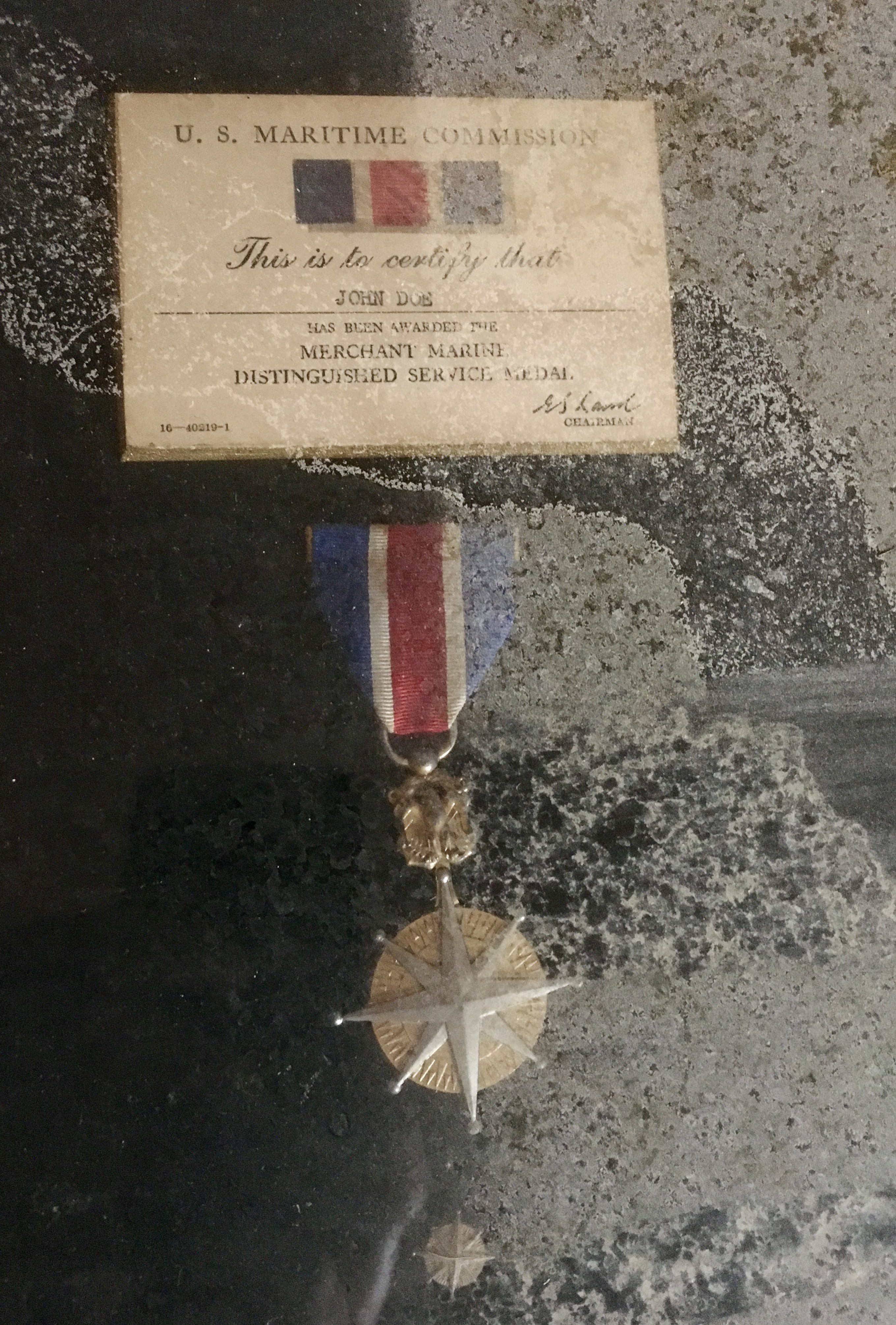
Creating a Distinguished Service medal specifically for the American Merchant Marine began as an extemporaneous idea floated between J. Franklin Carter and President Franklin D. Roosevelt. The rationale for granting members of the Merchant Marine medals is recorded in Carter’s “Report on medals for the merchant marine.” Unfortunately, the original report from Carter is lost, but granting medals may have been a calculated act as J. Franklin Carter operated in the capacity of President Roosevelt’s political spy; his job was to bolster the President’s image and maintain a finger on the Amercian people’s perception of the Administration. At the time, shipping losses were on the rise and Congress, at least, saw a need to bolster the spirits of merchant seamen symbolically. J. Franklin Carter’s union connections may have grabbed his attention since many of his reports came unsolicited from the President; this report came a few months after the passage of “Decorations for heroic service in the American merchant marine” (H.J. Res 263 12 Feb 1942) into law on 11 April 1942 – which President Roosevelt signed and parked. Within a month after the report’s receipt by Admiral E. S. Land, the U.S. Maritime Commission began work on the medal’s design. The President’s directive for the medal was to honor the extraordinary. Wishing for the artistic blessing of their work, and after several telephone conversations, the Commission sent their sketch of an acceptable medal design to the Commission of Fine Arts (CFA) – at the time, the medallic authority through which Federal Executive branch departments sent design requests for consideration.
After a scant review of the U.S. Maritime Commission’s sketch, the Commission of Fine Arts rejected it.
The CFA went so far as to say that a satisfactory medal could be created, using the ideas presented by the U.S. Maritime Commission, by a competent sculptor – namely, Paul Manship.
Taking CFA’s recommendation, in late August 1942, the U.S. Maritime Commission contracted Paul Manship to design the medal. Paul Manship was a prolific designer and took to the task with aplomb; at breakneck speed, he had the final product ready by the time of the medal’s first award ceremony on 8 October 1942 to Edwin F. Cheney, Jr.; Cheney’s medal was the second example of the medal.
The number of points cited was erroneous… eight would be the correct number.
Counting error aside, overall, Manship followed the process outlined in a New Yorker article published on 14 November 1942:
Early Paul Manship Design for the “Merchant Marine Medal.”
The design process went from the sketch above to the medal below over the period of a month and a half; the iterations and trials between did not have the best results. At one point, the eagle appeared cross-eyed, and strategic metal rationing prevented the use of some metals Paul Manship commonly used in the production process. Traditionally, United States Military medals had a base of red bronze and were sometimes gilded or covered in silver plate. The wartime Merchant Marine Distinguished Medal was originally made of solid silver “touched up” to look like gilded bronze – in a process known as vermeil or silver gilt. The medal’s abundance of silver presented an issue at the time of Cheney’s award; since the metal is so soft, the medal pendant and hinge fell from its suspension device when the President pinned the medal to Cheney’s jacket – Manship was on hand to make a quick repair (this might explain the E.S. Land’s rollicking smile in the official presentation photograph).
Mr. Roosevelt fumbled with the medal’s clasp, protesting: “They are all this way. They are terrible.” The Chief Executive turned the medal over to Admiral Emory S. Land, War Shipping Administrator, remarking that “I still can’t get the damn thing undone.”
8 October 1942, Award Ceremony1942 CCFA Merchant Marine Medal final design
Construction & Components
In designing the Merchant Marine Distinguished Service Medal, Paul Manship followed the guidance set by the U.S. military. Regulations at the time called for a medal of unusual shape for personal distinction – e.g., a cross, a medallion on a hinge, &c. – otherwise the general rule for campaign and service medals was for them to be round. Manship’s inspiration for the overall construction of the Merchant Marine Distinguished Service Medal stemmed from his successful design of the U.S. Navy Distinguished Service Medal. With the Navy medal, he employed the novel design element of a white enamel star with ball finials as a hinge between the suspension and the pendant. He followed a similar tack for the Merchant Marine Distinguished Service Medal and used an eagle as a hinge – but it was far more complex and involved several parts. The Merchant Marine medal’s pendant echoes his Greek and Etruscan archaic style as it displays a discrete balance between academic classicism design and Deco but does not quite approach Modernism. In a word, it was innovative, yet conservative. In my opinion, the medal is striking for the quality of detail and balance in composition.
Hinge & SuspensionRibbon & BroochPendant
Hinge & Suspension
The hinge between the ball suspension and the pendant is central to the medal. On the obverse of the hinge is a Federal eagle superimposed upon two crossed, traditional anchors. The eagle’s head is facing its dexter; the anchors rest on a laurel wreath. The reverse of the hinge has the sculptor’s initials P M incuse on a stylized band of cloth holding the wreath together.
Ribbon & Brooch
The silk moire ribbon is a simple affair of five red, white, and blue stripes. The stripes, outward in are: blue, white, and red. See below the United States Army Institute of Heraldry specifications which govern the ribbon’s color pattern.
The brooch was not a concern of a medal’s sculptor but was determined by the medal’s manufacturer. When ribboning a medal, the manufacturer usually uses available stock until depleted; and, as such, the Merchant Marine Distinguished Service Medal looks to have had at least three production runs by virtue of the observed brooch type found on existing medal specimens. The first brooch, as evident in the CFA photograph, is a split brooch with lock catch; this type of brooch appeared in 1918 and was used by manufacturers through the 1930s. The second brooch used with the Merchant Marine Distinguished Service medal is the wrap brooch with lock catch. These were common in the 1920s through early-war; unfortunately, they present the same profile on the ribbon when observed from the obverse as the earlier split brooch – thus positive identification is fraught. The third brooch style found on the wartime Merchant Marine Distinguished Service Medals is the slot brooch; these appeared in 1944. The latter brooches’ “tabs” were barely visible from the obverse.
Pendant
The pendant conveys Manship’s grounding in academic classicism. The obverse is comprised of a classical compass rose with the eight winds. A star depicts the winds; it is silver with rays tipped in ball finials; the remainder of the pendant is vermeil. The pendant’s reverse reads “United States Merchant Marine Distinguished Service” surrounding a striped Federal shield; the lettering utilizes an archaic font, evoking a link to ancient heroism; spaces between words are punctuated by stylus marks, and stars bookend “United States.”
The North Wind ray is incorporated into a pendant link to the hinge. The link is slightly beveled on the obverse and reverse abutting the compass card, imparting delicacy.
Official Strikes
The number of known awards of the medal was 154 during and immediately after the Second World War with at least one display medal at the United States Merchant Marine Academy at Kings Point. This supply came from The Medallic Art Company and the U.S. Mint with production at the former beginning in 1942. By 1952, all production and award of wartime Merchant Marine medals ceased – the Distinguished Service Medal, included. However, in 1956, the Merchant Marine Distinguished Medal was revived for use; no orders for the medal came at this time. The U.S. Maritime Administration (MARAD), the successor to the U.S. Maritime Commission, continued to draw from its existing stock. It presumably exhausted its supply in the early 1970s; this brought the first post-war order to fruition in 1973 with 50 medals from The Medallic Art Company. Stock may have dwindled by the 1980s due to co-terminus awards of the Merchant Marine Distinguished Service Medal and the Gallant Ship Award, causing MARAD to place its final order for the medal in 1987. The last number was 200 from HLI Lordship Industries. Since the last order, MARAD has not issued any new purchases. And, since 2000, only one medal has been awarded – albeit posthumously to Dr. Leonard H. Conley in 2019.
1942 The Medallic Art Company
The trial and first strike of the medal was manufactured at The Medallic Art Company; this makes sense as most of Paul Manship’s art medal and work went through MACO – most probably due to proximity to Manship’s studio in Manhattan. A late-war photograph in Fortune on MACO shows the Merchant Marine Distinguished Medal in the upper-left quadrant. Examples of the gold-colored gilt split brooch with lock catch are probably from MACO.
1942 U.S. Mint
The U.S. Mint had the first contract to mass-produce the medal. I posit that the wrap brooch and slot brooch are U.S. Mint products. The wrap brooch medal was awarded as late as 1946 – as an example to OS Richard G. Matthiesen attests. Brooch design suggests the U.S. Mint began production in 1943; but lack of corroboration leaves this solely as speculation on my part.
The pendant and hinge weigh 40g. The former is vermeil and silver; the latter is vermeil.
1973 The Medallic Art Company
Exhausting its supply of Merchant Marine Distinguished Medals and perhaps anticipating an increase in Gallant Ship citations in the wake of the Vietnam War, MARAD ordered 50 medals from The Medallic Art Company of Danbury, Connecticut. Medals at this time continued to have P M on the reverse of the hinge. The brooch is an unmarked crimp with a lock catch.
The pendant and hinge weigh 45g; both are made wholly of red brass (85% copper/15% zinc) and follow the same gilding pattern except the pendant and hinge are nickel plated over which is applied gold or silver plate depending upon the element.
1987 HLI Lordship Industries of Hauppauge, New York
The last contract for Merchant Marine Distinguished Medals went to HLI Lordship Industries of Hauppauge, New York. MARAD ordered 200 medals.
I have no examples of the HLI medal to weigh and measure nor brooches to analyze; it may be similar to the 1973 MACO contract strike; stylistically it lacks Paul Manships’s initials. This latter detail is probably due to them not appearing in the United States Army Institute of Heraldry CAD-generated detail specification sheet.
Note: Unfortunately, HLI became embroiled in a scandal for the sale of 300 unauthorized Congressional Medal of Honor on the sly and lost all Federal government contracts in 1996. However, it was able to purchase the ailing Ira Green, Inc. after it was found guilty of AAFES price fixing (in 1996), and under a new name, HLI re-gained its old government contracts.
1942 The Medallic Art Company
Col.: Anon.
1943 U.S. Mint
Col.: IW
1973 The Medallic Art Company
Col.: IW
Cast Copy – 2000
Sad cast at 28g. LI-GI crimp brooch is simply an artifact of the manufacturer taking the brooch from common medal and re-purposing it. This is probably a Wadim Nensberg production.
The United States Merchant Marine is not an armed service and has a relatively recent history of federally-issued medals and decorations. American merchant seamen and their ships have had a long history of being militarized without due recognition; before the Second World War, medals, awards, and decorations came from civic groups and managing operators. The wartime Roosevelt Administration started a new precedent: merchant seamen were to be honored just the same as their brothers-in-arms. And like sailors, merchant seamen received ribbons that were to become medals after the cessation of the war. Unfortunately, as momentum was building for placing seamen on an equal footing with the “battleship sailor” regarding benefits and medals, Roosevelt died; mariners had to wait to replace their hard-earned federally-issued ribbons with medals. Almost forty years after the close of hostilities, merchant seamen were granted veteran’s status – something far more valuable.
Below are some rarely-seen items from various entities: an award document for the highest wartime decoration to a United States Lines Master, a solid gold United States Lines award, and photographs of the collection of wartime medals at the American Merchant Marine Museum.
United States Maritime Commission Award Citation
Copy of Capt. George A. Vickers Merchant Marine Distinguished Service Medal citation sent to his employer, United States Lines. ca. 1945. He was presented his medal by a member of the War Shipping Administration – the government agency which assumed shipping management for the duration of the war from the U.S. Maritime Commission.
col.: AMMMcol.: AMMM
United States Lines Distinguished Service Medal & Award
With the retirement of Capt. George Fried from the United States Lines, the company’s Board of Directors instituted the “United States Lines’ medal for distinguished service.” Following the precedent of other Orders and Awards, there were two classes: Medal and Award. The former was awarded to ship masters and the latter to crew members and officers. November 20, 1934, marked its first award.
col.: AMMM. from Ocean Ferry, December 1934.
United States Lines Distinguished Service Award
Award medal presented to Philip Westerly Babcock, Jr. for his participation as lifeboat crew during the rescue of the fishing schooner Fieldwood by the SS American Farmer on December 19, 1938.
col.: IW
American Merchant Marine Museum collection
Merchant Marine Distinguished Service Medal and Award Card.
col. AMMM
Merchant Marine Meritorious Service Medal (obverse).
col. AMMM
Merchant Marine Mariner's Medal (reverse).
col. AMMM
War Shipping Administration Gallant Ship Unit Citation Bar Award Card.
col. AMMM
War Shipping Administration Merchant Marine Combat Bar Award Card.
col. AMMM
War Shipping Administration Merchant Marine Defense Bar Award Card.
col. AMMM
War Shipping Administration Atlantic War Zone Bar Award Card.
col. AMMM
War Shipping Administration Merchant Marine Meritorious Service Medal Award Card.
col. AMMM
In 1956, the Medal Awards Committee of the United States Maritime Administration made a study of awards and decorations to merchant seamen during the Second World War. Their findings described and analyzed the standards used in determining who merited an award. The study asserted the wartime Medal Awards Committee considered thousands of cases and “awarded a total of 145 distinguished Service medals, 380 meritorious service medals, and nine (9) gallant ship awards” (the numbers as cited by the 1956 study are refuted by a 1982 OMSA article stating 521). Mariners’ medals remained outside of the scope of the study since, although earmarked initially as a medal of merit, this medal was instead issued to seamen who received injuries as a result of enemy action; these awards became comparable to the Purple Heart awards to members of the armed services. Although not indicated by a medal or ribbon, letters of citation were an honor bestowed upon a seaman by the War Shipping Administrator and became part of a seaman’s permanent record; the number of these awards are unknown, but undoubtedly number in the thousands.
Based on the review of award cases, the wartime Committee under Frank Rusk had no established standards or criteria for award determinations. This was because the American Merchant Marine “Pyramid of Honor” was new and awards without precedent; thus, the Committee considered individual cases on their own merits. Yet, the Committee proceeded on a general pattern, and, to a certain extent, they were consistent with their determination. While changes in Committee personnel had some effect on the variation of awards, in most instances, all fell within the patterns, as noted below.
War Shipping Administration memorandum 24 July 1945
Citations
Citations each award had a grade of either “A,” “B,” or “C.” “A” cases were of an exceptional nature, but considered not sufficiently outstanding to warrant an award of the Meritorious Service medal; “B” cases were of a lesser degree, and “C” cases were less than that of “B.” These cases were subsequently reviewed and reconsidered for an award of a higher grade, especially when the Committee found additional material for consideration or when individual seamen became involved in another incident worthy of consideration for a different award.
“A,” “B,” and “C” cases generally fell into the following:
“Difficult and somewhat hazardous shipboard assignments, such as clearing fouled masthead rigging during a blow; attention to duty requiring long hours without relief; exacting time and attention to particular tasks; facing heavy seas and rough elements; faithfulness towards assignments; exceptional amount or quality of work performed such as making extensive and intricate repairs to machinery; etc.”
Meritorious Service Medal
Conditions for the award of the Meritorious Service medal involve noteworthy action, deed, or conduct at risk of life to save property and life of fellow crew members. The risk of loss of life or injury appears under these awards to only slightly less, yet distinctive, than in action meriting a Distinguished Service medal.
Examples
Standing by pumps to fight fire when dangerously close to high explosives.
Deliberately diving into shark-infested waters to rescue crew members from sinking vessel.
Removing personnel from below the deck area and repairing ruptured connections notwithstanding imminent danger of boiler explosions.
Assisting armed guard crews in manning guns with disregard of personal safety during strafing and bombing attacks.
Rescuing others under hazardous conditions involving torpedoed vessels in rough seas.
Distinguished Service Medal
This award resulted from the noteworthy performance of outstanding nature involving an act, conduct, or display of valor beyond the line of duty. The recipients of this award almost invariably faced near or certain death or bodily injury.
Examples
Facing close range and direct gun-fire in performance of rescue work where personal safety was extremely vulnerable.
Volunteering for special assignment when in so doing, it meant almost certain death, injury, or an ordeal of suffering.
Sacrificing position of safety for an almost certain loss of life, such as giving up space in a lifeboat and remaining on sinking craft.
Refusing rescue aid and giving preference to saving lives of others, such as remaining with sinking craft rather than crowd into a dangerously overcrowded life raft.
Under peril of being burned to death and without proper equipment, descending into the hold of vessel to extricate victims trapped under scalding steam and fire from ruptured boilers.
Descending on a rope over the side of the vessel into a storm to rescue an unconscious victim washed overboard.
Displaying courage and leadership in fighting furious fire surrounding high explosives, which, if detonated, would have caused complete loss of vessel and crew members.
Gallant Ship Award
The perpetuation of the ships’ names as gallant ships during the Second World War had been based on the display of stark courage of the crews in their stand against overwhelming odds during battle. The spirit of the award also permitted its award for outstanding gallantry in the event of maritime disasters or other emergencies to save life and property. This latter condition was later written into law.
Examples
“In eight of the nine awards, the records reflect that the vessels and the crews fought against prolonged series of bombing and submarine attacks and courageously repelled the enemy under odds that meant either death or surrender. These vessels were equipped with and used lighter armed weapons against much superior guns. They refused to give up when crippled, battered, and even ablaze and managed to outfight and outmaneuver the enemy to save a major portion of the lives of the crew members and valuable cargoes. The one instance of gallant ship award not resulting from enemy fire was an extremely hazardous nine-day rescue operation of a crew from a French destroyer during a violent storm and extremely heavy seas. In this instance, the gallant ship also managed to save a valuable warship by expert maneuvering and towing the stricken ship at extreme risk of loss and at terrific offs through submarine infested areas to a rendezvous point.”
SS Juan de Fuca documents
Below are a few documents from the Gallant Ship award case file on the SS Juan de Fuca which illustrate an awards file for a ship’s crew followed by copies of two citations (“Congratulatory Letters”).
The Master, Captain Charles S. Robbins – who was a recent recipient of the Merchant Marine Distinguished Service medal (below referenced as “Philippine Honor Award”) – felt strongly that his crew deserved recognition for the fine job of surviving enemy attacks and not abandoning their reef-crippled ship at Leyte Island in the Philippines. He was displeased that the U.S. Naval Armed Guard commander aboard received a commendation for convoy duty while his crew was left empty-handed. After consideration by the Medal Awards Committee, the ship did not earn the title of Gallant Ship since she did not fit into the rubric set during the Second World War for the award. The complete file is here.
Portion of the Captain Robbins’ complaint.Medal Awards Committee actions in reference to the Gallant Ship award application; page 1.Medal Awards Committee actions in reference to the Gallant Ship award application; page 1.Ship file with award decision (twice considered) and the awards to each seaman aboard. Note: Lloyd A. McIntire; he was a holder of class B citation and discharged prior to the activity in Leyte. The mutinous seaman is not on any award lists.
References
A. A. Hart. “Seamen Awards Study.” Maritime Administration, Washington D. C., 1956.
TIOH-designed common reverse for Merchant Marine medals post-1988. It is a modified U. S. Maritime Service shield.
Recognition: 1988
In 1988, U. S. Congress passed Public Law 100-324, “Merchant Marine Decorations and Medals Act.” This Act marked the conclusion to a waiting period of decades for Merchant seamen (by then called Merchant Mariners) to receive medals in place of their ribbon bars; during the Second World War, the federal government awarded ribbons in place of medals to members of the military for their various campaigns with the tacit understanding that after the cessation of hostilities, individuals would receive medals. Merchant Mariners received no such promise but assumed as such. After a few years in design and committee, the U.S. Maritime Administration announced the availability of planchets for the ribbons issued from the Second World War through the Vietnam Conflict on 19 May 1992 – just in time for Maritime Day (22 May 1992). The long wait was over.
All the planchets were designed by staff sculptors at the U.S. Army Institute of Heraldry (TIOH). Work in the reverse most probably began in 1990, since the Merchant Marine Expeditionary Medal (which shares the same reverse as the various Second War Medals) was designed in 1990 and first awarded in 1991. Below find all the planchets followed by design notes from MARAD. Each is suspended from a drape using the same pattern as the originally awarded ribbon bar – the moire effect suffered, though.
The Combat Bar and the Gallant Ship Citation ribbon remained ribbons without corresponding medals. All other previously awarded medals were not redesigned.
Atlantic War Zone Medal
Mediterranean-Middle East War Zone Medal
Pacific War Zone Medal
Merchant Marine Defense Medal
Korean Service Medal
Vietnam Service Medal
Post-1988 Merchant Marine Medals (ordering 2019) Click on the medal planchet for a larger image
Design
Merchant Marine Atlantic War Zone Medal: The compass rose is traditionally associated with maritime navigation and the superimposed triangle with duty and service other than in the Armed Forces. The eagle symbolizes the United States and freedom.
Merchant Marine Mediterranean-Middle East War Zone Medal: The shield and anchor symbolize a strong maritime service. The palms suggest the Mediterranean-Middle East area while denoting victory and achievement.
Merchant Marine Pacific War Zone: The trident, a symbol of naval prowess, rests upon a shaft of bamboo denoting the Pacific theater of operations. The seascape suggests maritime activities and service.
Merchant Marine Defense Medal: The shield and anchor, from the United States Maritime Service Seal, are superimposed on a ship’s wheel, denoting control and maritime service. The laurel branches symbolize achievement and excellence.
Merchant Marine Korean Service Medal: The tori gate and taeguk are traditionally associated with Korea. The ship’s chain alludes to maritime service.
Merchant Marine Vietnam Service Medal: The dragon is traditionally associated with Vietnam, the shoreline denotes service in the coastal waters adjacent to Vietnam and the anchor symbolizes maritime service. An alternate design for the lettering had “Vietnam Service” in Wonton font – it was deemed inappropriate for the medal and changed to a serif font. The font in question, potentially culturally offensive, was often used to imitate brushstrokes of an exotic East, and contemporary Vietnam used Western-type letters in print and script. This medal takes a cue from the Thomas Hudson Jones-designed Vietnam Service medal with its inclusion of the dragon – Mr. Jones was the prolific designer of U. S. military medals; he was responsible for some forty medals, including the WWII Victory Medal, thus the nod is understandable).