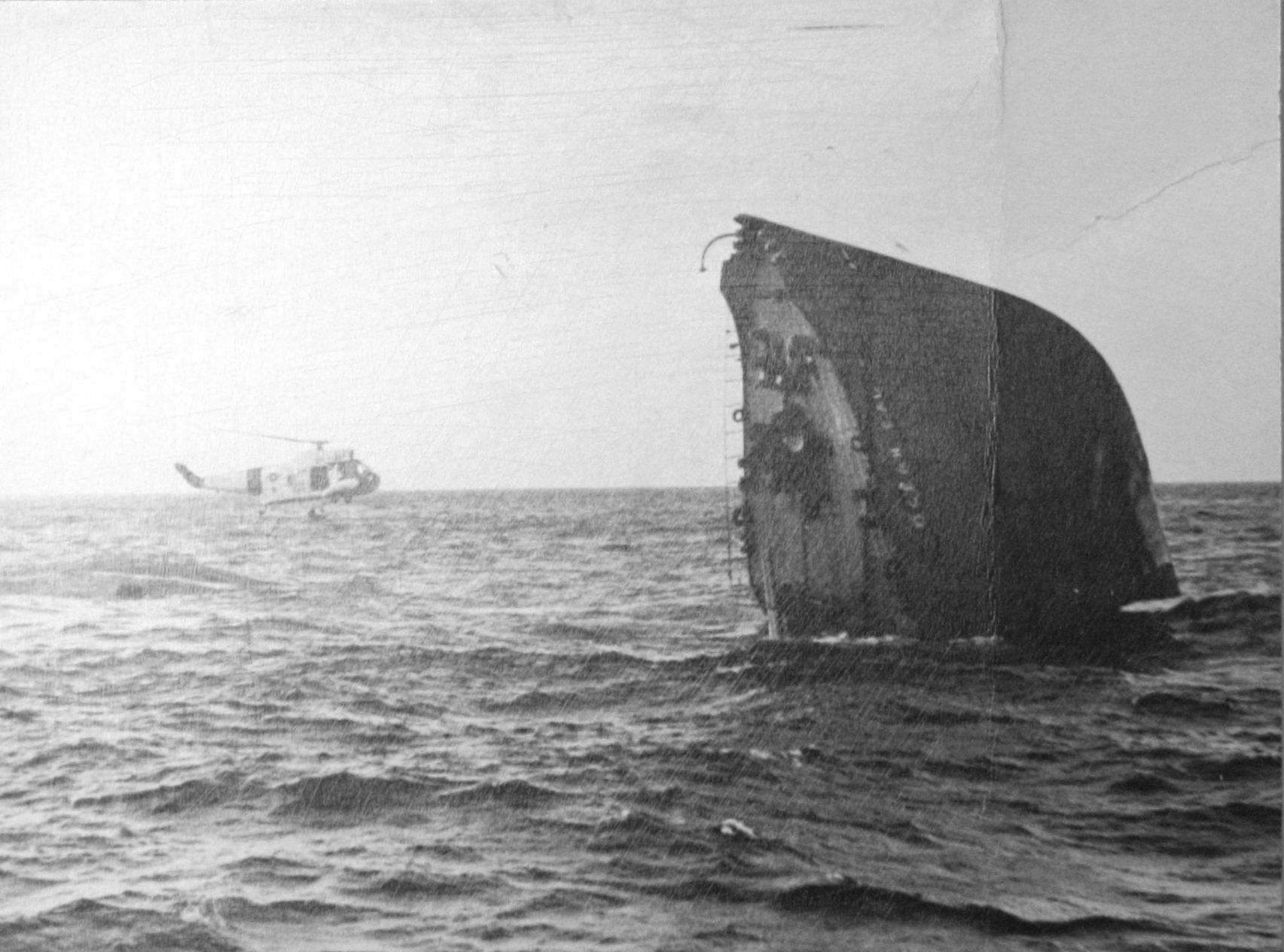

In the summer of 1943, the War Shipping Administration announced merchant seamen could apply for a series of ribbons Congress recently legislated for, and the President wrote into law. These bits of cloth and metal represented the American merchant seamen’s sacrifices made in service to the nation, and they came when the merchant seaman’s morale was at an ebb in the face of a protracted war. These same decorations were latecomers among the several pins and ribbons already available via union and other government channels, yet, as intended, they eclipsed all others. Among the new awards, the Merchant Marine Combat Bar represented the crux of merchant seamen recognition and became a ubiquitous marker of the combat-proven merchant seaman. It is arguably central to the U.S. Government’s understanding of how many merchant seamen experienced the rigors of war – it began as the “Torpedoed Seamen’s Club” insignia.
In 1920, the law to create a medal honoring merchant seamen who participated in the Great War expired. Congress did not extend the deadline owing to inadequate recordkeeping to identify merchant seamen who possibly qualified for the medal. In 1943, the U.S. Government was not so hindered. With the United States’ official entrance into the Second World War, the entire deep-water American Merchant Marine fleet fell under the umbrella of the War Shipping Administration (WSA). For the duration, merchant seamen aboard these ships became quasi-employees of the U.S. Government. Due to agreements negotiated with labor unions and shipping company management in early 1942, the U.S. Government acted within established industry parameters:
- The U.S. Government paid and gave merchant seamen their salaries and insurance.
- Unions placed men on ships through hiring halls.
- Steamship companies (also known as “managing operators”) as the U.S. Government’s agent, issued paychecks.
Before ship-out, seamen were duly credentialed and checked by the U.S. Department of Commerce. Thus, the bureaucratic process was in place for tracking seamen as assets of the United States in triplicate, and the potential for them to receive awards and decorations by the federal government.
As soon the United States declared war on Japan and its allies in December 1941, Germany dispatched a contingent of U-boats and positioned them off the United States’ eastern seaboard to prey on United States’ shipping. As a result, merchant seamen found themselves unwittingly thrown into the crucible of unrestricted submarine warfare. Absent were basic protections such as coastal blackouts, patrol aircraft, minesweepers, or military escorts. As a result, a great many seamen received otherwise preventable death sentences as the Germans attacked and sank their ships. Censorship rules prevented reporting the full breadth of the catastrophe in mass media, but it did not avert seamen from talking to each other.

It may be argued that the European Theater of the Second World War was won on the factory floor. It may be further argued that the United States’ ultimate success in Europe rested on the logistics process. Unhindered by the exigencies of war, American industrial output reached its zenith mid-war. However, it is often forgotten that early in the war, the United States faced numerous set-backs: its supply-lines to its overseas colonies and bases were severed, and its merchant fleets were sunk quicker than shipyards could replace the tonnage. Success only came with a steady stream of men to man the ships.
In this critical period, military planners schooled in von Clausewitz understood the grim calculus of numbers. The U.S. Maritime Commission sponsored building merchant ships cheaply and quickly, and the WSA embarked upon production-line style training of merchant seamen. Instead of mandating riveted hulls that could weather the shifting pressure of ocean waves, they chose welded constructions – they were cheap and modular – but brittle; ships did split in two. Since the overall investment was altogether low, they were not concerned if the ships sank after a convoy or two and or met its fate by a torpedo. Engines for the same ships were not the best – logisticians determined there was safety in numbers. Instead of depending upon speed to evade the enemy, merchantmen depended on the defensive screen of air cover or naval escorts. Since the delivery of war materiel was essential but could be replaced, convoys often contained shipments in duplicate. The unspoken rule was WSA planners expected high numbers of casualties; true to this assumption, 1942 saw some of the highest losses in terms of Allied and Neutral ships by tonnage and, by extension, their crews.[1] To the United States Maritime Commission’s credit, their maritime architects focused on automation, thus reducing ship complements and the WSA had maritime instruction beginning with lifeboat drills. But, in the mathematics of death, like frontline soldiers, merchant seamen were all expendable – to an extent.


The popular conception of merchant seamen at the time was not altogether positive. American opinion was colored by the violence of the past several decades in the docklands and the idea of seamen as wards of the state; workers on the waterfront were coarse and involved themselves in union agitation which often resulted in bloody riots. In January 1943, the press tapped into these negative sentiments – and having passed censors – circulated a fabricated story where seamen reportedly refused to unload their ships at Guadalcanal. Citing their contract did not cover working on Sunday, the seamen left the task to tired marines. The story struck a chord with the public – there was an outcry that while marines died selflessly for their country, seamen selfishly thought only of themselves. A Congressional Hearing determined the story was patently false and informed by anti-union bias, but the stigma remained.[2] Recruitment efforts stalled, and morale sagged. Yet, merchant seamen were needed to do a vital job more than ever. The loss of potential seamen trainees was devastating; the WSA understood the keen need for replacement hands. Even late in the war, Admiral E. S. Land reported:

As 1942 wore on, patriotism only ran so high. Many merchant seamen left the fleet and saw their fate as a soldier or sailor better off than death at sea. In sum, morale was terrible and needed a lift.
After the passage of the law that resulted in the eventual creation of the Merchant Marine Distinguished Medal in April 1942, concrete action by President Franklin D. Roosevelt and Congress to honor merchant seamen was noticeably lacking. Instead, a subtle game of one-upmanship of granting merchant seamen distinctive insignia to mark their status as bonafide patriots transpired between the WSA and maritime labor. February 1942 saw the creation of the U.S. Maritime Commission-sponsored Maritime Eagle, a version of which became a de-facto decoration in May. Published before a Congressional hearing in September 1942 on legislation to create a distinctive insigne for merchant seamen, LIFE Magazine included a feature on National Maritime Union pins in its 24 August 1942 issue;[3] this same hearing resulted in the Maritime Eagle being stricken as an award.[4]
Thus, up until 7 October 1942, merchant seamen had only the U.S. Naval Reserve badge as a decoration they could earn from a federal source – and these were only available to officers and cadet-midshipmen. Otherwise, only their employers and unions offered a small number of awards to seamen. The most noted among these were those from United States Lines and NMU. The former was awarded for lifesaving and gallantry, the latter for being torpedoed. Both awards were members-only, leaving the rest of the industry without recognition for their employees’ or members’ trials.[5] Finally, the first award of the Merchant Marine Distinguished Service Medal on 8 October 1942 to Edwin F. Cheney, Jr. came, and the relatively obscure “Torpedoed Seamen’s Club” insignia the day after. The latter was a “ribbon bar similar to that worn by members of the military” for a to-be-named “Club for Torpedoed Seamen” or “Seaman’s Honor Club.” Even though this club’s insignia was inaugurated one day after the first award of the Merchant Marine Distinguished Service Medal, to Congress, however, both were mentioned in the same breath. This point is significant: the Merchant Marine Distinguished Service Medal honored individuals who proved themselves as paragons of the spirit of the American Merchant Marine; the insignia recognized the struggles and triumphs of merchant seamen who experienced and survived combat.


By February 1943, the unnamed club extended beyond its original focus of torpedoing and shipwreck. It covered “all classes of seamen who have faced enemy action in the line of duty” on a vessel attacked or damaged directly or indirectly through enemy action, in addition to the abandonment of a vessel due to enemy action. Each eligible seaman received a ribbon bar of the club and a star for each time the ship is lost through enemy action.
In September 1942, Representative Francis E. Walter of Pennsylvania promoted a bill to further recognize merchant seamen due to perceived inertia. His preamble to the bill read:

Although Representative Walter’s intentions were admirable, U.S. Congress quashed the bill in committee the argument ran that merchant seamen were civilians and needed no further recognition since they had a medal on the way. The next bill – H.R. 132 – came before the House sponsored by Representative Schuyler Otis Bland of Virginia, then Chairman of the House Committee of the Merchant Marine and Fisheries, and it too was quashed but later rolled into H.R. 2281. This last bill was introduced in March 1943; it only reached criticality since the press reported in February that General Dwight D. Eisenhower wished to award merchant seamen military medals for their bravery and service in the face of the enemy. With the Maritime Eagle debacle undoubtedly in mind, Admiral E. S. Land approached President Franklin Roosevelt to allow the military to decorate seamen as a morale booster. Instead of military decorations, the American Merchant Marine gained a small constellation of ribbons and medals of its own, mostly due to the impassioned pleas of government-friendly tanker union advocates John J. and Agnes Collins. After some back-and-forth and a practical rubber-stamping by the U.S. Senate, the bill was presented to President Franklin D. Roosevelt on 5 May 1943, and written into Public Law five days later; thus becoming the culmination of the third attempt for proper recognition of the services of merchant seamen.[6]
Within the bill’s text, all the Merchant Marine service awards gave the appearance of duplicating or having parity with those of the Armed Services. All these decorations had U.S. Navy analogs except for the Merchant Marine Combat Bar. The Combat Bar was unusual because it was created as an Honor Bar, as evident in the House Resolution mandating its creation:

Moreover, the Combat Bar was actually the Torpedoed Seamen’s Club insignia; the law gave it “statutory basis” which removed it as a WSA administrative award:

Nevertheless, the Merchant Marine Combat Bar was a decoration in a class alone without an analogous place among military campaign or unit awards. Its potential analog among military honors would be the yet-to-be-created Combat Infantryman Badge. Less than a year after its creation, a reported 50% of veteran merchant seaman enrolled at the U.S. Maritime Service officers’ schools wore the ribbon, and 30% had a silver star affixed to it.[7] By war’s end, the WSA awarded the ribbon 114,145 times.[8] The last date of award of the Combat Bar was 26 March 1957.

Although the period for qualification for the award of the ribbon has long since expired, a version of the Merchant Marine Combat Bar, albeit with the bands rotated 180 degrees, is on the books as the United States Merchant Marine Academy’s “Academy Achievement Ribbon for Meritorious Service.”
design & wear

torpedoed seaman’s club insignia
The Torpedoed Seaman’s Club was an informal organization, so there were no membership cards or certificates, simply a ribbon bar. It appears that merchant seamen were given their lengths of ribbon to fashion or job-out their insignia. U.S. Maritime Service upgrade schools had clubs for each class as early as October through December 1942. Unions were notified of availability for their rank and file in February 1943. However, I have not seen the insignia in wear except for a single instance in combination with the USMMCC “Enemy Action – torpedoed ribbon” in June 1943.

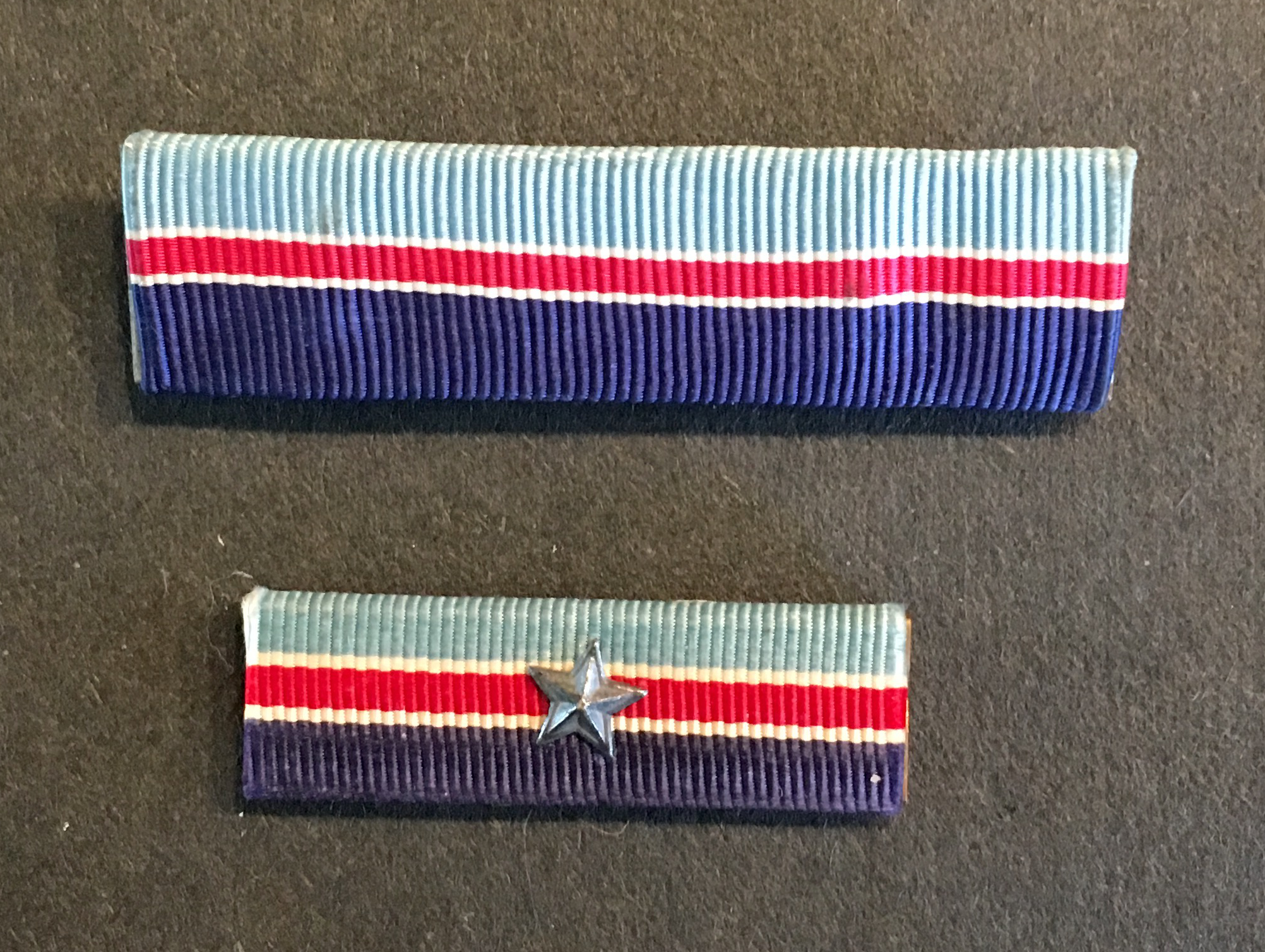
The Torpedoed Seamen’s Club insignia’s design was distinct for the time. Unlike military ribbons of the period, it used horizontal bands of color. As design elements, the colors were evocative of the condition that governed membership in the club: service aboard a ship attacked at sea. The bands represented the teal blue of a clear sky, the deep blue of the ocean, and a red band between the two of white representing both a ship ablaze and valor.
From top to bottom, the bands were:
Light blue
White
Red
White
Dark blue
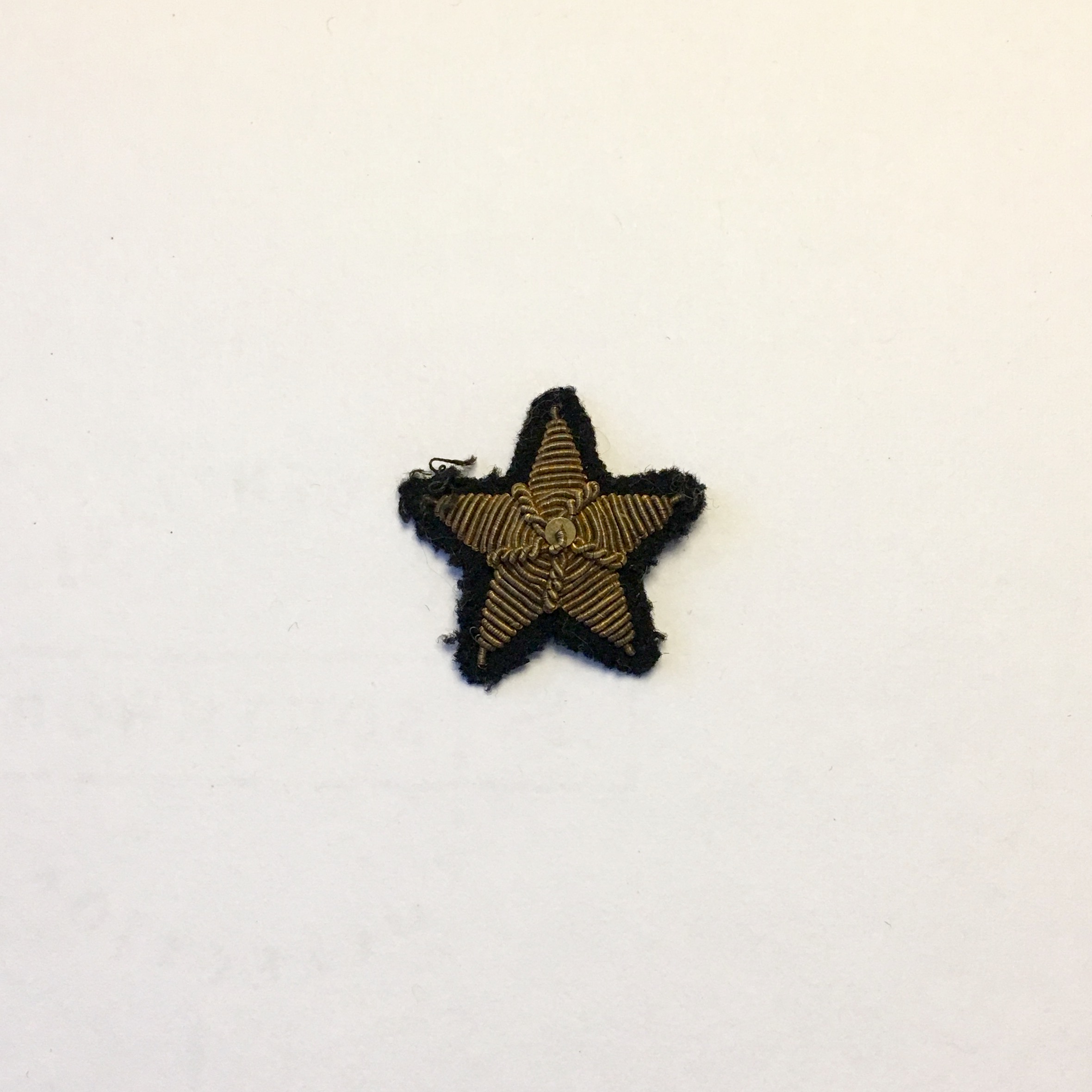
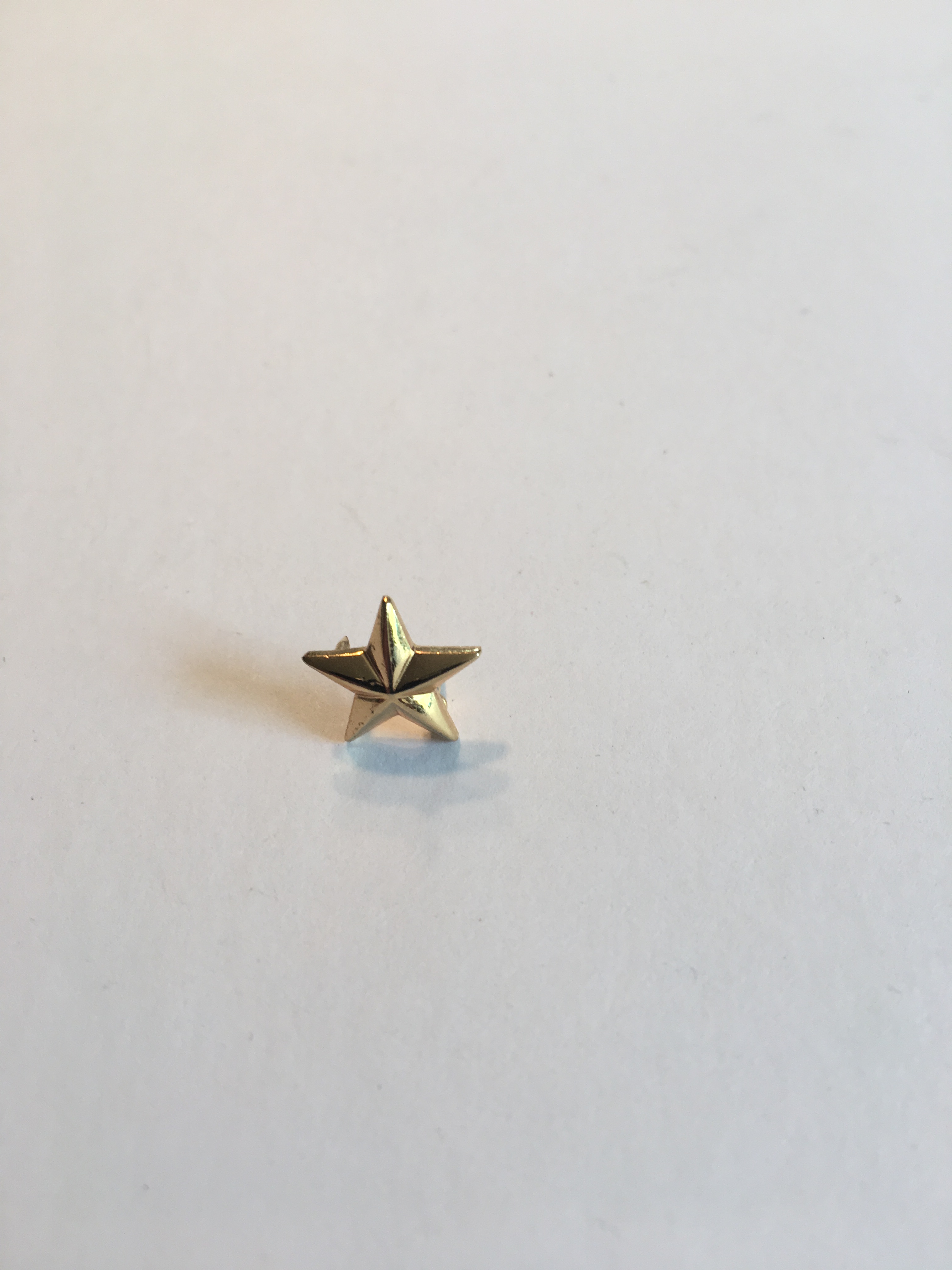
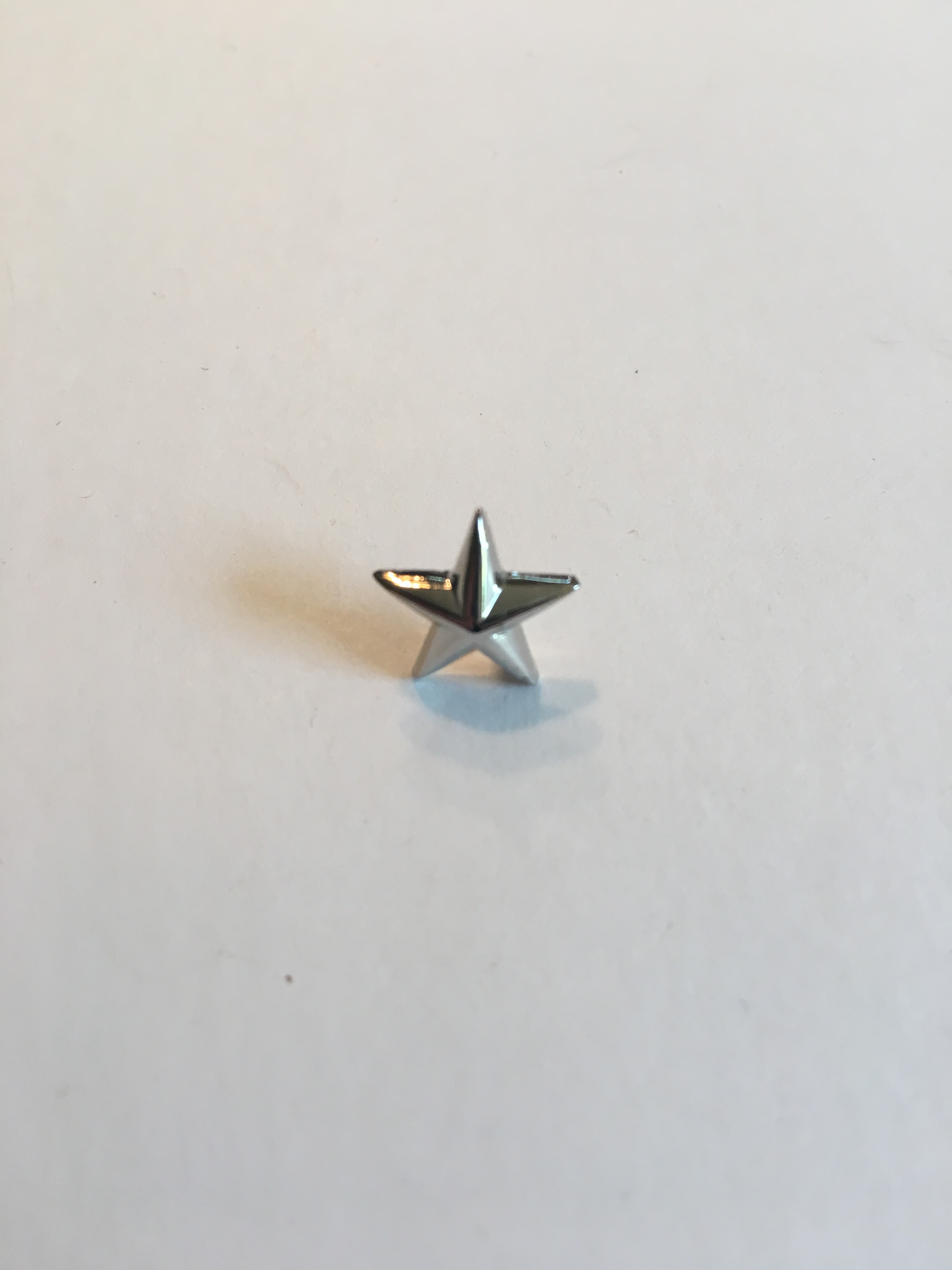
A silver star was attached to the insignia for each instance of forced ship abandonment. The star was 3/16″ with a single ray pointing upward.
As for its size, the ribbon was 2” wide x 1/2” tall. It was designed to stand alone on the wearer’s chest. The dimensions matched those of ribbon bars given to United States Maritime Commission Cadets for honors; the width also corresponded to that of the highest civilian decoration of the time: U.S. Treasury Lifesaving Medal.

merchant marine combat bar
With the passage of H.R. 2281 on 10 May 1943, the club insignia was deprecated renamed the Merchant Marine Combat Bar (and referred to in legislation as a seamen’s honor bar). Although sizes were not specified in the legislation, the size of the ribbon was changed to match that of ribbons of standard U.S. Navy size: 1 3/8” wide x 1/2” tall (length); although manufacturers often used U.S. Army ribbon dimensions of 3/8” tall.
Its initial precedence fell immediately behind the war zone bars and before the Mariner’s Medal despite it being mentioned first in the law. WSA regulations in November 1943 called for a space of 1/4” between all ribbons, matching the practices of the U.S. Navy. As the war progressed, ribbon order changed, once again following the U.S. Navy example: personal commendation and combat-related ribbons first, with campaign ribbons following. The practicality of spacing ribbons was no longer desirable, and by mid-1944, they were placed on medal bars colloquially known as racks or sewn in continuous bands on blues. The Secretary of the Navy approved all ribbons to be 3/8” tall at this point, although the wider format was still found in the fleet with formal deprecation in April 1949 and prohibition by March 1951.
Despite its statutory basis, the wear of the Merchant Marine Combat Bar – as well as all Merchant Marine medals and ribbon bars – on the Armed Services’ uniforms was a mixed bag. Since the American Merchant Marine was not a recognized, armed service de jure, all Armed Services took a dim view of Merchant Marine ribbons, but these positions changed as more merchant seamen joined the services in the post-war era. The U.S. Army explicitly prohibited their wear despite General Eisenhower wishing to award medals to some deserving merchant seamen. The U.S. Navy approved their wear only after bureaucratic inertia was overcome in April 1949; when found on U.S. Navy uniforms, the silver star follows U.S. Navy rules by having two rays of the star pointing upward. After the U.S. Navy, the other services followed suit.

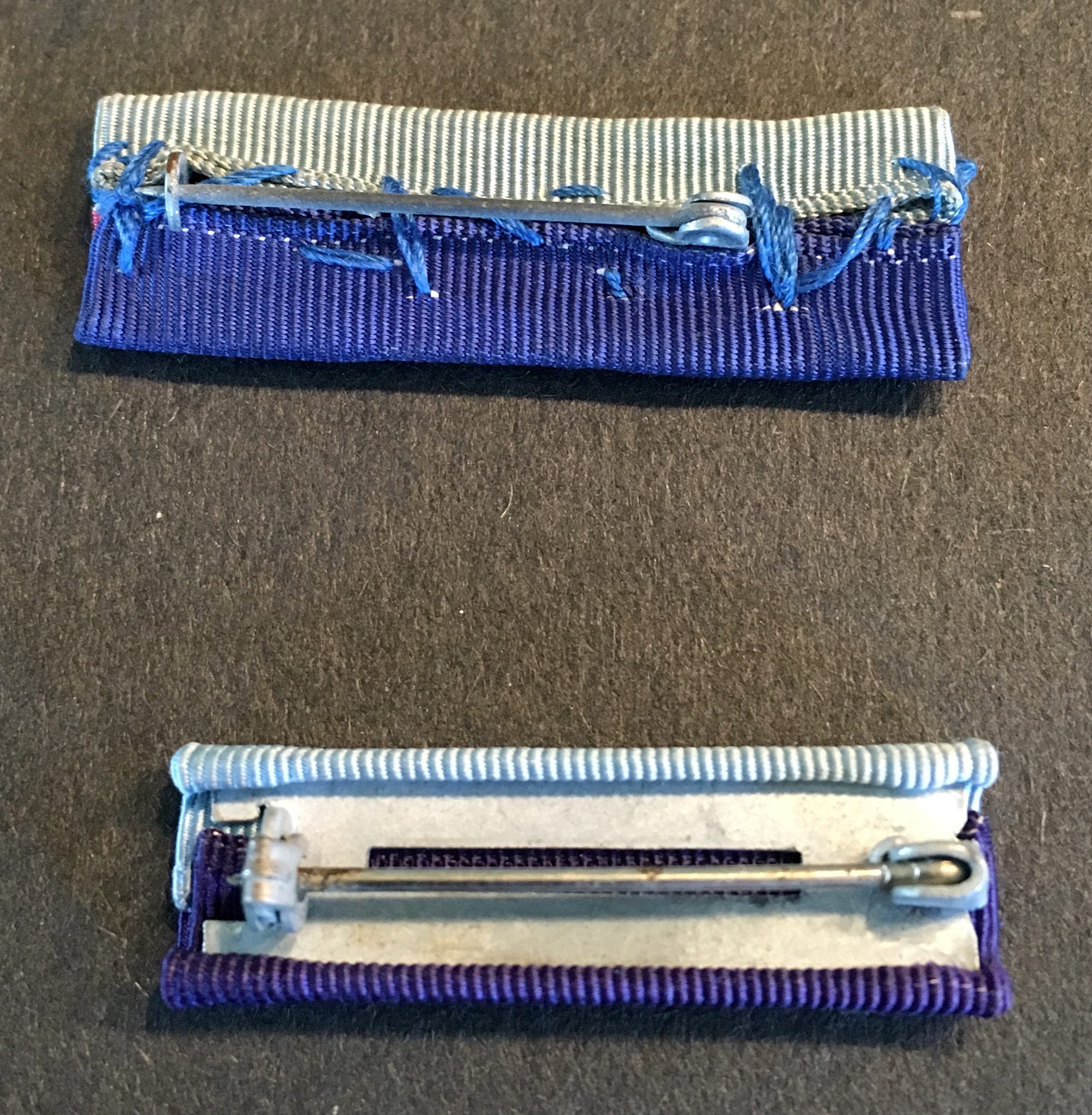
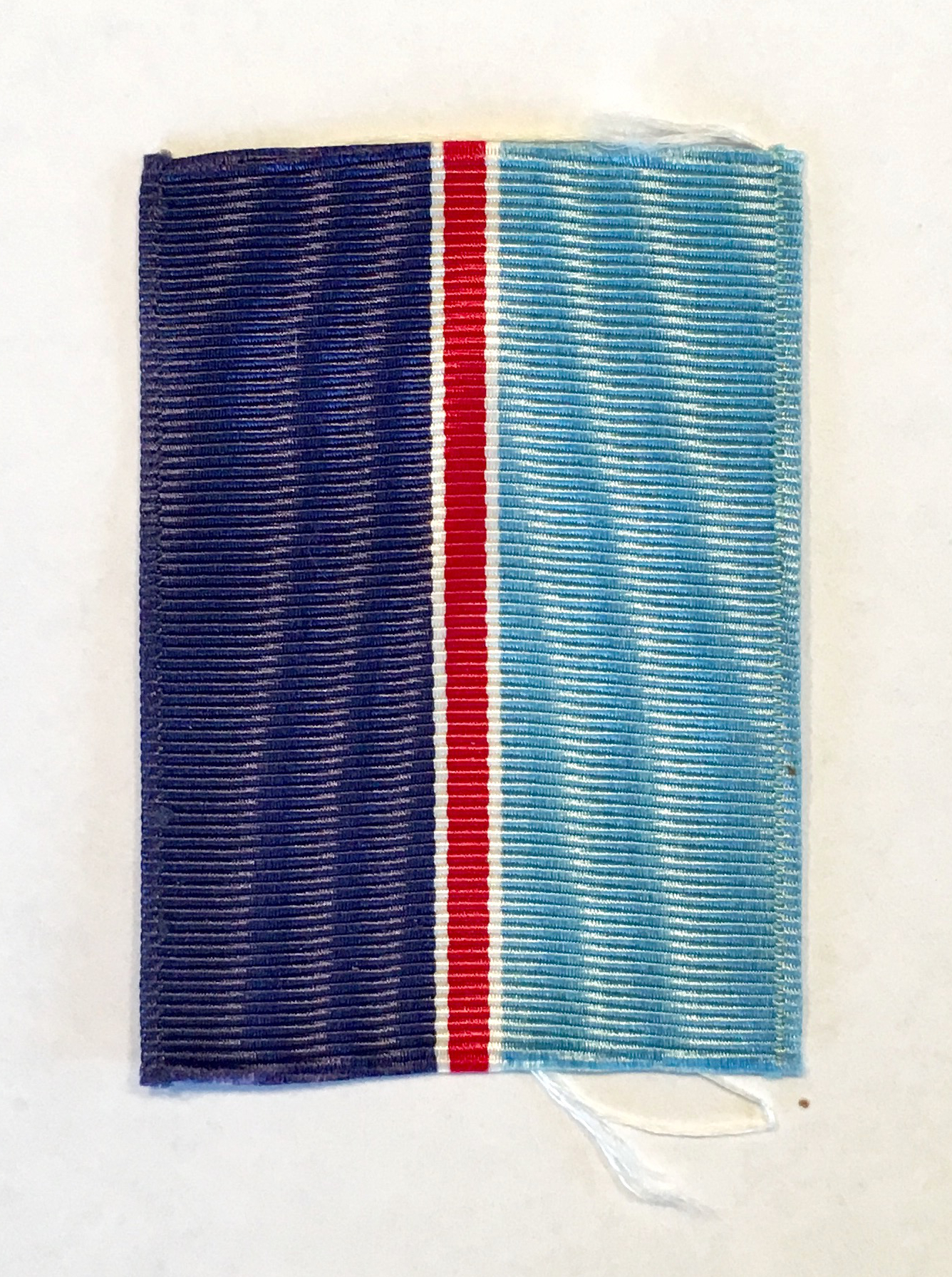
It is not uncommon to find both the Torpedoed Seamen’s Club insignia and the Merchant Marine Combat Bar in the wartime mementos of merchant seamen and among them, lengths of ribbon as well. It is of note that seamen did not receive ribbon bars, rather award cards that (barely) fit into their seaman’s identification wallets. They were free to purchase ribbons of which they qualified at their own expense – this tradition set in 1943 still holds at the United States Merchant Marine Academy today (July 2020).
gallery
Variations of the Torpedoed Seamen’s Club insignia & Merchant Marine Combat Bar

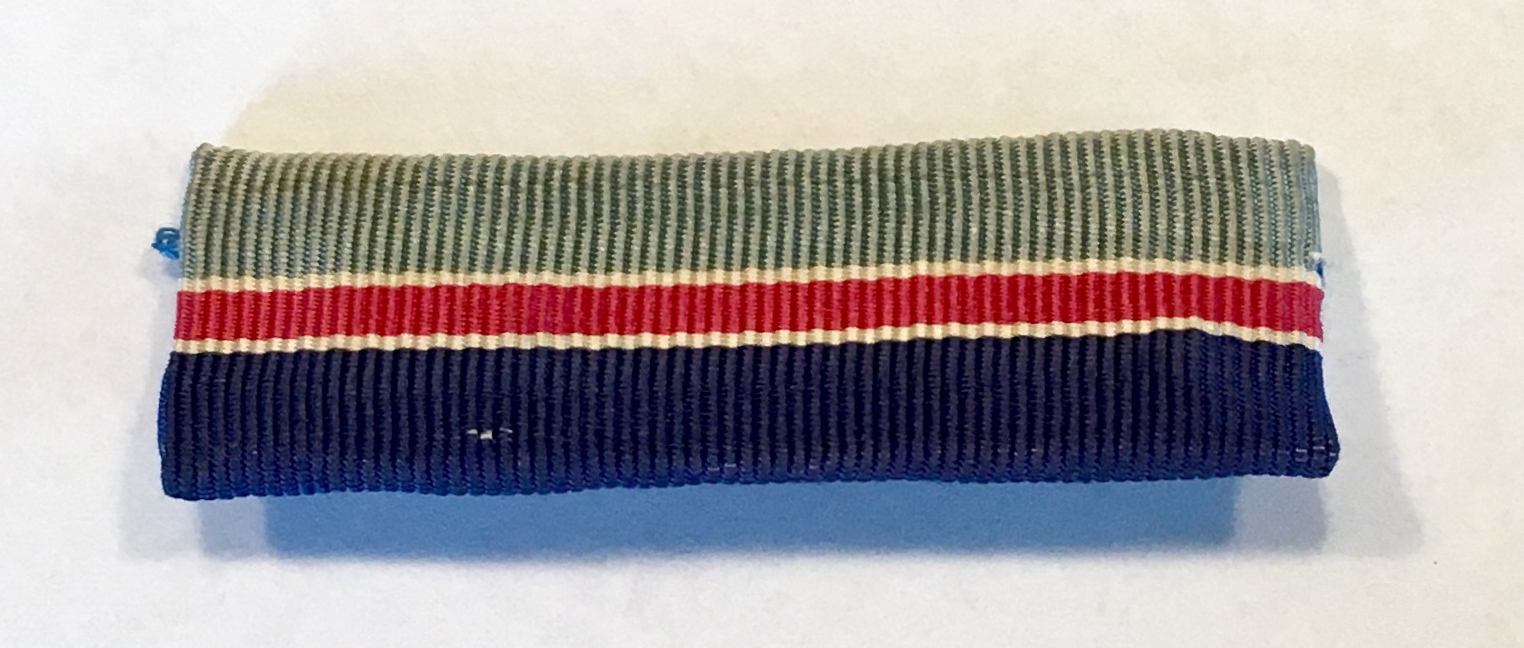
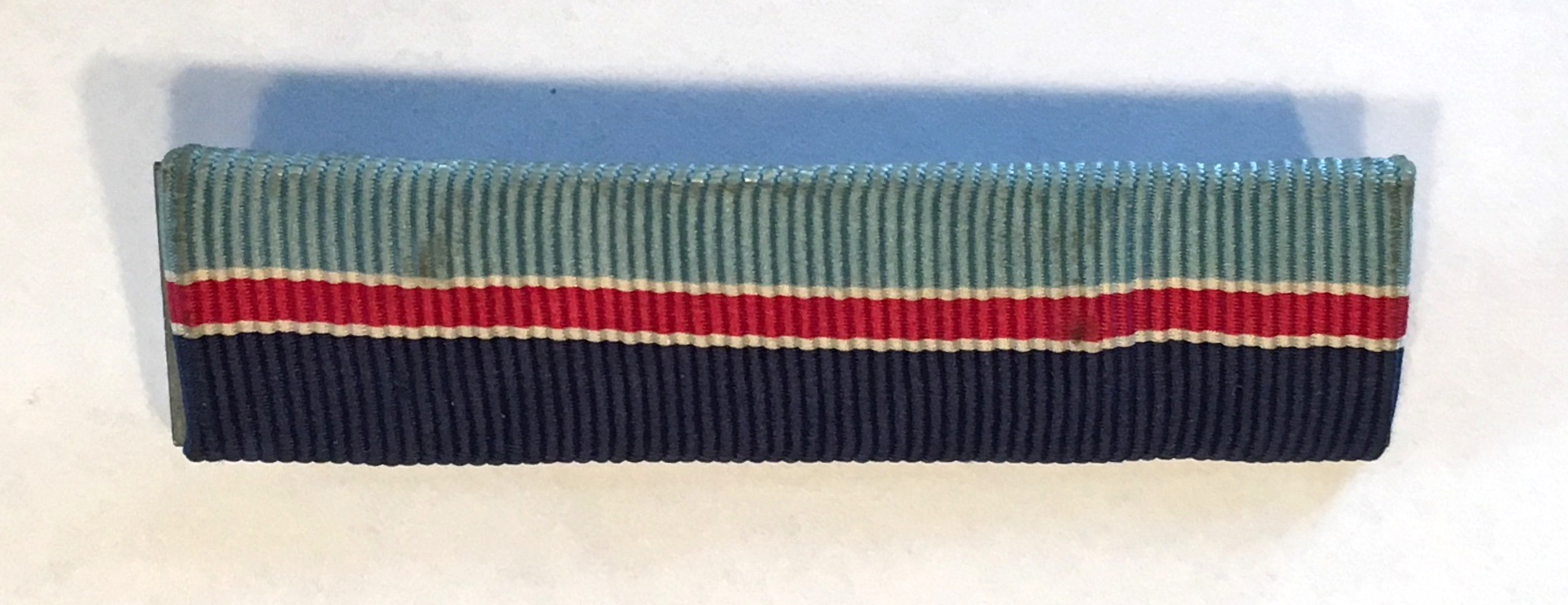
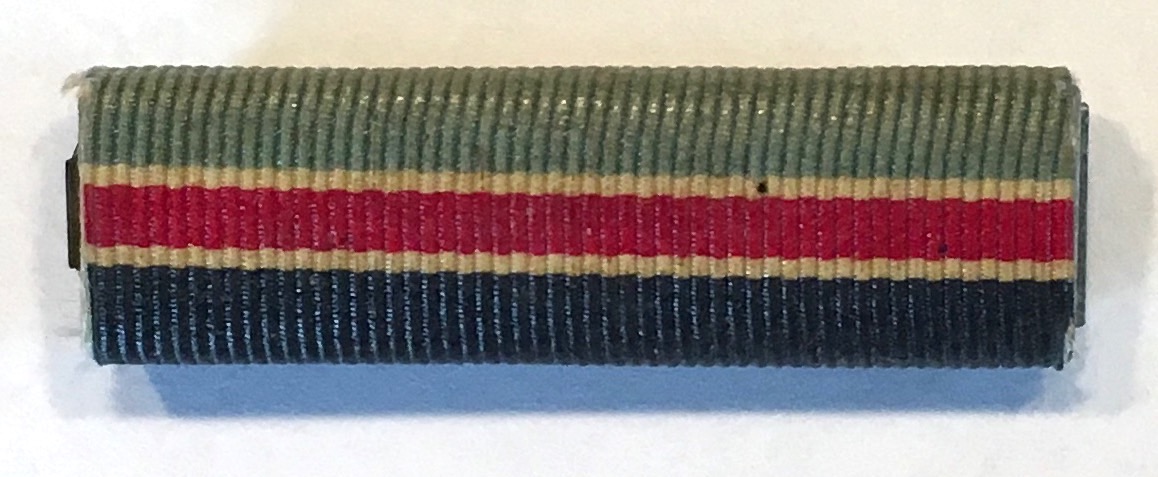
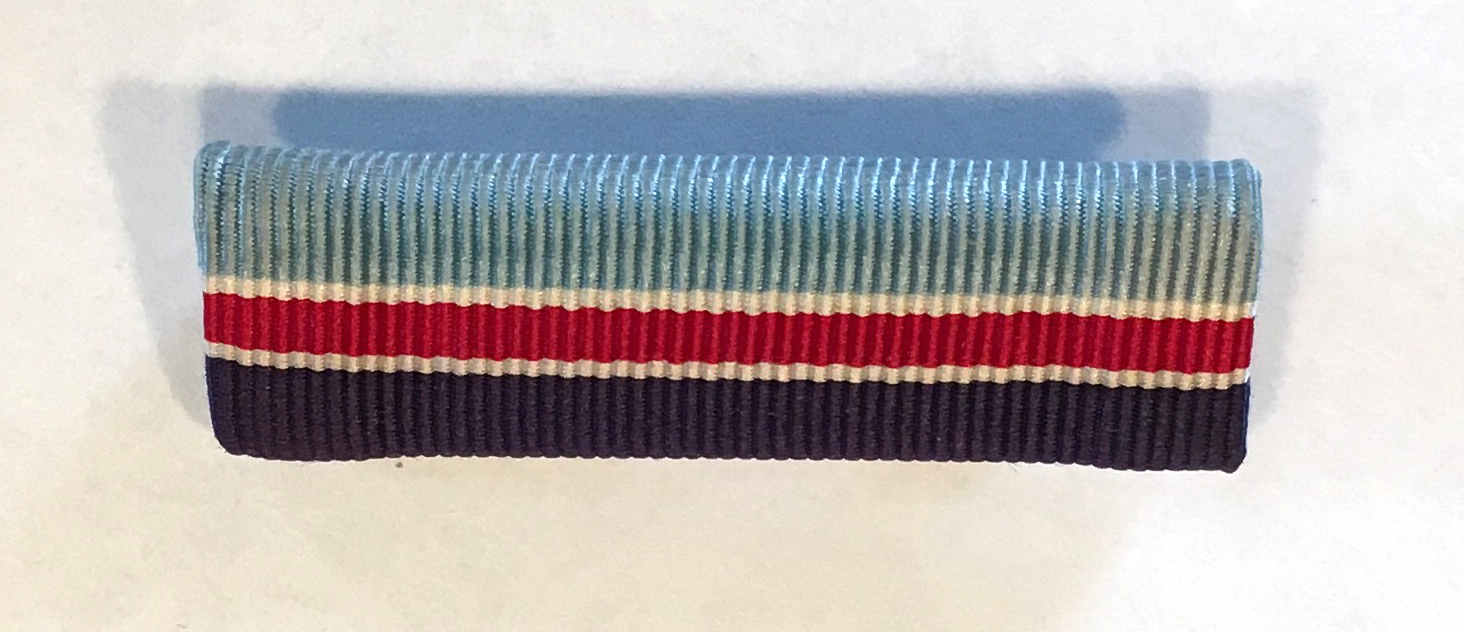
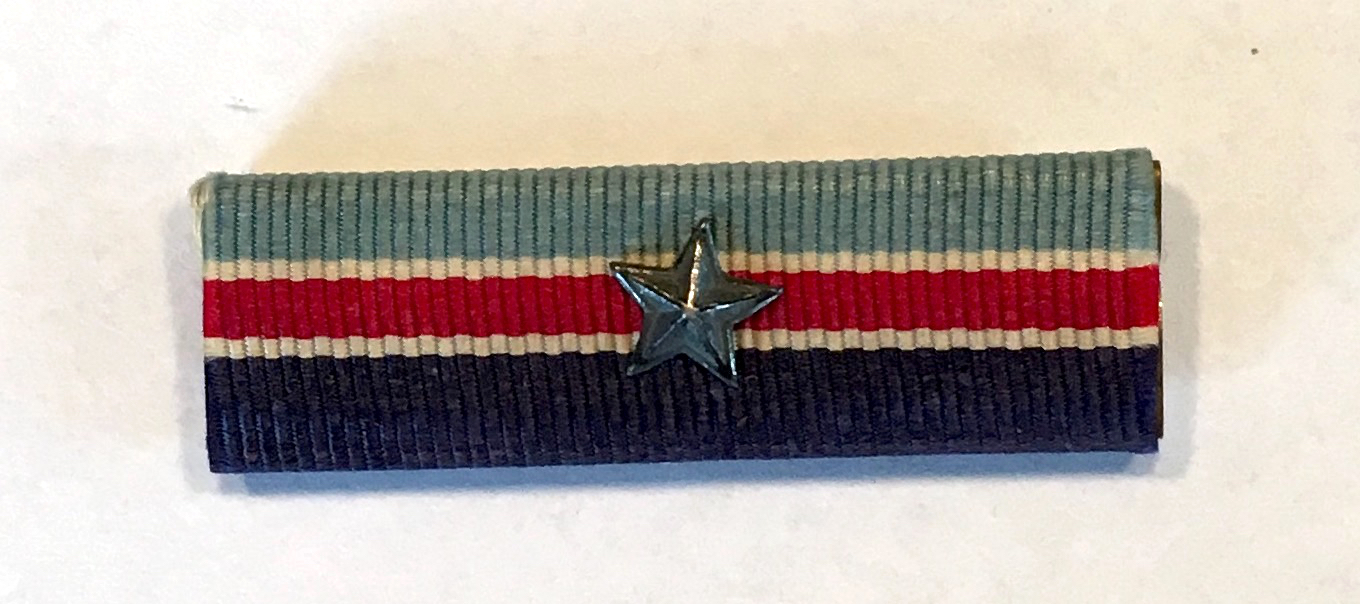
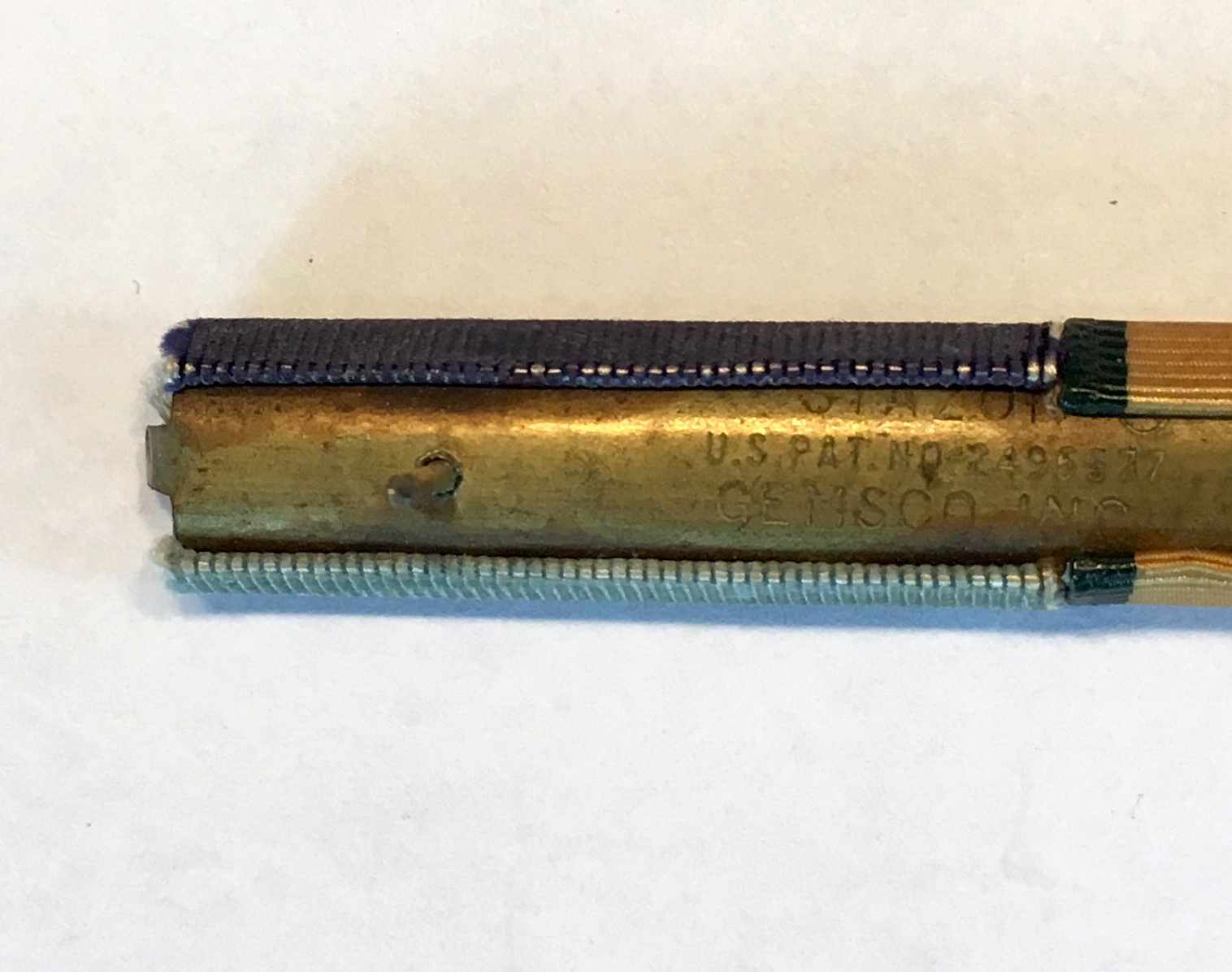
award card


on uniform


The above uniforms are circa 1944 and were once owned by the Kings Pointer, David Upham. The story behind the silver star on the Merchant Marine Combat Bar and more images of the uniforms are here.
Legislation
Public Law 78-52
78th Congress
AN ACT
To provide for the issuance of devices in recognition of the services of merchant sailors [H. R. 2281]
Be it enacted by the Senate and House of Representatives of the United States of America in Congress assembled, That the Administrator, War Shipping Administration, is hereby authorized to provide and issue
(a) a seamen’s service insignia of appropriate design to any person who, at any time during the period (hereinafter referred to as the war period) beginning December 7, 1941, and ending with the termination of the present war, serves on any vessel in the American merchant marine, and
(b) a seamen’s war zone insignia or device of appropriate design to any person who, at any time during the war period, serves on any vessel in the American merchant marine while sailing in any war or combat zone.
SEC. 2. The Administrator is authorized to provide and issue a seamen’s honor bar to any person who, at any time during the war period, serves on any vessel in the American merchant marine which, at the time of such service, is attacked or damaged by an instrumentality of war. The Administrator is further authorized to provide and issue a star (to be attached to such bar) to any such person who is forced to abandon such vessel when so attacked or damaged, with an additional star for each such abandonment.
SEC. 3. The Administrator is authorized to provide and award a medal of appropriate design and a ribbon, together with a rosette or other device to be worn in lieu thereof, to any person, who while serving on any vessel in the Ameri-can merchant marine during the war period, is wounded, suffers physical injury, or suffers through dangerous exposure as a result of an act of an enemy of the United States.
SEC. 4. The Administrator shall prescribe appropriate conditions of eligibility for the issuance or award of insignia or medals under this Act. Not more than one insignia or medal of each type provided herein shall be issued or awarded to any one person, but. for each succeeding service of any person sufficient to justify the award of a medal under section 3 of this Act, the Administrator may award a suitable bar, emblem, or insignia to be worn with the medal. In case any person who performs service sufficient to justify the award of a medal under section 3 dies before the award can be made to him, the award may be made and the medal presented to such representative of the deceased as the Administrator deems proper. No award of any insignia, medal, or device shall be made hereunder after two years after the termination of the present war.
SEC. 5. The Administrator is authorized to approve a design for a seamens service flag which may be displayed, and a design for a service lapel button which may be worn, by members of the immediate family, of a person serving in the American merchant marine during the war period. In approving any design under this section, the Administrator may approve the design approved by the Secretary of War under the provisions of the Act of Congress approved October 17, 1942 (Public Law 750, Seventy-seventh Congress), but only if the Secretary of War shall consent thereto and the Administrator shall approve for use in connection therewith a distinctive insignia or other device designating service in the American merchant marine. The Administrator, upon approval of the design for such service flag and service lapel button, shall cause notice of such approval and a description of the flag and button to be published in the Federal Register.
SEC. 6. (a) The Administrator is authorized to prescribe such rules and regulations as may be appropriate to carry out the provisions of this Act.
(b) The Administrator is authorized to expend out of any funds available for expenditure by the War Shipping Administration such sums as may be necessary to carry out the provisions of this Act.
Approved May 10, 1943
Further legislation determined that the award’s eligibility period was from 7 December 1941 to 25 July 1947.
notes
[1] Joshua Smith, “Allied and Neutral Shipping Losses by Month, 1939-1945.” (https://www.academia.edu/5535799/Allied_and_Neutral_Shipping_Losses_by_Month_1939-1945).
[2] United States. Congress. House. Committee on Naval Affairs on Sundry Legislation Affecting the Naval Establishment, “Serial No. 29: Hearing of Subcommittee on Misbehavior of Merchant Seamen at Guadalcanal, 5 February 1943,” 78th Congress, 1st Session. U.S. Government Printing Office, 1943.
United States. Congress. House. Committee on Naval Affairs on Sundry Legislation Affecting the Naval Establishment, “Serial No. 30: Report of Subcommittee of House Naval Affairs Committee appointed to investigate the alleged misconduct of merchant seamen at Guadalcanal, Solomon Islands,” 78th Congress, 1st Session. U.S. Government Printing Office, 1943.
[3] NMU’s creation of a gold pin of valor and torpedo pin was created in mid-1942 for those who survived enemy attacks. See: Ian Millar. “The Torpedoed Seaman’s Medallion of the National Maritime Union.” The Journal of the Orders and Medals Society of America, October 1991, Vol. 42, No. 10, pp. 30-33. And: “NMU: It is a union fighting a war.” LIFE Magazine, 24 August 1942, pp 77-82.
[4] United States. Congress. House. Committee on Merchant Marine and Fisheries, “Recognition of American Merchant Seamen: Hearings Before the Committee on the Merchant Marine and Fisheries, House of Representatives, Seventy-seventh Congress, Second Session, on H.R. 7548, a Bill to Provide for the Issuance of a Device in Recognition of the Services of Merchant Sailors. 30 September 1942,” 77th Congress, 2nd session. U.S. Government Printing Office, 1942.
[5] As noted, NMU had two decorations: a medal for bravery – usually awarded for lifesaving – and the gold pin of valor and torpedo pin – for surviving a torpedoing.
[6] The report which accompanied H.R. 2281 included a synopsis of all legislation for recognition of merchant seamen; the below is a list of all passed and failed attempts:
1942
H.J. Res. 263
“Decorations for heroic service in the American merchant marine”
Introduced: 12 February 1942
Approved: 11 April 1942; Public Law 524.
1942
H.R. 7548 (77th Cong.)
“Recognition of American merchant seamen”
Introduced: 30 September 1942; sponsor: Hon. Francis E. Walter.Dropped.
1943
H.R. 132 (77th Cong.)
“A bill to provide for the issuance of a device in recognition of the services of merchant sailors”
Introduced: 6 January 1943; sponsor: Hon. Schuyler Otis Bland.
Dropped; resurrected in H.R. 2281.
1943
H.R. 2281 (78th Cong.)
“An Act to provide for the issuance of devices in recognition of the services of merchant sailors”
Introduced: 29 March 1943; sponsor: Hon. Schuyler Otis Bland.
Approved: 10 May 1943; Public Law 52.
[7] Richard Donovan. “U.S. Merchant Marine Training Program.” The Log, July 1944, Vol 39, No. 8 “1944 Yearbook and Review Number,” p. 234.
[8] This number includes multiple awards to the same individual; that is: affixing stars. The number of Torpedoed Seamen’s Club insignia awards is unknown although it would be safe to assume its numbers are included with that of the Merchant Marine Combat Bar. Please see: Irwin R. Abraham. U.S. Merchant Marine Decorations and Awards. Author Edition, 1966, p. 25.
additional notes
Regarding General Eisenhower and military medal to the American Merchant Marine, please see:
Toni Horodosky. “Wartime Memos: U.S. Merchant Marine an Armed Force” http://www.usmm.org/fdr/armedforce.html