Panama Railroad Steamship Company

Panama Railroad Steamship Company hat badge. 30cm x 30cm
White enamel swallowtail house pennant (flag), black enamel P and gold fill.
No hallmark, but definitely Gemsco. The rear screw and flag style dates to it to the 1940s-50s (see below). This could either have been mounted on a wool-backing in the center of a wire and thread wreath or applied to Maritime Service-style eagle (although the shank is too short for the latter).
Panama Railroad Steamship Company (also known as Panama Steamship Company and Panama Line) was incorporated in New York in 1862 (or 1889) and operated to 1981. There are differing accounts of how and when this line was established: it could have been in 1862 to funnel passengers and freight to the newly constructed Panama Railroad; or it was established in 1889 by the French Isthmian Canal Company to support its construction efforts. After Panama became independent of Colombia with U.S. support, the United States government took over the canal-building effort and purchased the assets of the already bankrupt French company, including the shipping line. The line’s heyday was during the construction period; once the canal was finished in 1914 the line settled down to a more mundane level of business supporting the maintenance and operation of the canal and its supporting infrastructure, including the railroad. During the Second World War, the U.S. War Shipping Administration militarized the ships and crew, since cargoes traveling through the canal were of critical national importance; some graduates of the Maritime Service schools in Tampa, Florida and Pass Christian, Mississippi manned the company’s ships. After the war, it was the target of constant attacks by privately owned shipping firms who disliked having to compete with a government-owned line, but the Panama Line was so efficiently run that it managed to stave off calls for privatization until Panama took over responsibility for maintaining the canal and railroad in 1981.
The Panama Line used two different house flags:
  • A white swallowtail with a black P. 1912-1950s. P. Sources: Lloyds (1912), Wedge (1926), National Geographic (1934).
  • A blue over red swallowtail with a white triangle in the hoist extending to the fork, and a blue P on the white triangle. late 1950s-1981 (conjecture). Source: US Navy H.O. (1961).

American President Lines

American President Lines hat badge.


Gemsco hallmark on flag. Eagle and shield sterling; wreath brass/gold-plate. House flag, enamel with gold fill. Second World War era.
badge: 60mm x 65mm
flag: 25mm x 22mm

American President Lines was formed by the U.S. Maritime Commission in 1938 to stave off the impending bankruptcy of the Dollar Line, the leading carrier between the U.S. west coast and Asia. It is estimated that the company’s total liability in 1930s dollars was $17 million, with assets around $11 million and debt interest at $80,000 per month. Along with the government bail-out came a corporate restructuring, with allied changes in logos and insignia. The flag, as designed by the U.S. Maritime Commission, is red with a white eagle and a white star in each corner, recalling the Dollar Line’s red and white colors while evoking the U.S. Presidential flag – which at the time was blue with an eagle and four white stars.
During the Second Word War, American President Lines acted as an agent for the U.S. War Shipping Administration, overseeing vessel manning, equipping, overhaul and repair, handling of cargo and passengers, and fueling. Ships’ officers and crew insignia changed to match that of the U.S. Maritime Service; officers’ hat badges, such as the above example, changed from the usual shipping company house flag on wool-backing with wire and thread wreath to that of the house flag on Maritime Service eagle – this was a precedent followed by many U.S. shipping companies at the time.
The company’s fleet was used for the war effort alongside hundreds of Liberty and Victory ships. Later in the war, the U.S. War Shipping Administration began to use containers to ship vital supplies more quickly and efficiently than traditional break-bulk methods. As such, the U.S. government built 16 additional specially-fitted ships for American President Lines.
By the end of the war, the American President Lines’ assets were estimated at $40 million. R. Stanley Dollar, the heir of the Dollar Lines company, initiated the “Dollar Case” in order to force the government to return the company to his family. The case continued for the next seven years with Dollar eventually prevailing. By 1947, American President Lines returned to peacetime activities, once again providing passenger service on routes like the company’s celebrated round-the-world service. Insignia changes followed suite; with officers licensed by the U.S. Maritime Service wearing U.S. Maritime Service hat badges with their company uniforms – if so desired. In 1988, American President Lines officially changed its name to APL, Inc.; the company is now a subsidiary of NOL (formerly Neptune Orient Lines) of Singapore.
House flags of American President Lines:
  • Red with a white eagle and a white star in each corner. 1938-1955
  • White with a red eagle and “American President Lines” in white over span of eagle. 1955-1980
  • White with a red eagle and “American President Lines” in blue beneath eagle. 1980-1988
  • White with a red eagle and “APL” in blue beneath eagle. 1988-present
References:
A reference I found useful for tracking house flags is Lloyd’s House Flags and Funnels. A facsimile of the out-of-print 1912 edition available here:

Public Health Service

Public Health Service,
originally uploaded by waterclock.

U.S. Public Health Service Sanitarian hat badge.

No hallmark, however, manufactured by Gemsco, NY (General Merchandising Co.) with Second World War pattern dies. Same die used for base was also used for Master, Mate, and Pilot union hat badges.
Badge is plated with 1/20 10K Gold.


I personally think this design is horrible; the eagle is not at all graceful. The pattern for the anchor and caduceus continues to be used on contemporary U.S. PHS hat badges.


Reverse.


Badge base reverse.


Shield base plate obverse.


Shield reverse; incuse punch detail.

Hat Badge Production Methods


Maritime Service CPO obverse.
Red enamels and silver.


Maritime Service CPO Reverse.
Note silver toning of solder.

The methods of making a hat badge are similar to the process of making a coin: they can be cast or stamped… only there’re additional processes after the initial coining (stamping). Casting a badge is often imprecise and lacks the crisp lines found in stamping. This entry will detail coining and die production.

Casting
Casting involves wax casting, molten metal, and sand. Casting, more often than not, is the province of reproductions. A cast badge can be quickly identified by a seam along the edge, and a particularly hasty employment of the process is belied by pitting on the reverse. I have never seen a cast badge by any of the major insignia companies: Vanguard, Gemsco, Amico or Viking. Do not be fooled by the claim of “theatre created”; no Navy man or merchant sailor has been so hard up as a cast a badge in a ship’s shop; sew a hash mark, sure.

Coining/Stamping
Badge manufacture is a fairly straight-forward and precise process. If you take a moment to inspect a badge, oftentimes you’ll notice the high level of craftsmanship employed and often crisp lines – this is an artifact of the stamping process. It takes five distinct phases to produce a stamped hat badge; these processes have remained, for the most part, unaltered since the Second World War to the present day.

1. Stamp
A sheet of metal is placed under a press and the metal is embossed with the design found on the die. Common base metals are malleable substances which respond well under pressure, such as brass or silver (never steel or iron). The die will have pins indicating proper line up of the obverse and reverse dies; in a single stroke by either hand wince or machine press, the die pairing brings up the design. Even crisper designs are achieved by two strikes.

On older badges, you can visually determine if the base metal is brass by the presence of verdigris. Verdigris is a pale green coating of the metal produced when the metal has been exposed to sea or saltwater over time. I personally think the presence of verdigris lends a handsome look to a badge.

After the stamping is completed, the edges are trimmed of excess metal (salvage) and the jagged edges are filed. At this point, the badge is pierced if necessary. Piercing may be done with a small precision drill or minute punch points. The overall effect is to not to bend the metal.


2. Solder & Fusion
Devices, such as screw shanks or attach pins are soldered onto the base badge. Common lead/copper amalgams of lead, copper or silver/zinc are used during this process. Here, the jewelers’ or electronic machinists’ soldering gun is employed.

On hat badges, you can oftentimes determine the composition of the solder by using the following visual cues. Lead is highly malleable, and has a quicksilver color; copper oftentimes develops verdigris over time; and silver/zinc presents a deep patina, sometimes almost black, over time.

A hard solder of silver is used with hat badges so manufacturers may enamel the badge or pass assay. Such solder allows the badge parts to not come apart or desolder during the enamel firing process.

Badges which are not to be enameled or have epoxy applied are polished; otherwise…


3. Enamel & Epoxy
After soldering, the badge is allowed to cool and enamels and epoxy are applied. In terms of actual badge production, this is an extremely time-consuming task. Enamel is a paste-like substance comprised of powdered glass and distilled water; epoxy is a resin paste.

After the badge is cleaned in a bath of sulphuric acid and dried at 212F, either paste (glass in a molten state, resin in paste) is applied to the surface of the badge. Application methods involve either being either poured or brushed. The badge is then fired in a kiln between 1400-1500F for 2-5minutes – depending upon the enamel properties – for the enamel to fuse to the metal. This process is repeated for each individual color. The end product of enameling should be of a lustrous and uniform appearance without bubbles.

After enameling, the components of the badge are now stoned. Stoning is done via diamond or sand mesh cloth. At the completion of the process, the enamel is flush, with individual die lines visible.


4. Polish
Badges are now polished to a high luster. Polishing is achieved using high RPM diamond-brush polishing machines.


5. Plate/Anodize
Plating is an electrochemical process of depositing metals onto the surface of the badge. Anodization is a process of altering the crystal structure of the metal near the surface and creating a sealed and overall corrosion resistant surface; the trade name for this is STA-BRITE. Various manufacturers have anodized hat badges since the mid-1970s; Ira Green was a pioneer in the field.

In terms of plating, maritime hat badges are found have nickel, gold, rhodium and silver plate. Since a badge is usually not plated in two metals, more other than not, badges are comprised of different parts and attached to each other via pins, screws, solder or adhesive (super glue anyone? I’ve seen Senior Chief badges with star applied thusly). To plate, the badges are placed on racks and lowered into a tub. Electrodes are put into position, the solution is zapped for a specified period of time and then parts removed.

6. Assembly
Once the badges are air-dried and removed from their plating rack, their constituent parts are assembled and the badge is complete.

Maritime Service CPO hat badge hub.

Die production
Die production is pretty exciting and having an actual hat badge hub or die is quite a gift.

First, an artist creates a large plaster model of the badge. The model can be any where from two to eight times larger than the end badge. Once the model is approved, it is coated with rubber; the rubber is baked and then removed – creating an epoxy galvano. Next, a Janvier reducing lathe is used to reduce the image onto a steel master hub. Once complete, the master hub is then hardened via heat-treating.

The master hub is then used to make a master dies via a process called hubbing. Hubbing involves pressing the master hub into a steel blank to impress the image into the die. The master die is then used to form as many working hubs as needed through the same process, and then the working hubs are put through the same process to form working dies. These working dies are the ones used to produce the badges.

The process of transferring the hub to the die can be repeated as many times as necessary; the difference between a hub and a die is that the hub has a raised image and a die has an incuse image, so one forms the other.
U.S. Army Corps of Engineers, Floating Plant & Dredging Fleet Personnel


The U.S. Army Corps of Engineers has traditionally operated a wide variety of watercraft in support of the water resources and infrastructure under its purview. These vessels are found in the major waterways of the United States and its territories – once including the Panama Canal Zone when it was a U.S. territory, and South Vietnam during the war. Floating Plant (including the Dredging Fleet), as these vessels are known, are manned by civilian crews. The officers are licensed by U.S. Coast Guard; and presently most are graduates of the U.S. Merchant Marine Academy or other U.S. Maritime schools.

The military-status of Floating Plant personnel has had a chequered past. During the Second World War and the Korean War, unlike their colleagues serving in the Army Transportation Service, they were militarized and called to active duty. At the tail end of the Vietnam War, during the organizational reforms of the U.S. Army, Floating Plant personnel were deemed civilians.

In order to identify the officers serving on dredges, towboats, and ships of 60 feet or more, the Corps of Engineers directed they wear uniforms starting in 1969. The officers already wore khaki Navy-inspired uniforms with a variety of insignia denoting rank. Up until this point, hat badges were improvised and worn at the individual’s discretion. Some wore a Maritime Service-style gold wreath with a Corps of Engineers branch insignia collar device in the center; others wore ball caps or garrison caps with the same.

With the new regulations came an end to improvisation and officially sanctioned khaki uniforms, headgear and employee identification. The khaki uniform was retained and reefers abolished, and officers were given a combination hat. The means of determining an individual’s position aboard is indicated by identification plates: Master, Engineer (rank) and Mate (rank). License state is indicated by the color of the wear hat’s chinstrap: gold-colored for Coast Guard-licensed officers, black for all others. The Floating Plant personnel also wear a unique hat badge. The symbolism of the insignia is explained thus:

[…] silver Engineer castle with a gold anchor supporting on its stock, a silver eagle, wings displayed. The anchor represents the maritime functions of Floating Plant Personnel and the eagle represents Federal service.

The original directives provided for changing of hat cover from khaki to white, depending upon the season; current regulations do not state as such.

Governing regulations for Floating Plant personnel uniforms:

  • ? (30 October 1969).
  • ER 670-2-3 (20 April 1987).
  • ER 1130-2-520, Appendix S & W (29 November 1996).

It is really this hat badge and that of the U.S. Army Transport Service that piqued my interest in Sea Service hat badges. Having been raised in the Navy and always keen on matters maritime, I had never known that the USACE had a civilian-manned fleet of ships. I am still mostly unsure who strikes the current insignia, as they do not have U.S. Government contract manufacturer hallmarks; so for all I know, they may be made in some Army machine shop in Philadelphia.


Floating Plant, 1970s
55mm x 63mm. Gray gun metal body and gold anodized anchor.
No hallmark.


Floating Plant, 1990-present.
55mm x 63mm. Grey gun metal body and gold anodized anchor.
No hallmark.

Reverse of badge is coated in thin layer of dark gray acrylic; also on reverse, not the crisp detail lacking in the earlier version. The beak is damaged; perhaps due to poor stamping/filing.


U.S. Corps of Engineers Branch Insignia
25mm x 18mm. Gold-plated brass.
No hallmark. Circa 1950.

This example was worn on Floating Plant personnel garrison hat. This device is pre-Second World War; apparently it was passed down from through the decades via a thrifty Quartermaster.  Note cut-out windows and fine detail.


Floating Plant Variant
60mm x 70mm. Copper with “gold coating”
N.S. Meyer Inc., New York hallmark. Allegedly circa 1950s-60s.

This is most probably a fantasy or fake. This badge is comprised of elements found in unofficial (pre-1968 ) woven and metal variants of Floating Plant hat badges: wreath, castle & eagle.

The wreath is of traditional U.S. Army Transport Service & ROTC design; most Floating Plant variants are of contemporary period Maritime Service-style wreaths. The wreath has pitting as seen in casts. The reverse shows that the manufacturer had some difficulty in positioning the bars for soldering.

The castle has an N.S. Meyer Inc. New York hallmark. If this were a poor fake, we’d see evidence of sheared-off keeper pin posts.

Capping the emblem is an eagle; this eagle is MSTS officer-style (circa 1950s-1960s).

Overall nicely polished. Not quite sure what to make of this. Fantasy, fake, pattern or variant. Who knows?

American President Lines wool hat badge

American President Lines wool hat badge

Gemsco hallmark on flag.
Wool backing and wreath of gold bullion thread.
House flag, enamel with gold fill.
Second World War era.
badge: 70mm x 50mm
flag: 25mm x 22mm


As noted in a previous post, shipping companies’ ships were appropriated for the duration of the war with seamen and officers militarized. This is an example of the cited officers’ badge of wool backing.

Some have subtly speculated that wool backed badges without an eagle (with an eagle, such hats are known as “high pressure” hats) were worn by warrant officers or chief petty officers. Whereas, the truth of the matter is that ships appropriated by the Maritime Service and run by the shipping companies by their own personnel were not as rigid in uniform distinctions between grades of officers; in fact, shipping companies did not use a rating scale: officers were ranked according to seniority and responsibility (and licensure if in the Maritime Service proper). For example, seamen’s documents from after the war, and belonging to sailors on MSTS ships, showed a corresponding rank and rate, as such things did not exist in the Merchant Marine. As for officers aboard American President Line ships, their uniforms were prescribed by their company, and any hats and devices, and reefer jackets and cuff braid were oftentimes custom made and personal purchases. This particular device came from S. Appel & Co, a uniform company that had shops in both New York and Miami.


American President Lines
House Flag.
Woven cotton and canvas, no synthetics; attached to manila rope.
Flag, 4 x 6 feet
Circa Second World War.

S/T Ocean Eagle

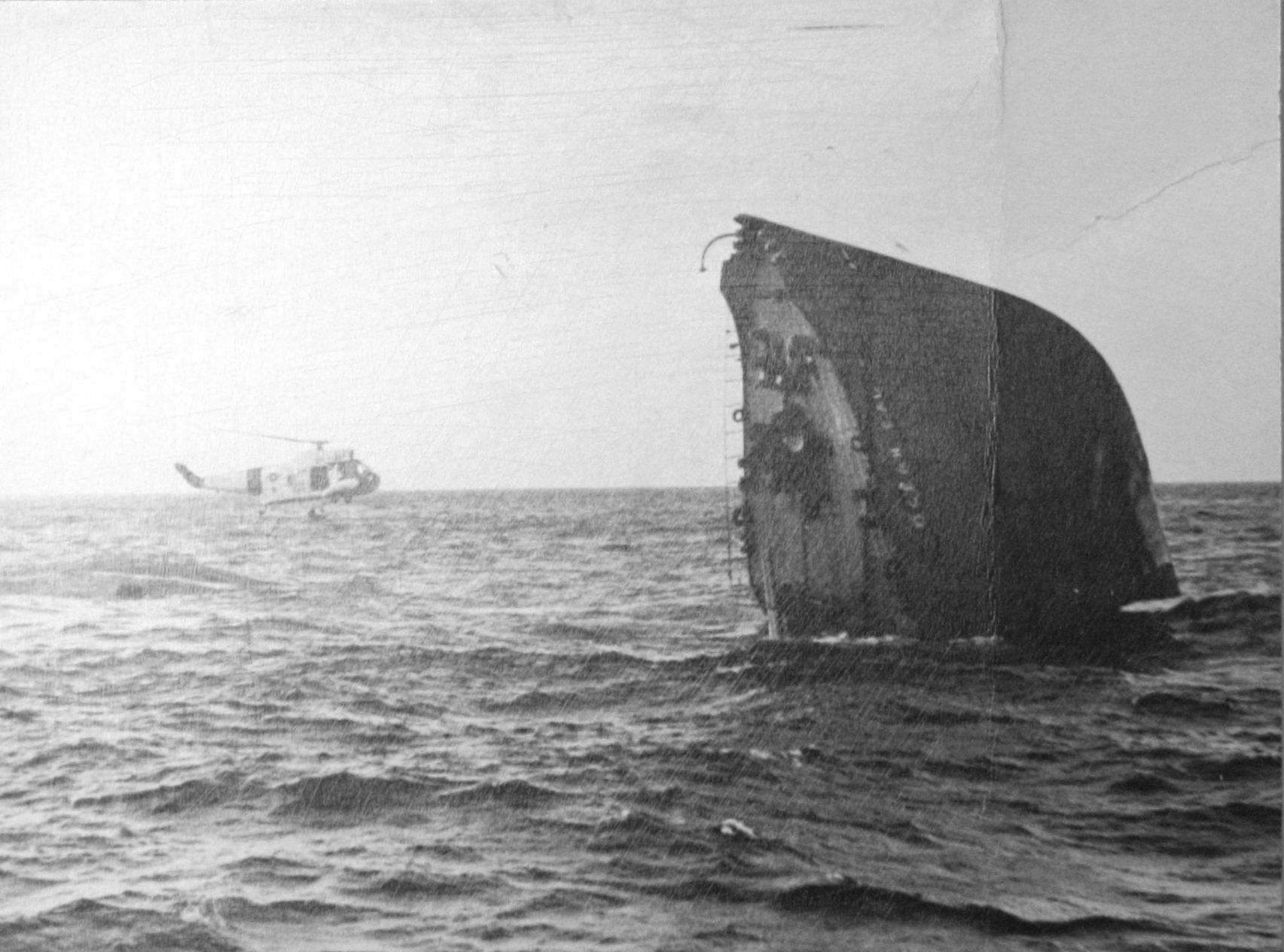
In case you’re curious about the header image, that is the Liberian Tanker Ocean Eagle sinking in the harbor off of San Juan, Puerto Rico on 3 March 1968.

  • NOAA Report
  • Office of Naval Research Oceanic Biology Program Report
  • The accident was devastating to local ecosystems as it was the most severe oil spill experienced in U.S. territorial waters up to that time; in its wake came improved methods for containing spills and improved tanker safety practices.

    I have gone through various U.S. government publications, however they are careful to remove references to owners and the name of the ship’s captain. If anyone might know of the shipping company that manned the ship at the time of the accident, I would be keen to obtain their hat badge.

    Massachussetts Maritime Academy

    The late 1800s saw a flurry of state nautical school openings with funds provided by U.S. Congress. One of them, the Massachusetts Maritime Academy began its life as the Massachusetts Nautical Training School in 1891. In 1913, along with training vessel and curriculum changes, its the name changed to the Massachusetts Nautical School. And, along with its move to Hyannis from Boston in 1942, its name changed its present form.

    The Second World War saw many changes in the structure of MMA corps of cadets. Like other state and federal maritime schools and academies, cadets were ushered into a rush program of 16-18 months from matriculation to graduation. America’s entry into the war called for an increased number of men to serve on the many convoy ships, merchantmen, and ocean-going vessels either under construction or underway. The US Navy instituted the v-12 program whereby to increase the number of young men joining the ranks of the Navy’s officer corps.

    With each change in name, MMA’s cadet insignia changed, with the exception of uniform buttons. The buttons depict the central device of seal of the Commonwealth of Massachusetts. MMA’s hat and uniform insignia have mirrored those of the U.S. Naval Academy, albeit with hat badges having “M.N.T.S.” and “M.N.S.” above the anchor; if you look at this page, you can see an example of the later. In the 1940s until the present, MMA has used insignia indistinct from the USNA – including the abandonment of woven for metal anchor devices on hats. It is the aforementioned indistinct insignia that has prompted this entry and a means for sleuthing an insigne’s period.

    When I had originally purchased this grouping, I was told that all items are from the United States Naval Academy and from the Second World War. I looked a bit closer and noticed the curious buttons. After examining the shoulder boards and corresponding rank ladders – those of a midshipman battalion lieutenant (junior grade) – I knew spot-on that the insignia was from the MMA and from the cited period.

    Here are my meandering notes:
    * Interestingly, unlike USNA boards, the stars are not metal, rather woven. The shoulder boards came from a private uniform shop, “Boston Uniform Co.” – it was located at 66 Chelsea St. in Charlestown, Massachusetts. The company last appeared in public records in 1958. But! Embroidered shoulder boards were not worn in the 1950s.

    * The ladders are plainly marked with the Hilborn-Hamburger manufacturer’s mark – “H-H” within a stylized eagle; such a mark was used on H-H insignia prior to the mid-50s. The fact that the insignia is clutch back – as opposed to pin – means that it was issued mid-war onward.

    * The buttons are brass and were manufactured by Waterbury Button Co. in Connecticut. Waterbury now has its archive online; however my specific button was not present – in this case, a useful tool proved not so.

    * Regarding the anchor devices: in an MMA setting, these would specify the class of wearer. Each collar insigne is unmarked. And, of the many examples present (4 pairs), they are either brass or gold-plated – you can still see the Brasso residue on a pair.

    * A blacklight test would show that the cap-band is not made of synthetics, but of Mohair; the band stitching corresponds to 1940s patterns. Mohair has a distinct warp and weft; the band has the correct texture for the period.

    If I hadn’t the other items alongside the cap badge, I would have been hard-pressed to determine the correct era and I would have misidentified the piece as being merely a Navy ROTC or perhaps USNA hat badge. And such is the joy of collecting.


    Massachusetts Maritime Academy.
    Cadet hat badge, reverse.
    Threaded screw and one non-rotating point (bent).
    Unmarked, cast. Gold metal plate over white metal.
    Circa Second World War.

    mma cadet insignia group


    Massachusetts Maritime Academy.
    Shoulder boards.
    Cadet/Midshipman Battalion Lieutenant (Junior Grade).
    Wool over hard board, gold bullion woven star and rank stripes.
    Brass fastener with Commonwealth of Massachusetts seal.
    Manufacturer: Boston Uniform Co., Charlestown, Mass.
    Circa Second World War.

    mma cadet insignia group


    Massachusetts Maritime Academy.
    Collar insignia, class rank anchors.
    Three examples, gold plate and brass.
    Clutch-back.
    Manufacturer: no mark.
    Circa Second World War.


    Massachusetts Maritime Academy.
    Collar insignia, rank ladder reverse.
    Cadet/Midshipman Battalion Lieutenant (Junior Grade).
    Gold plate.
    Clutch-back.
    Manufacturer: encuse Hilborn-Hamburger mark (H-H in stylized eagle)
    Circa Second World War.

    Please see: Hilborn-Hamburger maker’s mark on reverse of MMA rank ladder for detail.


    Massachusetts Maritime Academy.
    Reverse hat band, stitching detail.
    Band: Mohair. Hat screw post holes, worn with stitching.
    Badge plate: Leather and wool.
    Circa Second World War.

    British Petroleum Shipping Co.

    British Petroleum Shipping Co. Officer hat badge
    Metal, gold wire and colored thread on wool backing.
    Circa 1960s.

    With contemporary events unfolding regarding the catastrophe in the Gulf, it is worth pausing for a moment to think about transport of petroleum products. One of the safest, economical and most expedient methods to transport liquid petroleum and its derivatives is via ship. In fact, about 34% of all worldwide seaborne trade is devoted to the transport of oil. This entry is the first of several regarding oil tanker fleets and officer insignia.

    British Petroleum was originally formed as the Anglo-Persian Oil Company in 1909 to exploit oil deposits in Persia. The British Tanker Co. Ltd started in 1915 to handle sea transport and achieve a contained, integrated oil company model akin to its American counterparts. The parent group was renamed the Anglo-Iranian Oil Company in 1935. In 1951 the company’s Iranian assets were nationalized, a crisis partly resolved by negotiation in 1954 when the company was re-named British Petroleum. In 1955, the fleet was re-christened BP Shipping. During the 1970s BP extended its oil interests to the North Sea and Alaska, and eventually moved to major oil fields in the Middle East and Gulf of Mexico. The fleet and its manning remained in the province of BP until 1986 when staffing went the way of a modern crimping system known as “agency manning” concurrent with BP re-flagging its fleet under various flags of convenience.

    At present, BP Shipping is based out of Singapore and operates a fleet of 77 vessels and charters an additional 115. Its vessels are comprised of crude oil tankers, product tankers and LNG (liquefied natural gas) carriers. In its employ are some 2300 mariners and 600 onshore personnel. In all, 50% of BP’s maritime cargo is carried on these ships worldwide. BP remains one of the few major oil producing corporations that continues to man a fleet under its own house flag.

    British Petroleum Shipping hat badges may be found in three distinct variations:
    1. 1915-1926. Merchant Navy-style hat badge with the current house flag – a red flag with a horizontal white band expanded at the centre in the form of a circle, the band bearing the black letters “BTC”, the “T” being larger. I have read of the red being bordered in black; however I have yet to see an example.

    2. 1926-1955. Similar to the illustrated hat badge, with then current house flag – a St. George’s flag with a green diamond in the center – with a golden lion passant gardant above all.

    3. 1955-1968 (present?). The illustrated badge; the golden lion replaced by a red lion rampant.

    Images and analysis of several of the older badges may be found here.

    References:
    Bill Harvey, BP Tankers: A Group Fleet History. London: Greenhill Books, 2006.


    British Petroleum Shipping Co. Officer hat badge, obverse
    Metal, gold wire and colored thread on wool backing.
    Circa 1960s.

    In terms of British hat badges, the BP Shipping follows the British standard design of house flag as central device, Royal Navy wreath and Tudor maritime crown surmounting all. Over time, the embroidered leaves have grown thicker; and catalogs may denote the badge as belonging to the agency placing Deck and Engineering officers aboard BP vessels – Chiltern Maritime Ltd.


    British Petroleum Shipping Co. Officer hat badge, detail.


    British Petroleum Shipping Co. Officer hat badge, variation.
    Circa 1950s.

    Note the bronze-toned Tudor crown and the British Merchant Navy-style wreath.


    British Petroleum Shipping Co. Chief Petty Officer hat badge, obverse.
    Metal, gold wire and colored thread on wool backing.
    Circa 1960s.


    British Petroleum Shipping Co. Chief Petty Officer hat badge, detail.


    British Petroleum Tanker Co. Ltd.
    House Flag.
    914.4 x 1422.4 mm
    Circa 1955-67

    The house flag of the BP Tanker Co. Ltd. On a white field, there is a red St. George’s cross with a green diamond in the center, bearing a red lion, rampant. This design was in use from 1955 to 1968 and was re-introduced in 1984. The flag is made of a wool and synthetic fibre bunting. It has a cotton hoist and is machine sewn. The lion is printed. A rope and two Inglefield clips is attached.


    British Petroleum Tanker Co. Ltd.
    House Flag.
    Circa 1940s.

    The house flag of the BP Tanker Co. Ltd. from the 1940s. On a white field, there is a red St George’s cross with a green diamond in the center, bearing a golden lion passant gardant. This design was in use from 1926 to 1955. The flag is made of a wool and cotton bunting. It has a cotton hoist and is machine sewn. The lion is printed.

    British Tanker Co.

    British Tanker Co.
    Officer hat badge
    Metal, gold wire, silk and colored thread on wool backing.
    Circa 1940s.

    Lately there has been an increased number of television commercials urging tourists to flock to vacations on the Gulf Coast – all of which are sponsored by British Petroleum. This brings to mind that last year I presented a British Petroleum Shipping Co. Officer hat badge, here. In that post I mentioned an earlier hat badge used between 1926 and 1955; presented now is said badge.

    The period in which this hat badge was worn was an exciting one for the Anglo-Persian Oil Company, and by extension British Tanker Co. – profits were terrific, ships were built, the War came and Persia became Iran. There was much expansion of British oil exploration throughout the Middle East, and the Kingdom of Persia in particular. With government backing, the tanker fleet became one of the largest in the world, and its ships could be seen plying the waters between the Persian Gulf and the Suez on up to the British Isles – with regular stop-overs at the Port of Aden, where British interests created a safe haven for its sailors in the protectorate. In an effort to have a more efficient and profitable tanker fleet, vessels were fitted with modern tanks, pumping systems and numeous safety measures. The Second World War came, and with the declaration of hostilities, British Tanker Co. found its fleet under attack; by war’s end, a third of its assets sunk and later replaced. By 1955, the British Merchantile Marine reached its zenith, and afterward met an eventual swift decline. BP survived, the fall, however.

    References:
    Over this past year, I have come across many excellent and encyclopedic works on general British Petroleum history, with scant passages on its tanker fleet throughout. Bill Harvey’s book remains the best reference for BP tankers, in specific.

    Bill Harvey, BP Tankers: A Group Fleet History. London: Greenhill Books, 2006.

    Henry Longhurst, Adventure in Oil: The Story of British Petroleum. London: Sidgwick and Jackson, 1959.

    Ronald W. Ferrier, The History of the British Petroleum Company, Vol. 1: The Developing Years, 1901-1932. London: Cambridge University Press, 1982.

    James H. Bamberg, The History of the British Petroleum Company, Vol. 2: The Anglo-Iranian Years, 1928-1954. London: Cambridge University Press, 1994.

    James H. Bamberg, The History of British Petroleum, Vol. 3: The Challenge of Nationalism, 1950-1975. London: Cambridge University Press, 2000.


    British Tanker Co., officer hat badge, obverse
    Metal, gold wire and colored thread on wool backing.
    Circa 1940s.

    The central badge device is comprised of a rectangular British Tanker Co. house flag of applied ribbed silk fabric – with details stitched in silk floss – and outlined with coiled gold metal. The flag is surrounded by laurel leaves of gold purl with stems of applied coiled gold metal. Surmouting all is a stamped gilt base metal lion passant gardant. All is stitched on a padded black wool base.


    British Tanker Co., officer hat badge, obverse detail


    British Tanker Co., officer hat badge, obverse detail


    British Tanker Co. Ltd.
    House Flag.
    838.2 x 1219.2 mm
    National Maritime Museum, Greenwich, London, Pope Collection.

    The house flag of the British Tanker Co. Ltd, London. On a white filed is a red cross with a green diamond in the center bearing a gold lion passant gardant. This design was in use from 1926 to 1955 – the central lion symbolizing the Company’s Iranian interests. The flag is made of a wool and synthetic fiber bunting; it has a cotton hoist and is machine sewn. The flag’s central design is painted. A rope and two Inglefield clips are attached.


    British Tanker Co. Ltd.
    British Gratitude ship model.
    Scale: 1:192
    National Maritime Museum, Greenwich, London.

    The British Gratitude is depicted the model below in wartime rig with paravanes, light anti-aircraft machine guns, and anti-torpedo net booms and posts. British Gratitude was owned and operated by the British Tanker Company. Built in 1942 by Swan Hunter & Wigham Richardson, it was 470 feet in length and 8463 tons gross, very small by contemporary standards. It survived the Second World War and continued to have an active career under the ownership of British Petroleum. She was eventually sold for breaking up in 1959.


    From the Collection of Lyle Halkett I present two interesting British Petroleum hat badges.

    The first is a modern pattern of the first British Tanker Company design, followed by that of a 1940’s pattern of a BTC Petty Officer hat badge; both follow the same symbolic and stylistic language as other presented BP badges. Do take particular note of the Petty officer badge, as it follows the precedent set in The Mercantile Marine (Uniform) Order, 1921 Schedule which states that a Petty Officer’s cap badge is to be of the same design as hat of a officer’s with the exception that the surrounding oak leaves and acorns be deleted. The schedule outlines a previously announced, but not defined uniform order from 1919.

    British Tanker Co., officer hat badge, obverse
    Metal, gold wire and colored thread on wool backing.
    Pattern circa 1940s.
    Collection of Lyle Halkett


    British Petroleum Shipping Co. Chief Petty Officer hat badge, obverse.

    Metal, gold wire and colored thread on wool backing.
    Circa 1940s.
    Collection of Lyle Halkett