ear-alano

25 August 1943.

CONFIDENTIAL

From:       Cadet-Midshipman Raffarle Alano, Second Class, (D-1), USMMCC
To:         Supervisor, U.S. Merchant Marine Cadet Corps
Via:        District Cadet Supervisor, New York.
Subject:          Loss of vessel SS RICHARD CASWELL; Report on

  1.      The writer was assigned to the SS RICHARD CASWELL, South Atlantic Steamship Company, on January 22, 1943 and signed articles on the same day.  The vessel sailed from New York on 28 January in a convoy consisting of about 20 ships escorted by 6 American vessels.  The cargo was comprised of 30 and 50 caliber ammunition, food, machinery and tires and a deck cargo of trucks, trailers and jeeps destined for the Army Air Force.  The ship arrived in Port of Spain, Trinidad, refueled and received orders, then left that port on February 13 in a convoy of about 16 merchant ships and 6 escort vessels.  The convoy broke up off Pernambuco and the subject vessel travelled alone, following a zig-zag course at a top speed of 11.5 knots arriving at Saldanha Bay, South Africa, about 3 weeks later.  At this port of call, the Captain received orders, and three days later the ship sailed for Capetown where again she joined a convoy of 8 ships, this time escorted by one vessel.  The convoy dispersed about three days later and the subject vessel again traveled alone to Suez, where most of the cargo was discharged.  12 days later the ship sailed alone to the Mombasa where the remainder of the cargo was unloaded.  Following this, the ship sailed to Durban where she again joined a convoy of about 16 ships escorted by seven vessels.
  2.      After one day at sea, the ship ran into the first bad weather of the entire trip.  Rough seas and heavy swells forced her to fall behind the rest of the convoy.  As the ship was light, the screw was out of the water most of the time and this prevented her from making headway.  The Captain was forced to head her into the storm which was the opposite direction from our destination.  The seas moderated three days later and the ship proceeded to Capetown for repairs.   During the deep rolling of the ship in the rough weather, #3 life boat was severely damaged, and oil cans secured to the deck and ventilators broke loose and were damaged.  Repairs were made in Capetown and the ship left there about the first of June in a convoy consisting of about 12 vessels and 4 escort vessels.  The convoy broke up near St. Helena Bay the subject vessel traveled alone, following a zig-zag course, to Buenos Aires, arriving there about the last of June.
  3.      The ship was fully loaded again in Buenos Aires with a cargo consisting of cow-hides, tanned and raw, fertilizer, canned corned beef and bags of crystal-like glass used to make asbestos.  The vessel left the Argentine on 12 July and sailed on a straight course until two days later when orders were received changing the course and bringing the ship closer to shore.
  4.      On 16 July, 1943, at 1630, the first torpedo struck the ship directly in the engine room destroying the engine, steering control and fuel tanks.  The three men on watch in the engine room were killed instantly by the force of the explosion.  The writer was working on the fan-tail at the time the torpedo hit and was naturally knocked off his feet.  Quickly recovering himself, the writer ran to his quarters for a life jacket and then proceeded to his boat station.  Upon arriving at his station, he found that the boat had already been launched and swamped.  Due to the headway of the ship, the boat was well aft of the stern of the ship.  #3 boat had been destroyed by the explosion so the writer ran over to the port side.  The writer saw a life raft that had been cut loose and jumping over the side he swam to it and climbed aboard.  About a minute later, the ship was hit by another torpedo, this time in the #4 hold.  The ship broke in two and sank about a minute later.
  5.      Immediately after the ship sank, the submarine surfaced and pulled alongside one of the rafts, flying the German flag.  An officer, speaking perfect English asked the men on the raft the name of the vessel, her tonnage, type of cargo, destination, port of embarkation, name of the Captain and where he was.  On the sub’s port bow was written WILHELMSHAVEN, and below it Z26.  It carried a 40 MM anti-aircraft gun aft, one in the conning tower and a 4 or 5 inch gun forward.  Her paint appeared to be new and she had been identified from the photographs to be a heavy long range sub.  The crew consisted of young men.  After cruising around the boats and rafts for about 5 minutes, keeping a sharp lookout for planes and ships, it submerged.
  6.     We gathered all the boats and rafts together and attempted to secure them together with lines but the rough sea caused two of the boats to break away.  Impossible to reach them, they drifted away.  The following day, it was decided to try and row for land, which was about 140 miles away, as the ship was due in Rio de Janeiro the following afternoon.
  7.      On 22 July, a plane spotted the rafts and at about 1800 the same day a plane tender picked the survivors up and took them to Rio de Janiero, arriving there on 25July.  From Rio the survivors were flown to Miami from where the writer entrained for New York, reporting to the office of the District Cadet Supervisor on 17 August 1943.
  •     To the best of the writer’s knowledge Cadet-Midshipman Paul Williams is in Rio de Janeiro and Cadet-Midshipman Robert W. Barton is in Santos.  Cadet-Midshipman Howard Muhlenbruck arrived in New York together with the writer.  All are in good health despite the experience.

RAFFARLE ALANO


FIRST ENDORSEMENT.

To:         S-CC

Forwarded.                                            P. BRENNAN

                                                      G. F. FELTUS, By direction


Cadet File No. [unknown]
USNR Files No.    211844

24 August, 1943

To:         Supervisor, O, 5. U.S. Merchant Marine Cadet Corps
From:       Cadet-Midshipman Raffarle Alano, Second Class, (D-1), USMMCC
Via:        District Cadet Supervisor, New York.
Subject:    SS RCHARD CASWELL – Loss of

  1.      The writer was assigned to the SS RICHARD CASWELL, South Atlantic Steamship Company, on January 22, 1943 and signed articles on the same day.  The vessel sailed from New York on 28 January, 1943, in a convoy consisting of about 20 ships with 6 U.S. Navy escorts. The cargo was comprised of 30 and 50 caliber ammunition, food, machinery, tires, and a deck cargo of trucks, trailers and jeeps destined for the Army Air Force.  The ship arrived in Port of Spain, Trinidad, refueled and received orders, then left that port on February 13, 1943, in a convoy of about 16 merchant ships and 6 escorts.  The convoy dispersed off Pernambuco, Brazil, and the subject vessel travelled alone, following a zig-zag course at a top speed of 11.5 knots, arriving at Saldanha Bay, South Africa, about 3 weeks later.  At this port of call, the Captain received further orders, and three days later the ship sailed for Capetown and joined a convoy of 8 ships, this time escorted by one vessel.  The convoy dispersed about three days later and the subject vessel again traveled alone to Suez, Egypt, where most of the cargo was discharged.  12 days later the ship sailed alone to the Mombasa, Africa, where the remainder of the cargo was unloaded.  Following this, the ship sailed to Durban where it again joined a convoy of about 16 ships escorted by seven vessels.
  2.      After one day at sea, the ship ran into the first bad weather of the entire trip.  Rough seas and heavy swells forced her to fall behind the rest of the convoy.  As the ship was light, the screw was out of the water most of the time and this prevented her from making headway.  The Captain was forced to come about and head into the storm.  The seas moderated three days later and the ship proceeded to Capetown for repairs.   During the deep rolling of the ship in the rough weather, #3 life boat was severely damaged. Oil cans, which had been secured to the deck, and ventilators, broke loose and were damaged.  Repairs were made in Capetown and the ship left there about 1 June, 1943, in a convoy consisting of about 12 vessels and 4 escort vessels.  The convoy dispersed near St. Helena Bay the subject vessel traveled alone, following a zig-zag course, to Buenos Aires, Argentina, arriving there the last of June.
  3.      The ship was fully loaded again in Buenos Aires with a cargo consisting of cow-hides, tanned and raw, fertilizer, canned corned beef and bags of crystal-like glass used to make asbestos.  The vessel left the Argentine on 12 July and sailed on a straight course until two days later when orders were received changing the course and bringing the ship closer to shore.
  4.      On 16 July, 1943, at 1630, the first torpedo struck the ship directly in the engine room damaging the engine, steering control and fuel tanks.  The three men on watch in the engine room were killed instantly by the force of the explosion.  The writer was working near the stern at the time the torpedo struck and was knocked off his feet.  Quickly recovering, the writer ran to his quarters for a life jacket and then proceeded to his boat station.  Upon arriving at his station. Upon arriving at this station, he found that the boat had already been launched and swamped.  Due to the headway of the ship, the boat was well astern. No. 3 boat had been destroyed by the explosion so the writer ran over to the port side.  The writer saw a life raft that had been cut loose and, jumping over the side, he swam to it and climbed aboard.  About

(continued)

a minute later, the ship was hit by another torpedo, this time in the #4 hold.  The ship broke in two and sank a minute later.

  •      Immediately after the ship sank, the submarine surfaced and flying the German flag, pulled alongside one of the rafts.  An officer, speaking perfect English asked the men on the raft the name of the vessel, her tonnage, type of cargo, destination, port of embarkation, name of the Captain and where he was.  On the sub’s port bow was written WILHELMSHAVEN, and below it Z26.  It carried a 40 MM anti-aircraft gun aft, one in the conning tower and a 4 or 5 inch gun forward.  Her paint appeared to be new and she had been identified from photographs to be a heavy, long range sub.  The crew consisted of young men.  After cruising around the boats and rafts for about 5 minutes, keeping a sharp lookout for planes and ships, it submerged.
  •      All the boats and rafts were together and attempted made to secure them together with lines, but the rough sea caused two of the boats to break away.  Impossible to reach, they drifted away.  The following day, it was decided to try and row for land, which was about 140 miles away, as the ship had been due in Rio de Janiero the following afternoon.
  •      On 22 July, 1943, a plane spotted the rafts and at about 1800 the same day a plane tender picked the survivors up and took them to Rio de Janiero, arriving there on 25July.  From Rio the survivors were flown to Miami, where the writer entrained for New York, reporting to the office of the District Cadet Supervisor on 17 August, 1943.
  •      To the best of the writer’s knowledge Cadet-Midshipman Paul WILLIAMS is in Rio de Janiero, Brazil, and Cadet-Midshipman Robert W. BARTON is in Santos, Brazil.  Cadet-Midshipman Howard MUHLENBRUCK arrived in New York together with the writer.  All are in good health despite the experience.

Signed (Raffarla ALANO)

Cadet-Midshipman Raffarla ALANO, Second Class, (D-1), USMMCC


FIRST ENDORSEMENT

Forwarded.                                            P. BRENNAN

To:         Supervisor, U. S. Merchant Marine Cadet Corps

                                                      Signed (G. F. Feltus)

                                                            G. F. FELTUS

                                                            By Direction

ss virginia dare

SS Virginia Dare
Col.: AMMM 1946.042.0001

For seventeen days SS VIRGINIA DARE, loaded with high explosives, was en route to and in a north Russian port where her vital cargo was discharged, throughout this period she repelled countless enemy bomb and torpedo attacks by accurate fire from her guns and by skillful maneuvering. On a subsequent voyage she was torpedoed in the Mediterranean but, through smart seamanship, was beached and her valuable cargo salvaged.

The stark courage of her heroic crew under violent enemy attacks caused her name to be perpetuated as a Gallant Ship.

ss stephen hopkins

SS Stephen Hopkins
Col. AMMM 1946.045.0001

Two enemy raiders suddenly appeared out of the morning mist to attack her. Heavy guns of one raider pounded her hull, and machine gun fire from the other sprayed her decks at close quarters. The lightly armored merchantman exchanged shot for shot with the enemy raiders, sinking one and setting the other afire before she, with boilers blown up, engines destroyed, and ablaze from stem to stern, went down carrying many of her gallant crew with her.

The stark courage of her crew in their heroic stand against overpowering odds caused her name to be perpetuated as a Gallant Ship.

ss stanvac calcutta

SS Stanvac Calcutta
Col.: AMMM 1978.034.0001

When about 500 miles off the coast of Brazil she was attacked by a heavily armed raider which came up close on her in a heavy squall. Though armed with only a 4″ rifle aft and a 3″ antiaircraft gun the ship tried to escape in a running fight. On the 5th round fired, the STANVAC CALCUTTA knocked out one of the raiders 15 cm guns but the next round from the enemy guns shattered the pointer’s scope and sight bar. The crew continued to fight the gun by laying without signs until the ammunition magazine was hit and the ship began to sink. With fourteen dead and fourteen seriously injured, the crew was forced to abandon ship and were taken prisoners.

This heroic defense against overwhelming odds caused the name of the STANVAC CALCUTTA to be perpetuated as a Gallant Ship.


Per MARAD:

SS Stanvac Calcutta, a 501-foot tanker, was built for Socony-Vacuum Oil Company by Bethlehem Steel Company in Quincy, Massachusetts.  Completed in 1941, the vessel sailed under the Panamanian flag, although it was owned by an American company and most of its crew was American.

The War Shipping Administration requisitioned Stanvac Calcutta on April 25, 1942, while the vessel was in port at Coveas, Colombia.  Petroleum Shipping Company, a subsidiary of Socony-Vacuum, operated the vessel under a time charter agreement.

On June 6, 1942, the vessel was transiting from Montevideo, Uruguay to Caripito, Venezuela when it encountered the German commerce raider Stier in heavy seas.  Although the ship valiantly resisted capture, actions that later earned it the Gallant Ship Award, Stier overwhelmed and sunk Stanvac Calcutta after a brief firefight during which both the wheelhouse and ammunition magazine of the tanker were destroyed.

Of the 42 crew members and nine Naval Armed Guards aboard Stanvac CalcuttaStier picked up 37 survivors.  All but one of the survivors were taken to Japan and assigned to prison camps there; the remaining crew member was sent to a prison camp in Germany.


usmma richard r. mcnulty

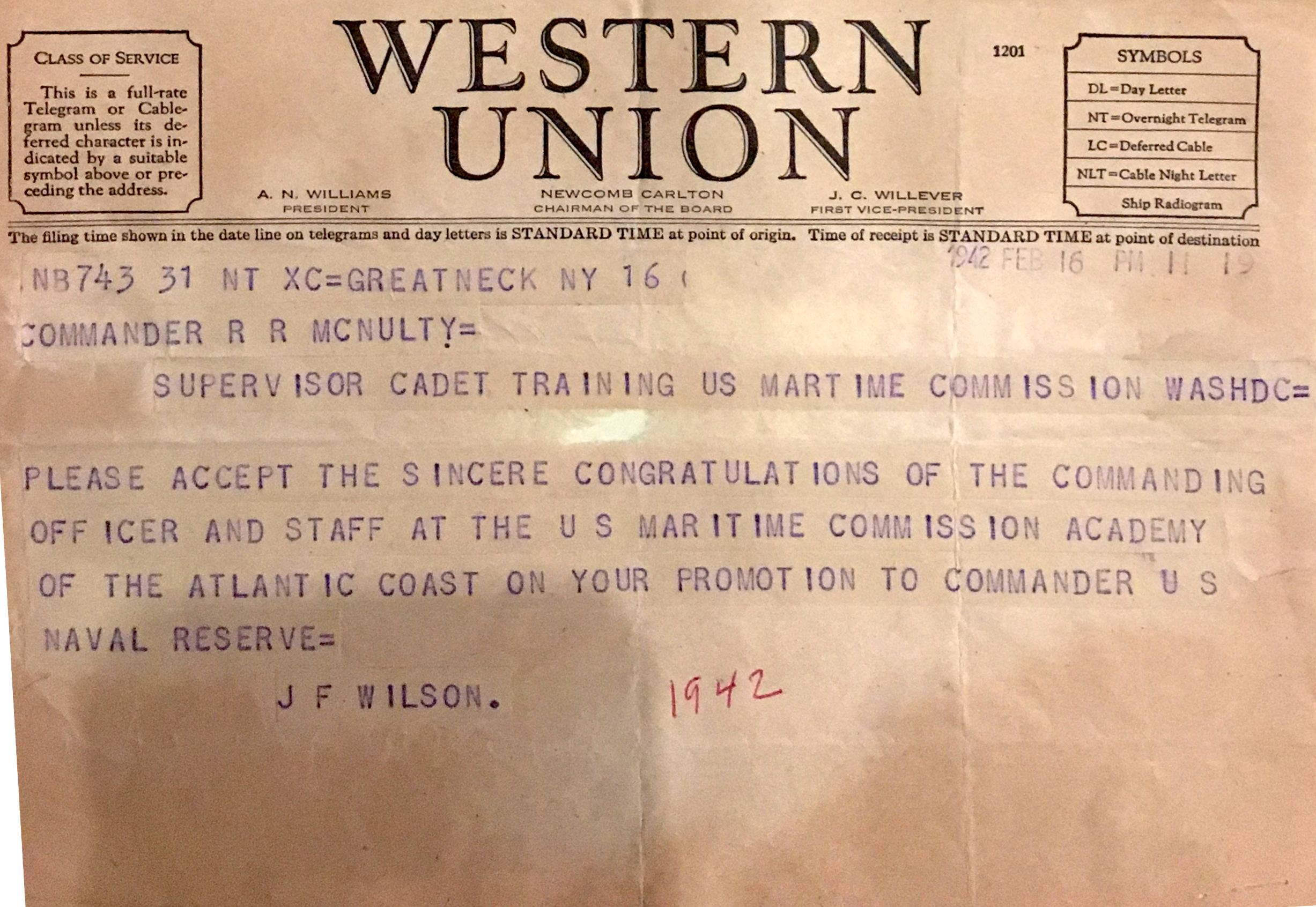
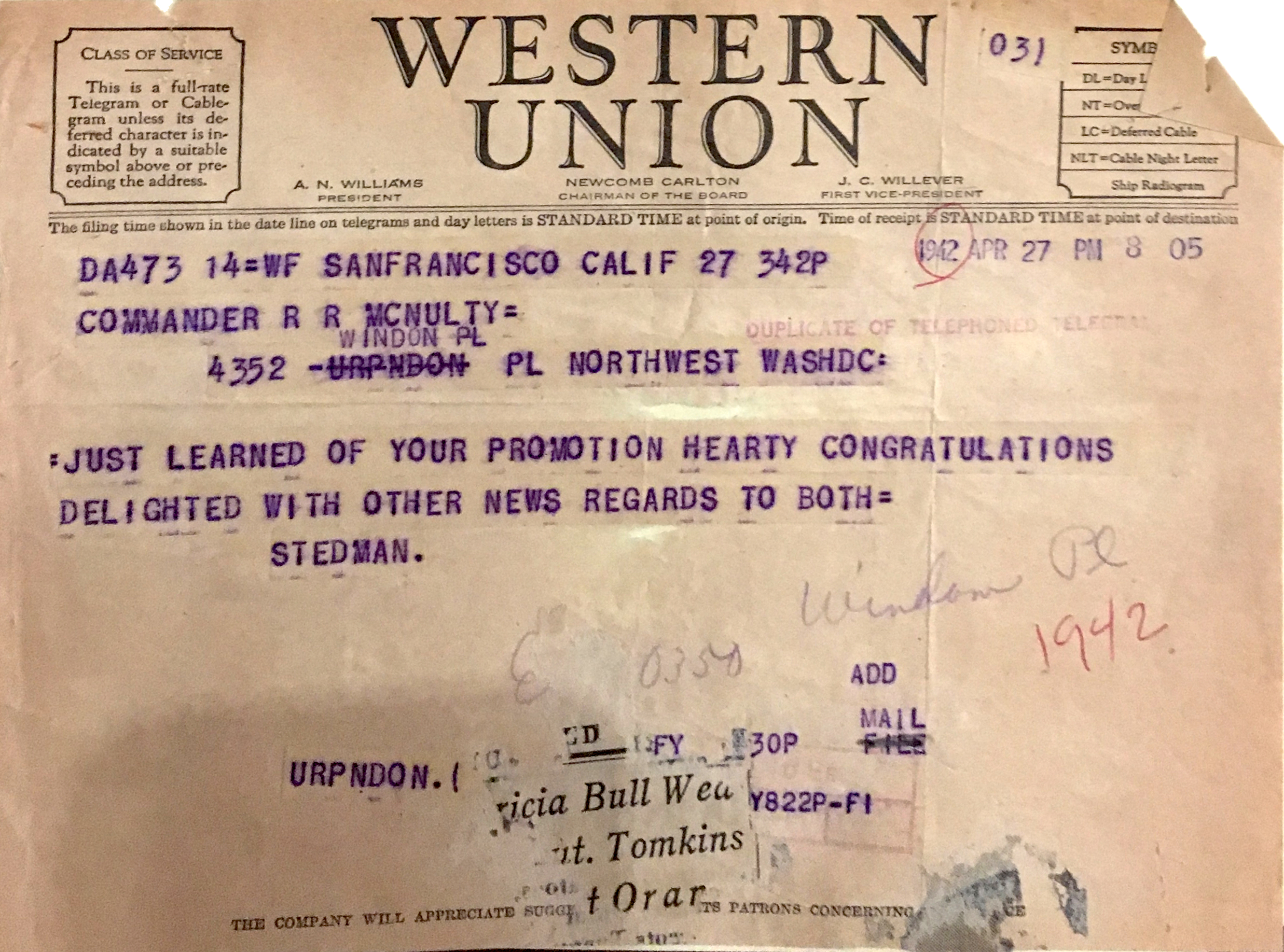
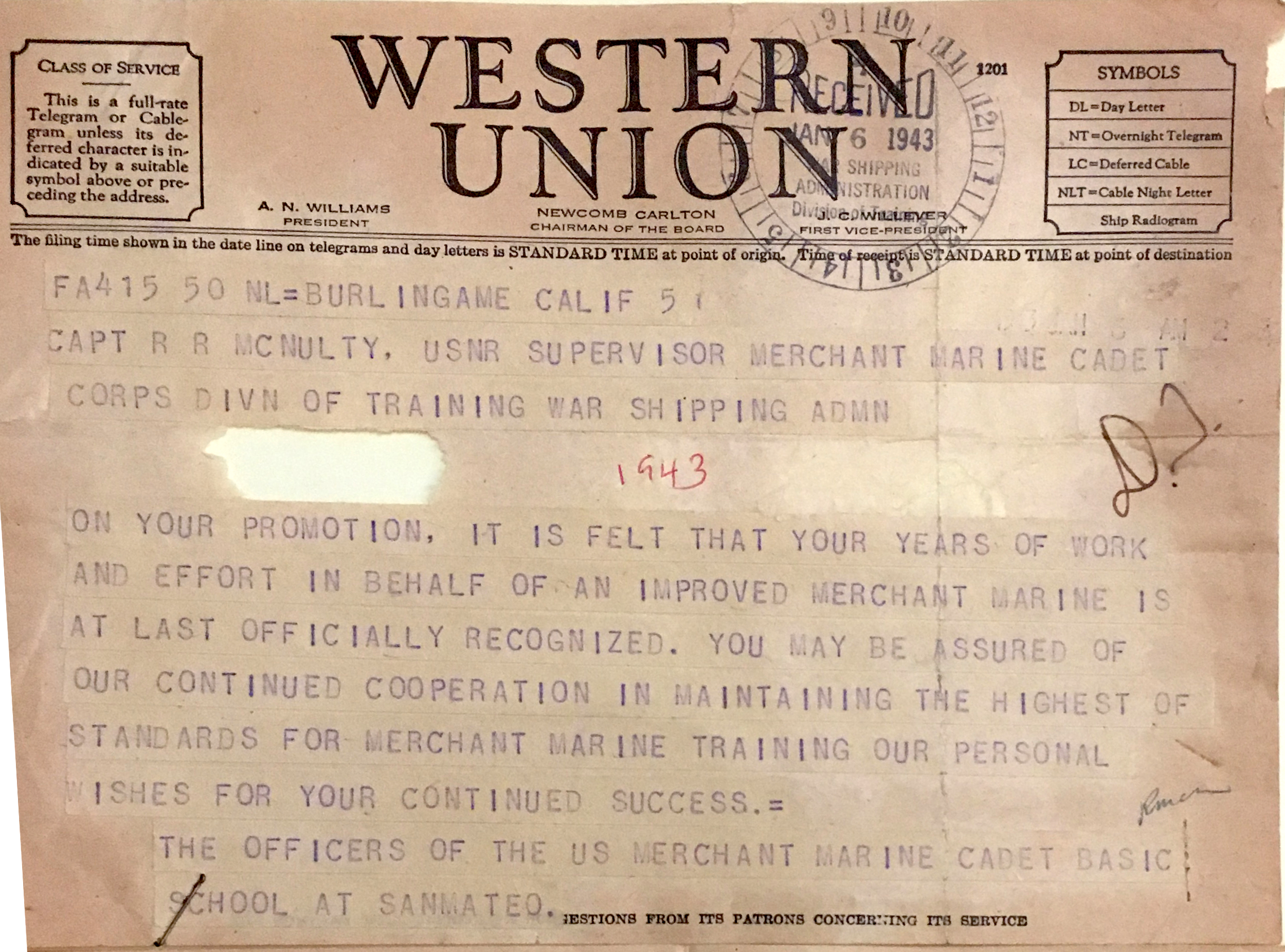
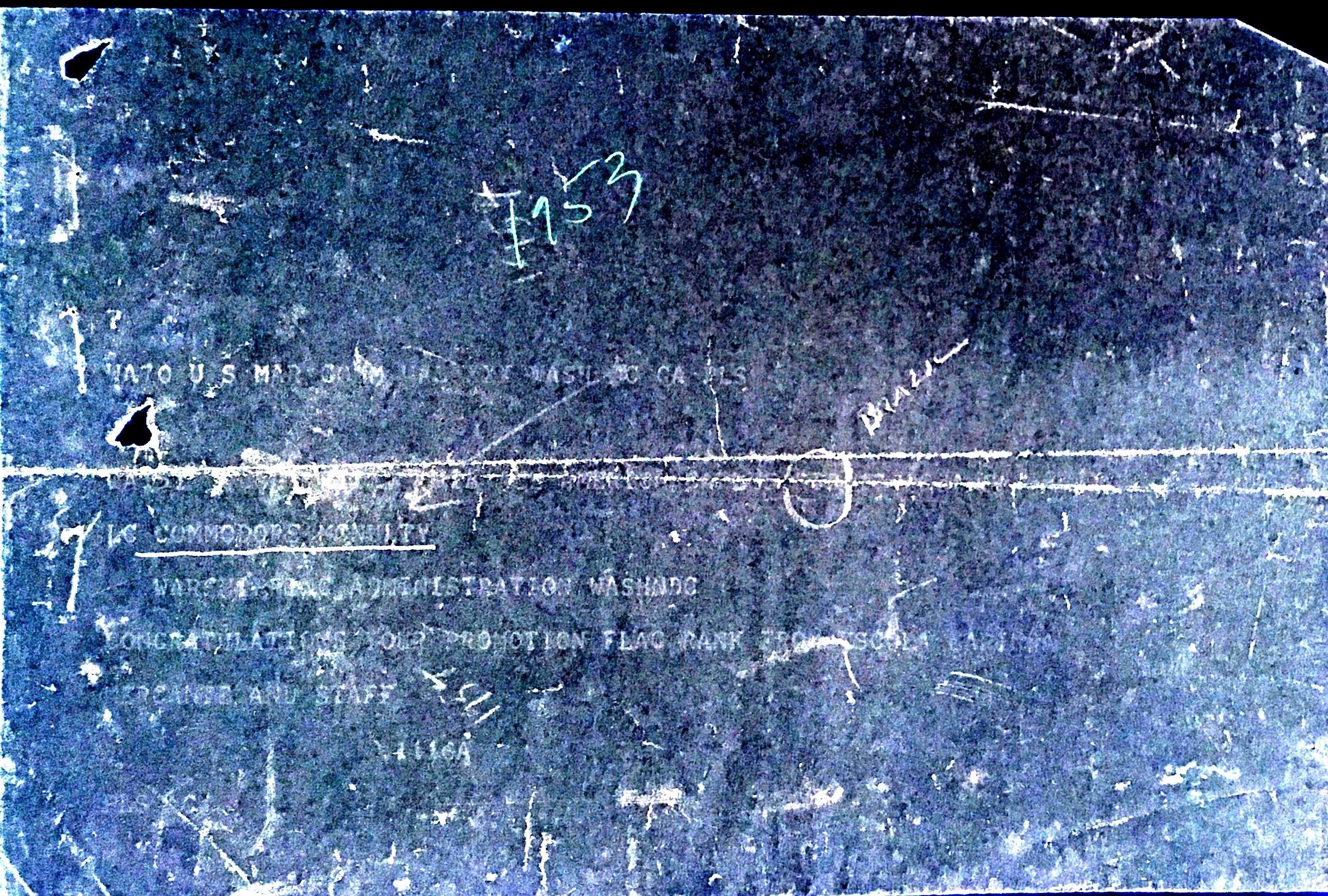
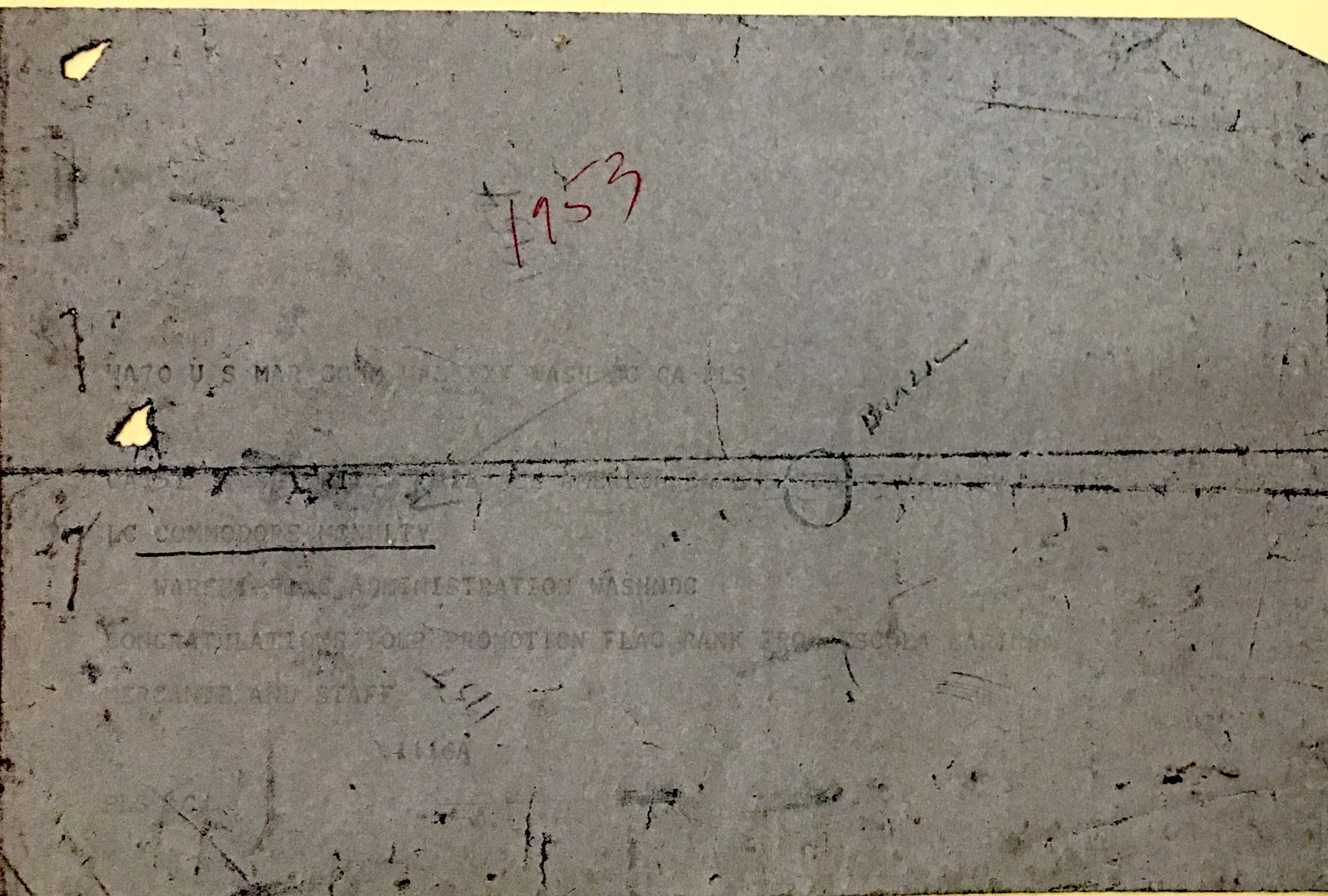
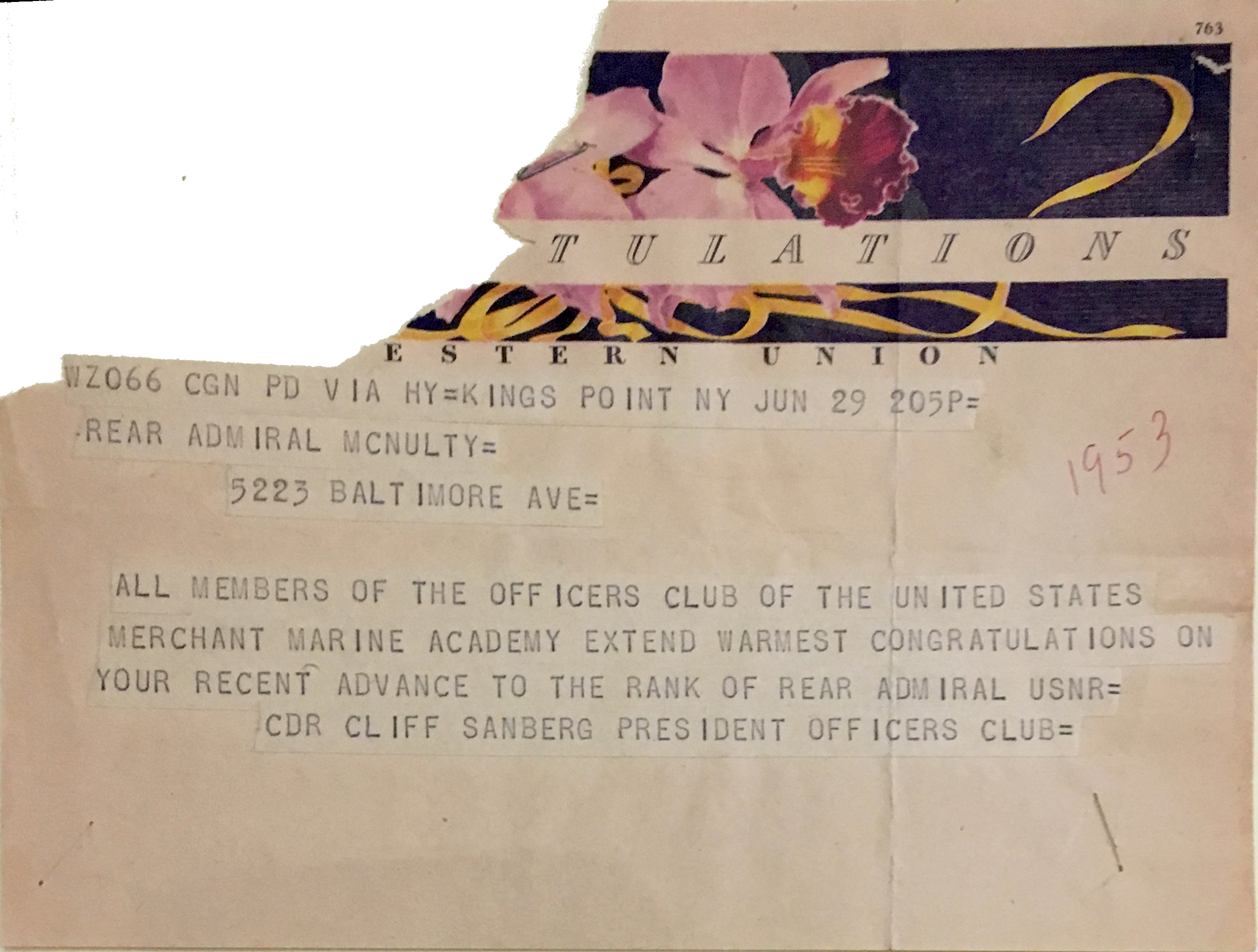
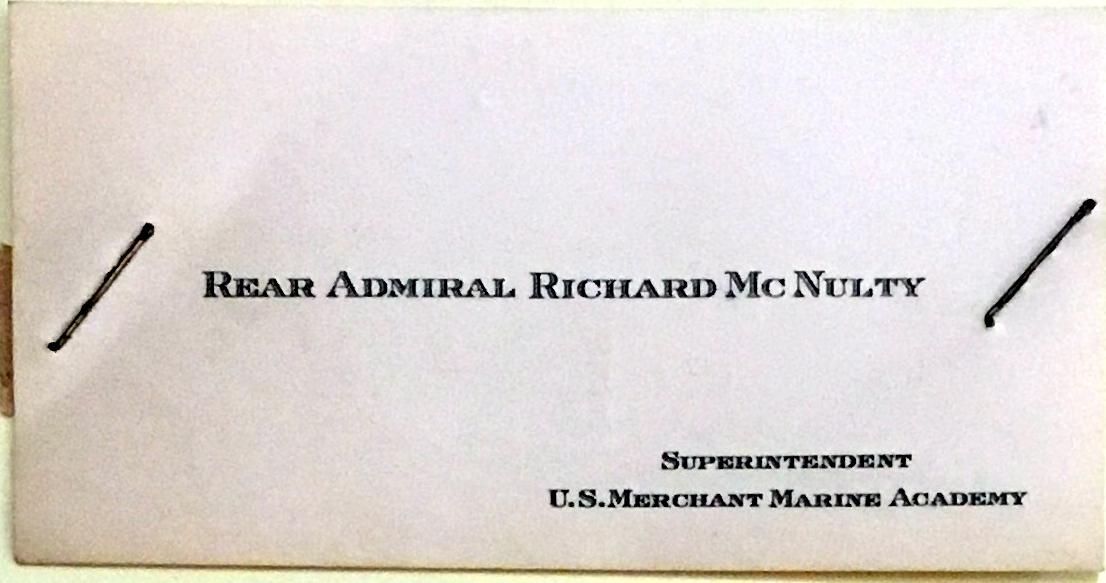
For decades Kings Pointers considered Richard R. McNulty the “Father of the United States Merchant Marine Academy” – a designation made official in 1976 by the Department of Commerce. Upon his death in 1980, he concurrently held the rank of Rear Admiral in the United States Naval Reserve and Vice Admiral in the United States Maritime Service; his official portrait found in Wiley Hall at the United States Merchant Marine Academy has him wearing the uniform of Commodore, United States Navy – a rank he attained in 1945, the year before his assumption of the rôle of Superintendent of the Academy on April 1, 1946, and from which he stepped down from on April 1, 1948.

Retired Navy Rear Adm. Richard Robert McNulty, 81, a former superintendent of the U.S. Merchant Marine Academy who later taught at Georgetown University, died Saturday in a retirement home in Gloucester, Mass. He had arteriosclerosis.

A Navy historical publication states that Adm. McNulty generally is accepted as the founder of the U.S. Merchant Marine Academy. It says that when he retired in 1953 he was the only officer to hold the rank of rear admiral in both the U.S. Maritime Service and the U.S. Naval Reserve.

He was a native of Gloucester and joined the Naval Reserve after graduating from the Massachusetts Nautical School in 1919. He came to Washington in the early 1920s and graduated from the Foreign Service School at Georgetown University. He worked for the Navy’s Hydrographic Office and with the U.S. Shipping Board’s Bureau of Research. He also worked for a New York shipping line before being called to active duty in the Navy during World War II.

In the war, he earned the Legion of Merit as supervisor of the U.S. Merchant Marine Cadet Corps. He was superintendent of the U.S. Merchant Marine Academy at Kings Point, N.Y., from 1946 to [1948].

He then joined the staff of Georgetown University as director of the international transportation program in the Foreign Service School. He held this post for nine years before retiring.

He lived in Bethesda before returning to New England in 1973. His wife, the former Sue Alice Collins, died in 1969. Adm. McNulty’s survivors include a brother and two sisters, all of Gloucester.

Obit: “R. R. McNulty, Founder of Academy, Dies.” Washington Post, November 11, 1980.

Vice Admiral Richard R. McNulty, USMS
Third Superintendent of the United States Merchant Marine Academy
1946-48
“Father of the Academy”
Col.: AMMM (Wiley Hall)

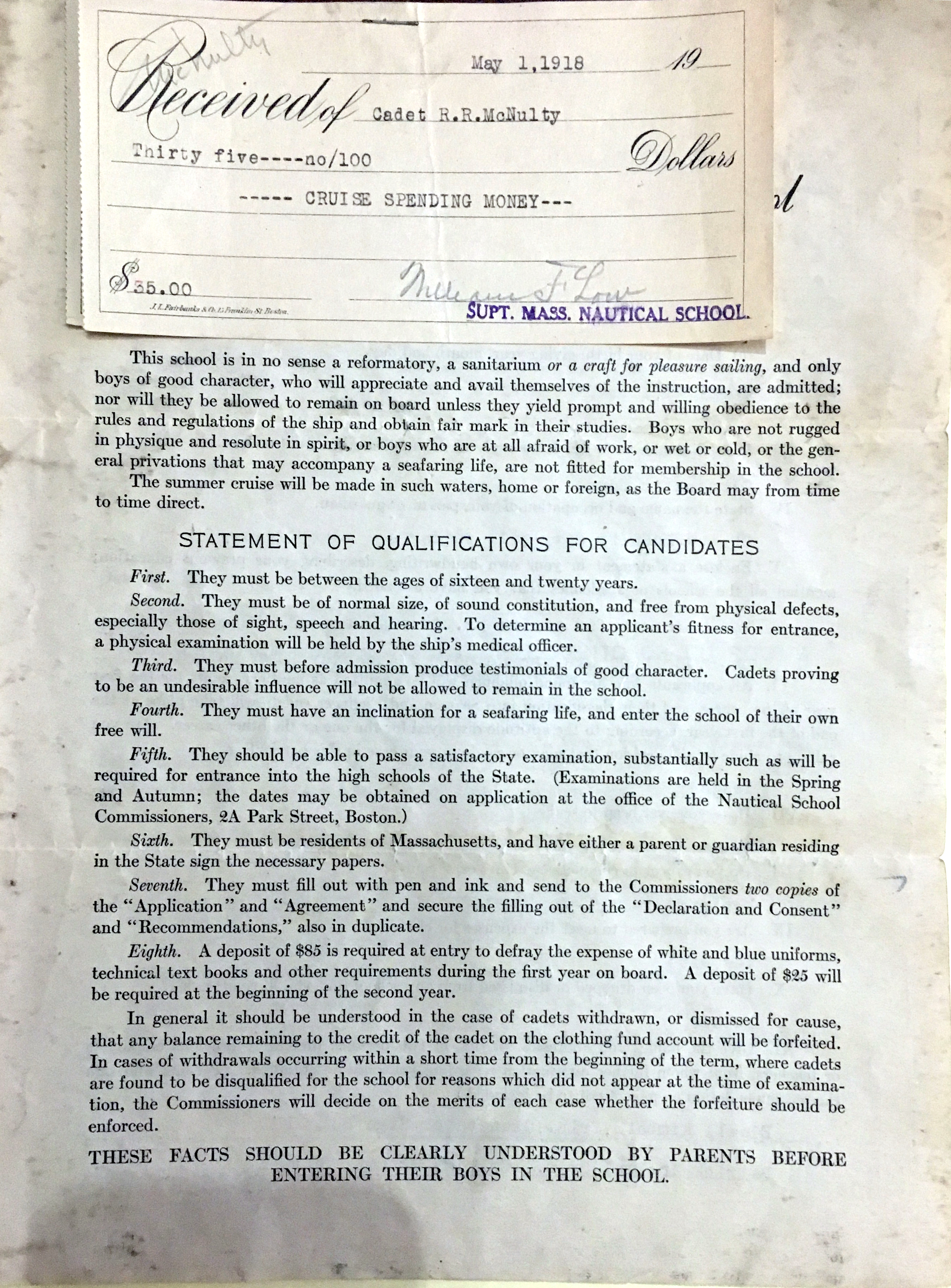
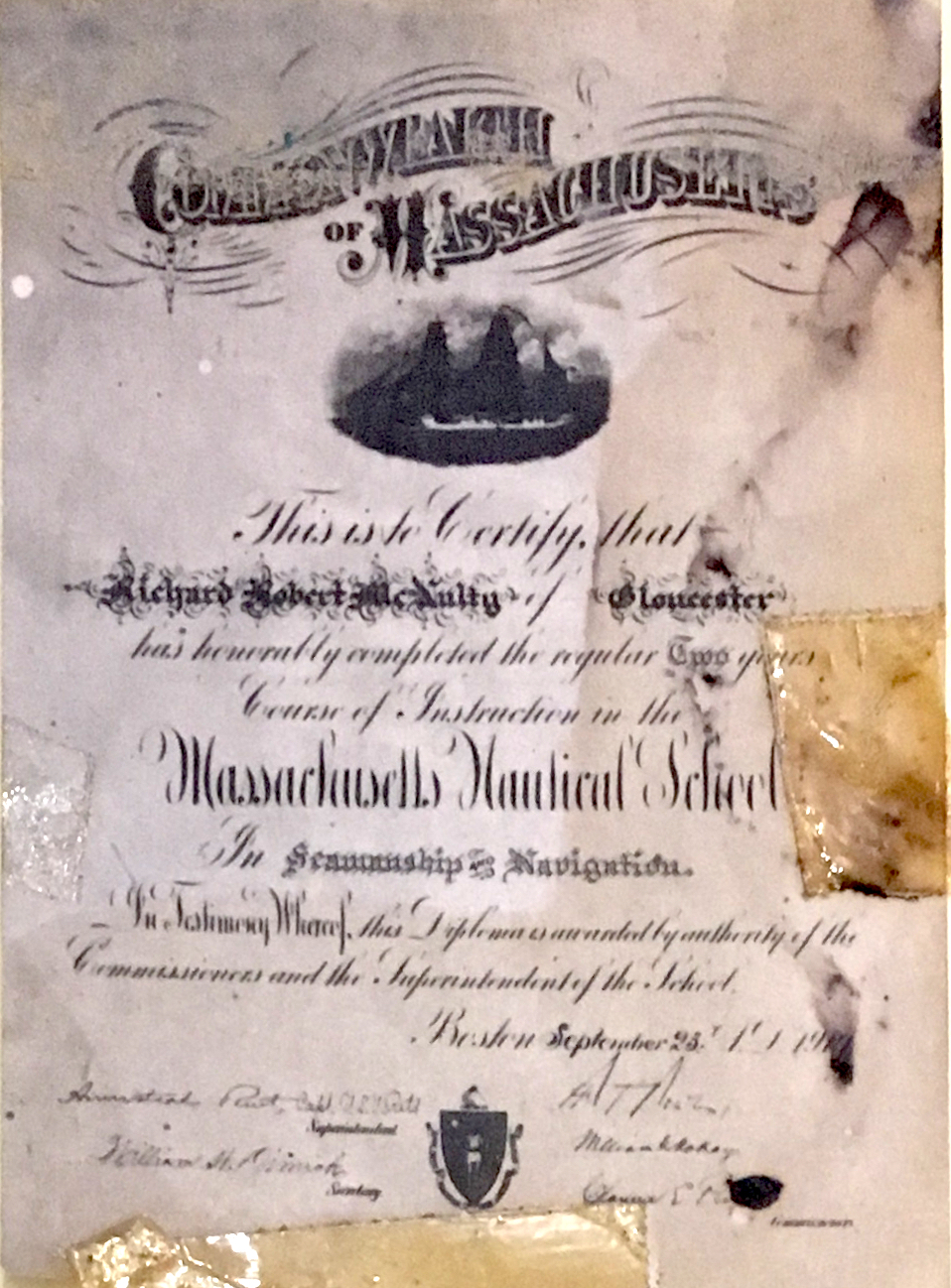
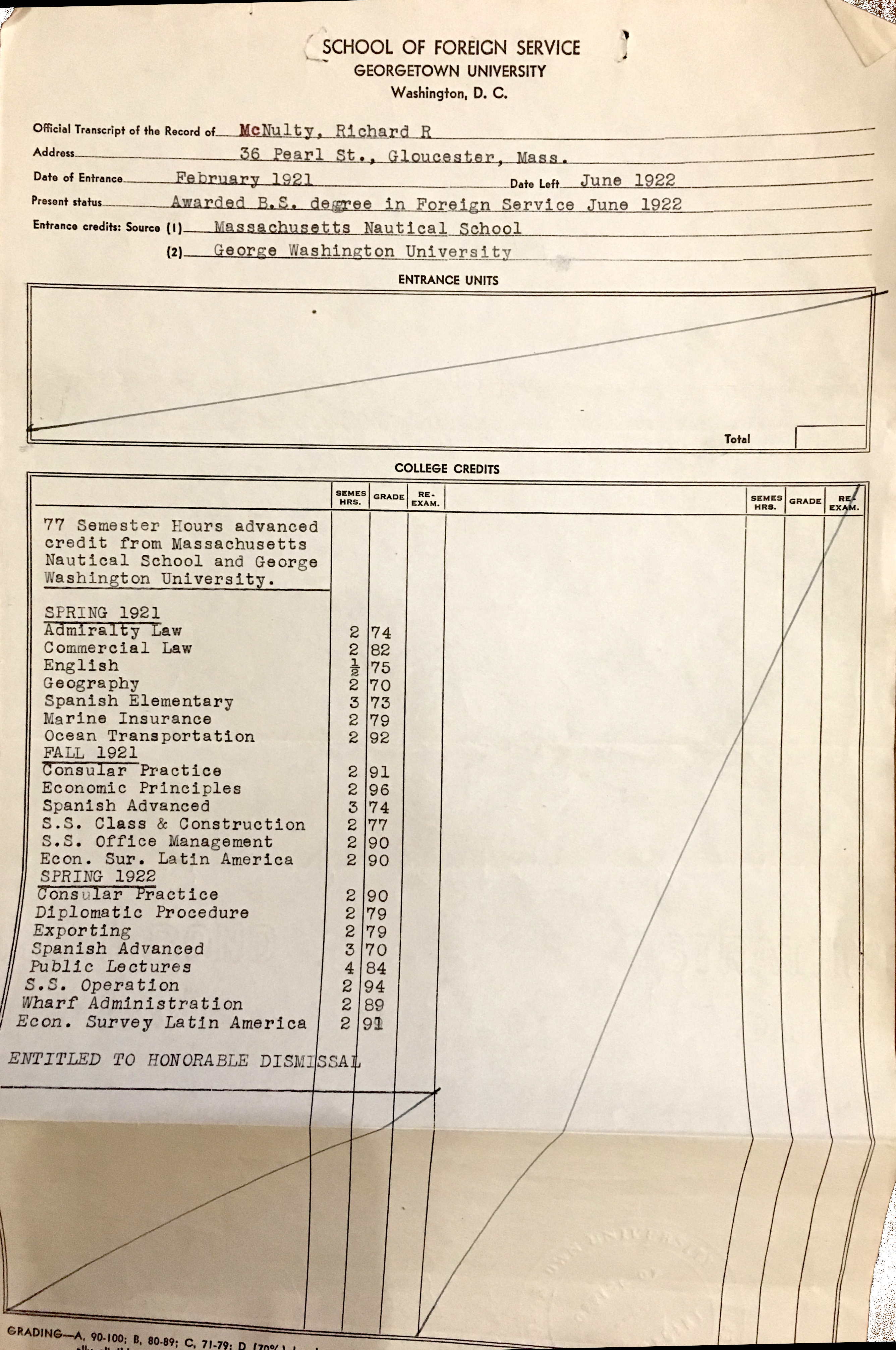
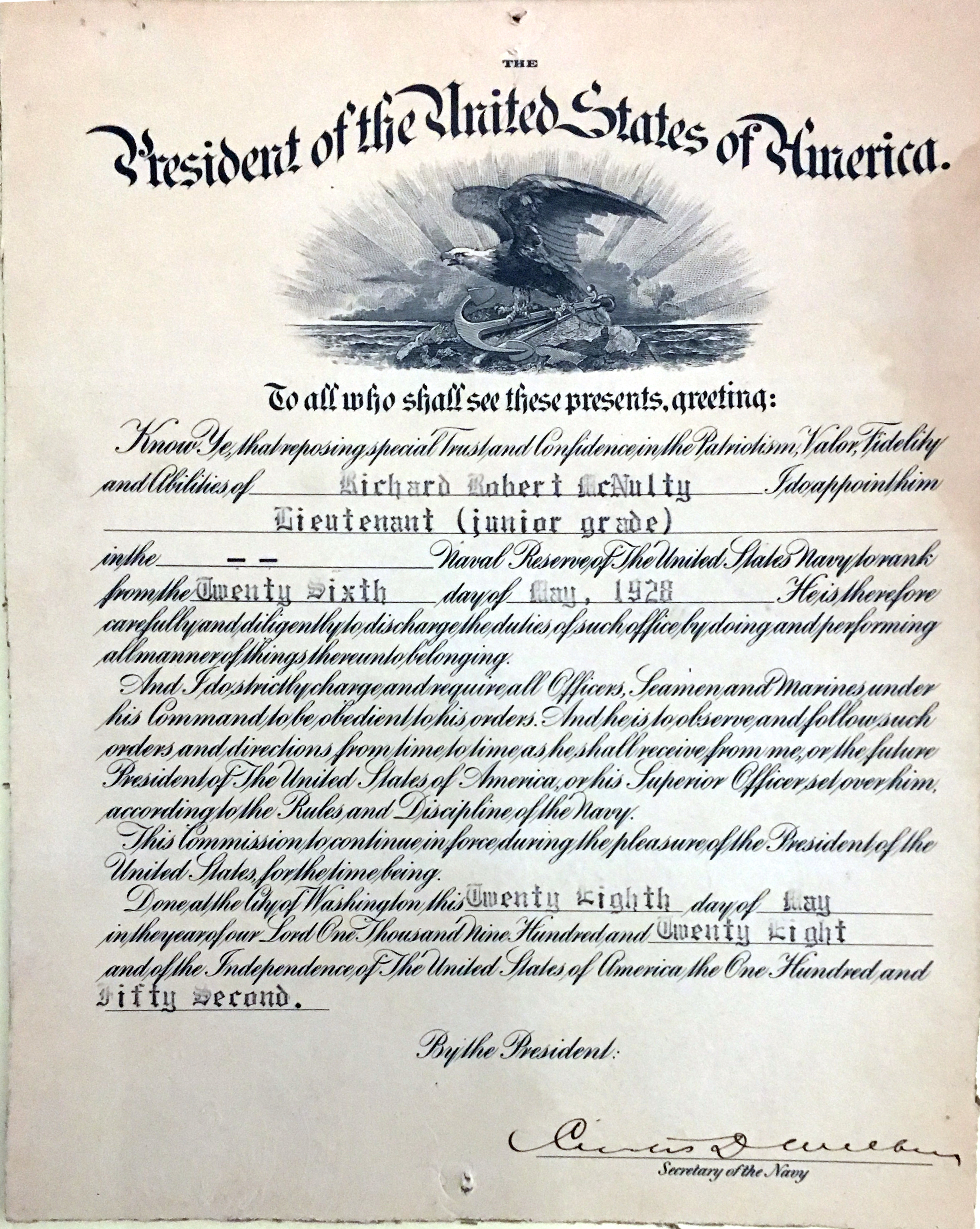
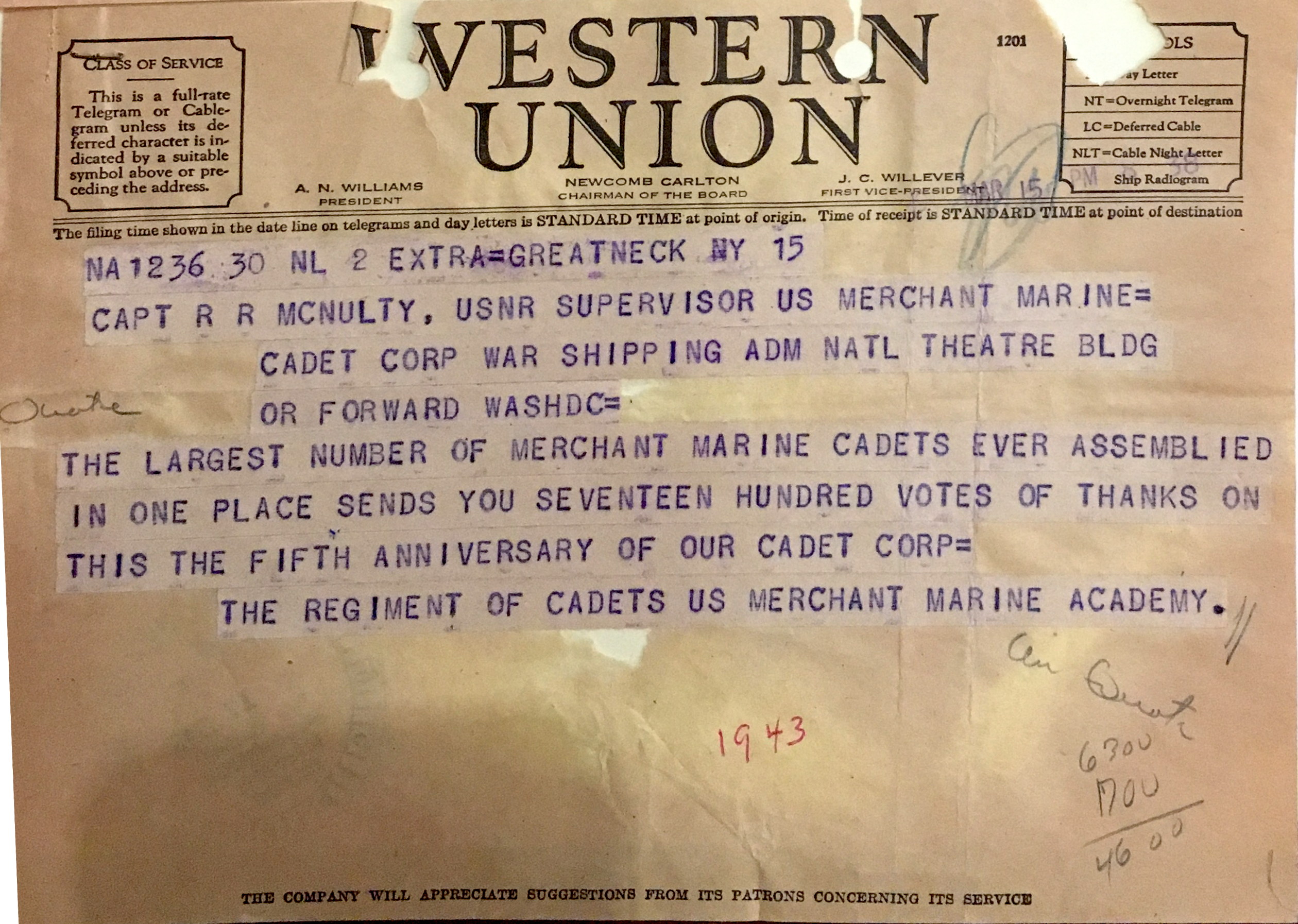
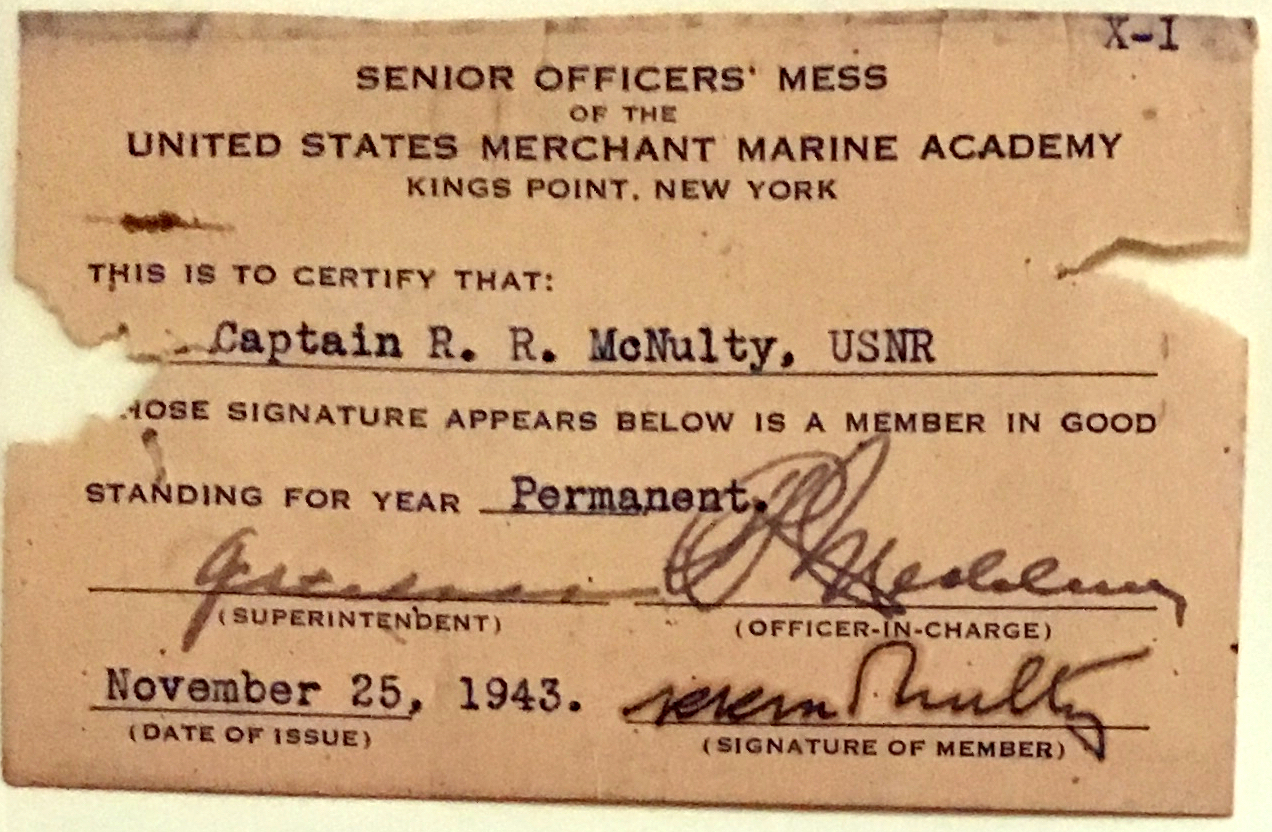
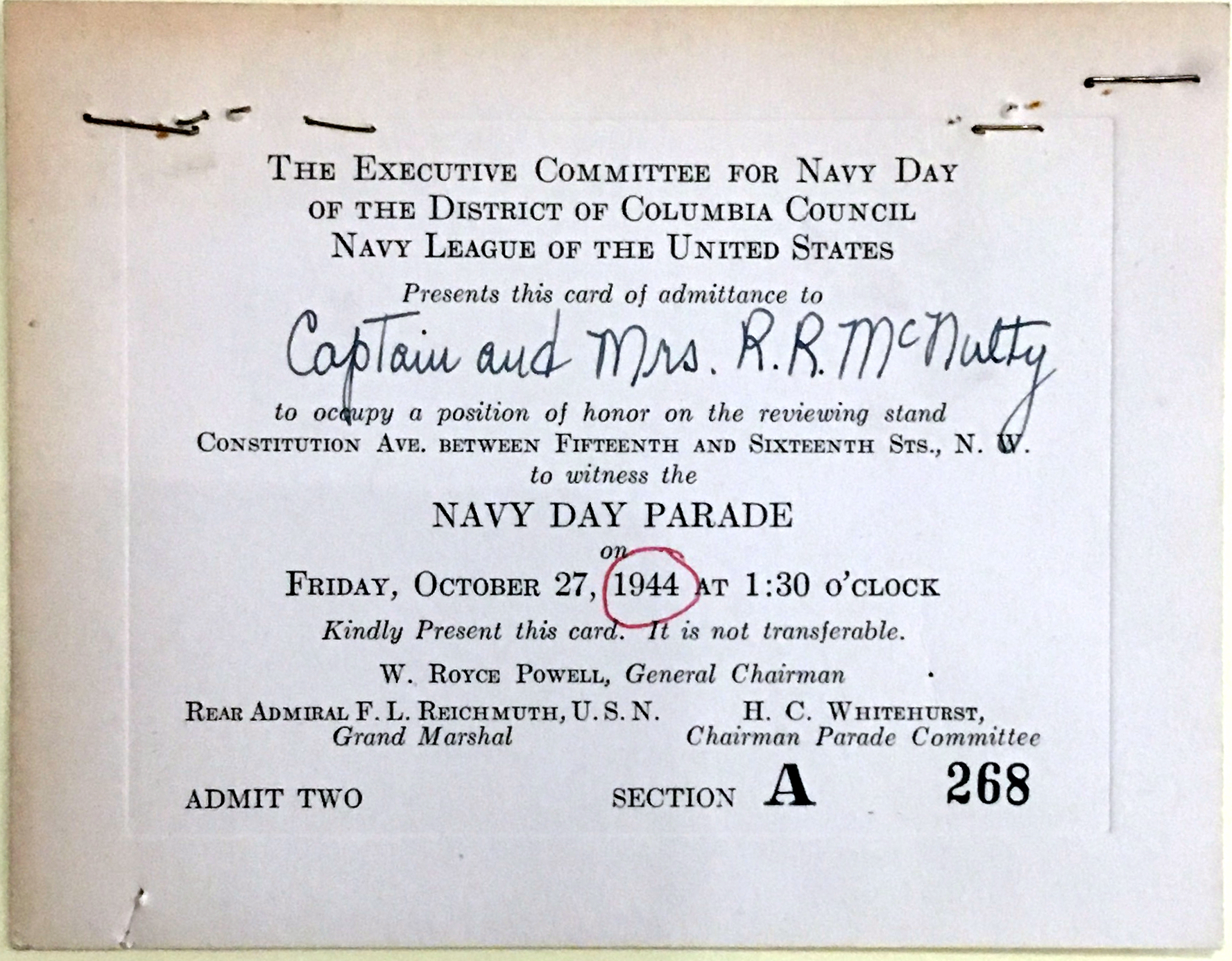
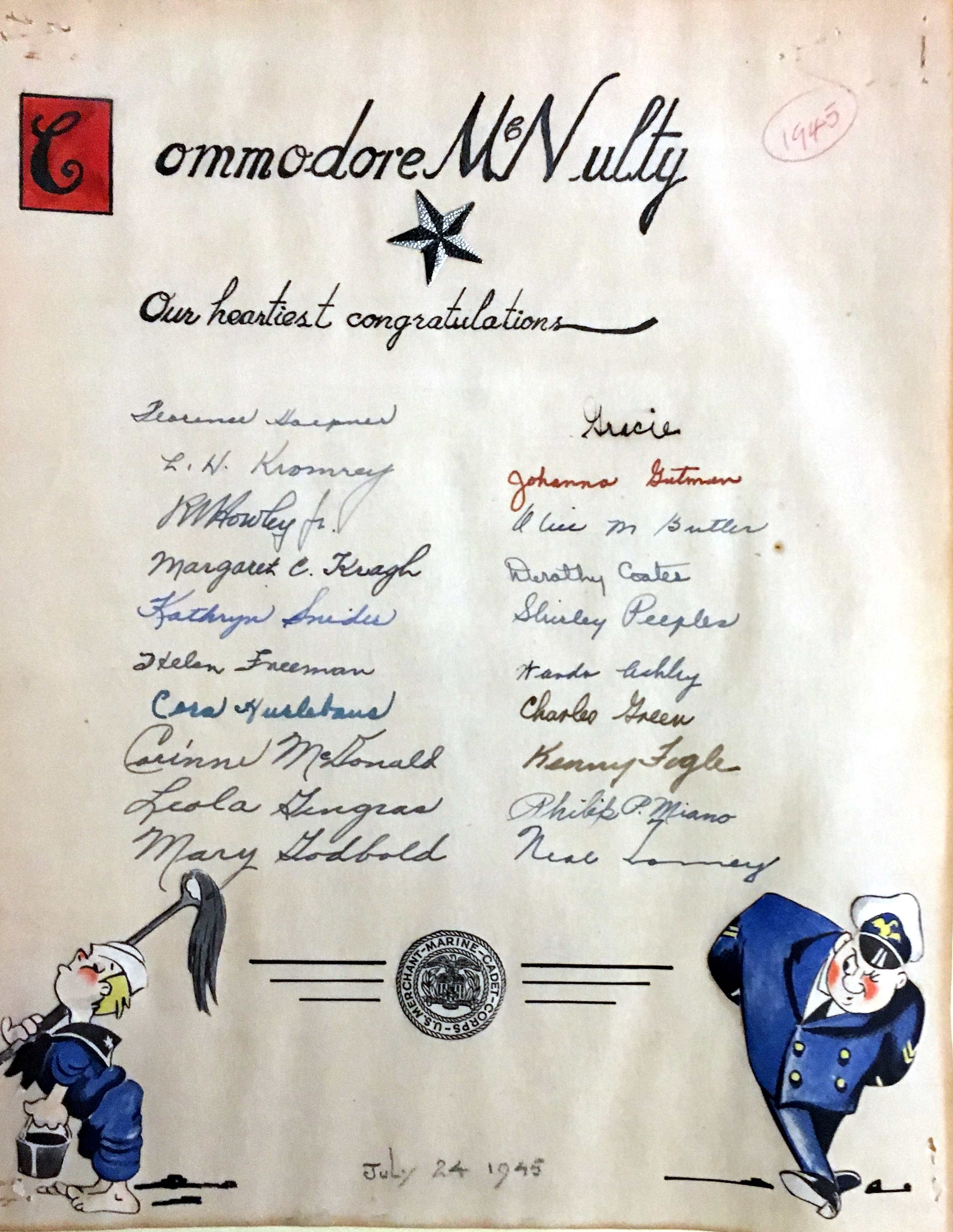
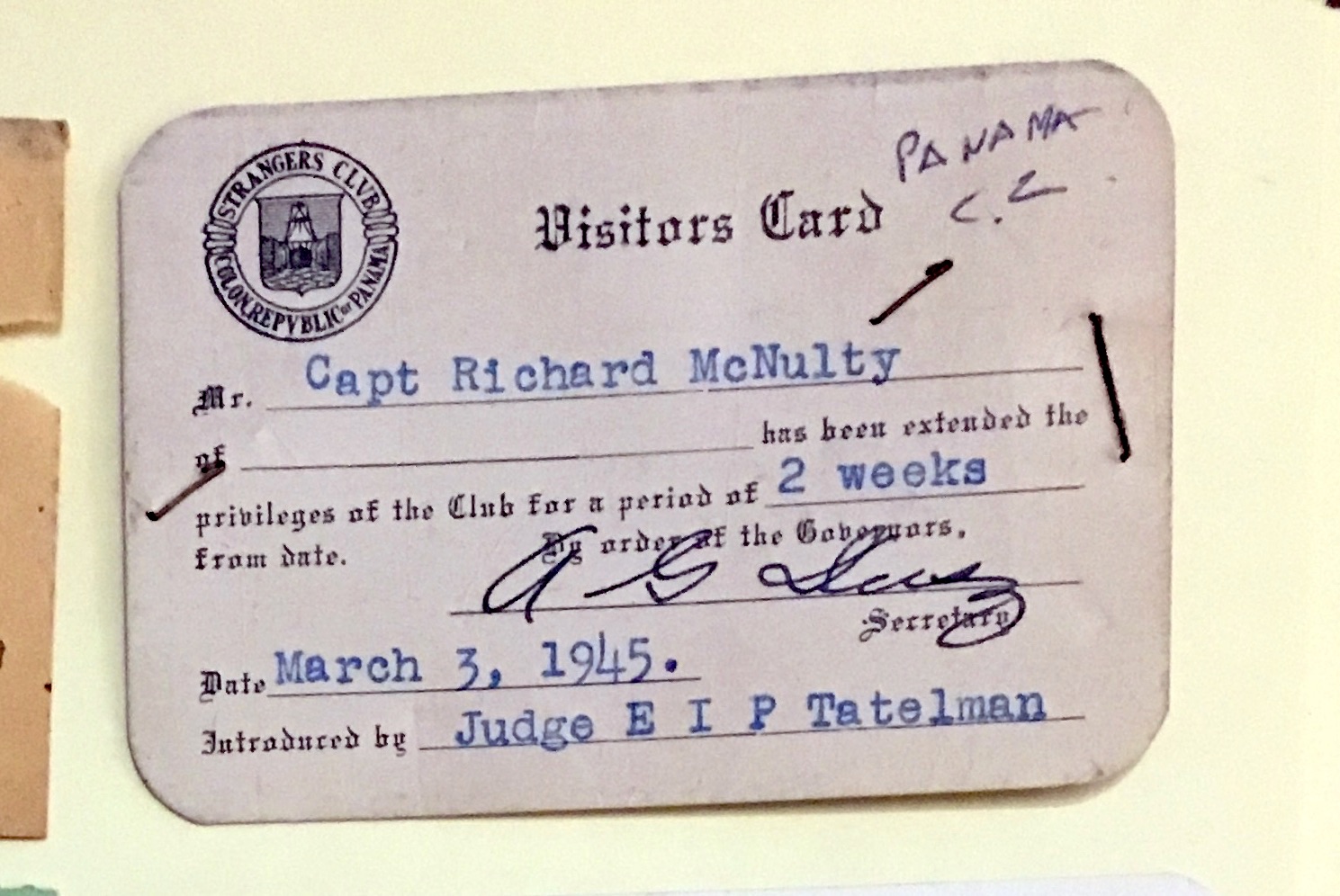
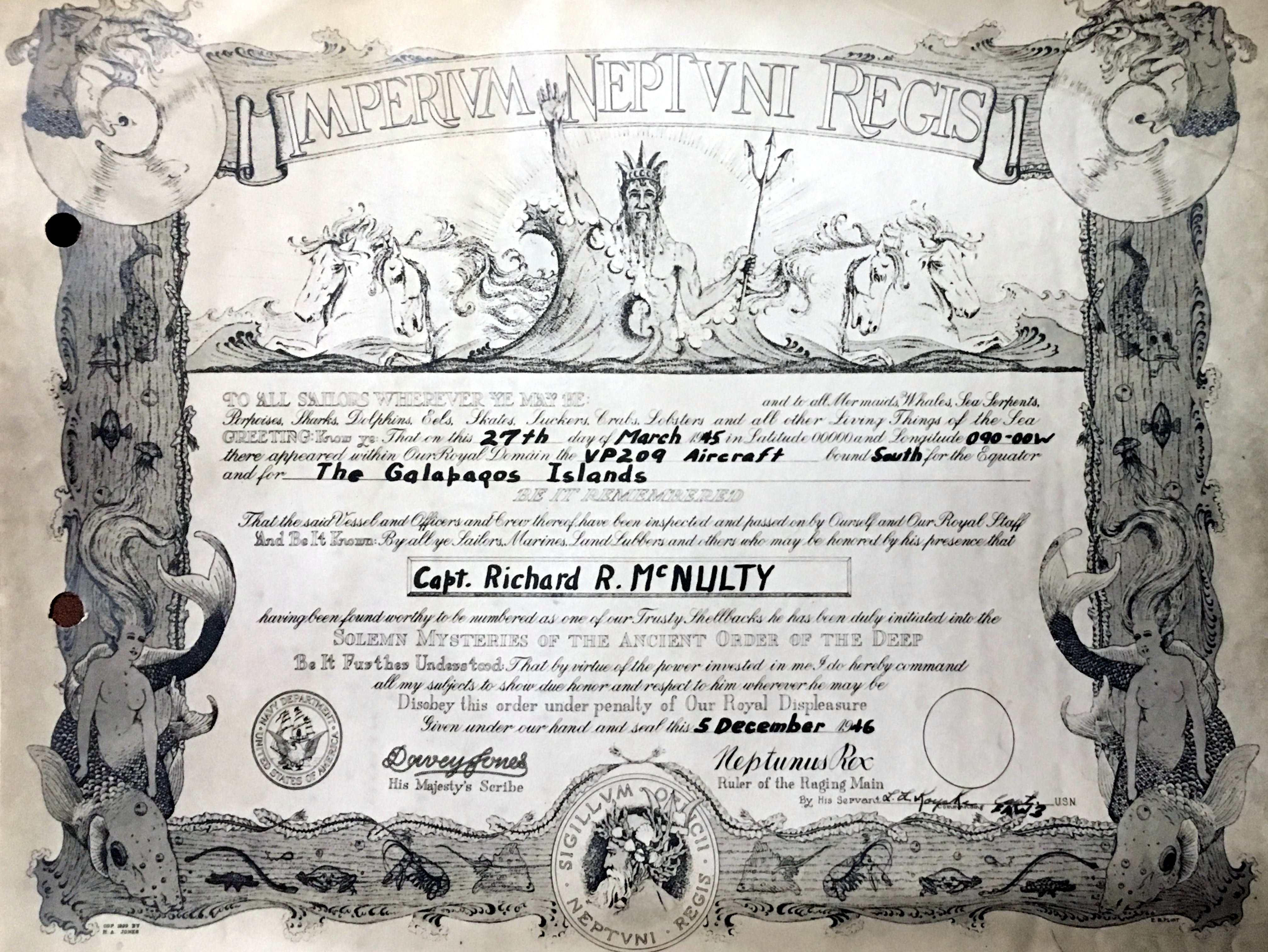
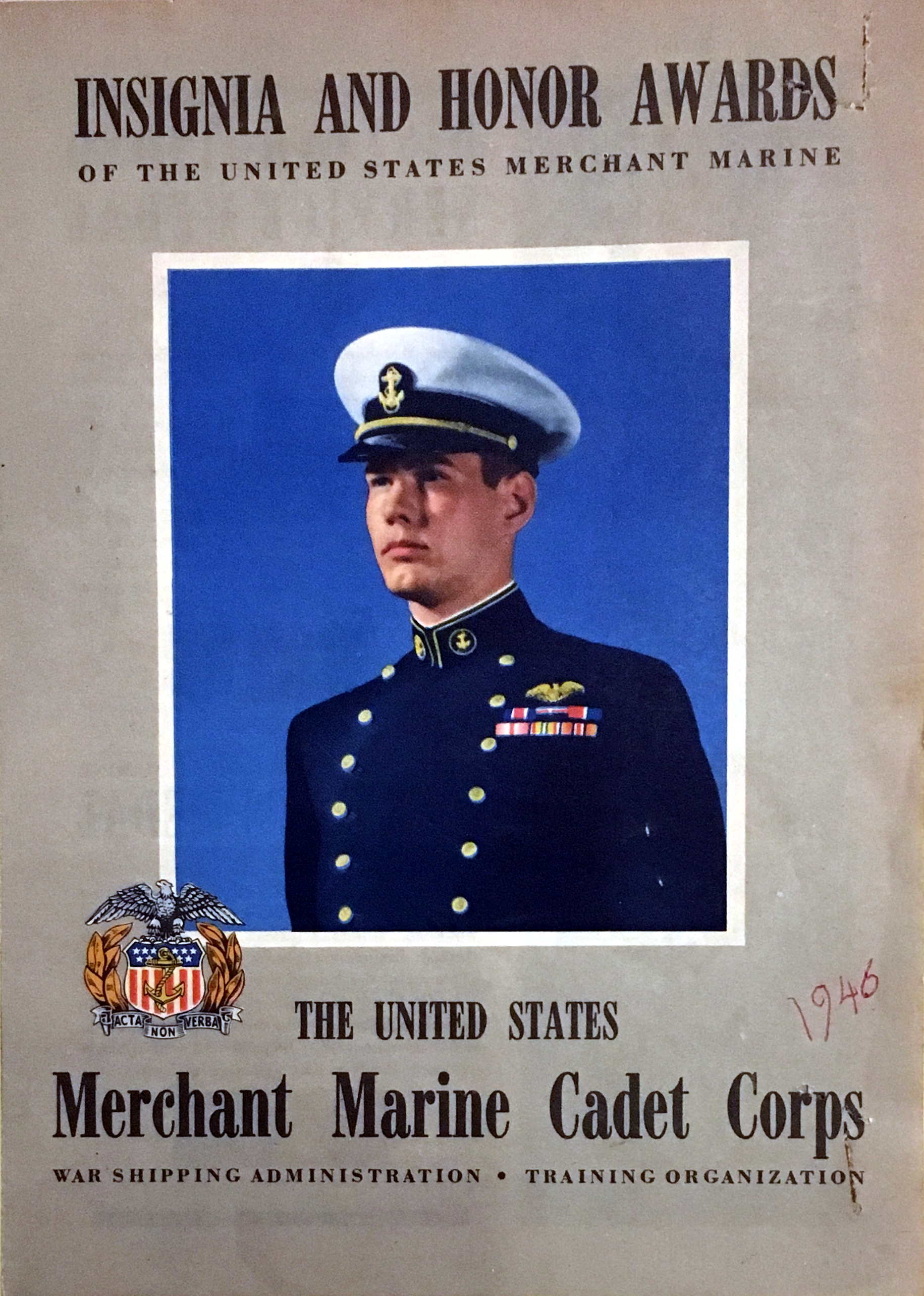
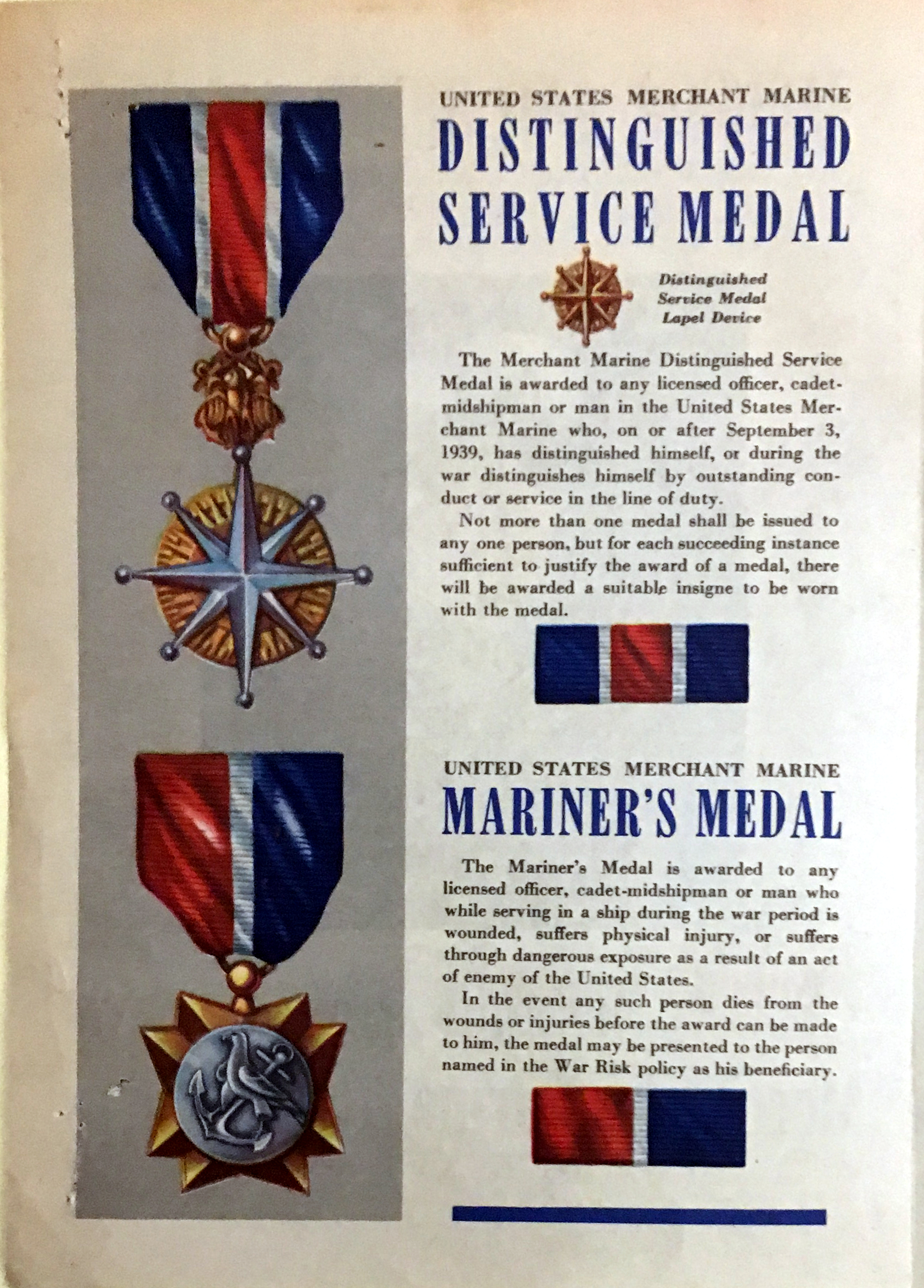
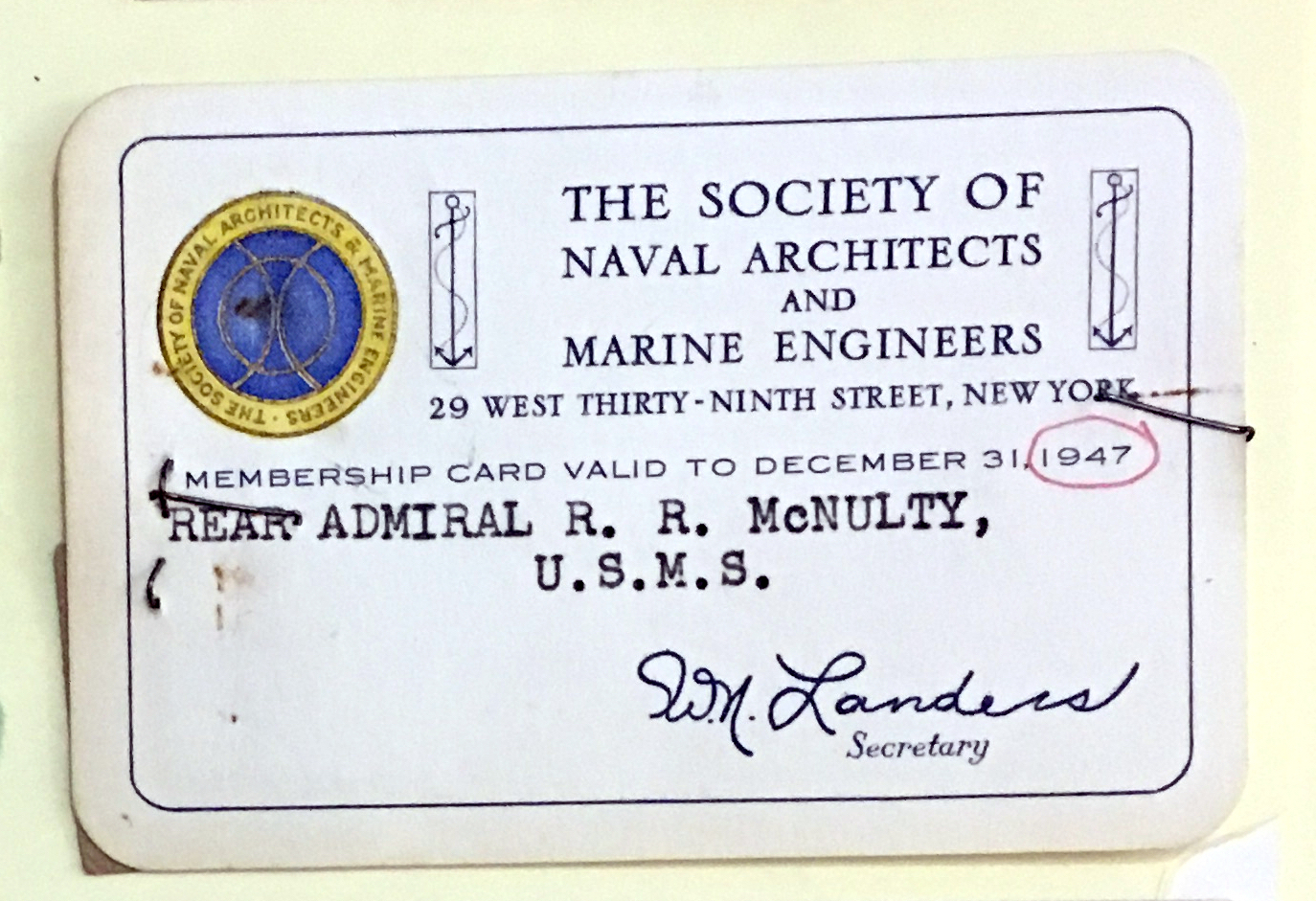
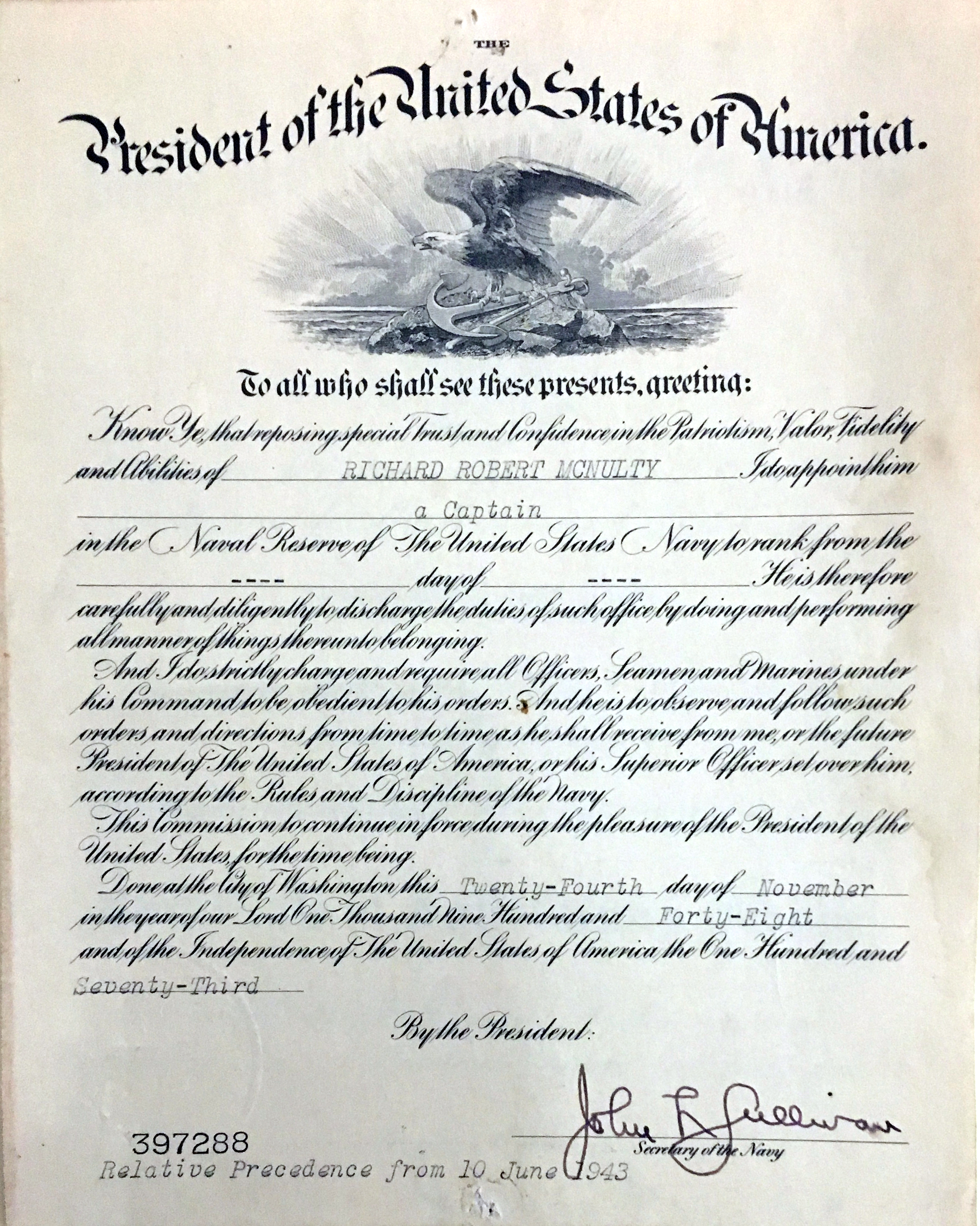
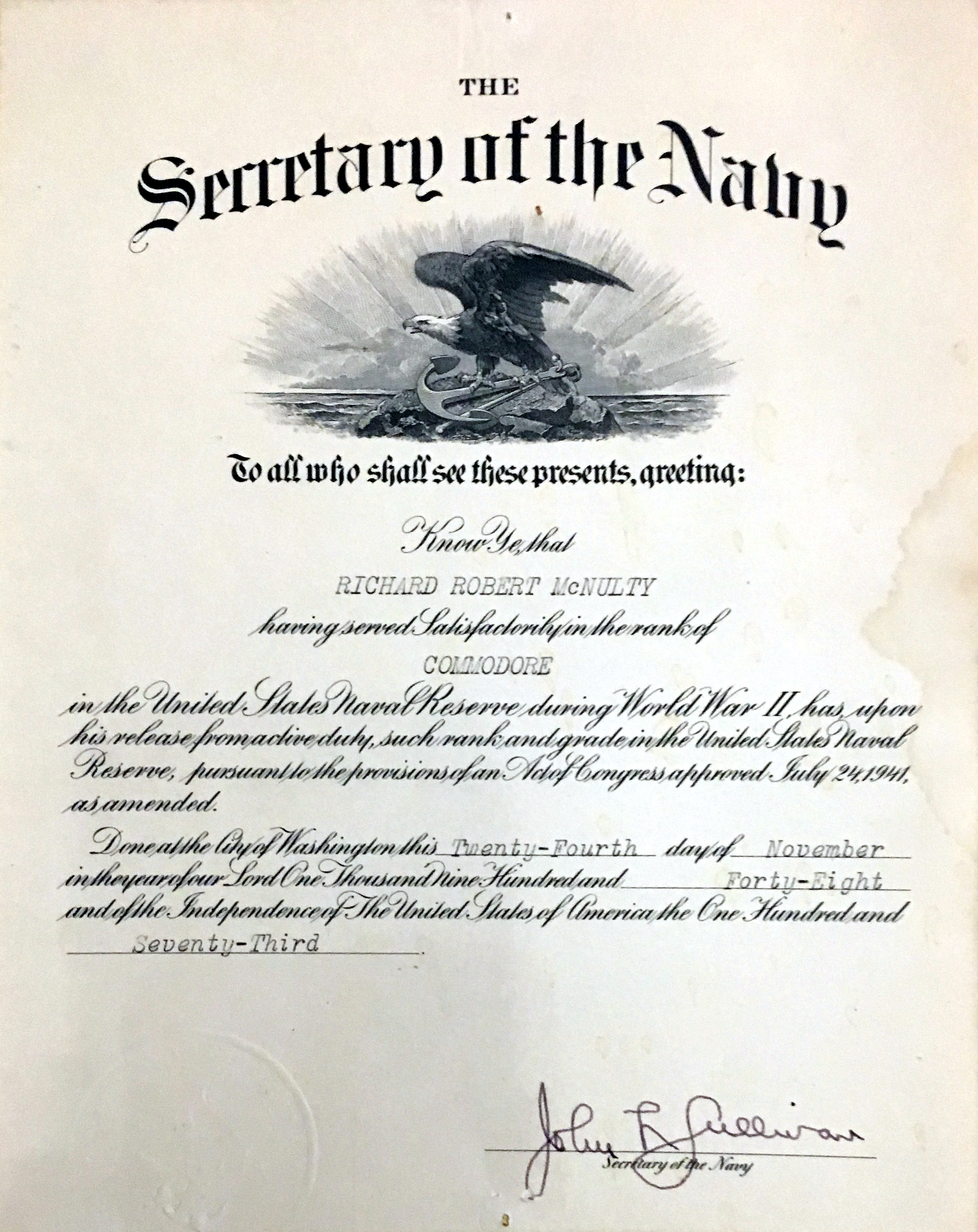
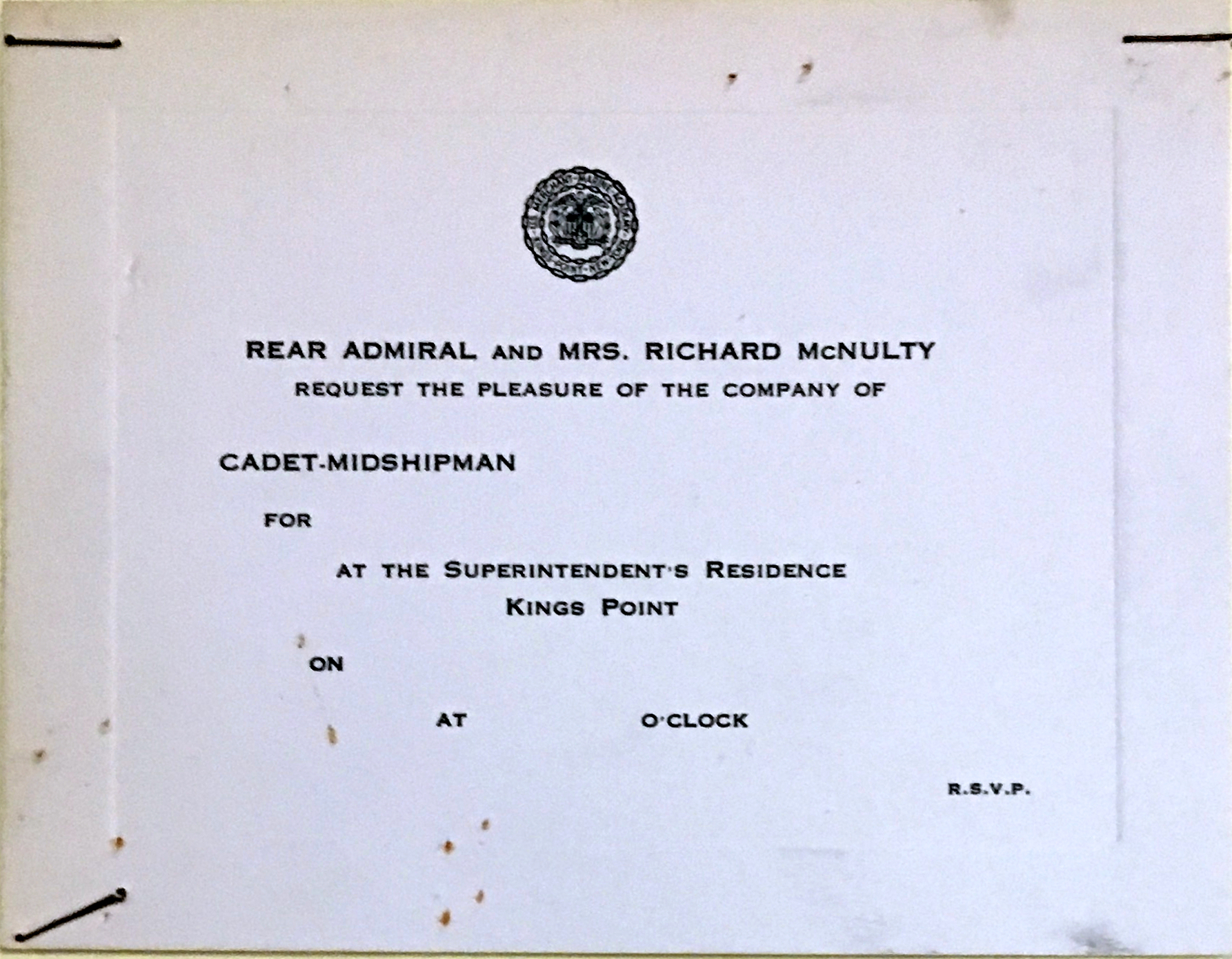
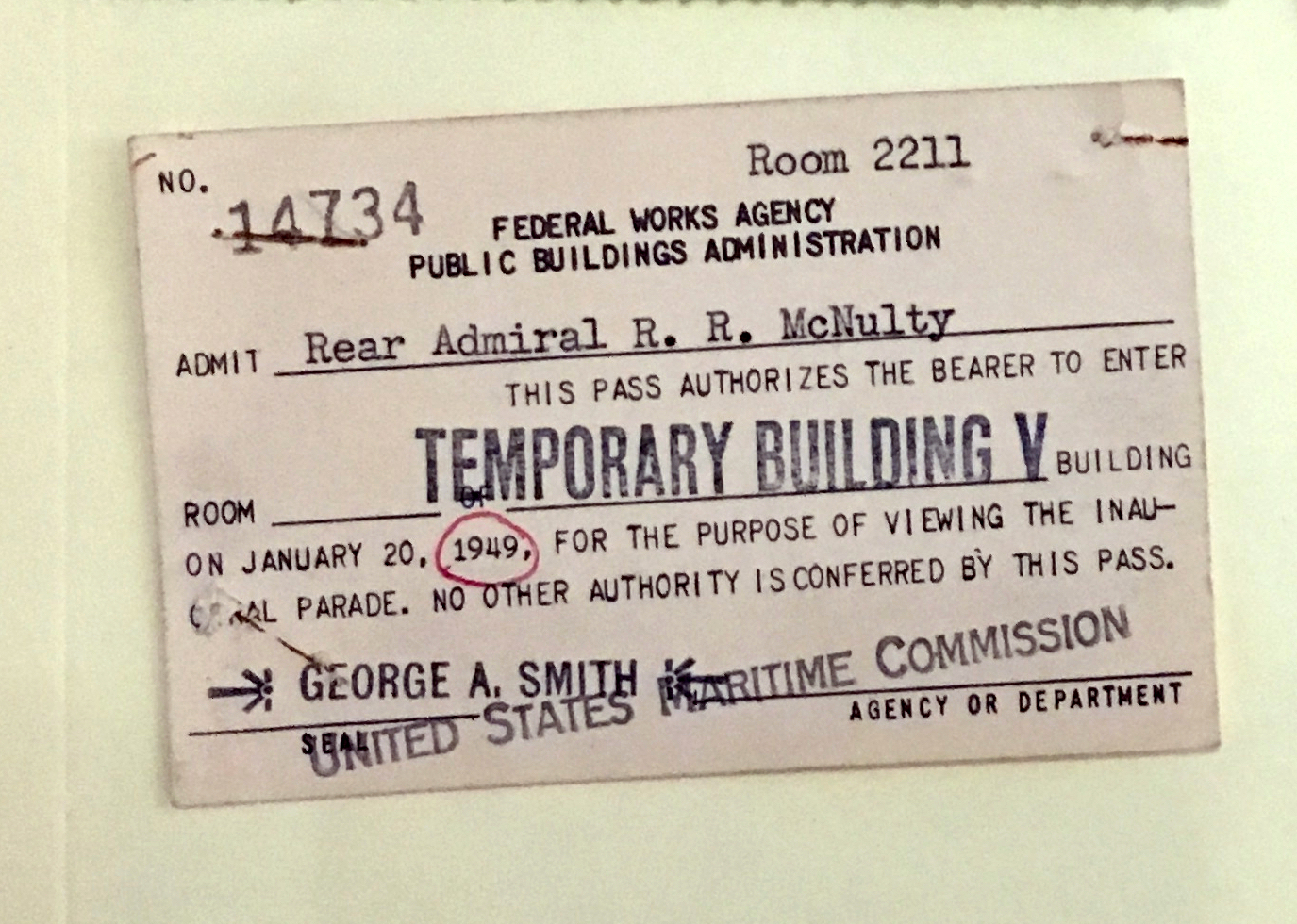
mcnulty ephemera

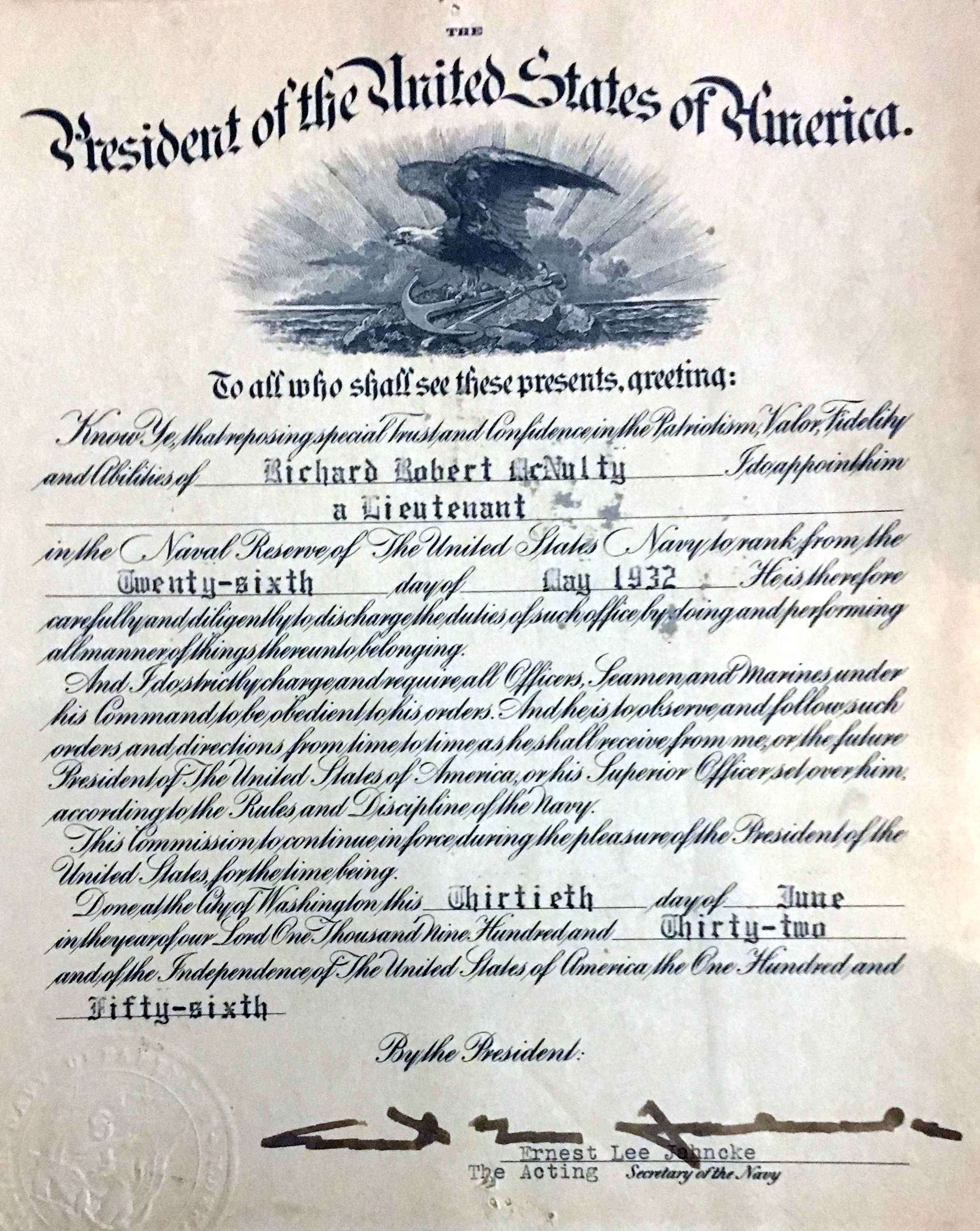
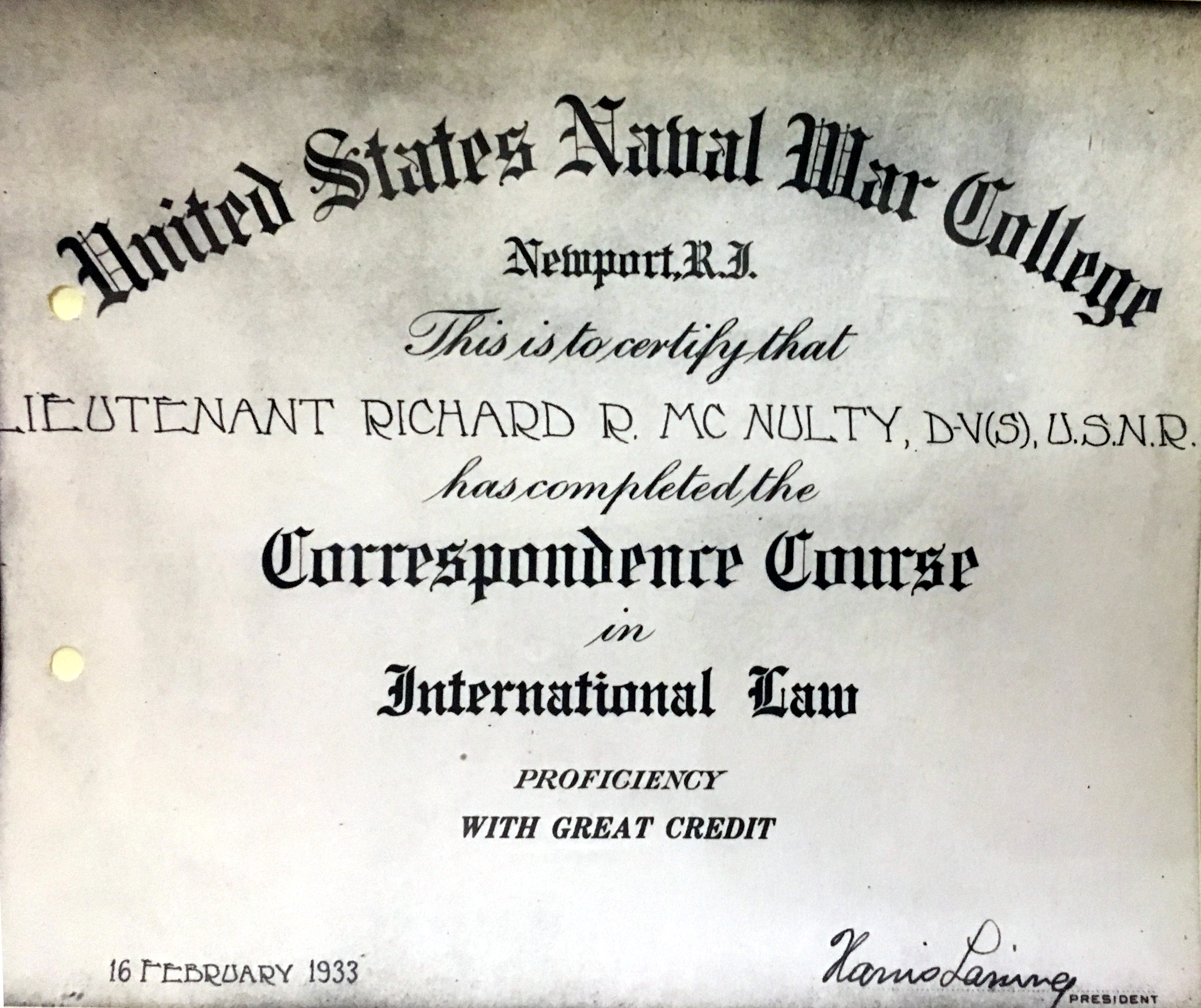
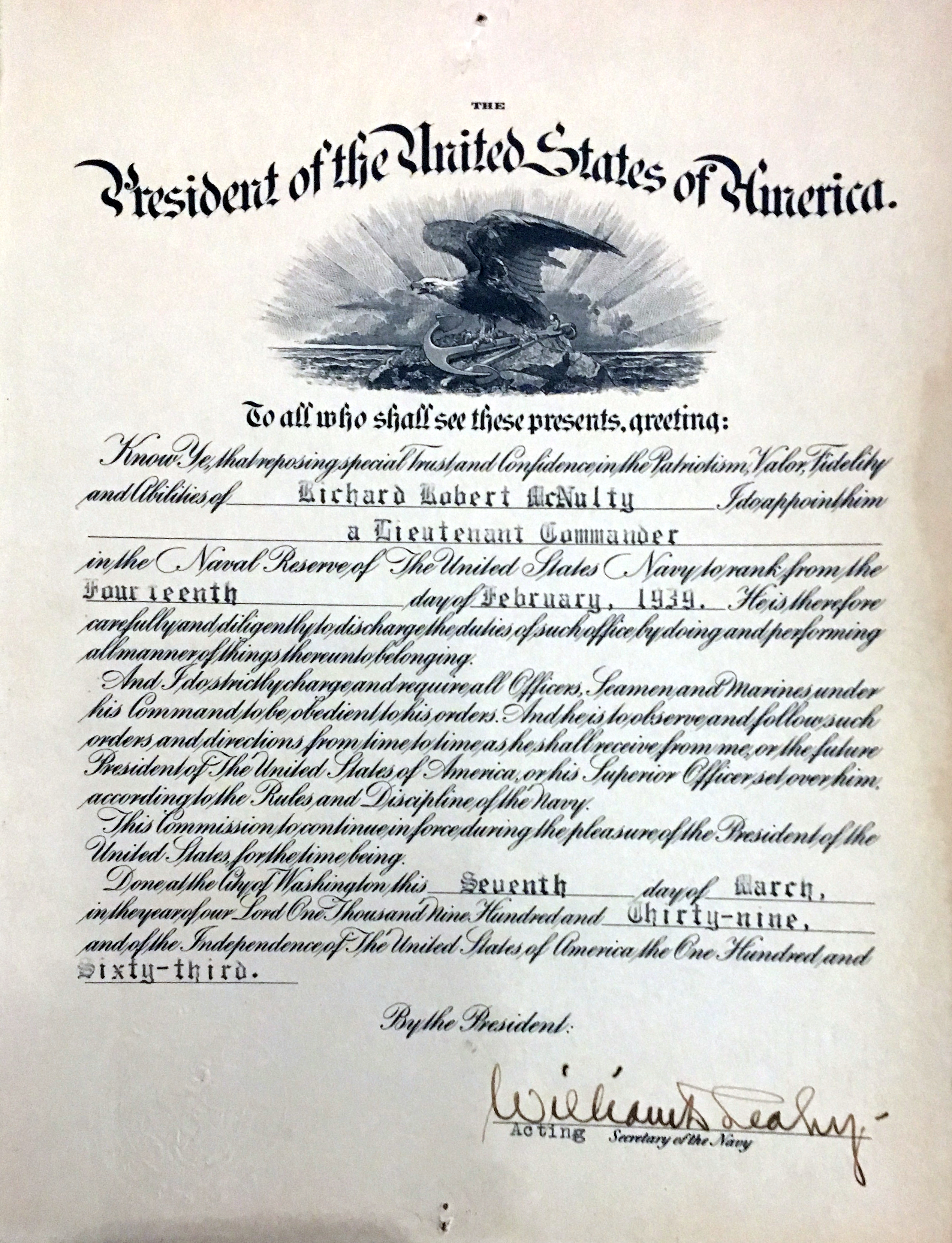
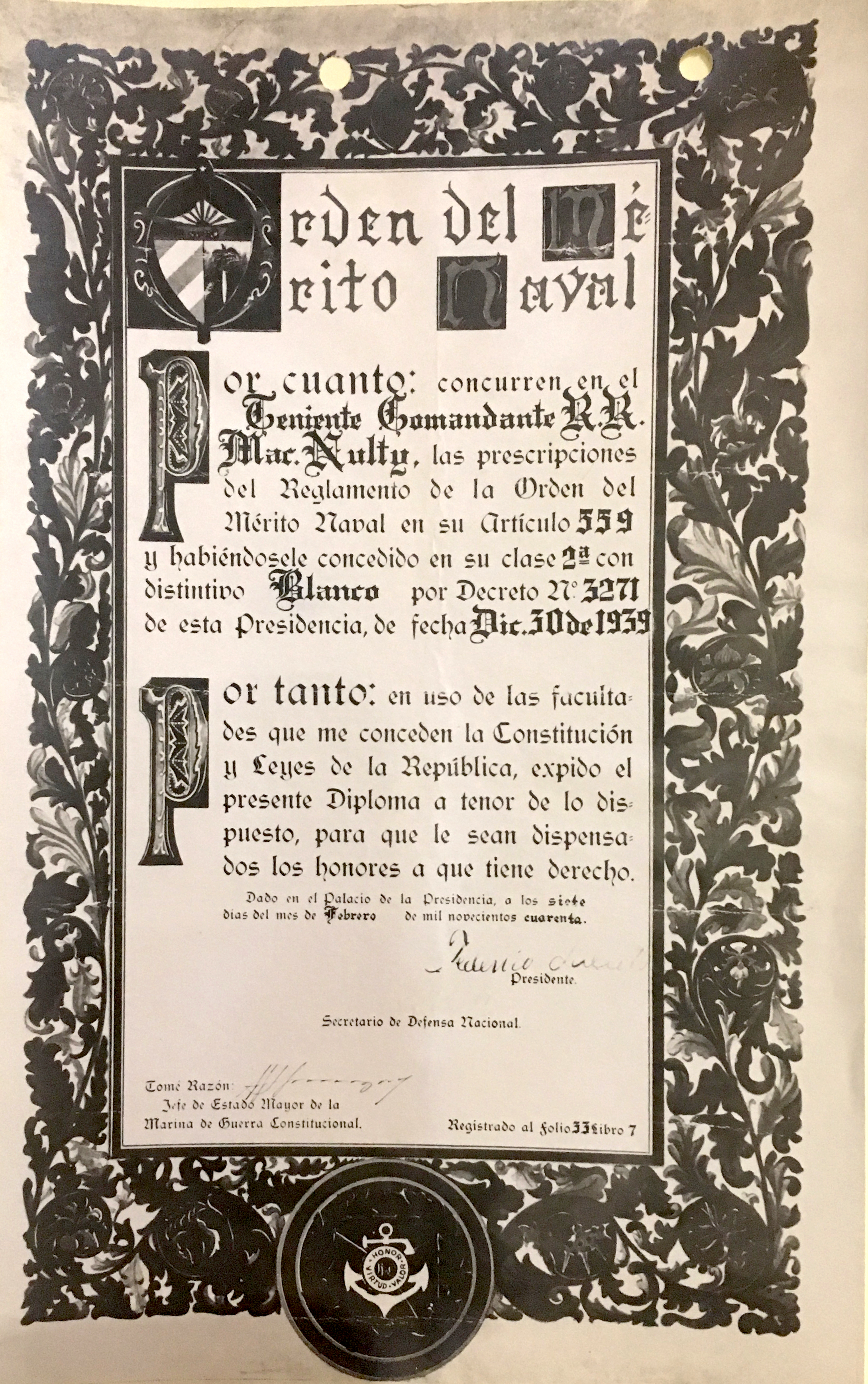
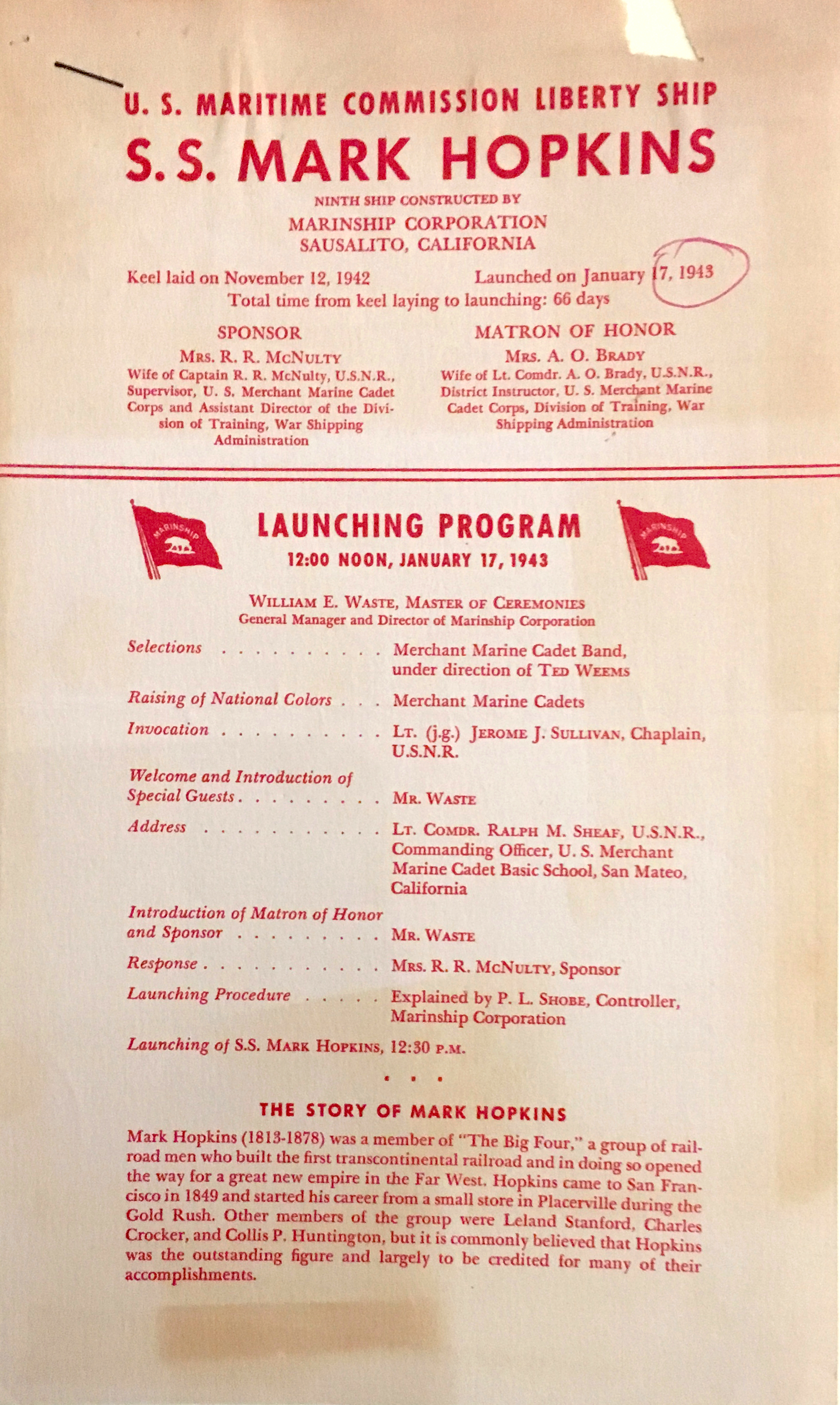
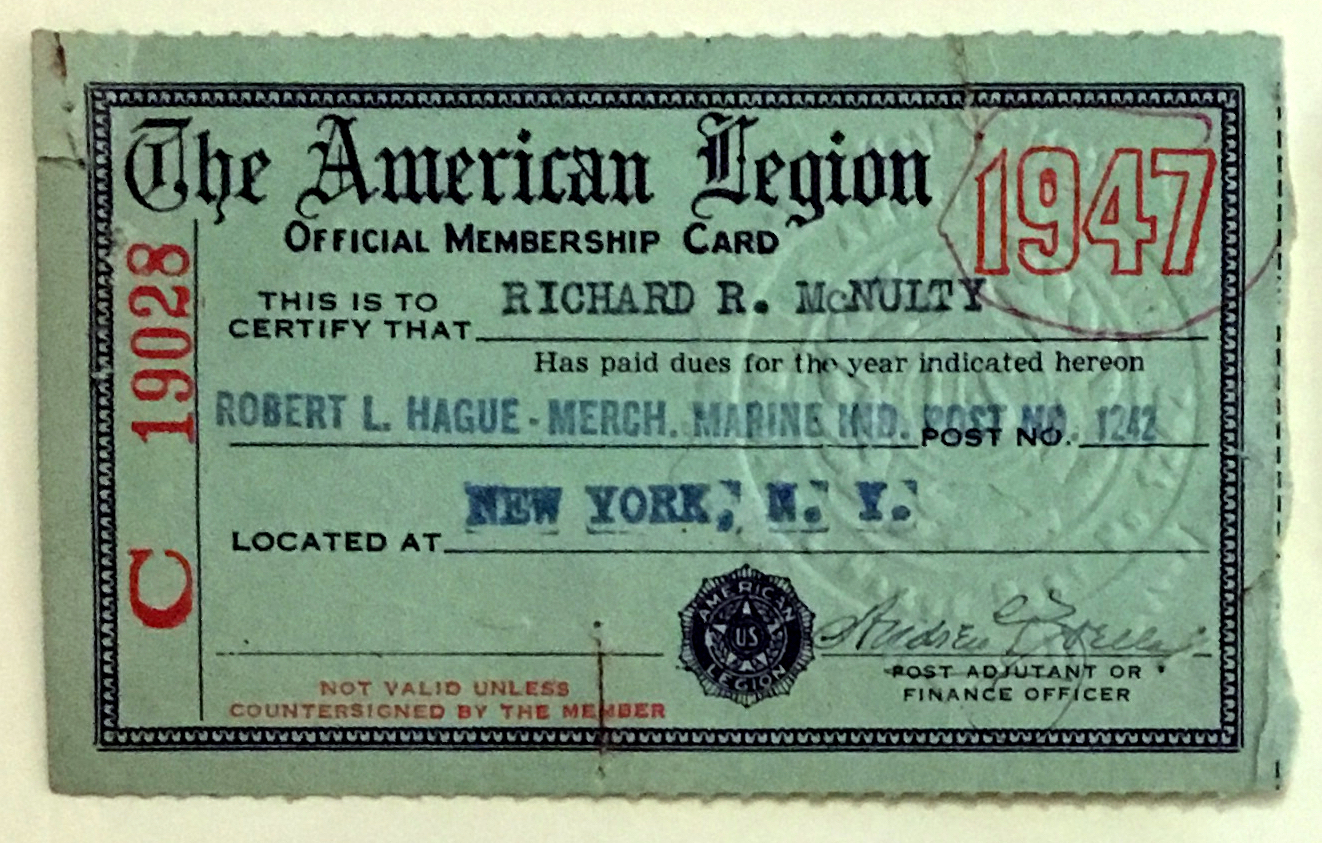
Tucked away in an archival box on a section of the campus that bears his name are pieces of ephemera that throw some color on the life of a man who eschewed the spotlight; all were undoubtedly once found in frames in his office. Sadly, someone defaced many of the documents with a red ballpoint pen.
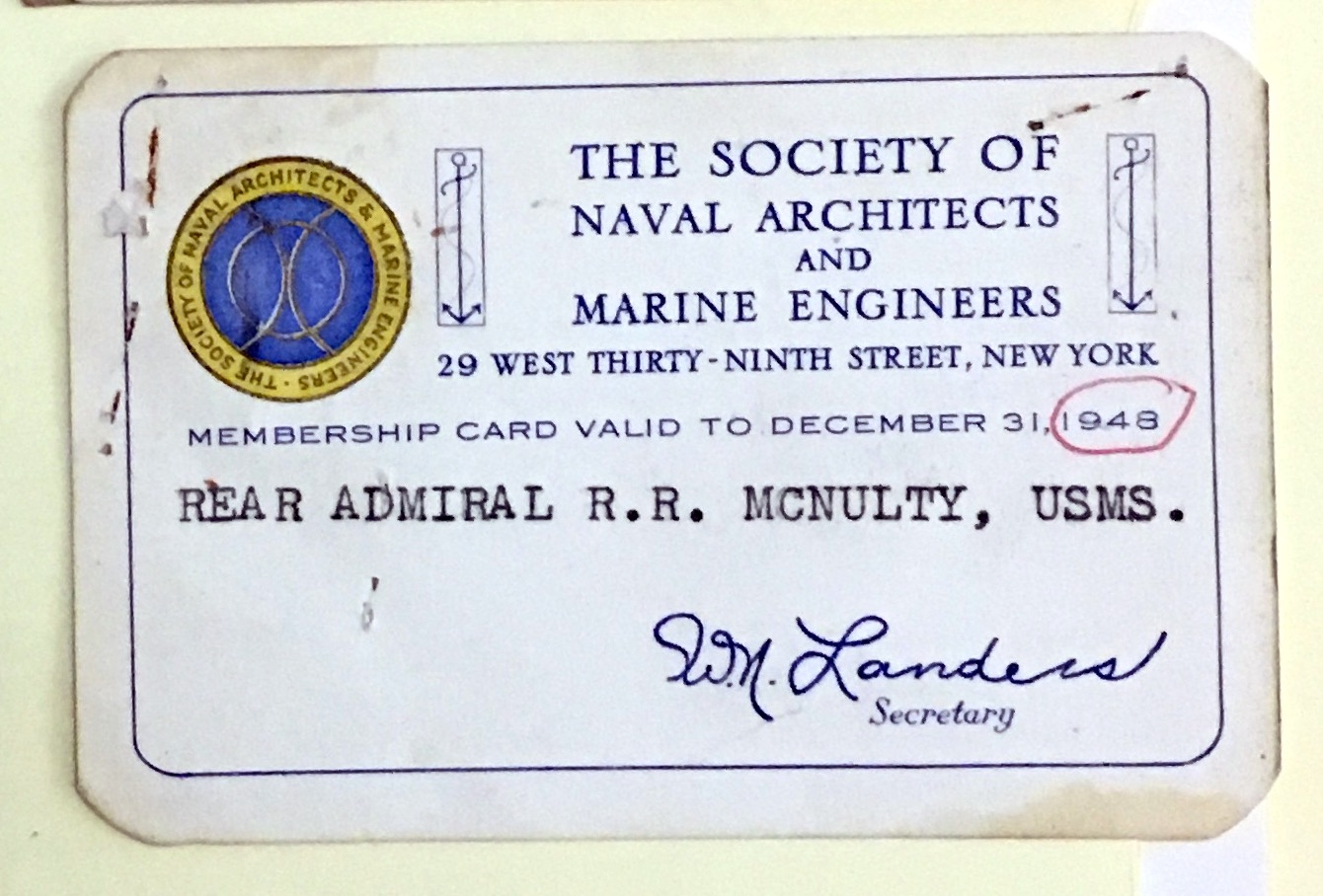
Col.: AMMM


Vice Admiral Richard R. McNulty citation plaque.

ss nathaniel greene

SS Nathaniel Greene
Col.: AMMM 1946.043.0001

During a long voyage to north Russia, SS NATHANIEL GREENE was under incessant and violent attack by enemy planes and submarines. In most gallant fashion, and in spite of many crew casualties, she consistently out-maneuvered and out-fought the enemy, finally discharging her vital cargo at the designated port. After effecting temporary repairs to her battered hull and rigging, she took part in the North African campaign. Bound for her last port, with limited cargo, she was torpedoed, and in a sinking condition was successfully beached.

The stark courage of her heroic crew in battle against overpowering odds caused her name to be perpetuated as a gallant ship.

ss marcus daly

SS Marcus Daly
Col.: AMMM 1946.041.0001

In October 1944, the SS MARCUS DALY was one of the first United States merchant ships to dock at Tacloban, Island of Leyte, during the initial invasion of the Philippines. For six days and nights her guns, manned by a skillful and courageous crew, defeated vigorous attacks by enemy planes in a series of heroic actions. In December 1944, she again engaged enemy bombers and suicide planes and emerged victorious.

The stark courage of her stalwart crew against overwhelming odds caused her name to be perpetuated as a Gallant Ship.

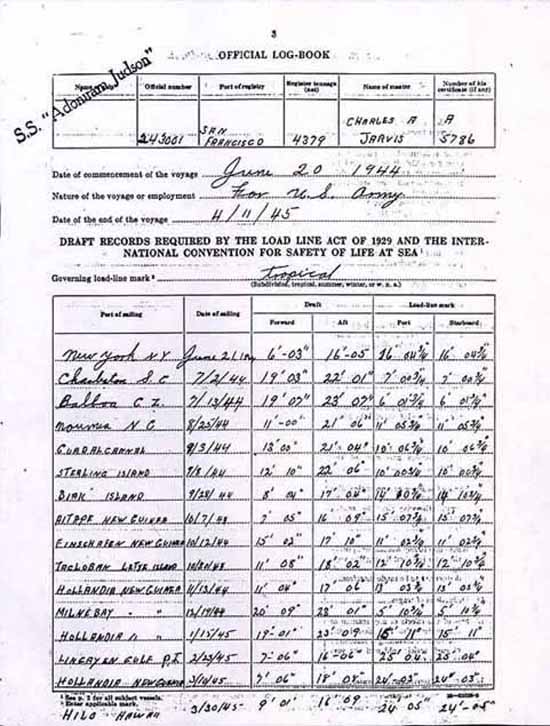
ss adoniram judson

SS Adoniram Judson
Col.: AMMM 1946.044.0001

In October 1944, the SS ADONIRAM JUDSON, first United States merchant ship to dock at Tacloban, Island of Leyte, during the initial invasion of the Philippines, provided the principal air cover for the landing area for two days until joined by other ships of the expedition. Her guns, manned by a skillful and courageous crew, defeated vigorous and continuous attacks by enemy planes in a series of heroic actions. During this period she unloaded steel airfield landing mats and other military material vital to the success of the operation.

The stark courage of her stalwart crew against overpowering odds caused her name to be perpetuated as a Gallant Ship.


Per MARAD:

The Liberty ship SS Adoniram Judson was built by Permanente Metals Corp. at Richmond, California. Delivered on March 3, 1943, the vessel was immediately placed in operation under a general agent agreement with W. R. Chamberlain Company.

Operating in the Pacific, Adoniram Judson took part in the Philippines campaign in the Fall of 1944. Adoniram Judson arrived at San Pedro Bay, offshore of the city of Tacloban on the island of Leyte, on October 23; just two days after the Allies invaded the Philippines. The vessel was carrying, among other cargo, metal landing mats to construct a temporary air strip on the island.

Early in the afternoon of October 24, Adoniram Judson was ordered to dock in Tacloban, becoming the first merchant vessel to arrive there after American forces liberated the port. In fact, for that first day, Adoniram Judson was the only U.S. vessel at Tacloban’s docks. Alongside two 40-milimeter gun emplacements and guns from several small landing craft Adoniram Judson‘s gun batteries provided the primary anti-aircraft defense for the area.

Japanese fighters and bombers continued to attack Adoniram Judson as it unloaded its cargo while the Naval Armed Guard and the ship’s merchant crew heroically defended the ship from enemy air strikes. As night fell, to conceal its position, the ship went dark whenever the crew heard more enemy bombers approaching while they continued to unload their cargo.

Air raids continued day and night for several more days as the ship continued to unload. By October 25, Adoniram Judson was one of three Liberty ships in port. On October 28, it had unloaded all of its cargo, including the vital landing mats.

According to the vessel’s master [Charles A. Jarvis], Adoniram Judson repelled the 56 bombing and strafing runs made on the ship over the course of its three days in port. The ship’s Naval Armed Guard, with assistance from its merchant crew, shot down at least two, and possibly up to six enemy aircraft, and used over 8,000 rounds of ammunition.


Gallant Ship award ceremony. Captain Charles A. Jervis at right.

captain charles a. jarvis report

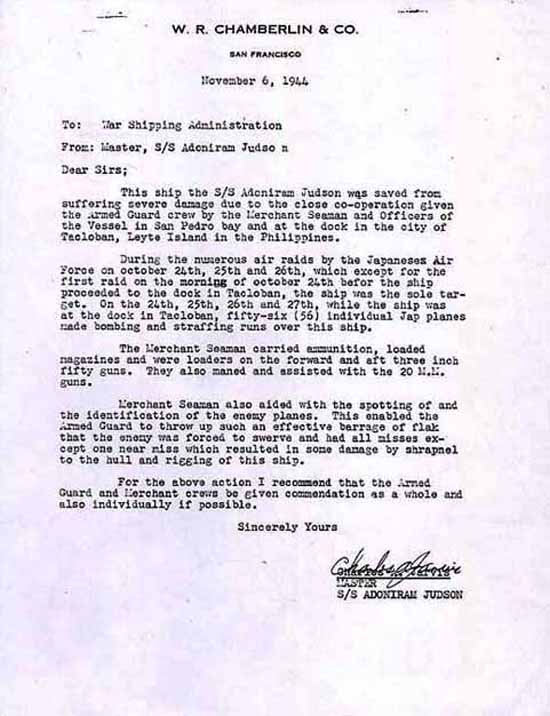
W. R. CHAMBERLIN & CO.
SAN FRANCISCO
November 6, 1944

To: War Shipping Administration
From: Master, S/S Adoniram Judson

Dear Sirs;

This ship the S/S Adoniram Judson was saved from suffering severe damage due to the close co-operation given the Armed Guard crew by the Merchant Seamen and Officers of the Vessel in San Pedro bay and at the dock in the city of Tacloban, Leyte Island on the Philippines.

During the numerous air raid by the Japanese Air Force on october 24th, 25th and 26th, which except for the first raid on the morning of october 24th before the ship proceeded to the dock in Tacloban, the ship was the sole tar- get. On the 24th, 25th, 26th and 27th, while the ship was at the dock in Tacloban, fifty-six (56) individual Jap planes made bombing and staffing runs over this ship.

The Merchant Seamen carried ammunition, loaded magazines and were loaders on the forward and aft three inch fifty guns. They also maned and assisted with the 20 M.M. guns.

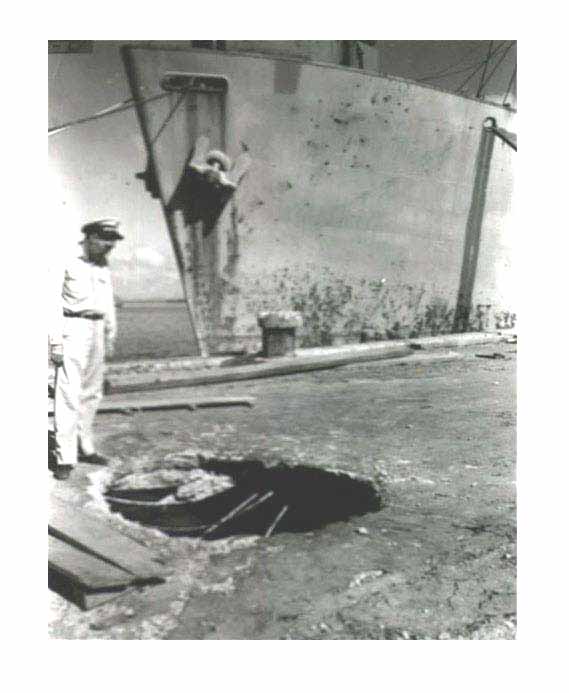
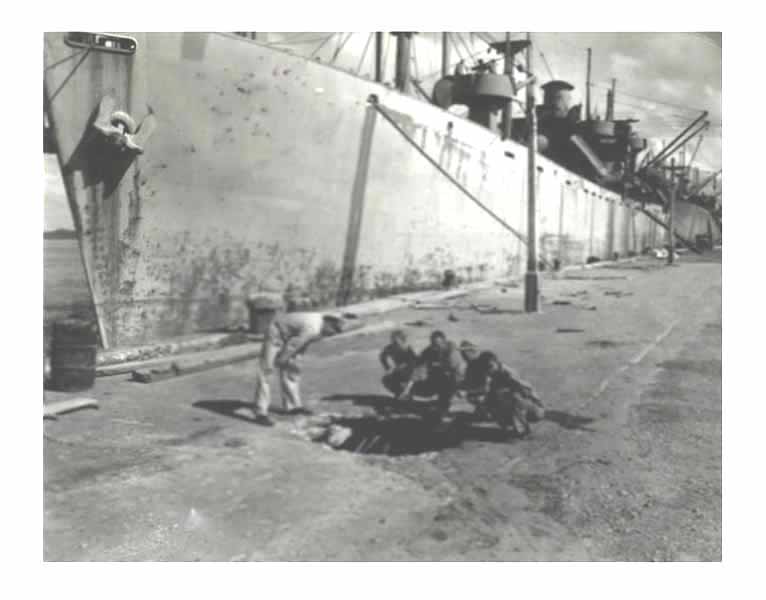
Merchant Seamen also aided with the spotting of and the identification of the enemy planes. This enabled the Armed Guard to throw up such an effective barrage of flak that the enemy was forced to swerve and had all misses ex- kept one near miss which resulted in some damage by shrapnel to the hull and rigging of this ship.

For the able action I recommend that the Armed Guard and Merchant crews be given commendation as a whole and also individually if possible.
Sincerely Yours

MASTER
S/S ADONIRAM JUDSON

———————————————
(1)

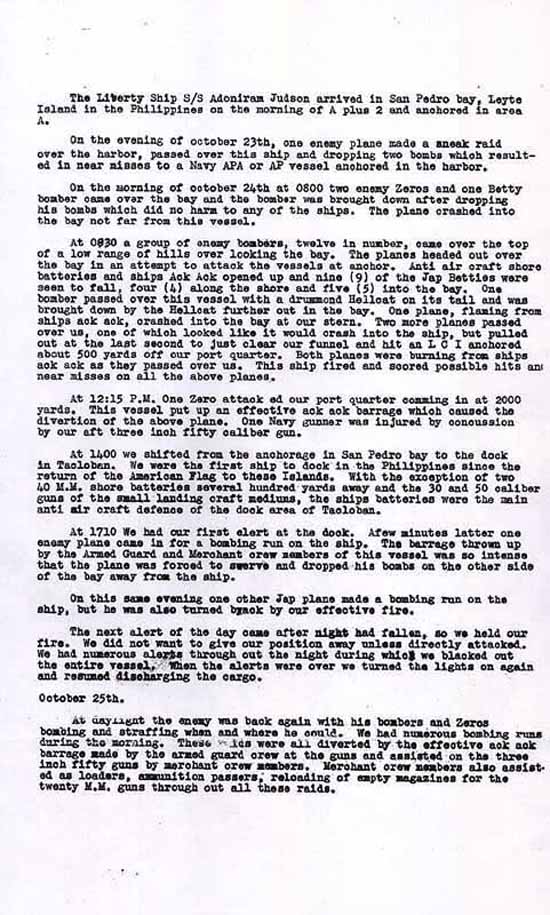
The Liberty Ship S/S Adoniram Judson arrived in San Pedro bay, Leyte Island in the Philippine on the morning of A plus 2 and anchored in area A.

On the evening of October 23th, one enemy plane made a sneak raid over the harbor, passed over this shop and dropping two bombs which result- ed in near misses to a Navy APA or AP vessel anchored in the harbor.

On the morning of October 24th at 0800 two enemy Zeros and one Betty bomber came over the bay and the bomber was brought down after dropping his bombs which did no harm to any of the ships. The plane crashed into the bay not far from this vessel.

At 0800 a group of enemy bombers, twelve in number, came over the top of a low range of hills over looking the bay. The planes headed our over the bay in an attempt to attack the vessels at anchor. Anti air craft shore batteries and ships Ack Ack opened up and nine (9) of the Jap Betties were seen to fall, four (4) along the shore and five (5) into the bay. One bomber passed over this vessel with a drummond Hellcat on its tail and was brought down b the Hellcat further out in the bay. One plane, flaming from ships ack ack, crashed into the bay at our stern. Two more planes passed over us, one of which looking like it would crash into the ship, but pulled out at the last second to just clear our funnel and hit an L C I anchored about 500 yards off our port quarter. Both planes were burning from ships ack ack as they passed over us. This ship fired and scored possible hits and near misses on all the above planes.

At 12:15 P.M. One Zero attack ed our port quarter coming in at 2000 yards. This vessel put up an effective ack ack barrage which caused the diversion of the plane. One Nav gunner was injured by concussion by our aft three inch fifty caliber gun.
At 1400 we shifted from the anchorage in San Pedro bay to the dock in Tacloban. We were the first ship to dock in the Philippines since the return of the American Flag to these Islands. With the exception of two 40 M.M. shore batteries several hundred yards away and the 30 and 50 caliber guns of the small landing craft mediums, the ships batteries were the main anti air craft defence of the dock area of Tacloban.
At 1710 We had our first alert at the dock. Afew minutes latter one enemy planes came in for a bombing run on the ship. The barrage thrown up by the Armed Guard and Merchant crew members of this vessel was so intense that the plane was forced to swerve and dropped his bombs on the other side of the bay away from the ship.

On this same evening one other Jap plane made a bombing run on the ship, but he was also turned back by our effected fire.

The next alert of the day came after night had fallen, so we help our fire. We did not want to give our position away unless directly attacked. We had numerous alerts through our the night during which we blacked out the entire vessel. When the alerts were over we turned the lights on again and resumed discharging the cargo.

October 25th.

At daylight the enemy was back again with his bombers and Zeros bombing and staffing when and where he could. We had numerous bombing runs during the morning. These ???ics were all diverted by the effective ack ack barrage made by the armed guard crew at the guns and assisted on the three inch fifty guns by merchant crew members. Merchant crew members also assist- ed as loaders, ammunition possessor, reloading of empty magazines for the twenty M.M. guns through out all these raids.

———————————————
(2)

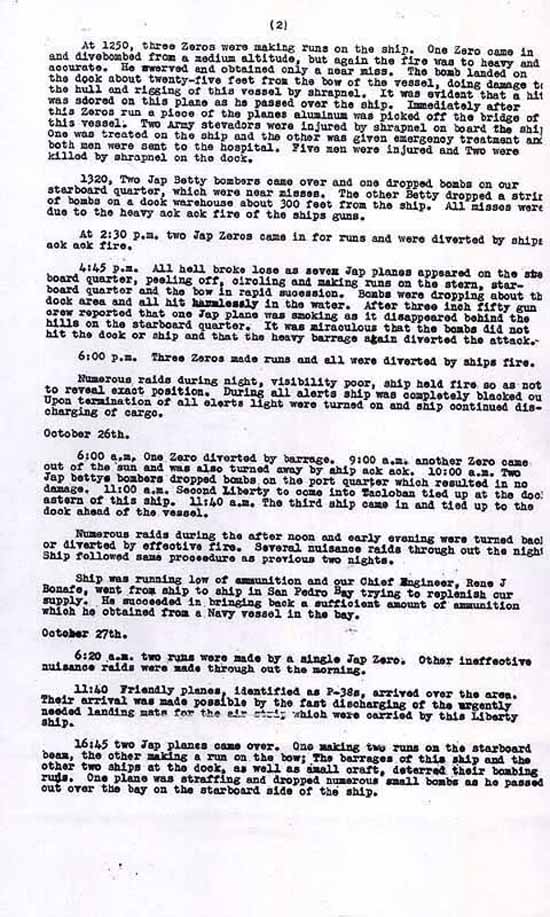
At 1250, three Zeros were making runs on the ship. One Zero came in and dive-bombed from a medium altitude, but again the fire was to heavy and accurate. He swerved and obtained only a near miss. The bomb landed on the dock about twenty-five feet from the bow of the vessel, doing dating to the hull and rigging of this vessel by shrapnel. It was evident that a hit was scored on this plane as he passed over the ship. Immediately after this Zeros run a piece of the planes aluminum was picked off the bridge of this vessel. Two Army stevadors were injured by shrapnel on board the ship. One was treated on the ship and the other was given emergency treatment and both men were sent to the hospital. Five men were injured and Two were killed by shrapnel on the dock.

1320, Two Jap Betty bombers came over and one dropped bombs on our starboard quarter, which were near misses. The other Bettt dropped a string of bombs on a dock warehouse about 300 feet from the ship. All misses were due to the heavy ack ack fire of the ships guns.

At 2:30 p.m. two Jap Zeros came in for runs and were diverted by ships ack ack fire.

4:45 p.m. All hell broke lose as seven Jap planes appeared on the star- board quarter, peeling off, circling and making runs on the stern, star- board quarter and the bow in rapid succession. Bombs were dropping about the dock area and all hit harmlessly in the water. After three inch fifty gun crew reported that one Jap plane was smoking as it disappeared behind the hills on the starboard quarter. It was miraculous that the bombs did not hit the dock or ship and that the heavy barrage again diverted the attack.

6:00 p.m. Three Zeros made runs and were diverted by ships fire.

Numerous raids during the night, visibility poor, ship held fire so as not to reveal exact position. During all alerts ship was completely blacked out. Upon termination of all alerts light were turned on and ship continued dis- charging of cargo.

October 26th.

6:00 a.m. One Zero diverted by barrage. 9:00 a.a. another Zero came out of the sun and was also turned away by ship ack ack. 10:00 a.m. Two Gap bettys bombers dropped bombs on the port quarter which resulted in no damage. 11:00 a.m. Second Liberty to come into Tacloban tied up at the dock astern of this ship. 11:40 a.m. The third ship came in and tied up to the dock ahead of the vessel.

Numerous raids during the after noon and early evening were turned back or diverted by effective fire. Several nuisance raids through out the night. Ship followed same procedure as previous two nights.

Ship was running low of ammunition and our Chief Engineer, Rene J Bonnie, went from ship to ship in San Pedro trying to replenish our supply. He succeeded in bringing back a sufficient amount of ammunition which he obtained from a Navy vessel in the bay.

October 27th.

6:20 a.m. two runs were made by a single Jap Zero. Other ineffective nuisance raids were made through out the morning.

11:40 Friendly planes, identified as P-38s. arrived over the area. Their arrival was made possible by the fast discharging of the urgently needed landing mats for the air strip which were carried by this Liberty ship.

16:45 two Jap planes came over. One making runs on the starboard beam, the other making a run on the bow; The barrage of this ship and the other two ships at dock, as well as small craft, deterred their bombing runs. One plane was staffing and dropped numerous small bombs as he passed out over the bay on the starboard side of the ship.

———————————————
(3)

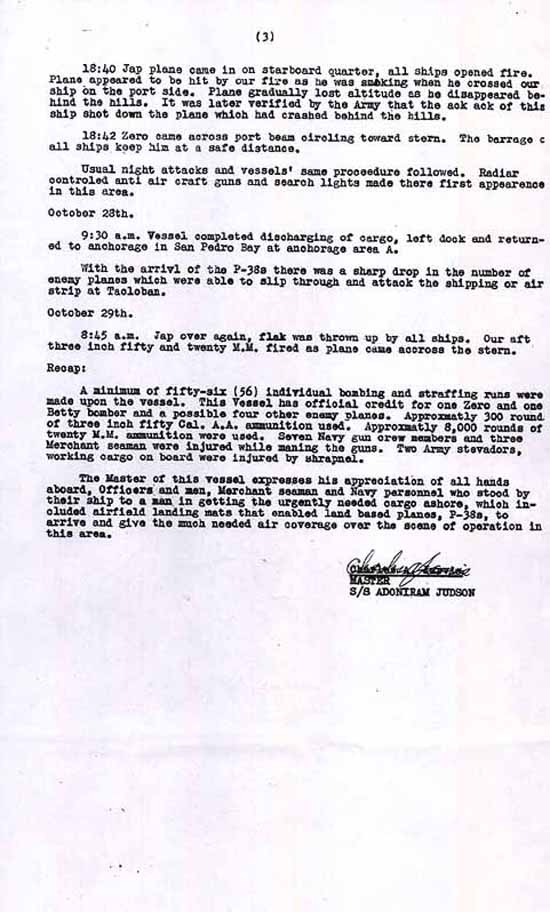
18:40 Jap plane came in on starboard quarter, all ships opened fire. Plane appeared to be hit by our fire as he was smoking when he crossed our ship on the port side. Plane gradually lost altitude as he disappeared be- hind the hills. It was later verified by the Army that the ack ack of this ship shot down the plane which had crashed behind the hills.

18:42 Zero came across port beam circling toward stern. The barrage of all ships keep him at a safe distance.

Usual night attacks and vessels’ same proceedure followed. Radiar controled anti air craft guns and search lights made their first appearance in this area.

October 28th.

9:30 a.m. Vessel completed discharging of cargo, left dock and return- ed to anchorage in San Pedro Bay at anchorage area A.

With the arrival of the P-38s there was a sharp drop in the number of enemy plane which were able to slip through and attack the shipping or air strip at Tacloban.

October 29th.

8:45 a.m. Gap over again, flak was thrown up by all ships. Our aft three inch fifty and twenty M.M. fired as plane came accross the stern.

Recap:

A minimum of fifty-six (56) individual bombing and straffing runs were made upon the vessel. This Vessel has official credit for one Zero and one Betty bomber and a possible four other enemy planes. Approximately 300 rounds of three inch fifty Cal. A.A. ammunition used. Approximately 8,000 rounds of twenty M.M. ammunition were used. Seven Navy gun crew members and three Merchant seamen were injured while manning the guns. Two Army stevadors, working cargo on board were injured by shrapnel.

The Master of this vessel expresses his appreciation of all hands aboard, Officers and men, Merchant seamen and Navy personnel who stood by their ship to a man in getting the urgently needed cargo ashore, which in- cluded airfield landing mats that enabled land based planes, P-38s, to arrive and give the much needed air coverage over the scene of operation in this area.

Charles A. Jarvis
MASTER
S/S ADONIRAM JUDSON

———————————————
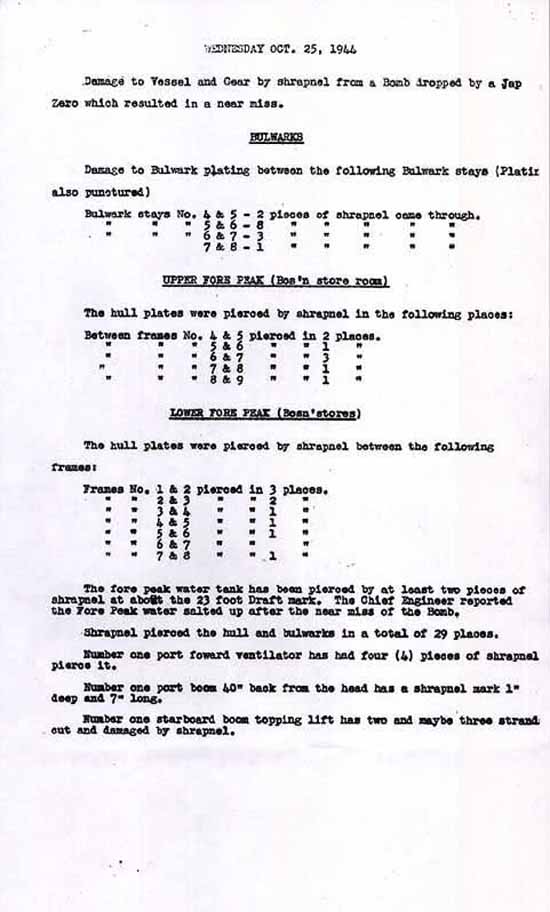
[damage report]
WEDNESDAY OCT. 25, 1944 Damage to Vessel and Gear by shrapnel from a Bomb dropped by a Jap Zerpn which resulted in a near miss.

BULWARKS

Damage to Bulwark plating between the following Bulward stays (Plating also punctured)

Bulwark stays No. 4 & 5 - 2 pieces of shrapnel came through. “ “ “ 5 & 6 - 8 “ “ “ “ “
“ “ “ 6 & 7 - 3 “ “ “ “ “
“ “ “ 7 & 8 - 1 “ “ “ “ “

UPPER FORE PEAK (Bosn’stores)
The hull plate were pierced by shrapnel between the following frames:

Frames No. 1 & 2 pierced in 3 places.

———————————————
[damage report]
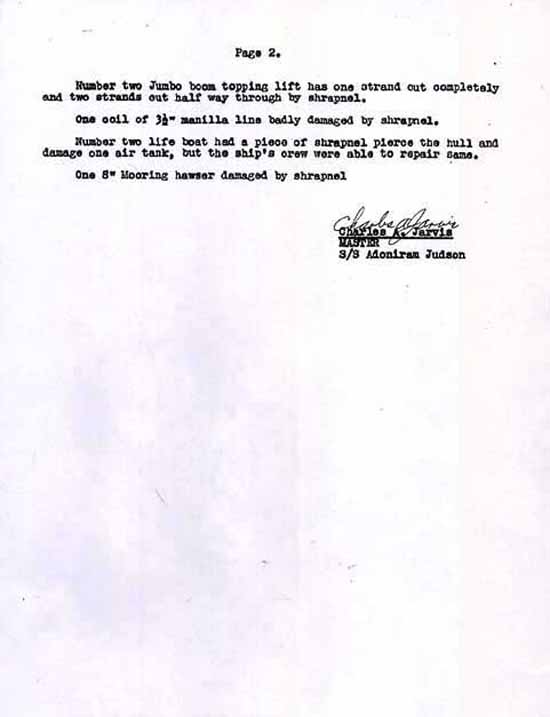
Page 2.
Number two Jumbo boom topping lift has one strand out completely and two strands out half way through by shrapnel.
One coil of 3 1/2” manilla line badly damaged by shrapnel.
Number two life boat had a piece of shrapnel pierce the hull and damage one air tank, but the ship’s crew were able to repair same.
One 8” Mooring hawser damaged by shrapnel

Charles A. Jarvis
S/S Adoniram Judson