buttons

Button Identification | USL Buttons | Kings Point Button

Recently I came across a news item where the United States Navy once again redesigned its working uniform.  Over the past decade, sailors complained they did not like the blue and purple or kelp green digital camouflage uniforms issued them by the fleet, nor did they appreciate having to change uniforms to and from work – Navy regulations forbade work uniforms being seen off-base although this directive has since loosened.  The Navy cited the uniform’s unpopularity as a factor for the redesign, but the real impetus was that the uniform’s nylon-cotton blend in a fire “will burn robustly until completely consumedโ€ – in other words: it melts into the skin.  The new uniform is fire retardant and has the innovation that instead of buttons, it uses only velcro and zippers. The selling point of the latter is it is perfect for the flight deck since the uniform would not be a vector for the introduction of debris into aircraft engines. Buttons no more? 

USN Black Anchor Button (gutta purcha), 1930s. Col.: IW.

The button is such a commonplace item that it is taken for granted and paid not much attention.  A button on a coat, shirt, or trousers is an ever-present – simple molded affair or complex construction.  And yet despite being so small, the uniform button is often laden with symbolism endemic to the organization that wears it.  In the American maritime profession, British traditions hold sway and along with them British forms and configuration of a uniform with the placement and design of buttons.  Fortuitously. coupled with fabric and insignia construction, buttons offer an excellent means of identifying the context of uniforms and their period of manufacture. and in the context of this project, where a seaman figured within a ship’s hierarchy.

Below, please find my reference collection, as well as an interesting button collection at the American Merchant Marine Museum – the Dollar Lines button, is amazing. I have another page devoted to the buttons of United States Lines, here.

Do note: I am not a button collector by any stretch of the imagination, but I keep a collection of buttons to assist with identifying and dating uniforms and uniform items. Buttons are one of those items easily overlooked, yet understanding them provides a wealth of information.


united states navy

Many United States Navy buttons were manufactured in England; however, with the emigration of British artisans to New England, a button industry sprang up in Connecticut. Many of these early buttons were of sophisticated composition and had fine detail. The Waterbury button (NA-113) is a good example of this craftsmanship; some contracts were better than others, and for mass-market buttons, items such as NA-115 could be had (this came from the estate of an ex-American Mail Lines quartermaster). The plain anchor button of the Chief Petty Officer is often confused with that of a general nautical button; however, each of the examples presented shows the variation on a theme. With the re-design of the CPO reefer from eight to six buttons, buttons once exclusively worn by officers became standard for CPOs. The buttons marked a CPO and in nickel were worn by officer wardroom stewards; by the 1940s, the nickel buttons came to be replaced by white plastic buttons.


united states government marine

Included in the “Government Marine” section of my button collection is a U.S. Army Corps of Engineers button. This button came from a reefer worn by a member of the U.S. Army Corps of Engineers Dredge Fleet – these individuals were (and are) civilians in the employ of the Army who keep U.S. waterways passable. Among these buttons is the seldom-seen U.S. Maritime Commission (U.S. Maritime Service) button for both ship’s officers and stewards; this button has been all but forgotten, but reflects the close affinity of the nascent U.S. Maritime Service (USMS) with the U.S. Coast Guard (USCG). In 1941, the training mission of USMS was removed from the USCG and placed under the jurisdiction of the War Shipping Administration (WSA); I discuss the changes in USMS insignia here. The button of the United States Merchant Marine Academy (USMMA GO-26 and GO26-B) is a bit less straightforward and I have written about its story here; suffice to say, the USMMA button became a “catch-all” maritime button, despite the existence of a such a button for that explicit use (see “Merchant Marine Generic, obverse” below). The USMMA “steward” button is a prime example of this shift.


united states merchant marine, schools, and organizations

Of interest is the “generic” Merchant Marine button; it was sold by Leopold Morse, Company which was an upscale Boston clothier that had also dabbled in uniforming Union officers during the United States Civil War. This button is fascinating as it illustrates the NOMMP button, which is a derivation of one of the oldest American nautical buttons – the New York Yacht Club. I have a selection of United States Lines (USL) button detailed here. Unlike this page, I analyze the timeline of USL button adoption and wear.


american merchant marine museum collection

The AMMM collection of maritime buttons has an absolute jewel in the form of the Dollar Steamship Line button. This entity was in existence from 1929 through 1938, and was ultimately seized by the United States Maritime Commission. What makes this button of particular interest is how a previous owner had made an effort to both pick out and file down the two pillars in the dollar symbol, thereby making it an S. Another button of interest is the C on a swallowtail. What makes this button interesting is how the designer (presumably) followed traditional heraldic tincture rules – the flag field would be green and the C would be on a white lozenge. If the rules were followed, it would not be the flag of W.R. Chamberlin.


References

Albert, Alphaeus H. (1977). Record of American Uniform & Historical Buttons 1775-1976. Bicentennial Edition. Hightstown: Alphaeus H. Albert.

This is the classic button reference. It shows most of the Armed Services. Government, and Merchant Marine issues. It is incorrect in attribution for many merchant marine buttons and lacks dates – but, at least it shows the major varieties (something is better than nothing).

McGuinn, William and Bazelow, Bruce S. (2006). American Military Button Makers and Dealers; Their Backmarks & Dates. McLean, Virginia: William McGuinn & Brice S. Bazelow.

A catalog of backmarks along with brief histories of manufacturers.

VanCourt, Don. (1998). Transportation Uniform Buttons, Vol. III: Maritime and Aviation. Madison, New Jersey: Don VanCourt.

The only reference on commercial maritime uniform buttons; the author uses McGuinn and Bazelow to assist in cross-referencing button dates.

kings point

U.S. Merchant Marine Academy at Kings Point Regiment of Midshipmen

Kings Point is a compact campus founded in 1943 on Long Island, New York. It is devoted to training future maritime leaders of the United States Merchant Marine. The Academy has about one thousand students altogether comprising of the Regiment of Midshipmen. These pages offer some primary source material for the study of the Regiment, and its culture and history.


When asked about how he heard about the U. S. Merchant Marine Academy, a Cadet replied:

โ€œI was an ordinary seaman with the U. S. Lines, and the director of unlicensed personnel told me about the Cadet Corps and he encouraged me to join the Corps.  I always thought Cadets were sissies, but I learned different when I joined.โ€

Regimental Culture & History


Albums, Collections & Photographs


Matters Uniform


Publications


col.: AMMM

Miscellany


The bane of midshipmen from the 1950s through the early 1970s.

the 142: kings point’s wartime dead

Almost every April or March since 1985, the outgoing class of the United States Merchant Marine Academy hosts a gathering of First Classmen, alumni, and distinguished guests called the โ€œBattle Standard Dinner.โ€ Before a packed crowd in Delano Hall, the keynote speaker – invariably a high-ranking military officer or an official in the Federal government – gives a speech apropos to the audience. The dinner affirms the strong link the Academy shares with the armed forces and how the crucible of war fashioned the Regiment’s identity. The dinner both celebrates the Regiment and honors its roots.

The gathering’s name evokes the flag that the United States Merchant Marine Academy alone holds among its five sister service academies; The Battle Standard. A battle standard – or battle flag – is a type of ceremonial heraldic flag used by military units as a rallying point in war. The Academy has one since it is the only academy that has sent its students into war zones. A part of the Academy’s curriculum during the Second World War was for its students to enter a Sea Year after their indoctrination period; while these cadets under instruction shipped out to learn the ropes of their new vocation, all went directly to a raging war. Many were injured, and many died – either by direct enemy action, shipboard accident, or illness.  These individuals are memorialized by the Academy and are known as the 142.

At the Battle Standard Dinner, the 142 are often mentioned, and their link to the present Academy and is emphasized, reminding students they are not only remembering those earlier generations of Kings Pointers but are part of a continuum. In 2014, noted maritime author and researcher Commander Thomas F. McAffey, USNR (ret.), gave an address at the Battle Standard Dinner in which he spoke of Kings Point students’ courage as they headed off to wartime seas. He further linked those who survived and died during the Second World War to current Kings Pointers through the shared ritual of the Sea Year. He emphasized the Battle Standard was a remembrance of King Point’s participation in the war.

The Battle Standard at Wiley Hall, United States Merchant Marine Academy.

War flags often hold elements of the national flag or national symbols; the Battle Standard is laden with such, but none is more specific to the Academy than the number 142 emblazoned on a compass card. Admiral Mark Buzby, both a United States Maritime Administrator and Kings Pointer, described the numberโ€™s meaning succinctly in a message celebrating the Academyโ€™s seventy-fifth year:

142 is a special number. Itโ€™s the number of USMMA midshipmen who lost their lives in combat during WWII while embarked onboard transport and resupply vessels supporting our Nationโ€™s Armed Forces. [โ€ฆ] In memory of the 142, the battle standard bears the number “142” on its field of red, white and blue. In its center is the eagle of the Academy’s seal in blue and gray, the school colors, and the anchor of the merchant marine in gold. From its top hang the ribbons which represent the various combat zones in which the Academy’s cadet-midshipmen served.

Admiral Mark Buzby, “One Hundred and Forty-two.” Maritime Logistics Professional, April 12, 2018.

Plaque commemorating the 142. The image is reprinted with the approval of the United States Merchant Marine Academy Alumni Association and Foundation. Col.: USMMAAAF.

An example of the Battle Standard may be found in the center of Wiley Hall, the veritable heart of the Academy (above), and another behind glass at the nearby American Merchant Marine Museum (see below). The latter is installed in a beautiful space called the “142 Gallery” along with a permanent exhibit, โ€œRemembering the 142.โ€ In the same room are a framed citation, a medal, a ribbon, and a photo of their posthumous recipient. It truly is a place of quiet contemplation, where the distance of time almost makes the sacrifices of the 142 feel like a foreign country.

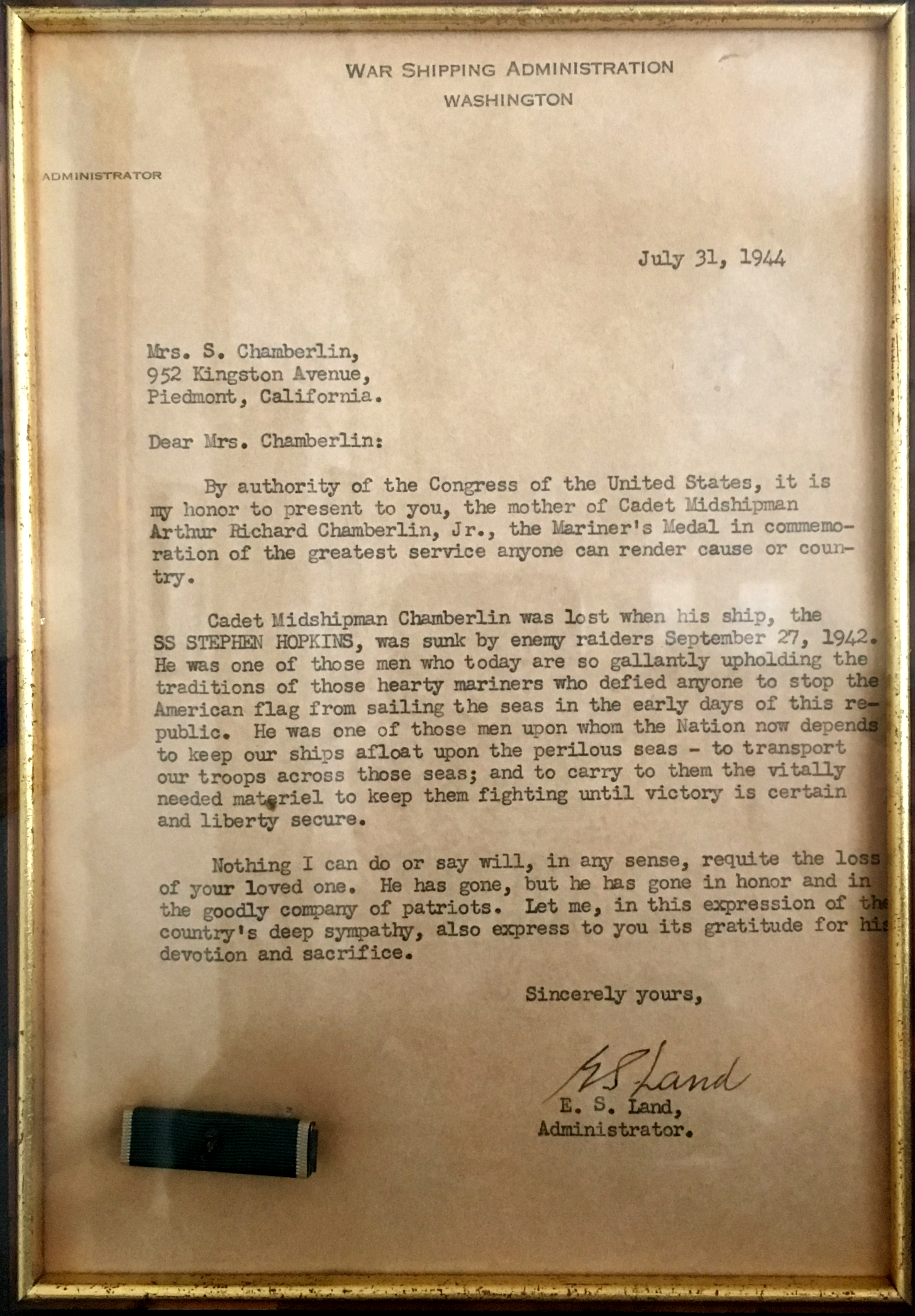
July 31, 1944

Dear Mrs. Chamberlin:

By the authority of the Congress of the United States, it is my honor to present to you, the mother of Cadet Midshipman Arthur Richard Chamberlin, Jr., the Mariner’s Medal in commemoration of the greatest service anyone can render cause or country.

Cadet Midshipman Chamberlin was lost when his ship, the SS STEPHEN HOPKINS, was sunk by enemy raiders September 27, 1942. He was one of those men who today are so gallantly upholding the traditions of those hearty mariners who defied anyone to stop the American flag from sailing the seas in the early days of this republic. He was one of those men upon whom the Nation now depends to keep our ships afloat upon the perilous seas – to transport our troops across the sea; and to carry the vitally needed material to keep them fighting until victory is certain and liberty secure.

Nothing I can do or say will, in any sense, requite the loss of your loved one. He has gone, but he has gone in honor and in the goodly company of patriots. Let me, in this expression of the country’s deep sympathy, also express to you its gratitude of his devotion and sacrifice.

Sincerely yours,
E.S. Land,
Administrator.

E.S. Land letter to S. Chamberlin, July 31, 1944. Col.: AMMM 1984.028.0002

I decided to honor the memory of the 142 by charting – where known – the places of their death. A list of individuals, their photographs, and dates do move the conscience, but to see how some were so very close to home when they died and how some lost their lives in such faraway seas is particularly sobering. In comparing this chart, and the maps below, the 142 died in every war zone, with the heaviest concentration of losses between Fall of 1942 and the Winter of 1943. Edwin O’Hara, the only of the 142 to receive a posthumous award of the Merchant Marine Distinguished Service Medal, lost his life at the cusp of mounting casualties in September 1942; his award came just before a turning point in the War of the Atlantic, where the tide began to turn toward the Allies.

The 142 locations of casualties


The 142 locations and MM-DSM locations

The map coordinates were culled from the following works: USMMAAF, Braving the Wartime Seas: A Tribute to the Cadets and Graduates of the U.S. Merchant Marine Academy and Cadet Corps who Died During World War II (2014); Captain Arthur R. Moore, “…A Careless Word โ€ฆ A Needless Sinking ” : A History of the Staggering Losses Suffered By the U.S. Merchant Marine, Both in Ships and Personnel, During World War II (1993); wrecksite.eu; uboat.net. Full specifics on “the 142” may be found in the below table:

A complete table may be found here.

In-depth and detailed maps of the 142 from year to year may be found here.


Many thanks are due to the USMMAAAF for permission to reprint their materials and Dr. Joshua Smith of the American Merchant Marine Museum for access to the “142 Gallery” and for showing me the amazing plaques in the Museum’s storage.


awards & decorations

Throughout the history of the American Merchant Marine, awards and decorations were not unknown to seamen, but their blanket award specific to the Merchant Marine in particular as begun by the Federal government during the Second World War was novel. When considering Federal awards and decorations for the American Merchant Marine, their classification often falls along the lines of placement in a “Pyramid of Honor” – that is, a hierarchy of military decorations awarded for combat valor and meritorious service. This was done not only under the auspices of the War Shipping Administration, but continued by post-war authors making sense of the awards. At the pinnacle of the United States armed services’ pyramid is the Medal of Honor, followed by various Distinguished Service crosses particular to the armed service in question, Distinguished Service medals, valor and service awards, and finally the Purple Heart at the base.  Something of the same was true for the American merchant seaman. Although ostensibly having their own system of precedence and hierarchy, it is far more useful to consider Merchant Marine awards and decorations in the context of their establishment.

Postwar, the rรดle of the American Merchant Mariner in the Second World War and as an auxiliary to the military was either relatively forgotten or taken for granted by the United States. Other nations, notably France and Russia, awarded Americans with medals thanking them for their service to their nations.

The following pages display and analyze some of the arrays of awards and decorations that were and are available to American Merchant Mariners, midshipmen at the United States Merchant Marine Academy, and commissioned officers with the United States Maritime Service at Kings Point.


Awards & Decorations

Studies & Essays

Collections & Objects

gallant ship plaques

Off the main gallery space at the American Merchant Marine Museum is a small room easily mistaken for a chapel. This is understandable since upon entering, the visitor finds a Deco stained-glass window above an altar-like desk arrayed with newspaper clippings under a vitrine. The room is called, “Gallant Ship Room,” and like a chapel, it is a place of quiet reflection.

In the “Gallant Ship Room” rest eighteen brass plaques. Inscribed on each is the motto “Unit Citation For” followed by a ship name and a short paragraph. Mounted above two of the plaques are large 19-inch bronze medallions. Most of these plaques are awards that graced the wheelhouses of ships that earned a curious citation called the “Gallant Ship citation” and others were granted to sunken ships. These citations relay the bravery and often superhuman efforts of an entire ship’s crew facing and overcoming seemingly insurmountable adversity: be it a relentless enemy attack or the capricious ocean.


A couple of months after the two and half-year anniversary of United States’ involvement in the Second World War – with no end to the war in sight – President Franklin D. Roosevelt issued Executive Order 9472 on August 29, 1944. The Order established a series of decorations and awards for the United States Merchant Marine; among them was the Gallant Ship citation. It is significant the award came before all others in the proclamation as it indicated the President understood the collaborative nature of a merchant seaman’s work and his wish to honor the ship’s complement.

EO 9472 in Federal Register. Vol. 9, No. 174, August 31, 1944, p. 10613.

Immediately thereafter, the Seaman’s Service Awards Committee received petitions from various managing operators on behalf of ships and crews which exemplified the spirit of the law. The first award came on April 17, 1945 to the SS Samuel Parker. This ship’s award was significant since it provided a touchstone for the “fighting Merchant Marine.” Other ships soon followed and to the shipping companies, the War Shipping Administration issued wood plaques with a bronze medallion and brass plaque with the text of the citation affixed. If the ships were in service, the awards were placed in the wheelhouse for all to see; with the War Shipping Administration keeping replicas of the citation plaques for the historical record. In time, the depository eventually changed to the United States Merchant Marine Academy at Kings Point, followed by the American Merchant Marine Museum.

Following permutations of administrative re-organizations resulting in today’s Maritime Administration, the law governing the award followed suit. The Secretary of Transportation now has the latitude to award the Gallant Ship citation; this is usually done following the suggestion of the Maritime Administrator :

46 USC ยง 51902: Gallant Ship Award, 2019

To date, the United States has honored forty-three ships with the title “Gallant Ship.”

USMMA Regiment Awards & Decorations

Over the past – close to – 90 years of its existence in various guises, the present United States Merchant Marine Academy Regiment of Midshipmen has awarded its members or been awarded by various outside entities any number of awards and decorations. These pages focus on the the more tangible ribbons and medals.

Main Pages

โ˜† โ˜† โ˜†

Individual Awards & Decorations

branch distinction

As follows is a table of Branch Distinction colors found on officer shoulder boards and cuffs of Royal Navy uniforms per 1918 regulations, Merchant Navy livery as standardized by the British Board of Trade in 1918, U.S. Navy officer uniforms per 1919 U.S.N. uniform regulations, U.S. Army Transport Service regulations in effect from 1933-44, and United States Lines Steamship Co. rate detail from a 1937 passenger list brochure.


References

United States Lines SS Co. SS Washington Passenger List (Westbound) June 1937. United States Lines, New York, 1937


Although not fully detailed in the United States Lines chart, epaulets – or shoulder boards – followed the same design. Of interest is the fact that USL shoulder boards did not use the same button as the uniform coat.


Shoulder board, Royal South African Navy


Col.: Anon


References for the Collector

U.S. Maritime Service Commissioned and Warrant Officer hat
Winter hat; navy blue wool with wicker frame, ยฝ-in. wide. gold bullion chinstrap and two 22ยฝ-ligne gilt cap screws.ย  (note: if strap is ยผ-in., hat would be that of a warrant officer).
Circa Second World War.

It is one thing to collect, and another to actually know what one is collecting. As follows is a reference bibliography of use to collectors of Second World War period maritime insignia; I owe a great debt of gratitude to Herbert “Sarge” Booker for sharing with me his archive of The Crow’s Nest as well as placing me in contact with Rudy Barsuto, Steve Soto, and Dave Collar. Each of these individuals has proven an excellent correspondent in matters of maritime insignia.

Some of the references below deserve a bit of an introduction.ย  The Crow’s Nest is mainly a pictorial review in zine format shared among aficionados of maritime insignia and self-published by Sarge; in its various issues are India ink drawings done by Sarge complemented with photographs of various insignia and charts from uniform manuals; it is an interesting zine the likes of which I have never seen before (and perhaps never again).ย  Of particular interest are the self-published monographs by Steve Soto and Rudy Basurto; they synthesize and order collections.ย  In regard to Insignia by Mr. Basurto, it is a singular work that presents civilian insignia – it is a bit loose on time period, but most of the illustrations are from around the Second World War; Sarge was the artist, designer, and typesetter of study – he insisted I make this work available on this site.

Works that may be downloaded or purchased online have their titles in bold.

Rudy Basurto & Herbert Hillary “Sarge” Booker, 2nd
Insignia of America’s Little Known Seafarers, 2nd Ed. Privately Printed, nd.
Insignia of America’s Little Known Seafarers, 3rd Ed. (edited and revised by Steve Soto and Cynthia Soto).ย  Privately Printed, 2008.
N.B. May be purchased by contacting Mr. Soto.

Herbert Hillary “Sarge” Booker, 2nd
The Crow’s Nest #1 (Summer 1992).
The Crow’s Nest #2 (Autumn 1992).
The Crow’s Nest #3 (Winter 1992).
The Crow’s Nest #4 (New Year’s Special Issue – 1993).
The Crow’s Nest #5 (Summer 1993).
The Crow’s Nest #6 (Mid-Summer 1993).
The Crow’s Nest #7 (Autumn 1993).
The Crow’s Nest #8 (Special 1993 Encyclopedia Edition).
The Crow’s Nest #9 (Fall 1993).
The Crow’s Nest #10 (1994 New Year’s Special).
The Crow’s Nest #11 (Spring 1994).
The Crow’s Nest #11 (Spring 1994 – The Issue That Never Was).
The Crow’s Nest #12 (Summer 1994).
The Crow’s Nest #13 (Fall 1994).
Speciality and Distinguishing Marks: U.S. Coast Guard, U.S. Maritime Service, U.S. Navy, and U.S. Public Health Service, 3rd Revision.ย  Privately Printed, 1996.

Dave Collar
“Insignia of the Army Transportation Service in World War II.” ASMIC: The Trading Post October-December 1994: 29-43.
“Insignia of the United States Maritime Service, World War II.” ASMIC: The Trading Post April-June 1995.
“Insignia of the United States Shipping Board.” ASMIC: The Trading Postย  October-December 1996.

William K. Emerson
“Section XIII. The Army’s Navy: Chapter Thirty-Six.ย  Army Transport Service and Harbor Boat Service” in Encyclopedia of United States Army Insignia and Uniforms. Norman, Oklahoma:ย  University of Oklahoma Press, 1996. 331-352.

Steve Soto & Cynthia Soto
A collector’s guide to the History, Uniforms and Memorabilia of the U.S. Merchant Marine and Army Transport Service during World War II. Privately Printed, 1996 (revised 2008).
N.B. May be purchased by contacting Mr. Soto.

Joseph J. Tonelli
Visor hats of the United States Armed Forces: 1930-1950
. Atglen, Pennsylvania:ย  Schiffer Publications, 2003.
US Military Cap Insignia. Website with Joe’s (always growing) collection.

Jeff Warner
“U.S. Merchant Marine” in U.S. Navy Uniforms in World War II Series;ย Weapons, Equipment, and Insignia: Submarine Service, PT Boats, Coast Guard, other Sea Services. Atglen, Pennsylvania:ย  Schiffer Publications, 2008.

Insignia Houses

Where have all the insignia manufacturers of the American Merchant Marine managing operators gone? Long passed are the days of enamel flags on high-pressure caps, and so too is true for their makers. Through complex mergers and acquisitions, tools that once struck these diminutive flags found their way to the scrap heap or in the hands of other insignia houses.

GEMSCO of New York under the Elkies family once manufactured a majority of American Merchant Marine steamship company cap flags. The company was established in 1881 and later incorporated as Gordon, Elkies Military Supply Company, Inc. on 31 July 1934 with the State of New York, and in less than a month’s time re-registered as GEMSCO, Inc. on 8 August 1934 – although an abbreviation for the original company’s name, it was implied that it was an abbreviation for the trademark “General Embroidery & Military Supply Co., Inc.” which hid the company’s Eastern European roots. GEMSCO was a one-stop shop for all embroidered and metal insignia items. In time, as was a common practice among insignia houses, GEMSCO subcontracted out most of their production. Enamel flags went to The Reynolds Co. of East Providence, Rhode Island.

The period of mass cap flag manufacture was relatively short-lived in the United States – they had their heyday from the mid-1930s through the late 1940s. Until the 1930s, enamel work was not common for maritime insignia in the United States, but was widespread throughout the British shipping industry. The 1930s saw a shift in insignia styles, first with the Chapman-run United States Lines copying White Star Line’s uniform motifs, and then Dollar and Matson. Eventually, most shipping companies had an enamel flag on their employees’ caps – it was almost requisite for doing business as a serious company; along with the stock certificates with a steamship, a house flag, and buttons with said flag. This insignia innovation continued through the Second World War with GEMSCO providing the bulk of blue water shipping’s cap flags.

Style and economics brought an end to cap flags. Once an item worn by all, many mariners opted to wear their Government-issue cap eagles over cap flags while others switched to cheaper embroidered cap badges. GEMSCO provided the latter first from looms in New York, and then New Jersey. Notable exceptions were Ibrantsen, American Export, and United States Lines which continued to issue them through the 1950s and 1960s. With the collapse of the American Merchant Marine industry in the late 1960s, the market for maritime insignia items was no longer profitable, and their specialized manufacture ceased. In the case of GEMSCO, the company realigned its business during the 1970s with Denmark Military Equipment (D.M.E.) eventually buying Reynolds in the 1980s. Denmark operated Reynolds as the Topper Division of D.M.E. for about a decade, at the tail end of which they closed the East Providence location and subsequently, the tooling for cap flags disappeared – unfortunately, I am unaware as to the range of tools lost during the closure. GEMSCO went bankrupt in 1992 and went into re-organization; it decided to pursue contracts in the law enforcement market. Enamel cap flags are now created from old tools for collectors.

Below is a list of current insignia houses, from where their tools came, and the original owner. If the tools have since been discarded, I have indicated as such. After the list, I have provided vendors (Sources) who offer original or restrikes of the cap flags – and what flags they have in stock (current November 2022). As of 2022, Armour Insignia is the holder of most tools.


Argonaut Line (Armour restrike)

Tool Repositories

Armour Insignia (Nevada)

ex-Town & Country which acquired the stock of:
ex-Robbins

  • Mallory
  • Mowinckel

ex-Denmark Military Equipment [as Topper DME] (New York) which acquired the stock of:
ex-The Reynolds Co. (Lincoln/East Providence, Rhode Island) subcontractor for GEMSCO (New York):

  • Alcoa
  • American Export
  • American Export Isbrandtsen
  • American President
  • American Republic
  • American-Hawaiian
  • Argonaut
  • Black Diamond
  • Brovig
  • Central Gulf
  • Everett Orient
  • Farrell
  • Grace
  • Gulf & South American
  • Isbrandtsen
  • Joklar
  • Kerr
  • Knoch
  • Luckenbach
  • Matson
  • Moore-McCormack
  • Olsen & Uglestad
  • Panama Railroad
  • Rasmussen
  • Socony
  • Standard
  • States Marine
  • United Fruit
  • United States Lines

ex-GEMSCO:

  • U.S. Army Floating Plant & Dredges

ex-International Insignia which acquired the stock of Krew
ex-Krew:

  • The Great Lakes Dock & Dredge

ex-Blackintron:

  • Southern Pacific (Golden Gate Ferries)

ex-Blackintron which acquired the stock of Braxmar
ex-Charles G. Braxmar Co. (New York):

  • Hudson River Steam Navigation
  • New York Queens Ferry (NYQ)
  • Yonkers Ferry

โ˜† โ˜† โ˜†

International Insignia (Providence, Rhode Island)

ex-Krew:

  • Hy-Line

โ˜† โ˜† โ˜†

VH Blackinton (North Attleborough, Massachusetts)

current:

  • Cleveland Cliffs

ex-Charles G. Braxmar Co. (New York):

  • Clyde
  • J. H. Brown & Co.
  • Walter Runciman & Co. / Moor Line

ex-GEMSCO (New York) scrapped 1970s:

  • American Mail
  • Anchor
  • B&Y
  • Central American
  • Cunard
  • Dollar Line (Steward)
  • Dow Chemical
  • ET (Eastern Transport Co.)
  • Essberger
  • Munson
  • New York & Cuba
  • Nobco
  • Oceanic & Oriental
  • P&O
  • Panama Pacific & Bull
  • Standard
  • United States Lines
  • Ward
  • Waterman

Sources

When they’re gone, they’re gone… Below find dealers of Period – original cap flags – and only active dealer offering re-strikes.

Period

Joshua Segal of Lost Legions Militaria in Alexandria, Virginia (https://www.ebay.com/str/lostlegionsmilitaria) is the only known source of GEMSCO-manufactured United States Lines cap flags from the 1930s and early 1940s. His stock comes from the 1992 Army-Navy store close-out and liquidation sale.

โ˜† โ˜† โ˜†

Stephen E. Lipski, based in New Jersey, is another merchant on eBay (https://www.ebay.com/sch/reatra05/m.html) who has some stock of original GEMSCO-manufactured cap badges. His stock comes from an Army-Navy store close-out about three decades ago. He offers:

  • American Export Lines
  • American President Lines
  • American-Hawaiian Steamship Company
  • Matson Lines
  • Panama Railroad Steamship Line

โ˜† โ˜† โ˜†

For over a decade, Robert Steinberg of Pinback Paradise (https://www.ebay.com/str/pinbackparadise) in Medford, New Jersey has been offering the same two cap flags:

  • American President Lines
  • American-Hawaiian Steamship Company

His stock came from the buy-out of the stock of another dealer two decades ago.

Restrikes

Armour Insignia in Henderson, Nevada (http://armourinsignia.com/) has restrikes available of the following (November 2022):

  • American Export Line
  • American-Hawaiian Steamship Company
  • American President Lines
  • American-Export Isbrandtsen Lines
  • Argonaut
  • Grace Line
  • Great Lakes Dock & Dredge
  • Hudson River Steam Navigation
  • Isbrandtsen
  • Moore-McCormack Lines
  • New York Queens Ferry
  • Olsen & Uglestad
  • Southern Pacific Steamship Lines (via Blackinton)
  • Yonkers Ferry

Armour Insignia GEMSCO re-strikes are easy to differentiate from period cap badges – the planchets are a bit thicker and have no hallmark; from 1942 onward, GEMSCO hallmarked most of their badges.
mm dsm recipient photographs

Roll of Honor | Recipient Photos | OWI Recipient Citations | MM DSM | Leonard Conley | MM DSM Design | MM DSM Price Guide

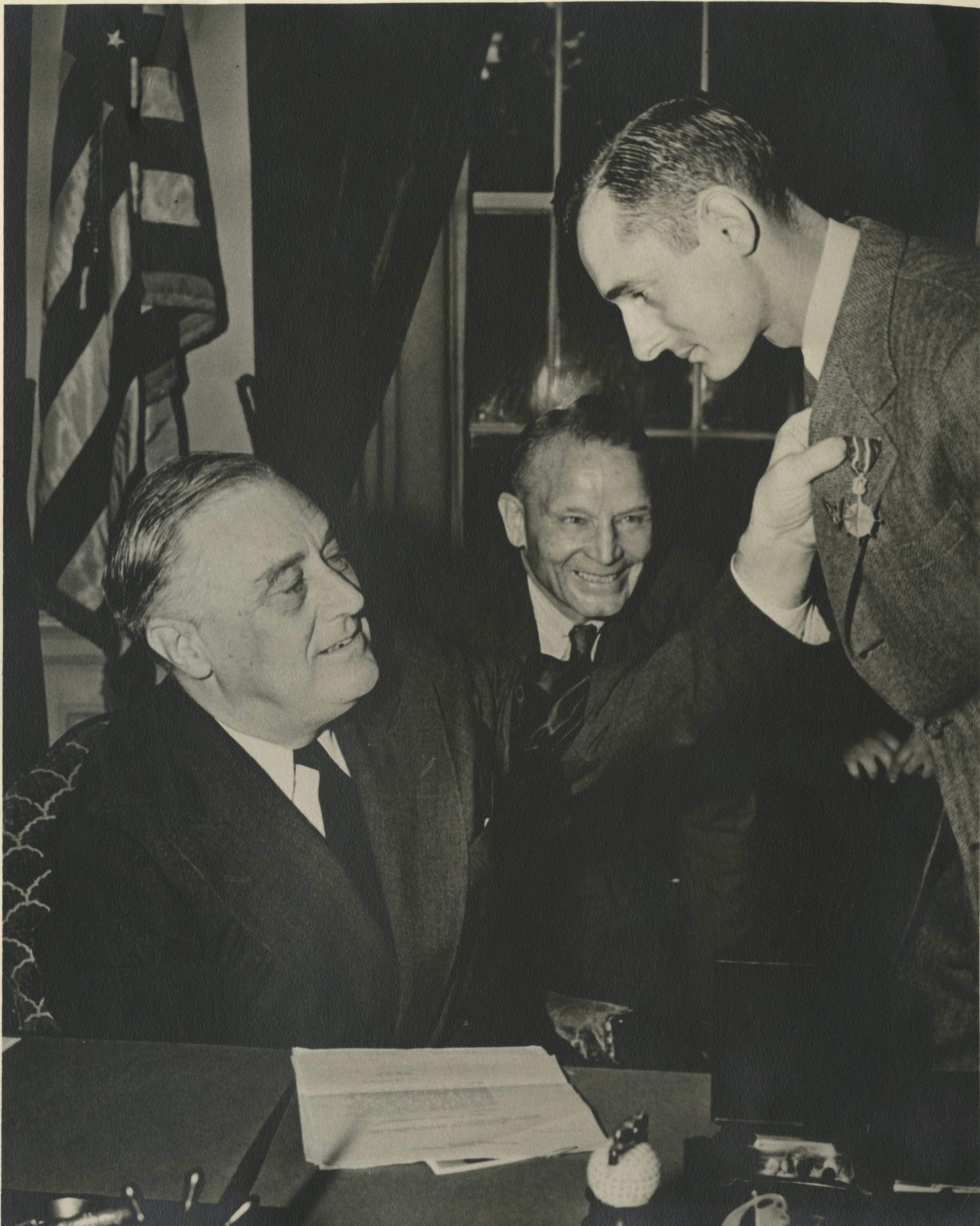
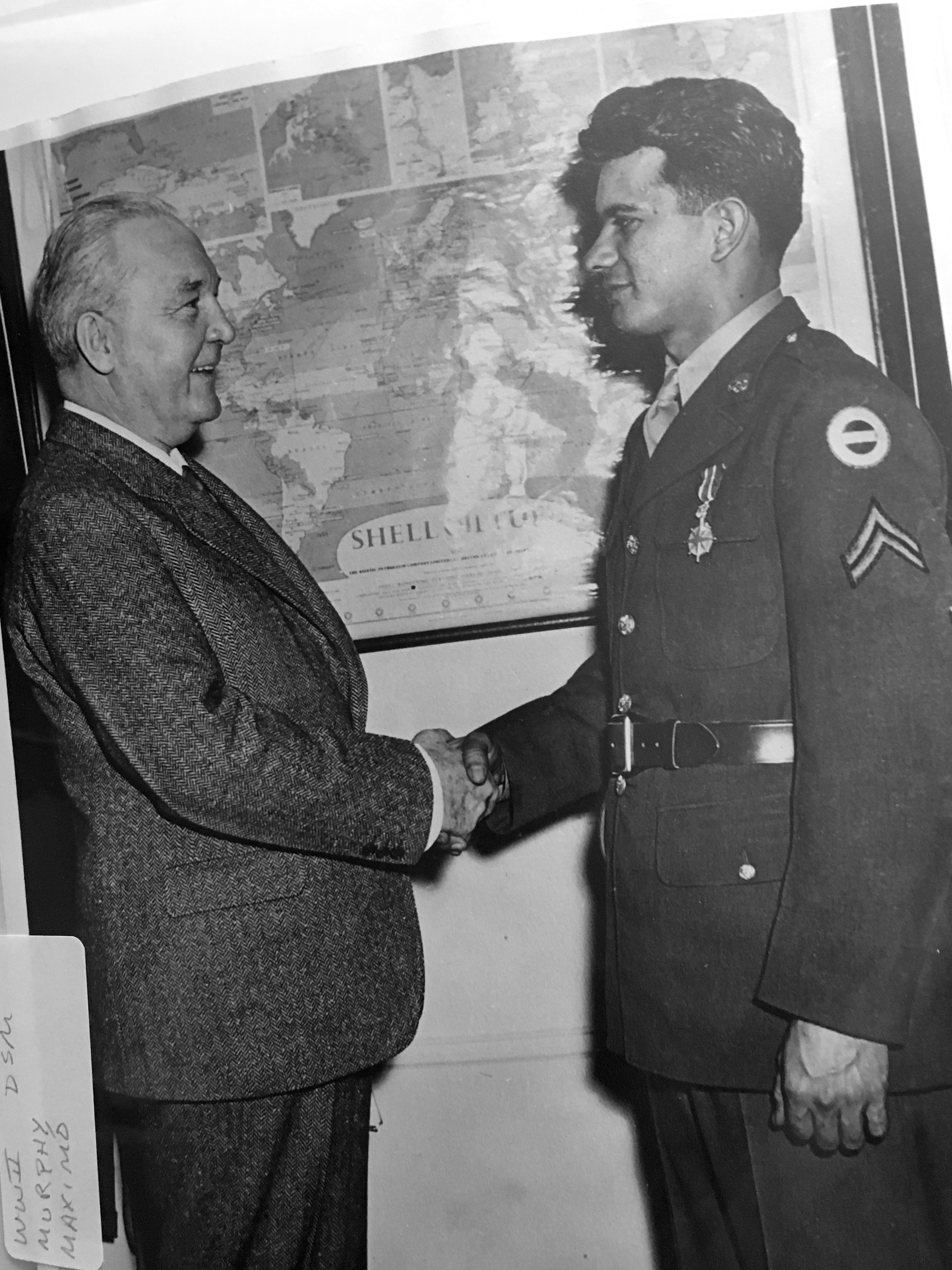
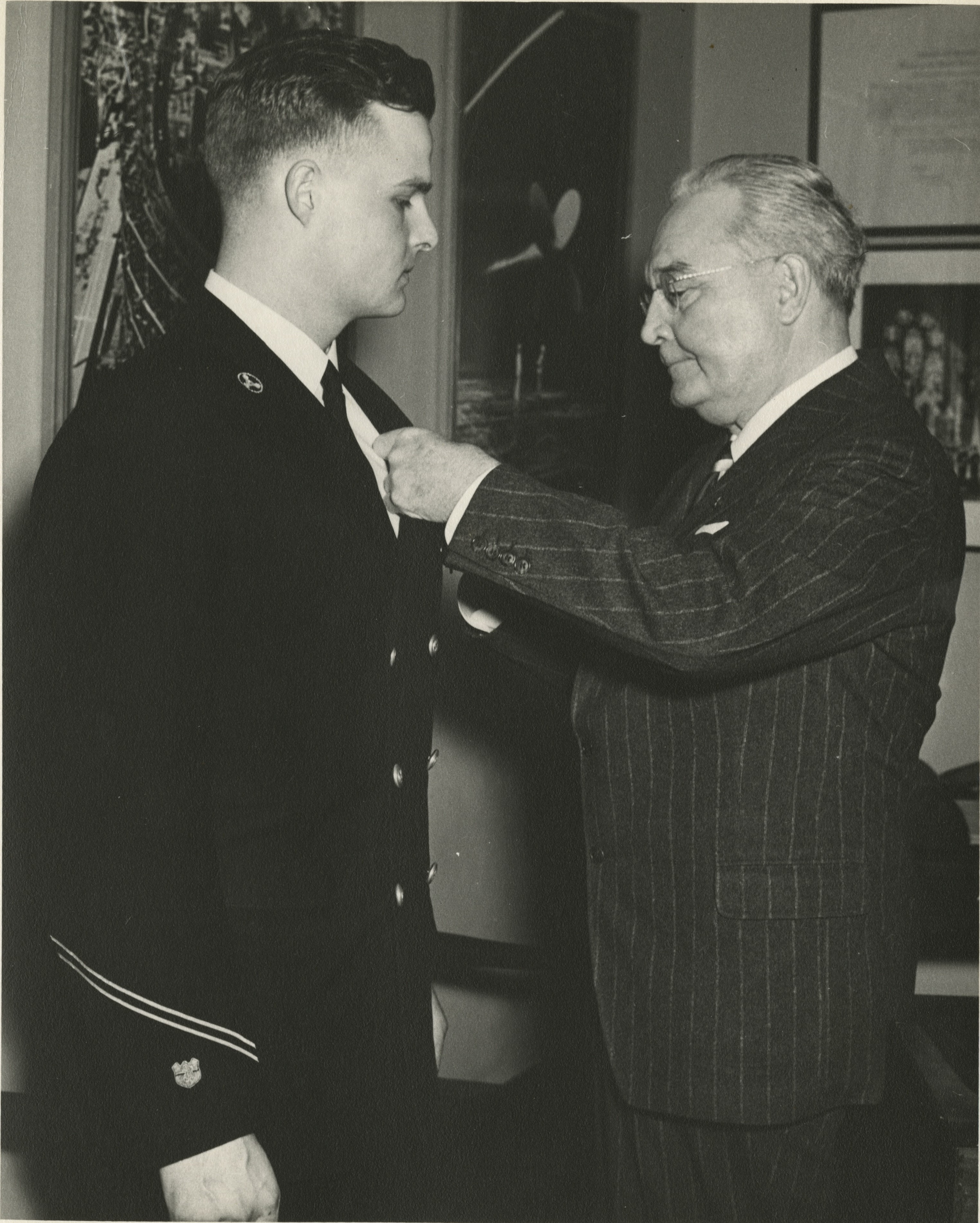
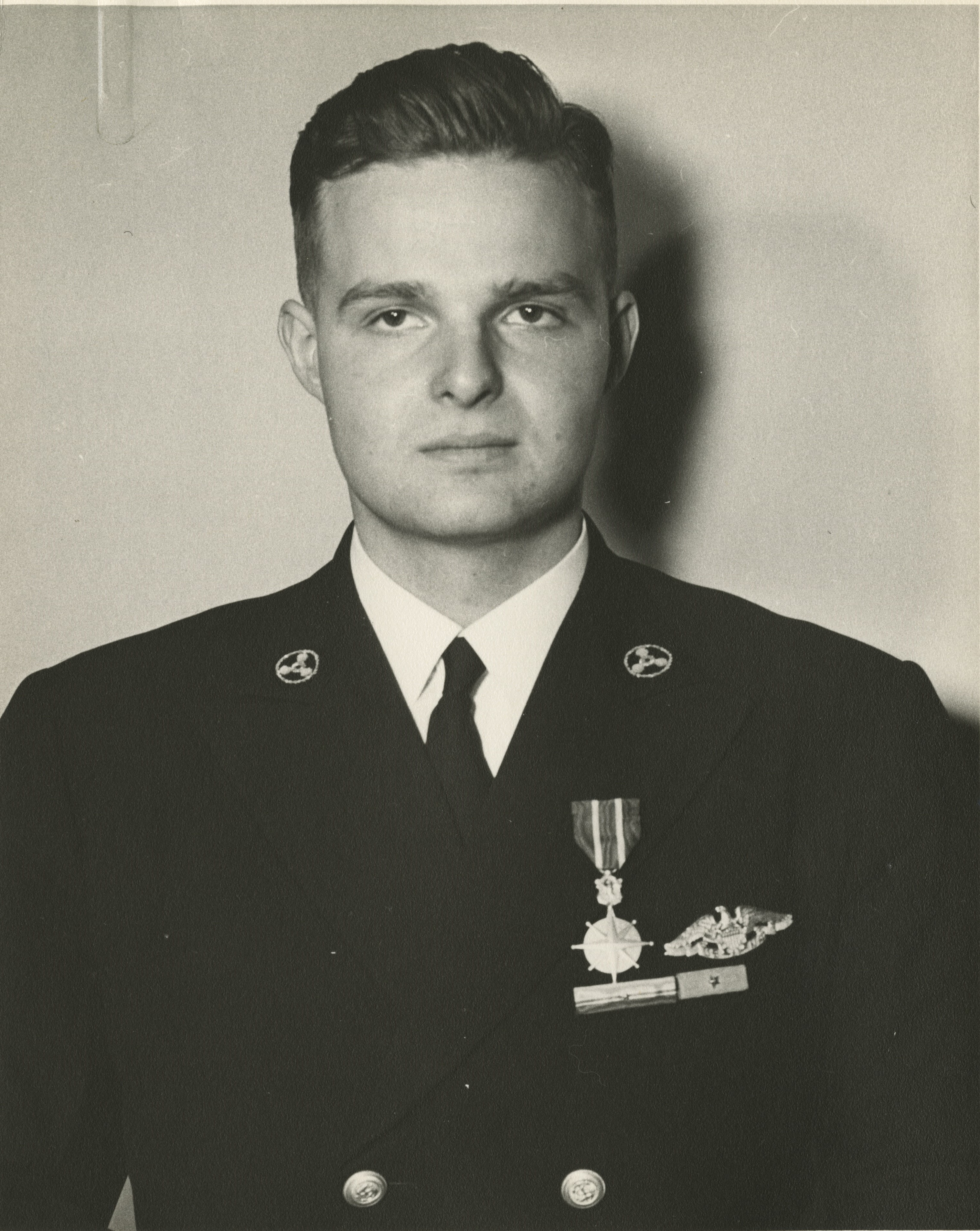
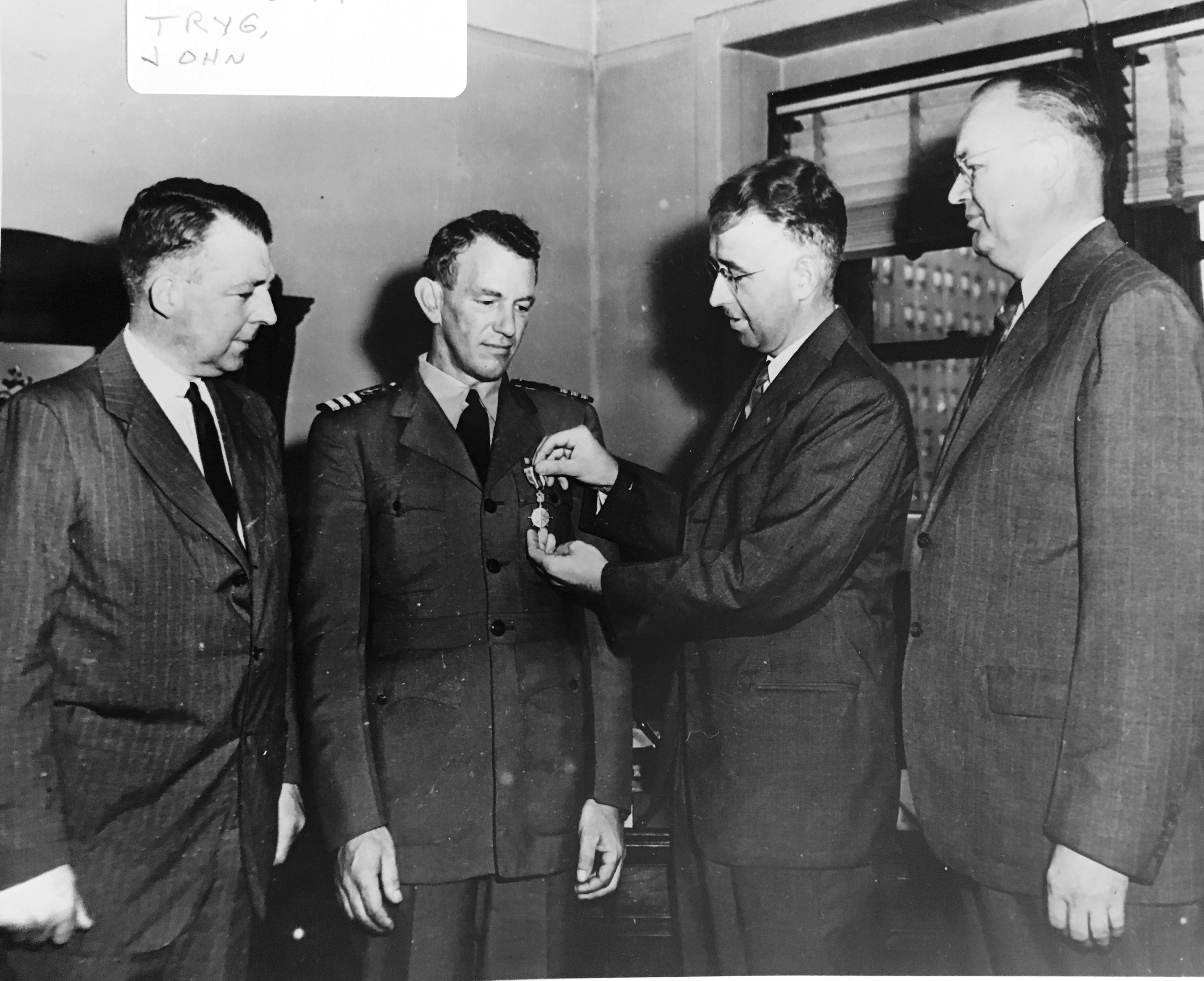
The American Merchant Marine Museum has in its collections press photographs of wartime recipients of the Merchant Marine Distinguished Service Medal. Some photos show stalwart widows, and others a smiling Admiral E. S. Land.

These photographs are rough – I had originally taken them to create a list of recipients. Then I discovered after a quick count that the 100 photographs represented only 79 of all those awarded the medal. Since these are not online or available anywhere, here you go.

Col.: AMMM