ear-harley

From:     Cadet-Midshipman John A. HARLEY, First Class, (D-1), USMMCC
To:           Supervisor, U.S. Merchant Marine Cadet Corps
Via:         District Merchant Marine Cadet Supervisor, New York
Subject: SS NATHANAEL GREENE- loss of

  1.         The SS NATHANAEL GREENE sailed from New York on April 1, 1942 with a full cargo bound for Russia. Although departure was taken for Russia, the ship did not start the northward journey until September 2, 1942, as part of the cargo was discharged in Sunderland, England and other cargo was loaded in Middlesborough. Subject vessel finally sailed for northern Russia on September 2, 1942 from Lock Eve, Scotland.
  2.          Subject vessel proceeded northward past Iceland and when off Spitsbergen, proceeding through the passage between Iceland and Bear Island the vessel was subjected to attacks by submarines and aircraft almost all the way from there on in to Archangel. The first attack same on came on September 13, when the convoy lost two ships through torpedoing. This happened at 0900 and shortly thereafter all Hell broke loose. A wave of German torpedo bombers, Heinkel III’s came up on the starboard beam and in the space of five minutes ten ships were sunk. It happened so quickly that one can’t realize how it happened. The aircraft carrier AVENGER was acting as escort and her planes were all on deck during the attack. The crew on subject ship was pretty down hearted after the attack as the two outside columns were gone and it was thought that tomorrow the next column would bear the brunt of the attack.
  3.          The next day was clear with a clear sea and good visibility. There was no action during the morning but it turned out to be the lull before the storm. The storm broke at 1237 when, from dead ahead, 17 planed made for the carrier escorting us but fortunately they all missed their mar. During the attack the carrier was running up and down the column, her AA shells exploding overhead. Then the attack to finish off the convoy came, and the writer personally counted 27 planed coming in. stopping his work, he made his peace with the Lord and started to load the3-inch 50 gun as fast as possible. On the morning of the 15th, the Commodore signaled the following message to the NATHANAEL GREENE: “Reverence to your gunners, you are at the top of the class”. Credit was received for shooting down five planes. Following this attack, during which the NATHANAEL GREENE was hit several times by aerial bombs, course was resumed for the discharge port The compass was destroyed during the attack, and it was necessary to steer by a boat compass loaned by an escort destroyer. This was a date to be long remembered, September 14, 1942. It shows the type of men merchant mariners really are and the ability they have to survive action of this kind.
  4.         Arriving in Russia the cargo was discharged and temporary repairs made, subject vessel left Russia on November 17 bound for the United Kingdom. After leaving the White Sea, convoy broke up and for the next ten days the NATHANAEL GREENE proceeded alone. Course was set for the ice field, to the north, proceeded to 76 24’ north and thence southward along the east coast of Greenland to Iceland. Leaving the coast of Iceland the course was se tfor Lock Eve and from there to Glasgow to discharge cargo. At Glasgow a full cargo was loaded for North Africa and the vessel sailed on January 21, 1943. The voyage to Africa was uneventful, arriving at Mostaganem, Algeria, on February 5, 1943.
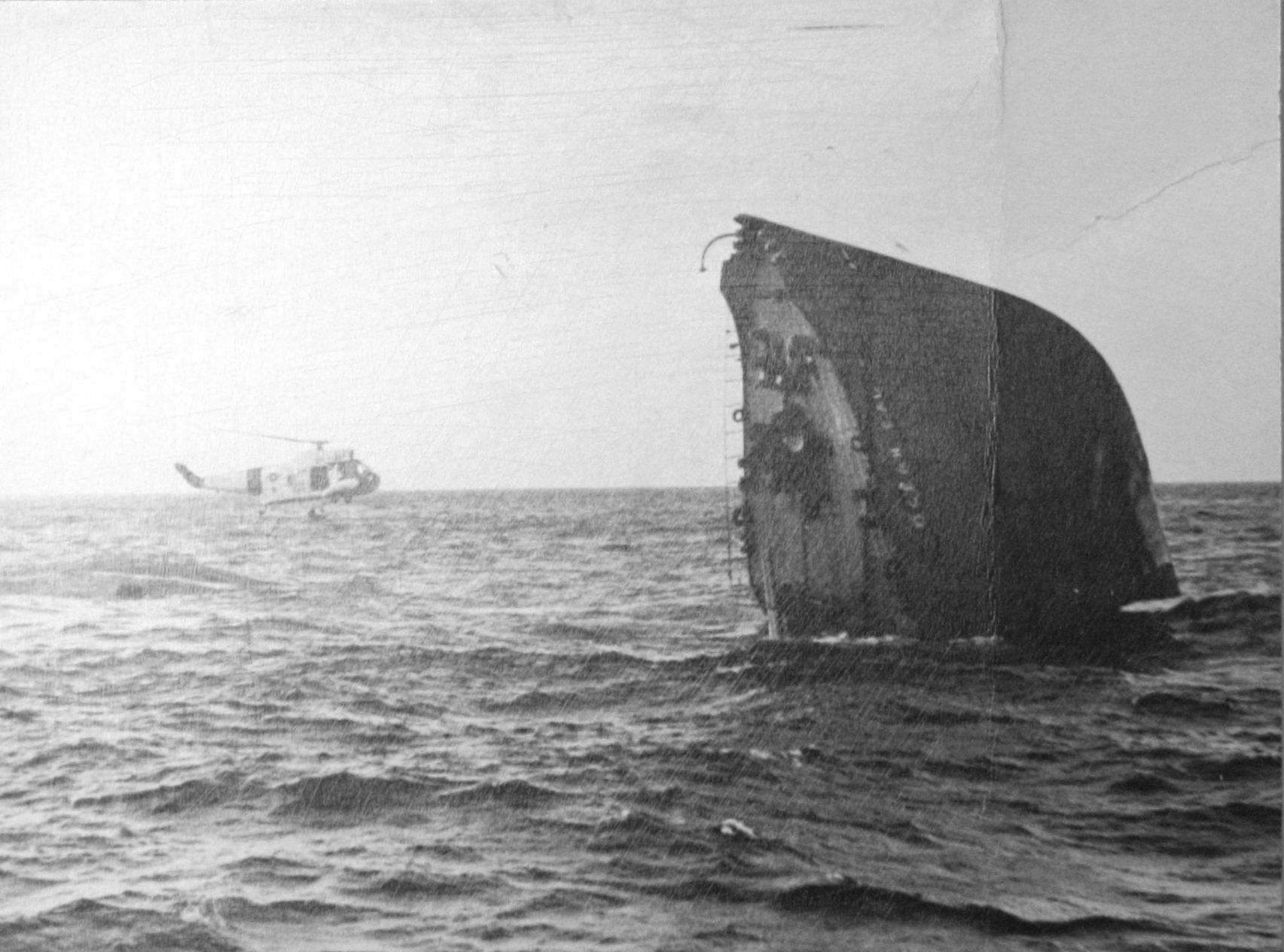
  5.         At Mostaganem all cargo except about 800 tons of food stuff destined for other ports in Algeria was discharged. The NATHANAEL GREENE left Mostaganem at 1200 on February 24, 1943 escorted by a mine sweeper. Proceeded on various courses to sea and fire and boat drills were held while steaming slowly. On the horizon was seen the convoy which the NATHANAEL GREENE was scheduled to join at 1345 at 1351 two torpedoes suddenly struck, one at the forward bulkhead of #2 hold and the other amidships. The ship settled by the head quickly as enemy planes came towards her. HMS SCHYLLA steamed out to meet them and like a volcano she brought down five planes while two Hurricane fighters dove at the oncoming HEINKELS, split up the formation, distributing the planes along the port and starboard sides of the convoy. A shell form the NATHANAEL GREENE’s guns hit the wail of the plane, and it fell but finally a plane let go three torpedoes, two together and one singly that headed straight for the bow of the ship, the ship was slowly turning away from them when they hit. Shrapnel was raining form the sky. The SS MARY BUCKENSACK had been hit and she exploded 500 feet off the port bow. The midship section of the NATHANAEL GREENE was the engulfed in a cloud of smoke and could not be seen. The deck cargo of canerod crates was littered with debris. In the excitement the two forward life rafts had been cast adrift, their painters parted and they drifted astern, when the torpedo struck, the writer was standing on the port wing of the bridge and he was knocked down. Picking himself up he heard the Master say “Stop the engines”. He rang “Stop” on the telegraph, but it was never answered. Central alarm was sounded and the writer went to his boat station taking his sextant with him. All hands stood by the boats and the Master asked the Chief Engineer how the ship was below. The Chief Officer was taking soundings to see if the vessel was tight. Out of a clear sky someone yelled “Let’s take this damn thing to Russia”. International “II” was hoisted and a destroyer came alongside and took off the wounded. Further inspection was then made to determine the extent of the damage. Down below the bulkheads had been ripped out, midship deck house smashed, all doors and blackout equipment was destroyed. In the Cadet-Midshipman’s room the bunks were moved approximately 8 inches from the bulkheads, sinks and radiators were blown from the bulkheads. Hasty repairs were made to blackout he ship. The vessel was carrying 700 tons of ballast in #1 and #2 deep tanks and the ship had now settled with the bow just awash. The fore and aft tween deck beam was pushed up at the #2 hold by the Foremast housing piercing the deck. No. 3 lifeboat was smashed. Pipes were broken and water was in the rooms.
  6.         Nos. 2 and 4 boats were lowered and later picked up by the Minesweeper BRICHAM which put a line on the NATHANAEL GREENE and towed her into the beach. Survivors went aboard the following morning to salvage what personal gear could be found, and it was learned that the ship was beached at Salamanda, five miles west of Mostaganem. Salvage work was started and survivors were transported to Cran and thence given transportation back to the United States.
  7.         The writer desires to report that his shipmate, Cadet-Midshipman John R. GORDON, Jr., who was lost while on the engine room was last seen working by the grease extractors, one of his assigned duties.

                                                                                    Signed (John A. Harley)

Cadet-Midshipman John A. HARLEY, First Class, (D-1), USMMCC

ear-golding

WAR SHIPPING ADMINISTRATION
TRAINING ORGANIZATION

———

UNITIED STATES MERCHANT MARINE CADET CORPS
NATIONAL MARINE BANK BUILDING
BALTIMORE 2. MARYLAND

30 November, 1943

UNOFFICIAL MEMORANDUM

TO:           LT Findlay

Some time ago the SS TIVIVIES of the United Fruit Company was in this harbor and I inspected Cadet-Midshipman Cornelius Golding. I understand via the grapevine that this ship was bombed a few weeks ago in the Mediterranean and one of the heroes of the aftermath of the bombing was Cadet-Midshipman, who, I understand, is now in the hospital in Oran and is probably disfigured for life with burns.

As I said, I only heard the above via the grapevine, but what I heard included that right after the bombing when the deck of the ship was being strafed by machine guns, this Cadet-Midshipman ran aft through the line of fire to cut loose a barrage balloon and his wounds were a result of his daring and bravery. Of course, these stories are sometimes magnified as they are passed from one person to another and from Africa to Baltimore but if part of what I heard is true, I believe some recognition should be given this Cadet-Midshipman.

It seems to me that the Gunnery Officer or the Captain would be in a good position to tell the true story of his alleged bravery.

Don’t you think it is worth looking into – perhaps you know the whole story and if so, forget this personal memorandum.

(Signed Sampson Scott)

SAMPSON SCOTT

Lt. Commander, USMS


File No. 43-6258
USNR No. 234307

CONFIDENTIAL

22 December 1943

From:     Cadet—Midshipman Cornelius E. GOLDING, Second Class, (D-1), USMMCC
To:           Supervisor, U.S. Merchant Marine Cadet Corps
Via:         District Cadet-Midshipman Supervisor, New York.
Subject:                 Loss of Vessel SS TIVIVIES; Report on

1. The subject vessel departed from the port of Algeria bound for Oran with a cargo of 1800 tons of frozen meat when, at about 1850, on 21 October 1943 while she was about 15 miles of Cape Tenez, she was hit by a torpedo. About 1000 that day, the Master had received a communique from British Intelligence warning him to be on the lookout for an attack that evening. During the morning the convoy commodore ordered the barrage balloon to be taken down, but about 1845, Captain Peterson order the balloon to be put back up. While the balloon was being unreeled, 23 enemy planes came over, flying very low, strafing the ships and releasing torpedoes.  The subject vessel and a British ship were hit by torpedoes, the subject vessel being hit in #4 hatch about five minutes after the attack started.

2. The writer was standing on #4 hatch together with the Chief Mate and the Bos’n when the torpedo exploded directly beneath them. The three men were blown about 20 feet in the air, the writer turning a somersault and landing on his back. The ship took a sudden list and sank within about 15 minutes.

3. The writer picked himself up and ran to the poop deck, chased into a life boat an A.B. who was running around berserk, and proceeded to follow suit. However, after the reel on the #1 lifeboat jammed, one of the gunners had taken too many turns off the bit letting the boat drop too abruptly and jamming the reel. The writer tried to release the pin but was unable to do so. Everyone was going down the man ropes and not finding any room, the writer jumped over the boat falls and dropped into the water unconscious. When the writer revived, he saw Capt. Peterson in the water, swimming around and directing the #3 boat to survivors in the water. After being taken into the boat, they continued to search for survivors but found no more. The boat the writer was in, along with the #2 boat drifted alongside and were taken aboard one of the escorting corvettes.

4. The writer was taken to Oran and immediately hospitalized suffering with severe burns of the head, face, back, arms, forearms, feet and neck which he received when the barrage balloon was hit by bullets from the planes and exploded. After remaining in the hospital from 22 October until 19 November, the writer was discharged and given passage back to the United States on the SS CARRILLO, arriving in New York on 17 December.

CORNELIUS E. GOLDING


File No. 43-6258
USNR No. 234307

CONFIDENTIAL

22 December 1943

From:        Cadet—Midshipman Cornelius E. GOLDING, Second Class, (D-1), USMMCC
To:             Supervisor, U.S. Merchant Marine Cadet Corps
Via:            District Cadet-Midshipman Supervisor, New York.
Subject:    Loss of Vessel SS TIVIVIES; Report on

1. The subject vessel departed from the port of Algeria bound for Oran with a cargo of 1800 tons of frozen meat when, at about 1850, on 21 October 1943 while she was about 15 miles of Cape Tenez, she was hit by a torpedo. About 1000 that day, the Master had received a communique from British Intelligence warning him to be on the lookout for an attack that evening. During the morning the convoy commodore ordered the barrage balloon to be taken down, but about 1845, Captain Peterson order the balloon to be put back up. While the balloon was being unreeled, 23 enemy planes came over, flying very low, strafing the ships and releasing torpedoes.  The subject vessel and a British ship were hit by torpedoes, the subject vessel being hit in #4 hatch about five minutes after the attack started.

2. The writer was standing on #4 hatch together with the Chief Mate and the Bos’n when the torpedo exploded directly beneath them. The three men were blown about 20 feet in the air, the writer turning a somersault and landing on his back. The ship took a sudden list and sank within about 15 minutes.

3. The writer picked himself up and ran to the poop deck, chased into a life boat an A.B. who was running around berserk, and proceeded to follow suit. However, after the reel on the #1 lifeboat jammed, one of the gunners had taken too many turns off the bit letting the boat drop too abruptly and jamming the reel. The writer tried to release the pin but was unable to do so. Everyone was going down the man ropes and not finding any room, the writer jumped over the boat falls and dropped into the water unconscious. When the writer revived, he saw Capt. Peterson in the water, swimming around and directing the #3 boat to survivors in the water. After being taken into the boat, they continued to search for survivors but found no more. The boat the writer was in, along with the #2 boat drifted alongside and were taken aboard one of the escorting corvettes.

4. The writer was taken to Oran and immediately hospitalized suffering with severe burns of the head, face, back, arms, forearms, feet and neck which he received when the barrage balloon was hit by bullets from the planes and exploded. After remaining in the hospital from 22 October until 19 November, the writer was discharged and given passage back to the United States on the SS CARRILLO, arriving in New York on 17 December.

Signed (Cornelius E. Golding)

Cadet-Midshipman Cornelius E. Golding, Second Class, (D-1), USMMCC


FIRST ENDORSEMENT

22 December, 1943

To:  Supervisor, U.S. Merchant Marine Cadet Corps

Forwarded                                                                                        

P. Brennan

                                                                                                            Signed (G. S. Findlay)

                                                                                                            G. S. FINDLAY

                                                                                                            By direction

ear-fahrner

Training Organization
U.S. Merchant Marine Cadet Corps
39 Broadway, New York, N.Y.

Confidential

From:     Cadet-Midshipman Willard F. FAHRNER, Third Class, (E-2), USMMCC
To:           Supervisor, U.S. Merchant Marine Cadet Corps
Via:         District Cadet Supervisor, New York.
Subject:                 Loss of vessel SS STANVAC MANILA; Report on

The tanker STANVAC MANILA left pier 60, New York  on of Squadron 12, 1948 carrying a deck load which consisted of seven P.T. boats of Squadron Tweleve, Several thousand tons of dry cargo consisting of P.T. engines, aircraft engines, radar equipment, carried in the dry cargo hold forward. There was no liquid cargo except 1200 tons of fresh water to be discharged in Aruba, our loading port. We proceeded from New York without escort and headed south via Crocked Island Passage, picking up a thirty two ship convoy off Guantanamo, Cuba. Three P.C. boats and a small destroyer served as escorts. We proceeded in convoy to San Nicholas, Curacao where our ship was detached from the main body and proceeded to Aruba. We ddischarged the fresh water ballast and loaded 100,000 bbls of Navy fuel oil after which we proceeded to Balboa, unescorted. We then proceeded through the Canal and into the Pacific. The Weather from Balboa and across the Pacific consisted for the most part of cool weather with clear skies and medium seas and swells. A gale was encountered about fourteen days out of Balboa, but this blew itself out after the second day.

                 2.              The ship was hit by a torpedo at 0409 the morning of May 24th. The sky was hazy, emitting enough of the half moon to silhouette our ship. The sea was heavy and choppy. The writer had come off wath at 0400 and was in his quarters at the time the torpedo struck. Members of the fun crew on watch claim seeing one torpedo miss the stern a moment before the ship was hit by the second torpedo. The vessel was on course 317 deg. True, zigzagging, and 72 miles from Noumea, L.H. bearing 323 deg. True. The torpedo struck dead astern, below the fire room, engine, electricity and steerage were cut off immediately. Gun and fire stations were manned and the crew stood by for action.

                 3.              The ship began going down by the stern, and in an hour the after gun was under water. Life boats aft were manned and launched almost immediately, the Chief Mate and the writer took the port forward boat off about two hours later, and stood by for survivors. A half hour later, the Chief Mate was put aboard again as he wished to try to get some of the P.T. boats off the deck. The writer was left in charge of the life boat and layed off to starboard of the ship to await orders.

4.              No enemy craft sighted at any time.

5.              About 0800 the first P.T. boat was taken off the sinking ship and was used to relieve the life boats of excess passengers. As the ship sank lower by the stern, another P.T. boat was floated off. This boat was alsol used to pick up men who had abandoned the rapidly sinking stern. As the ship began to collapse amidships, the writer went alongside and took the second and third mates aboard along with members of the gun crew who were nearly swamped by the suction of the sinking ship. At 1210 the ship disappeared and at 1300 all the survivors were picked up by the life boats or the P. T. boats. About 1400 we were sighted by the USS Prebele which took the P.T. boats in tow and landed in Noumea at 1400 the following day. The injured were taken to the hospital ship at Noumea at 1400 the following day. The injured were taken to a hospital ship at Noumea and all the rest of the survivors were taken to a Navy Receiving Station from where we were given passage back to San Francisco.

6.              The P.T. boats used their radar very successfully until their generator went dead, and shortly thereafter we were hit by the torpedo.

ear-ewing

                                                                                                May 14, 1943

CONFIDENTIAL

From:              Cadet-Midshipman Paul C. EWING, Second Class, D-2, USMMCC
To:                  Supervisor, U.S. Merchant Marine Cadet Corps
Via:                  District Cadet Supervisor, New York
Subject: Loss of the SS SANTA CATALINA, Report on

  1.       On April 21, 11943, we completed loading explosives at Hog Island, Pa., and proceeded to sea the same day, operating singly and without escort. The weather was fair and we made good speed until the following two days.
  2.      On April 23, at 2050, zone plus 4, shortly after darkness had set in, we were struck by two torpedoes, one following the other, on the starboard side in the after end of No. 1.
  3.       The writer having watched below was turned in at the time of the torpedoing but was not asleep, dressing immediately and detaining a life jacket, he proceeded to the boat deck.
  4.       The boats and rafts were all placed in the water except the two boats on the port side which could not be cleared because of a heavy starboard list. All hands got into the boats and on to the rafts without much delay except two U.S. Navy radio men, who had remained in the shack in spite of the abandon ship order. The ships regularly assigned civilian operator, Mr. Arnold Seltz, took a portable transmitter from the shack and deposited it in No. 1-A lifeboat, returned to the shack and made the two Navy operators leave. One of these Navy operators could not swim, so, therefore, Mr. Seltz, the ship’s operator, had to pick him up and throw him into the water, from where he was pulled into the lifeboat. 
  5.       Shortly after all hands had gotten away from the ship, a third torpedo was sent into her. It struck amidship on the port side and caused the ship to right itself, and then sink vertically, bow first. A moment after it had disappeared below the surface, a violent explosion occurred, and although it shook the boats considerably, it did not cause any damage to them. The explosion also caused the fuel oil, which had accumulated on the surface, to ignite and illuminate the area for many miles around.
  6.      We were spotted by a plane about midnight, and this plane directed a Swedish vessel, the SS VENSSIA to our rescue. We were picked up about 0900, and taken to Puerto Rico, and while on route, we received excellent treatment.
  7.       We arrived in San Juan, P.R., on April 27, and on May 6, we left by plane for Miami, and thence to New York, where we have now finally been paid off, and are ready to go home on a short leave before being assigned to another ship.

Cadet-Midshipman Paul C. Ewing


Cadet File No: 43-2900
USNR File No: 181641

From:              Cadet-Midshipman Paul C. EWING, Second Class, D-2, USMMCC
To:                  Supervisor, U.S. Merchant Marine Cadet Corps
Via:                  District Cadet Supervisor, New York
Subject: Loss of the SS SANTA CATALINA, Report on

1.                     On April 21, 11943, we completed loading explosives at Hog Island, Pa., and proceeded to sea the same day, operating singly and without escort. The weather was fair and we made good speed until the following two days.

2.                     On April 23, at 2050, zone plus 4, shortly after darkness had set in, we were struck by two torpedoes, one following the other, on the starboard side in the after end of No. 1.

3.                     The writer having watched below was turned in at the time of the torpedoing but was not asleep, dressing immediately and detaining a life jacket, he proceeded to the boat deck.

4.                     The boats and rafts were all placed in the water except the two boats on the port side which could not be cleared because of a heavy starboard list. All hands got into the boats and on to the rafts without much delay except two U.S. Navy radio men, who had remained in the shack in spite of the abandon ship order. The ships regularly assigned civilian operator, Mr. Arnold Seltz, took a portable transmitter from the shack and deposited it in No. 1-A lifeboat, returned to the shack and made the two Navy operators leave. One of these Navy operators could not swim, so, therefore, Mr. Seltz, the ship’s operator, had to pick him up and throw him into the water, from where he was pulled into the lifeboat.  

5.                     Shortly after all hands had gotten away from the ship, a third torpedo was sent into her. It struck amidship on the port side and caused the ship to right itself, and then sink vertically, bow first. A moment after it had disappeared below the surface, a violent explosion occurred, and although it shook the boats considerably, it did not cause any damage to them. The explosion also caused the fuel oil, which had accumulated on the surface, to ignite and illuminate the area for many miles around.

6.                     We were spotted by a plan about midnight, and this plane directed a Swedish vessel, the SS VENSSIA to our rescue. We were picked up about 0900, and taken to Puerto Rico, and while on route, we received excellent treatment.

7.                     We arrived in San Juan, P.R., on April 27, and on May 6, we left by plane for Miami, and thence to New York, where we have now finally been paid off, and are ready to go home on a short leave before being assigned to another ship.

Cadet-Midshipman Paul C. Ewing

ear-getchell

C O N F I D E N T I A L

Cadet File No:    43-857
USNR File No:     232934

From:                                         Cadet-Midshipman Patrick F. GETCHELL, Third Class, (D-2), USMMCC
To:                                               Supervisor, U. S. Merchant Marine Cadet Corps
Via:                                             District Cadet Supervisor, New York.
Subject:                                                     SS James W. DENVER – loss of

                                    1.              Subject ship sailed from New York on April 1, 1943 bound for Casa Blanca, carrying a general military cargo. The number of ships in our convoy, and the number of escort ships was unknown, both to the writer and the members of the crew. Experienced good weather for almost the entire trip, although at the time of the torpedoing there was a heavy sea running.

                                    2.              At approximately 1700, ship’s time, on April 11th, the ship was hit by the torpedo, striking on the starboard bow. The position of the ship at this time was Lat. 28° 51’ North, Long. 25° 27’ West. At the time of the attack, the writer was not on watch and was in his quarters. Immediately after the general alarm sounded, the writer proceeded to the bridge and remained there until the “abandon ship” was sounded, then proceeded to the chart room, took the Second Mate’s sextant and went to #3 boat which was his designated station. The writer worked the forward falls and then got into the life boat.

                                    3.              Immediately after the “abandon ship” was sounded, the port boats were lowered. In the process of lowering the boats davit #6 boat, which had evidently been cracked by the explosion of the torpedo, gave way at the arm and scuttled the boat. After the port boats were lowered, the men proceeded to the starboard side and lowered all the boats under the Captain’s supervision.

                                    4.              At the time of the sinking, no enemy craft were sighted, but we believe that we sighted a periscope ten days after abandoning ship. There were no suspicious actions among the crew.

                                    5.              On May 4th, at about 2035, after 23 days in the boat, we sighted a light on the starboard beam. Sent up Very flares, and at 2130 we furled sails and started rowing. At 2200 we were alongside the Portugese steam trawler ALBUFEIRA. All hands came aboard and the lifeboat was scuttled. Landed in Lisbon, Portugal on May 10th and were met at the pier by representatives of the United States Consulate. After this, survivors were removed to a British hospital, were the writer remained for three days. Were taken to a hotel in Lisbon until June 14th, on which date left by Clipper at 0420, arriving New York at 1430, June 15th, 1943.

                                                                                                                              Signed (Patrick F. Getchell)

Cadet-Midshipman Patrick F. GETCHELL, Third Class, (D-2), USMMC

_      _      _      _      _      _      _      _      _      _      _      _      _      _      _      _      _      _     

FIRST ENDORSNMENT

From:                           District Cadet Supervisor, New York
To:                                Supervisor, U. S. Merchant Marine Cadet Corps

  1.           Forwarded. Attention invited to the fact that these Cadet Midshipman spent 23 days in their lifeboat before being rescued.            

TRAINGIN ORGANIZATION
U.S. MERCHANT MARINE CADET CORPS
39 BROADWAY, NEW YORK, N.Y.

June 16, 1943

CONFIDENTIAL

From:                                         Cadet-Midshipman Patrick F. GETCHELL, Third Class, (D-2), USMMCC
To:                                               Supervisor, U. S. Merchant Marine Cadet Corps
Via:                                             District Cadet Supervisor, New York. Subject:                                                     Loss of vessel JAMES W. DENVERS; Report on

                                    1.              The ship to which the writer was attached left New York on April 1, 1943 bound for Casa Blanca, carrying a general military cargo. The number of ships in our convoy, and the number of escort ships was unknown, both to the writer and the members of the crew. We experienced good weather for almost the entire trip, although at the time of the torpedoing there was a heavy sea running.

                                    2.              At approximately 1700, ship’s time, on April 11th, the ship was hit by the torpedo, striking on the starboard bow. The position of the ship at this time was  28 deg. 51 min. N., longitude 25 deg. 27 min. W. At the time of the attack, the writer was not on watch and was in his quarters. Immediately after the general alarm sounded, the writer proceeded to the bridge and remained there until the “abandon ship” was sounded, after which he proceeded to the chart room, took the Second Mate’s sextant and went to #3 boat which was his designated station. The writer worked the forward falls and then got into the life boat.

                                    3.              Immediately after the “abandon ship” was sounded, the port boats were lowered. In the process of lowering the boats davit #6 boat, which had evidently been cracked by the explosion of the torpedo, gave way at the arm and scuttled the boat. After the port boats were lowered, the men proceeded to the starboard side and lowered all the boats under the Captain’s supervision.

                                    4.              At the time of the sinking, no enemy craft were sighted, but we believe that we sighted a periscope ten days after abandoning ship. There were no suspicious actions among the crew.

                                    5.              On May 4th, at about 2035, after 23 days in the boat, we sighted a light on the starboard beam. We sent up Very flares, and at 2130 we furled sails and started rowing. At 2200 we were alongside the Portugese steam trawler ALBUFEIRA. All hands came aboard, and we scuttled the life boat. We were landed in Lisbon, Portugal on May 10th and were met at the pier by representatives of the United States Consulate. After this we were removed to a British hospital, were the writer remained for three days. We were taken to a hotel in Lisbon until June 14th, when we left by Clipper at 0420, arriving in New York at 1430, June 15th.

ear-elliott

National Marine Bank Building
Water & Gay
Baltimore -2, Maryland

May 27, 1943

CONFIDENTIAL

From:              Cadet-Midshipman James M. ELLIOTT, Jr., Second Class, (D-1), USMMCC
To:                  Supervisor, U.S. Merchant Marine Cadet Corps
Via:                  Cadet Instructor – Baltimore
Subject:                       SS HARVEY W. SCOTT – Loss of

  1. At 0800 on March 3, 1943 subject vessel left Durban, South Africa, in a convoy bound for the Persian Gulf.
  2.  On March 3, 1943 at 2325 vessel was struck by one torpedo just aft of #2 hold on the port side.
  3. Writer was in bed at the time and immediately after the explosion, reported to his station on the bridge as messenger to the captain. He was then ordered to carry Code Box from the bridge down to boat deck and to stand by same. After boats had been placed in water and all hands safely left the ship, the writer was ordered to lower Code Box into lifeboat. He was then ordered into the boat, being the next to last man to leave the ship, followed by the captain. The Code Box was dropped over the side of the lifeboat.
  4. The ship sank about twelve minutes after the four lifeboats had cleared the ship’s side. Approximately five minutes after the disappearance of the vessel, a series of explosions was felt beneath the lifeboat. Following this an arc of 20 mm tracer bullets swept the sea, the source of which was not known. This lasted for about 30 seconds and was followed by the firing of 3 parachute flares. During this time and for about a half hour thereafter, all lights and cigarettes were extinguished and the occupants of the lifeboats remained motionless.
  5. Following this, with #1 lifeboat in tow, an attempt was made to contact the other boats. The boat motor was started and while idling about the scene a cry for help was heard. Following the cry to its source, approximately two hundred men from other torpedoed ships in the convoy were observed to be swimming in the water. The captain then ordered #1 boat to cast off and both boats began pulling the men aboard. After having saved as many of the men as possible, a line was again made fast to #1 boat and both boats proceeded toward land, leaving the remaining men who were in the water to their fate. During this time, nothing was seen of the submarine or the escort vessels. 

National Marine Bank Building
Water & Gay
Baltimore -2, Maryland

-2-

                  6.   At approximately 0530 on the morning of March 4, an airplane was heard flying overhead and lights were flashed into the air. The plane signaled down that help was coming. At 1400 land was sighted and at 1900 a landing was made on the African coast just below Port St. Johns. A family who lived nearby met the boats upon their landing and “all hands,” including five officers and 2 cadet-midshipmen, were taken into their home.

                  7.   On the morning of March 5, transportation was arranged and the crew was taken to Umtata, from there to Kokstad, and then on to Durban. While in Durban, it was learned that 9 out of 11 ships in the convoy were sunk and the remainder of the convoy recalled. The writer stayed in Durban until April 3, 1943 when he was assigned to the MV CAPE HENRY bound for the United States, and arrived in Baltimore on May 20, 1943.

                  8.   During the time spent in South Africa, the crew was treated exceptionally well and everything possible was done for their comfort by the American Consul and the local inhabitants. In appreciation of this fact, two plaques were purchased by the officers and men. One was presented to the family that took us in the first night ashore, and one was presented to the town of Umtata.

                                                                        Signed _________________________________

                   Cadet-Midshipman James M. Elliott, Second Class, (D-1), USMMCC     

– – – – – – – – – – – – – – – – – – – – – – – – – – – – – – – – – – – – – – – – – – – – – – – – – – – – – – – – – – – – – – – – – – –                                                           

FIRST ENDORSEMENT                                                                         May 27, 1943

From:                          Cadet Instructor – Baltimore
To:                              Supervisor, U.S. Merchant Marine Corps

  1. Forwarded.

SAMPSON SCOTT

Lt. Commander, USMS

ear-edgar

April 16, 1943

CONFIDENTIAL

Cadet file No:  43-2196
USNR File No:  181674

From: Cadet-Midshipman Lauren F. Edgar, Fourth Class, (E-2), USMMCC
To: Supervisor, U.S. Merchant Marine Cadet Corps
Via: District Merchant Marine Cadet Instructor, New York

Subject: SS WILLIAM EUSTIS – loss of

1. Subject vessel sailed from New York on March 8, 1943 in a convoy consisting of approximately 40 ships, and escorted by three destroyers and two corvettes. On the run from New York both clear and heavy weather were experienced with swells and heavy seas at the time the ship was torpedoed.

2. March 16, at about 2220, while there was bright moonlight, the vessel was struck on the starboard side, at #3 hold by a torpedo. The order to abandon ship was given and all hands proceeded to boat stations.

3. Upon reaching his boat station, the writer noticed that #2, #3, and #5 boats had been rendered useless by the concussion of the explosion, and that #6 boat had been swamped while it was being lowered. Only #2 raft could be used because the other rafts went adrift due to the fact that the ship was still moving when they were lowered. Fortunately, there was plenty of time to abandon ship, or the casualty list might have been very high. As it was, the ship was still on an even keel even after all hands had been taken off, and it was necessary for the British to shell her in order to sink her.

(continued)

Copies made 32

Distribution only as follows:

1. Rear Admiral E. S. Land USN(Ret.) 17. Lt. J. Kelly, USMS
2. Capt. Edward Macauley, USN(Ret.) 18. Lt. Comdr. H. A. Burch, USNR
3. Mr. Telfair Knight 19. Rear Admiral A. S. Randall, USNR
4. Captain J. H. Tomb, USN (Ret.) 20. Mr. J. C. Outlor, WSA
5. Comdr. R. M. Sheaf, USNR 21. Mr. Frank Rusk, WSA
6. Comdr. Patrick Brennan, USNR 22. Mr. S. D. Schell
7. Comdr. A. C. Brady, USNR 23. Lt. Stanton H. Delaplane, USMS
8. Lt. Comdr. H. R. McPhee, USNR 24. Lt. Stephen Manning, USMS
9. Comdr. B. M. Dodson, USNR 25. Lt. M. Breece, USNR
10. Capt. Giles C. Stedman, USNR 26. Rear Admiral H. A.Wiley,USN(Ret.)
11. Lt. Comdr. E. S. Nochull, USNR 27. Captain R. R. McNulty, USNR
12. Lt. Comdr. J. Powers, USNR 28. Comdr. W. B. Tucker, USNR
13. Capt. Felix Johnson, USN 29. Comdr. G. E. Lindloy, USNR
14. Comdr. J. J. Tunney, USNR 30. Lt. Comdr. W. F. Thornton, USNR
15. Lt. F. Riesenberg, USMS 31. Lt. J. R. Sanders, USNR
16. Comdr. Paul S. Maquire, USNR 32. Lt. Comdr. R. Waters, USNR

4. The writer did not see any signs of enemy craft, and to his knowledge none of the crew of the ship sighted any in the vicinity.

5. The entire crew was picked up by the HMS VOLUNTEER which was nearly torpedoed herself after all the survivors of the boat and rafts were picked up. Survivors were taken to Liverpool arriving there on March 22. It was necessary to live in very crowded quarters while awaiting transportation back to New York, but it must be said that considering the circumstances, all hands were treated very hospitably by the British during the stay in Liverpool.

6. Passage back to New York was arranged, arriving on April 13. The Supervisor is informed that Cadet-Midshipman John Gordon Dunn, (D-2), was operated on for appendicitis and at the time of leaving England he was recuperating nicely in the Naval Hospital in Londonderry, Ireland.

Signed (Lauren F. Edgar)

Cadet-Midshipman Lauren F. Edgar, Fourth Class, (B-2), USMMCO


First Endorsement                                                                                                   April 6, 1943

From: District Merchant Marine Cadet Instructor, New York
To: Supervisor, U.S. Merchant Marine Cadet Corps

  1. Forwarded.

Comdr. B. N. Dodson, USNR

Signed (C. P. Jensen)

Lt. Comdr. C. P. Jensen, USNR

By direction


MOBILE OCEANIC LINE
WATERMAN STEAMSHIP CORP.

SS JAMES M. WAYNE
Newport News, Va.
December 7, 1943

District Merchant Marine Cadet-Midshipman Instructor,
War Shipping Administration
39 Broadway
New York, N. Y.

Dear Sir:-

            It gives me great pleasure to forward my report to you, with reference to Cadet-Midshipman Engineer, Lauren Edgar, residing at #412 N. W. 41st Street, Miami, Florida, and who has served as such on board this vessel from July 26, 1943 up to this date, the termination of voyage, and under my personal supervision.

            During this period, Mr. Edgar proved himself to be an ambitious, studious and well-mannered persons; always showing keen interest in the Marine Engineering profession.

            By working with the Watch Engineers and assisting in the maintenance work on main engine, boilers, auxiliaries and deck machinery installed in this vessel, he has become highly proficient in the operation of the steam driven, reciprocating engine power plant.

            Therefore with confidence I recommend him as capable of assuming the responsibilities and duties of Second or Third Assistant Engineer on any of the Liberty type ships. Also consider him a credit to the U.S. Merchant Marine Academy.

            Wishing you every success in the accomplishment of your mission, I am,

Very truly yours,

/S/ George E. Hissig
Chief Engineer
SS JAMES M. WAYNE


ear-gagliano

30 July 1943

CONFIDENTIAL

To:  Supervisor, U. S. Merchant Marine Cadet Corps
Via: District Cadet Supervisor, New York
Subject: Loss of vessel SS WILLIAM KING; Report on

The subject vessel sailed from New York in a convoy of about 25 ships with four or five escort ships. The ship was loaded with tricks, ammunition, food, blankets, medical supplies and rail axles bound for Russia, the port of discharge being Bushire, Persia. The convoy disbanded at Panama, and the subject vessel proceeded to her destination unescorted at a speed of about ten knots. The weather was ideal except for one rain storm which lasted for three days while in the vicinity of Madagascar.

The cargo was unloaded at Bushire and the ship the proceeded to Durban, South Africa. While on the way to that port, on June 6, 1943, at 0345, ship’s time, the vessel was struck by a torpedo on the port side and in the settling tanks. The writer was studying in the Third Assistance Engineer’s room when the explosion occurred. Instantly all the lights went out, and the engines stopped. The writer groped his way through the darkness to the Boat deck. Arriving there, the Chief Officer had already given orders to lower the boats, so the writer then went down to the main deck and released a forward life raft.   

The ship was sinking very slowly. A second torpedo had missed the ship passing by the stern by about two feet, but 25 minutes after the first torpedo struck, the ship was hit by another, striking amidships on the starboard side. The ship then went down in about two minutes, but all hands had abandoned ship by that time. There were six casualties, all killed by the exploding torpedoes.

The survivors spent the next six days in the boats and under the skillful guidance of Mr. Milliken, An A.B. and Mr. McGrath, Bos’n sailed to within 14 miles of land. The boats travelled 360 miles, at an average speed of three knots.

Immediately after the ship went down, the submarine surfaced. It appeared to the writer to be new, as a brass plate on the bow was untarnished. It was a German submarine and carried two deck guns. It appeared to be about 300 feet long. The submarine came alongside the boats, asked the name, tonnage, port of destination etc., and when these questions were answered, they took the Captain prisoner. The submarine then disappeared.


Subject: Loss of vessel SS WILLIAM KING; Report on

On June 12th, the survivors were sighted by a patrol bomber, and about one and a half hours later were rescued by the HMS RELENTLESS, a British destroyer. The survivors were landed in Durban about 1800 the same day. The writer was given first class passage back to the United States and landed in New York in July 26, 1943.

Cadet-Midshipman Henry BOGARDUS, Second Class, (E-1), USMMCC was on duty in the engine room at the time the first torpedo struck the ship, and he was among the five or six men killed at that time. The writer has not been able to contact anyone who saw this Cadet-Midshipman die, but all were of the opinion that he was killed by the explosion of the torpedo. Cadet-Midshipman Lueddecke and Canavan, together with the writer, got off the ship safely and all are now in New York.

                                                                        [Signed]

                                                                        Cadet- Midshipman Joseph A. GAGLIANO, Second Class, (E-1), USMMCC

FIRST ENDORSEMENT.

30 July 1943

To:                             S-CO

Forwarded. Attention invented to last paragraph above concerning the loss of Cadet-Midshipman Henry Bogardus.

                                                                                                            P. BRENNAN

                                                                                                            G. F. FELTUS

                                                                                                            By direction

ear-carmines

CONFIDENTIAL

August 28, 1942

Memo to:    Lieut. J. Linder
From:       Cadet Charles D. Carmines
           223 Raleigh Avenue
           Hampton, Virginia

      On the morning of August 13, 1942, we were travelling in convoy coming up through Windward Passage when at 1545 a ship about a quarter of a mile off our starboard quarter was struck by a torpedo. At that time, I woke and looked out the port-hole on the port side, the balance of the ships were travelling along in order, so I thought it was one of the escorts [that] had picked up a U-boat.

      Then at approximately 0356 a torpedo struck us. I put my clothes on and grabbed my life jacket and went up on the boat deck to my boat station. My boat, No. 2, the motor boat was destroyed and also No. 4 boat, at that time the ship had a list to the port.

      Mr. Lanford, Chief Officer got there about the same time as I did and told me to go get No. 1 boat. I went to the boat and gave a hand to the Third Officer. The boat was lowered and it was loaded as it was being lowered. The boat was caught in the wash and was broken up. I went down with the boat and when I came up the ship was out of sight.

      I made out to get hold of some dunnage and with the aid of my life jacket made out to keep afloat. I was in the water about nine minutes when I was picked up by a life boat which was the only one to get away and then taken aboard by a British destroyer and landed at a naval station in Cuba at 0030 and held there until August 22, 1942 from there we were sent to Camaguay, Cuba and had to wait there for a plane until August 25th. I arrived here, New Orleans at 2030 August 27, 1942. I reported to the District Instructor at 1000 August 28, 1942 for instructions. We aboard the SS DELMUND, did not get the correct time of the vessel going down but a captain from a ship in the same convoy which was sunk the next night and landed at the same station I was said we went down in four minutes.

                                                Charles D. Carmines

ear-cardinale

File No. 43-2179
USNR No. 181475

CONFIDENTIAL

12 April 1944

From:       Cadet-Midshipman Anthony J. CARDIHALE, First Class,

To:         Supervisor, U. S. Merchant Marine Cadet Corps

Via:        District Cadet-Midshipman Supervisor, New York.

Subject:          Loss of vessel SS SEAKAY; Report on

1.    The vessel to which the writer was assigned departed from New York with a full cargo of vapor oil and a deck cargo of airplanes. She was proceeding in a 15-knot convoy of about 25 ships, escorted by 10 American DE’s, bound for the port of Avonmouth, England.

2.    On 18 March 1944, the convoy escorts started to drop depth charges on the outer fringes of the convoy area, of the subject vessel’s starboard bow. The position of the convoy at this time was approximately 700 miles west of Ireland, in the North Atlantic. At this outburst of activity, the writer immediately started below to his quarters in order to procure his life preserver. As the writer reached the door of his room, the subject vessel was hit by a torpedo in the extreme forward end of the ship, on the starboard side. The writer grabbed his life preserver and hurried to his station on the boat deck. Arriving topside, the writer saw that the ship had caught fire almost immediately, so he went forward to assist with the hoses. The writer then went in search of the pumpman to aid him in pumping the oil out of the tanks forward in order to bring the ship to an even keel.

3.    By this time the abandon ship signal had sounded and the writer proceeded to his boat, secured the plug and directed the lowering of the boat. After all the men were safely in the boat, the falls were released and the writer had to cut the man ropes which had become attached to the thwarts. The ship was abandoned in an orderly fashion, and all the men were safely in the boats except the Captain, who stayed with his ship until the last moment and then jumped overboard and swam to a life raft.

4. Within an hour and a half, all the boats, including the Skipper’s raft were picked up by one of the excorting DE’s, the USS REEVES, DE156. All hands were saved except one member of the Naval Armed Guard who was lost when his life boat overturned.

5.    The survivors were taken to Londonderry, Ireland and there were given clothes by the British Merchant Navy Relief Association. From there to Glasgow, thence to Avonmouth where the writer was placed aboard the MV LIGHTNING and returned to the United States.

                                                                                          ANTHONY J. CARDINALE


CONFIDENTIAL                      452                     File No. 43-2179
USNR No. 181475

12 April 1944

From:       Cadet-Midshipman Anthony J. CARDINALE, First Class, (E-1), ???
To:         Supervisor, U. S. Merchant Marine Cadet Corps
Via:        District Cadet-Midshipman Supervisor, New York
Subject:          SS SEAKAY – loss of

1.    Subject vessel departed from New York with a full cargo of vapor oil and a deck cargo of airplanes. She was proceeding in convoy, twenty five ships, escorted by ten American DEs, bound for a port in England.

2.    On 18 March, 1944, the convoy escorts dropped depth charges on the outer fringes of the convoy area, off the subject vessel’s starboard bow. Position at this time was approximately seven hundred miles from the west coast of Ireland. [Words unclear] hearing the outburst of activity, the writer immediately started below to his quarters in order to procure his life jacket. As the writer reached the door of his room a torpedo struck in the extreme forward end of the ship on the starboard side. The writer grabbed his life preserver and hurried to his station on the boat deck where he saw that the ship was already in flames. He went forward to assist with the hoses then went in search of the pump operator to aid him in pumping the oil out of the tanks forward and bring the ship to an even keel.

3.    By this time the abandon ship signal had sounded and the writer proceeded to his boat, secured the plug and directed the lowering of the boat. After all the men were safely in the boat, the falls were released and the writer cut the man ropes which had become attached to the thwarts. The ship was abandoned in an orderly fashion, and all the men were safely in the boats except the Master who stayed with his ship until the last moment then jumped overboard and swam to a life raft.

4. Within an hour and a half, all boats, including the Masters’s raft were picked up by one of the excorting DEs, the USS REEVES, DE156. All hands were saved except one member of the Naval Armed Guard who was lost when his life boat overturned.

5.    The survivors were taken to Londonderry, Ireland, and given clothing by the British Merchant Navy Relief Association. From there survivors were transported to Glasgow, thence to Avonmouth where the writer was placed aboard the MV LIGHTNING and returned to the United States.

                                          Signed (Anthony J. Cardinale)

          Cadet-Midshipman Anthony J. CARDINALE, First Class, (D-1), USMMCC

—————————————————————————–

FIRST ENDORSEMENT

12 April 1944

To:         Supervisor, U. S. Merchant Marine Cadet Corps

1.    Forwarded.

                                                P. BRENNAN

                                          Signed (G. S. Findlay)

                                                G. S. Findlay
By direction